



TL;DR
The most useful way to interpret a VCF Automation marketplace is not as a portal filled with infrastructure icons. It is a governed application-environment factory.
Platform teams define supported products such as development sandboxes, three-tier applications, Kubernetes environments, databases, private AI workspaces, and disaster recovery patterns. VCF Automation then provides the consumption, blueprint, policy, tenancy, networking, and extensibility layers needed to deliver those products repeatedly.
The difficult work is not creating a catalog tile. The difficult work is building the operational contract behind it: ownership, versioning, security, placement, cost, backup, monitoring, Day-2 actions, support, and retirement.
Introduction
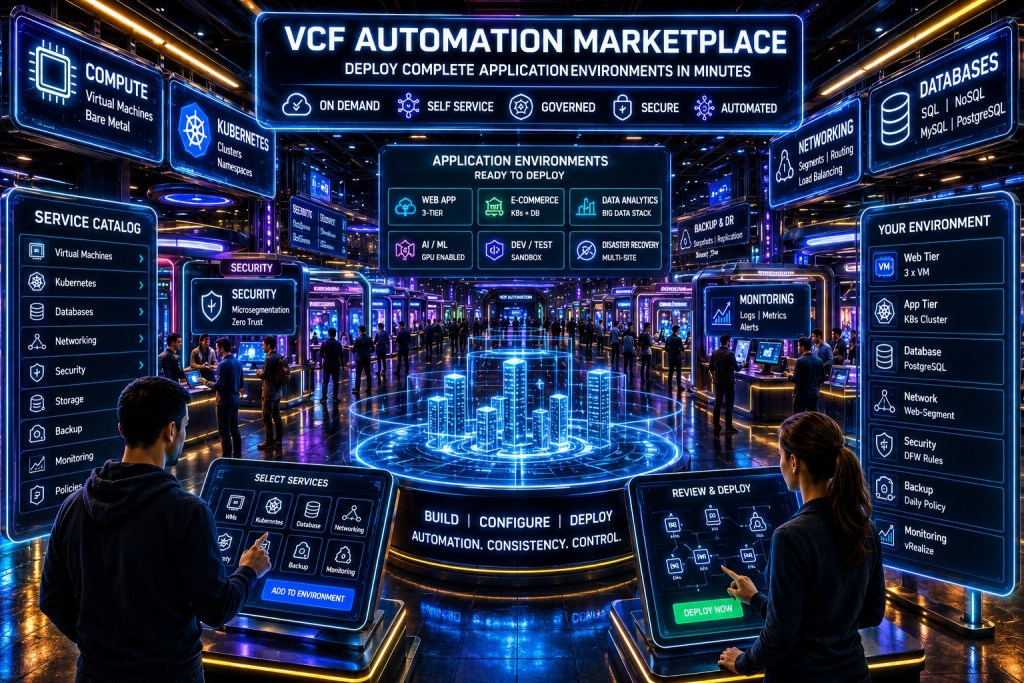
The supplied image presents VMware Cloud Foundation Automation as a brightly lit marketplace where consumers assemble complete application environments from compute, Kubernetes, databases, networking, security, storage, backup, and monitoring services.
That visual is useful because it shifts the conversation away from individual infrastructure resources.
A developer rarely wakes up wanting three virtual machines, two network segments, a database instance, six firewall rules, a backup policy, and a monitoring dashboard. The developer wants a working development environment, an e-commerce platform, a data analytics stack, or a production-ready application service.
Traditional infrastructure operations force the consumer to translate that outcome into dozens of technical requests. A private cloud marketplace should reverse that model. The consumer requests the outcome, while the platform translates it into approved infrastructure and operational controls.
VCF Automation can provide the machinery for that operating model. However, the marketplace experience only works when the organization treats each catalog offering as a supported platform product rather than a collection of automation scripts.
Read the Marketplace as an Operating Model
The term marketplace in this article is a mental model. It is not a separate VCF product or licensing SKU.
It describes an operating model in which a provider team publishes supported services and application patterns that organization and project users can consume through approved interfaces. Those interfaces may include a curated catalog, self-service infrastructure services, command-line tools, APIs, Kubernetes-style declarative interfaces, or infrastructure-as-code workflows.
The image should therefore be interpreted as a target-state architecture, not as a claim that every displayed capability is enabled automatically in every VCF deployment.
Several services shown in the concept may depend on:
- The installed VCF version and deployment model
- Additional VMware advanced services
- Third-party integrations
- Separate licensing or entitlements
- Provider-created blueprints and workflows
- Network, identity, and security preparation
- Backup and recovery architecture
- Organizational support readiness
The visual experience may look simple. The provider architecture underneath it is not.
From Infrastructure Catalog to Application Environment Factory
Many organizations already have something they call a service catalog. The problem is that the catalog often exposes the same fragmented infrastructure model that users were trying to escape.
A virtual machine catalog is useful, but it is not yet an application marketplace.
| Delivery model | Consumer request | Platform response | Governance point | Operational result |
|---|---|---|---|---|
| Ticket queue | Individual infrastructure components | Multiple teams complete separate tasks | Manual review during fulfillment | Slow, inconsistent delivery |
| Resource catalog | VM, network, volume, or cluster | Automated deployment of one resource type | Catalog permissions and basic policy | Faster provisioning, continued integration work |
| Application marketplace | Complete application environment | Coordinated deployment of infrastructure, platform services, and controls | Policy enforced before and during deployment | Repeatable, supportable environment |
| Platform product model | Versioned application service with lifecycle commitments | Deployment, Day-2 operations, observability, recovery, and retirement | Product ownership and measurable service objectives | Sustainable private cloud consumption |
The architectural leap happens between the second and third rows.
A resource catalog answers, “Which infrastructure object do you want?”
An application marketplace answers, “Which supported environment do you need?”
That distinction changes how blueprints are designed, how ownership is assigned, and how success is measured.
The VCF Automation Marketplace Architecture
The marketplace model needs multiple layers working together. The consumer experience is only the visible surface.
The following diagram shows the path from a service request to a governed application environment. The important point is that the catalog does not communicate directly with random infrastructure endpoints. It moves through product definitions, policy gates, and provider-controlled execution services.

The Experience Layer
The experience layer provides the consumer-facing entry points.
Different personas may need different interfaces:
- Application owners may prefer a curated service catalog.
- Developers may prefer declarative APIs or command-line tooling.
- Platform engineers may use blueprints, Terraform, GitOps, or Kubernetes APIs.
- Operators may need provider interfaces for organizations, projects, quotas, services, and placement.
- Automation engineers may use orchestrator workflows and event subscriptions.
A mature marketplace does not force every persona into one user interface. It provides multiple controlled interfaces over the same service contracts.
The Product Definition Layer
The product definition layer describes what is being delivered.
In VCF Automation, that definition may include blueprints, templates, content libraries, image mappings, input properties, service integrations, workflow subscriptions, and policy assignments.
VCF 9.1 expands this model with application stack formation, allowing running groups of virtual machines and related configuration to be captured into reusable application blueprints. That can be valuable for multi-tier environments, but capture alone does not create a production product.
The captured stack still needs:
- Supported operating system and middleware versions
- Defined input variables
- Environment-specific configuration
- Secrets handling
- Network and security policy
- Backup and recovery behavior
- Monitoring integration
- Upgrade and deprecation rules
- A named service owner
Without those elements, the result is a reusable deployment artifact, not a managed service.
The Governance Layer
Governance determines whether a technically valid request should be allowed to execute.
Useful controls can include:
- Role-based access
- Organization and project boundaries
- Resource quotas
- Approval policies
- Lease policies
- Day-2 action policies
- Placement rules
- Network and security profiles
- Image and content restrictions
- Cost estimates and pricing visibility
- Service-specific policy-as-code
- Exception and escalation workflows
Governance should remove dangerous choices from the consumer’s path without turning every request into a manual approval chain.
A low-risk development sandbox may deploy immediately within a quota. A production database containing regulated information may require additional review. A GPU-enabled AI environment may need capacity, cost, and data-location validation.
The policy should reflect the risk of the service, not the organizational habit of approving everything.
The Execution and Integration Layer
The execution layer translates the product request into actual platform resources.
Depending on the service, this may involve:
- VM Service resources
- Containers
- VMware vSphere Kubernetes Service clusters
- Namespaces
- Virtual Private Clouds and subnets
- Persistent volumes
- Image and content libraries
- VMware Data Services Manager
- VMware Avi Load Balancer
- VMware vDefend controls
- IP address management
- VCF Operations orchestrator workflows
- Event broker subscriptions
- External infrastructure and security systems
This is where support boundaries become critical. A blueprint that can call an external API is not automatically a supported integration. The provider must define authentication, error handling, retries, rollback, ownership, compatibility, and escalation.
The Operations and Feedback Layer
The marketplace is incomplete until deployed environments can be operated.
The operations layer should answer:
- Is the environment healthy?
- Did every component deploy successfully?
- Are security controls active?
- Is the service protected by a validated backup policy?
- Can the application be recovered?
- Who receives alerts?
- How is cost attributed?
- Which Day-2 actions can the consumer perform?
- What happens when the blueprint version changes?
- How is the environment retired?
VCF Operations becomes especially important here because the marketplace must connect consumption with capacity, performance, cost, service health, and operational evidence.
How a Marketplace Request Should Flow
A polished catalog can hide a dangerous amount of complexity. A useful design exercise is to map every decision that must occur between the request and the final handoff.

The failure paths deserve as much attention as the success path.
When a request fails, the platform should not simply report that deployment failed. It should identify whether the cause was an invalid input, exhausted quota, unavailable capacity, network allocation problem, security integration failure, unsupported image, workflow timeout, or downstream service error.
A marketplace that automates deployment but leaves failure analysis to manual investigation has only moved the ticket queue to a different point in the lifecycle.
Build Complete Environments, Not Component Piles
Consider the three-tier web application shown in the image.
The consumer may see one product called Standard Web Application Environment. The underlying service contract is much broader.
| Service domain | Product decision | Marketplace artifact |
|---|---|---|
| Compute | VM sizes, cluster placement, availability, image version | Blueprint resources and placement policy |
| Application runtime | VM-based application tier or Kubernetes cluster | VM Service, VKS, container service, or application stack |
| Networking | VPC, subnets, IP allocation, routing, load balancing | Network profiles, VPC services, IPAM, load balancer integration |
| Database | Engine, version, size, availability, patching | DSM service, external database workflow, or managed application component |
| Security | Segmentation, firewall rules, access groups, certificates | Security profiles, policy objects, vDefend integration, workflow actions |
| Storage | Capacity, performance tier, persistence, expansion | Storage class, volume definition, storage policy |
| Protection | Backup frequency, retention, recovery target | Protection service, workflow, policy assignment, validation job |
| Observability | Metrics, logs, alerts, service ownership | VCF Operations integration, dashboards, notifications |
| Cost and quota | Estimate, chargeback context, resource limits | Rate card integration, project quota, placement controls |
| Lifecycle | Scale, snapshot, restart, patch, retire | Day-2 actions, leases, workflows, product runbook |
This table is the real product.
The catalog tile is only its storefront.
Golden Paths Need Versioned Product Ownership
A golden path should reduce cognitive load without hiding responsibility.
Every marketplace product should have a record that identifies:
- Product name and service purpose
- Current supported version
- Blueprint or application-stack version
- Product owner
- Technical owner
- Security owner
- Operational support group
- Intended consumers
- Supported deployment targets
- Required integrations
- Availability objective
- Backup and recovery objective
- Cost and quota model
- Approved Day-2 actions
- Known limitations
- Deprecation date
- Replacement path
Treating the blueprint as a versioned product is especially important when the environment contains multiple technologies. Updating an operating system image, Kubernetes version, database release, firewall policy, or monitoring agent can change the supportability of the entire stack.
A marketplace should therefore distinguish between:
- Blueprint development, where the product is being built and tested
- Published version, where the product is approved for new requests
- Deployed instances, which may run older product versions
- Upgrade path, which moves existing instances forward
- Retired version, which can no longer be requested
- Unsupported version, which requires remediation or formal exception
Without that lifecycle model, catalog growth eventually creates blueprint sprawl.
Governance Must Happen Before Deployment
The strongest marketplace control is not an approval after a risky environment has already been created. It is a product definition that prevents the risky configuration from being requested.
For example, a production application product can enforce:
- Approved images only
- Required availability settings
- Minimum backup retention
- Mandatory monitoring
- Specific network zones
- Restricted external connectivity
- Required firewall profiles
- Encryption requirements
- Placement on an approved cluster class
- Maximum and minimum resource sizes
- Project-level quotas
- Defined lease or review periods
- Limited Day-2 actions
This is why reusable property groups, blueprint inputs, policies, security profiles, tags, and placement logic matter. They convert architecture standards into deployment behavior.
The platform team should still preserve exceptions, but exceptions need an owner, expiration date, justification, and review path. Permanent undocumented exceptions become a second, unmanaged marketplace.
Self-Service Does Not Mean Self-Support
The image shows users selecting services and deploying an environment in minutes. That is the consumer experience the platform should pursue.
It does not mean the application team becomes responsible for every layer.
A useful responsibility model looks like this:
The boundaries must be documented for each product.
An application team may own application configuration while the platform team owns the Kubernetes cluster. A database team may own database policy while the VCF team owns infrastructure capacity. A security team may define controls while the platform product automates enforcement.
Self-service should make those relationships clearer, not erase them.
The Marketplace Boundary Is Wider Than VCF Automation
VCF Automation can act as the consumption and orchestration layer, but the service being delivered often crosses several product boundaries.
The marketplace may depend on:
- VCF Operations for performance, capacity, cost, alerts, and operational visibility
- VCF Networking for VPCs, subnets, gateways, NAT, VPN, firewalling, and IP management
- VCF compute and storage services for placement, images, volumes, and availability
- VMware Data Services Manager for managed database services
- VMware vDefend for advanced microsegmentation and security controls
- VMware Avi Load Balancer for application delivery
- Kubernetes protection services for namespace or cluster recovery
- VCF Operations orchestrator for custom workflows
- Event subscriptions for integration with external systems
- Third-party tools such as IPAM, ITSM, configuration management, secrets platforms, or enterprise backup products
Some of these capabilities may be core platform functions. Others may be advanced services, separately licensed products, optional integrations, or provider-developed automation.
The service owner must know which category each dependency belongs to.
A catalog product that relies on an unowned external workflow is not production-ready, even when the happy-path demonstration succeeds.
A Practical Implementation Roadmap
Organizations should resist the temptation to open a marketplace with dozens of products. A small number of well-supported products will generate more trust than a large catalog of partially automated resources.
| Phase | Primary objective | Recommended scope | Exit criteria |
|---|---|---|---|
| Product discovery | Identify high-volume, repeatable demand | Review tickets, application patterns, and manual handoffs | Two or three products selected with named owners |
| Minimum viable marketplace | Prove the complete request lifecycle | Development sandbox, standard VM, or basic application environment | Request, deploy, validate, operate, and retire successfully |
| Governance integration | Move controls into the product | Identity, quota, approval, placement, security, cost | Policy behavior tested for success and denial paths |
| Application composition | Deliver complete environments | Multi-tier application, VKS environment, database-backed service | Dependencies deploy and roll back as one product |
| Operational integration | Make services supportable | Monitoring, backup, alerts, recovery, Day-2 actions | Support team accepts ownership and runbooks |
| Scale and lifecycle | Expand without creating sprawl | Additional products, versions, organizations, and regions | Adoption, reliability, cost, and retirement metrics are tracked |
Start With Demand, Not Available Features
The first products should solve recurring operational pain.
Good candidates often include:
- Standard development sandbox
- Governed Linux or Windows application server
- Three-tier development environment
- VKS development cluster
- Database-backed application environment
- GPU-enabled AI development workspace
- Recovery testing environment
Do not publish a product simply because the underlying platform can provision it.
Publish it because consumers need it repeatedly and the provider can support it reliably.
Test Denial and Failure Paths
Testing should include more than successful deployments.
Validate:
- Unauthorized user
- Incorrect project
- Quota exhaustion
- Unsupported input
- Insufficient capacity
- IP allocation failure
- Image synchronization failure
- Downstream workflow timeout
- Security-policy failure
- Partial application deployment
- Backup-registration failure
- Monitoring-registration failure
- Rollback behavior
- Product retirement
A marketplace becomes credible when its failures are predictable and recoverable.
Operational Metrics That Matter
The number of catalog items is not a useful success metric by itself.
A small marketplace with high adoption and reliable outcomes is healthier than a large catalog that users avoid.
Useful measures include:
- Request-to-ready lead time
- Successful deployment rate
- Validation failure rate
- Rollback success rate
- Median remediation time
- Percentage of deployments using approved product versions
- Day-2 action success rate
- Backup registration and recovery-test success
- Monitoring coverage
- Policy exception count and age
- Cost estimate variance
- Capacity-denial frequency
- Abandoned or expired environments
- Consumer adoption by organization and project
- Support incidents per product version
- Time required to publish a safe product update
These measures connect the marketplace to operational outcomes instead of presentation quality.
Common Marketplace Failure Modes
Turning Every Infrastructure Object Into a Catalog Item
This creates a searchable inventory, not a product experience. Consumers still need to understand how every component fits together.
Correction: group resources into supported environment patterns based on real application demand.
Building One Blueprint for Every Scenario
A single oversized blueprint creates an untestable decision tree filled with conditional logic.
Correction: define a small product family with shared components and clear variants.
Automating Day 0 and Ignoring Day 2
Provisioning receives attention because it produces an impressive demonstration. Patching, scaling, certificate renewal, backup, recovery, troubleshooting, and retirement are left manual.
Correction: define lifecycle actions before publishing the product.
Requiring Approval for Everything
Universal approval recreates the ticket queue behind a modern interface.
Correction: automate low-risk requests and reserve approvals for risk, capacity, cost, or compliance decisions.
Hiding Integration Ownership
The blueprint calls networking, database, security, backup, and monitoring systems, but no team owns the end-to-end result.
Correction: create one product owner and a documented dependency matrix.
Publishing Without a Version Strategy
Consumers continue deploying old images, database versions, and application patterns because nothing expires.
Correction: define published, deprecated, retired, and unsupported product states.
Assuming Every Service Is Included
The design treats advanced security, database, load-balancing, AI, or protection services as universally available.
Correction: validate licensing, support, compatibility, entitlement, and deployment prerequisites for every product version.
Marketplace Readiness Questions
Before opening the catalog broadly, the architecture and operations teams should be able to answer the following questions.
| Readiness area | Question |
|---|---|
| Demand | Which recurring requests will the marketplace eliminate? |
| Product ownership | Who is accountable for each application product? |
| Platform capacity | Can the underlying clusters, storage, network, and IP pools support expected demand? |
| Identity | Are provider, organization, project, and consumer roles defined? |
| Governance | Which requests are automatic, denied, or manually reviewed? |
| Security | Are network, firewall, secrets, image, and access controls embedded? |
| Operations | Are monitoring, alerting, patching, and escalation defined? |
| Protection | Are backup, restore, recovery objectives, and validation documented? |
| Cost | Are quotas, estimates, pricing context, and high-cost services controlled? |
| Lifecycle | Can products and deployed instances be upgraded, deprecated, and retired? |
| Support | Can the service desk and platform teams diagnose failed requests? |
| Evidence | Can the organization prove that required policies were applied? |
An organization that cannot answer these questions is not ready for a broad marketplace. It may still be ready for a controlled pilot.
Operational Implications for the VCF Team
A VCF Automation marketplace changes the job of the infrastructure team.
The team is no longer responsible only for provisioning resources and maintaining platform components. It becomes responsible for designing and operating the products through which consumers access the private cloud.
That introduces new disciplines:
- Product management for internal platform services
- Version and dependency management
- Consumer experience design
- Policy engineering
- Service-level measurement
- Cost and quota governance
- Cross-team support agreements
- Automated validation
- Deprecation and retirement
- Documentation and adoption management
This is why VCF Automation should not be treated as a side project owned by one automation engineer.
Its value comes from becoming the controlled consumption layer for the private cloud. That requires participation from VCF infrastructure, networking, security, operations, database, platform engineering, application, financial, and support teams.
Conclusion
The image of a VCF Automation marketplace captures the correct destination: application teams choosing complete, ready-to-use environments instead of coordinating a chain of infrastructure tickets.
The architectural lesson is that the marketplace is much larger than its catalog. Behind every product must be a versioned blueprint, a service contract, policy controls, placement logic, security, protection, observability, cost ownership, Day-2 operations, support, and retirement.
VCF Automation can provide the consumption and orchestration foundation for that model. VCF Operations, networking, compute, storage, advanced services, and external integrations complete the operational system around it.
The practical starting point is not to publish every available infrastructure service. It is to select a few high-value application patterns, assign product ownership, automate the complete lifecycle, test the failure paths, and measure whether consumers receive reliable environments faster.
That is the point where a private cloud catalog becomes a governed application environment factory.
