



TL;DR
AI coding tools are reducing the effort required to produce software, but they are not removing the work required to make software safe, supportable, observable, and valuable. The constraint is moving downstream into architecture review, test design, security analysis, release governance, documentation, production operations, and cost control.
CIOs should not treat lines of code, pull-request volume, or deployment frequency as standalone evidence of productivity. The better question is how many accepted business changes reach production with controlled risk, low rework, predictable cost, and sustainable operational ownership. That requires a quality-adjusted delivery scorecard built around escaped defects, rollback and rework, review burden, security remediation, operational toil, and cost per accepted business change.
Introduction
For most of software engineering history, code creation was expensive.
A feature required scarce developer time. A backlog represented work that could not yet be translated into software. Architecture teams worried about whether enough engineering capacity existed to implement the roadmap. Delivery leaders invested heavily in frameworks, reusable libraries, low-code platforms, automation, and developer tooling because writing and changing code was one of the dominant constraints.
AI-assisted development changes that constraint.
Copilots can draft functions. Coding agents can modify repositories, write tests, update configuration, open pull requests, and work across multiple tasks in parallel. The cost of producing a plausible software change is falling, and the volume of proposed changes is rising.
That sounds like a pure productivity gain until the rest of the system is considered.
Every change still has to be understood, reviewed, tested, secured, released, observed, documented, supported, and connected to a business outcome. Those activities do not automatically scale because code generation accelerated. In many enterprises, they are already the scarce resources.
The result is a new CIO problem: code abundance is colliding with operational scarcity.
The Constraint Has Moved Downstream
The strongest current evidence is not that AI coding has failed. It is that local coding gains are colliding with system-level limits.
CloudBees reported in its 2026 State of Code Abundance research that 67 percent of surveyed enterprise technology leaders saw a significant increase in code volume and 52 percent saw higher development output. At the same time, 92 percent expressed confidence in the production readiness of AI-generated code, while 81 percent reported an increase in production issues associated with it. The study included 213 enterprise technology leaders and reported a margin of error of plus or minus 8 percent.
GitLab’s 2026 AI Accountability research, conducted by The Harris Poll with 1,528 developers and technology buyers, found a similar pattern. Seventy-nine percent said individual developer productivity had improved, but the overall delivery process had not accelerated at the same pace. Eighty-five percent said the bottleneck had shifted from writing code to reviewing and validating it.
DORA’s 2025 research provides a broader operating-system interpretation. AI adoption showed a positive relationship with delivery throughput and product performance, but it continued to have a negative relationship with delivery stability. DORA’s conclusion was not that AI should be avoided. It was that AI acts as an amplifier. Strong platforms, testing practices, version control, feedback loops, and team alignment become more valuable. Weak delivery systems become more visibly constrained.
These studies have different populations, methods, and vendor interests, so their percentages should not be treated as universal constants. The directional pattern is still difficult to ignore:
AI can increase the rate at which change enters the software delivery system faster than the enterprise can increase its capacity to validate and absorb that change.
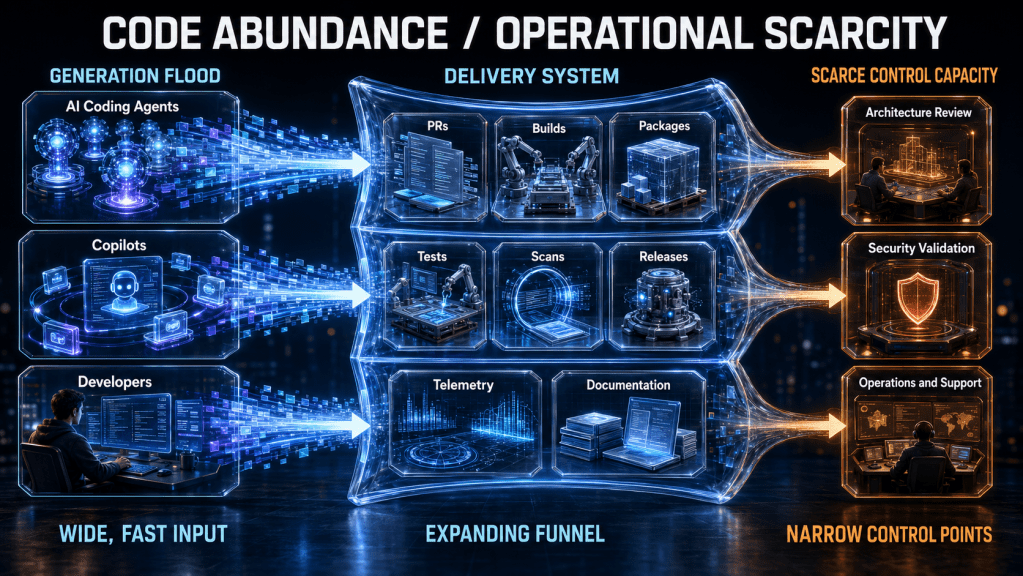
The AI Delivery Funnel
The software lifecycle can be viewed as a constrained funnel. AI expands the input side, but the control points further downstream remain bounded by people, platform capacity, evidence quality, and operational risk.
The important point is the last box.
Code is not the enterprise outcome. A merged pull request is not the enterprise outcome. Even a successful deployment is not necessarily the enterprise outcome.
The outcome is a change that produces intended business value, remains stable in production, can be supported, and does not create disproportionate future cost.
Code Is an Input, Not the Unit of Value
Lines of code have always been a weak productivity measure. AI makes them actively misleading.
A coding agent can generate hundreds of lines where a careful engineer would use twenty. It can create a new abstraction, duplicate an existing one, add dependencies, expand configuration, produce verbose tests, or solve a local task without understanding the wider system. More code may reflect more capability, but it may also reflect more surface area to review, secure, operate, and maintain.
Pull-request volume has a similar problem. More pull requests can indicate smaller batches and healthier flow. It can also indicate automated task fragmentation, low-value churn, repeated rework, dependency updates without ownership, or agent-generated changes that consume reviewer attention without advancing a meaningful business objective.
Deployment frequency remains useful, but only in context. DORA’s current five-metric model deliberately balances throughput with instability. Deployment frequency sits beside change lead time and failed deployment recovery time, while change fail rate and deployment rework rate measure instability. DORA also warns against using one metric as the goal and against comparing unlike services.
The practical lesson is straightforward:
Activity metrics describe how much movement occurred. They do not establish whether the movement created value.
Productivity perception is also an unreliable substitute for system evidence. METR’s early-2025 randomized study found experienced open-source developers took 19 percent longer on the measured tasks when AI tools were allowed, even though participants believed the tools had sped them up. METR’s February 2026 update found some evidence of improved speed with newer tools, but the researchers concluded that selection effects made the updated estimate unreliable. The lesson is not that AI coding is slow. It is that productivity varies by task, developer, tool, and measurement method, so CIOs should not build an enterprise business case from self-reported speed alone.
| Familiar Metric | What It Can Reveal | What It Cannot Prove Alone | Required Counter-Metric |
|---|---|---|---|
| Lines of code | Change volume and codebase growth | Business value, simplicity, correctness, or maintainability | Accepted business changes, code removed, complexity trend |
| Pull-request volume | Flow activity and batch count | Review quality, necessity, or outcome value | Review burden, acceptance rate, rework rate |
| Deployment frequency | Ability to release changes often | Stability, customer value, or supportability | Change fail rate, deployment rework, recovery time |
| AI tool usage | Adoption and workflow penetration | Productivity, quality, or ROI | Cost per accepted change, time saved after rework |
| Test count | Test activity and coverage effort | Effective risk reduction | Defect escape rate, mutation or fault-detection evidence |
| Security finding count | Detection volume | Risk reduction or remediation effectiveness | Time to remediate exploitable risk, recurrence rate |
Operational Scarcity Is Broader Than Human Review
It is tempting to describe the new bottleneck as a code-review problem. Review capacity is part of it, but the constraint is wider.
Architecture Scarcity
AI-generated changes can be locally correct and still be architecturally harmful. A change may introduce a second integration pattern, bypass a shared service, weaken a domain boundary, add a new data store, or create a dependency that conflicts with lifecycle standards.
Architecture review cannot become a manual committee for every pull request. It must be translated into machine-checkable constraints where possible, supported by architecture decision records, approved component catalogs, dependency policies, interface contracts, and clear exception paths.
The scarce resource is not only architect time. It is encoded architectural context.
Test-Design Scarcity
AI can generate tests, but test volume is not the same as test quality. Generated tests may mirror the implementation, assert superficial behavior, miss adverse conditions, or reinforce an incorrect assumption. The difficult work is deciding what must be true, which failure modes matter, and what evidence is sufficient for the risk of the change.
CloudBees reported that 70 percent of its surveyed leaders viewed test-suite maintenance as a greater burden than writing code. Sonar’s 2026 developer survey found that 96 percent of respondents did not fully trust AI-generated code to be functionally correct, while only 48 percent said they always checked AI-assisted code before committing it.
This is verification debt: the enterprise creates change faster than it creates confidence.
Security-Remediation Scarcity
More code expands the attack surface, dependency graph, secret-exposure opportunities, and volume of findings. Security scanning can scale computationally, but triage, ownership, remediation, exception handling, and evidence collection remain constrained.
An enterprise that celebrates finding more vulnerabilities while remediation queues grow is measuring scanner activity, not reduced exposure. AI-generated fixes can help, but they still require policy, context, validation, and accountability.
Release and Recovery Scarcity
A release pipeline can deploy more frequently without becoming better at deciding what should be released. AI increases the need for small batches, feature flags, progressive delivery, rollback automation, compatibility testing, and evidence-based change classification.
The release function should not become a centralized approval queue. It should become a policy-driven risk-routing system.
Observability and Support Scarcity
Code that reaches production creates a long operational tail. Teams need service ownership, telemetry, dashboards, alert thresholds, runbooks, dependency maps, on-call coverage, and support documentation.
If AI generates a feature in two hours but the organization spends three days instrumenting, documenting, reviewing, and supporting it, the coding speedup is not the delivery speedup.
Operational scarcity appears when no one budgets for the work after the merge.
Quality-Adjusted Delivery Metrics
The answer is not to discard software delivery metrics. It is to measure the whole delivery system and tie activity to accepted outcomes.
A useful starting point is to define an accepted business change.
An accepted business change is a production change that:
- maps to an approved business objective or service outcome
- meets explicit acceptance criteria
- passes the required architecture, test, security, and release evidence gates
- remains within the defined stability observation window
- has an identified service owner and support path
- includes the required telemetry, documentation, and rollback capability
This definition intentionally excludes proposed code, merged code, and deployments that immediately create rework.
Core Quality-Adjusted Measures
| Measure | Practical Definition | Why It Matters |
|---|---|---|
| Accepted business changes | Changes that meet business, risk, stability, and ownership criteria | Replaces raw output with usable outcome throughput |
| Escaped defect rate | Production defects per accepted change, weighted by severity | Shows whether validation is keeping pace |
| Change fail rate | Share of deployments requiring immediate intervention | Balances delivery speed with stability |
| Deployment rework rate | Share of deployments performed to repair prior production changes | Exposes hidden throughput consumed by correction |
| Review burden | Human review minutes per accepted change, segmented by risk tier | Reveals whether AI output is creating a reviewer bottleneck |
| Security remediation burden | Remediation hours and aging findings per accepted change | Connects code volume to security operating capacity |
| Operational toil | Repetitive support and recovery hours created by delivered changes | Captures the downstream cost of low-quality delivery |
| Cost per accepted business change | Total model, engineering, pipeline, platform, review, security, incident, and support cost divided by accepted changes | Connects AI spend and delivery cost to business output |
| Outcome realization | Percentage of accepted changes that achieve the stated service or business target | Prevents technically successful but irrelevant delivery |
The cost formula should include more than model tokens:
Cost per accepted business change =

  AI model and coding-tool cost
+ developer and reviewer labor
+ CI/CD compute and test infrastructure
+ security scanning and remediation
+ release and change-control effort
+ observability and documentation work
+ incident, rollback, and support cost
-------------------------------------------------
  accepted business changes in the measurement window
This is not an accounting standard. It is a management model. Its purpose is to make hidden delivery cost visible enough to improve decisions.
Do Not Collapse the Scorecard Into One Magic Number
CIOs often ask for a single productivity score. That instinct is understandable, but dangerous.
A single composite score can hide the exact constraint the organization needs to fix. A team may increase accepted change throughput while review burden doubles. Another may lower escaped defects by creating a six-week approval queue. A third may deploy more frequently while operational toil consumes the gains.
Use a scorecard with healthy tension:

Leaders should look for movement across the scorecard, not optimization of one box.
A CIO Operating Model for Code Abundance
Code abundance requires an operating-model change, not merely a better coding assistant contract.
Treat Generation Capacity as Supply, Not Savings
An increase in code-generation capacity does not automatically reduce engineering cost. It creates potential supply. The organization decides whether that supply becomes business value, backlog expansion, experimentation, rework, or technical debt.
CIOs should require every major AI coding initiative to state which constraint it is expected to improve. Examples include feature lead time, migration throughput, defect remediation, documentation quality, test coverage, modernization capacity, or reduced support toil.
Without a named system constraint, AI coding adoption becomes activity looking for justification.
Shape Demand Before Expanding the Funnel
If every product team can create more code, the portfolio can generate more work than architecture, security, platform, release, and operations teams can absorb.
Demand shaping should include:
- explicit business outcome IDs for significant changes
- work-in-progress limits for agent-generated tasks
- service-level capacity budgets for review and validation
- repository and service risk classification
- approved use cases for autonomous coding agents
- stop criteria for low-value or high-rework experiments
The objective is not to suppress experimentation. It is to prevent inexpensive generation from creating expensive downstream queues.
Build Evidence-Carrying Changes
Every meaningful change should arrive with the evidence needed to evaluate it. The pull request should not merely contain code. It should carry context.
A mature change package includes:
- business objective and acceptance criteria
- AI-assistance and tool provenance where required by policy
- risk tier and affected services
- architecture implications and new dependencies
- test strategy and results
- security findings and disposition
- observability changes
- rollout and rollback plan
- documentation and service-owner confirmation
- estimated and actual AI and pipeline cost
This reduces the amount of context reviewers must reconstruct manually.
Route Review by Risk, Not by Code Origin Alone
Not every AI-assisted change requires heavier review. A one-line documentation correction and an authentication redesign should not enter the same process.
Risk routing should consider:
- production impact
- data classification
- identity and authorization changes
- financial or regulated behavior
- dependency and supply-chain changes
- blast radius
- reversibility
- novelty of the architecture
- amount of generated change relative to reviewed context
AI provenance is one signal. Consequence is the stronger signal.
Invest in the Internal Platform as the Control Plane
The platform should make the safe path easier than the unsafe path.
That means providing reusable pipeline templates, approved components, test environments, security policies, observability defaults, feature-flag integration, release strategies, cost telemetry, and evidence collection. Platform engineering becomes the mechanism that converts organization-wide delivery policy into repeatable developer and agent workflows.
The goal is not a golden cage. Teams need exception paths. The goal is to make common low-risk changes fast, high-risk changes visible, and unsupported patterns difficult to introduce accidentally.
Put FinOps at the Change Boundary
Coding-agent cost is highly variable because it depends on model selection, codebase size, context length, parallelism, retries, automation, and the number of active instances. Anthropic’s current Claude Code documentation reports wide variation and recommends pilot baselines, team spend limits, and usage tracking. It cites enterprise averages around 150 to 250 dollars per developer per month, while noting that usage patterns can materially change the result.
The model charge is only one layer. More generated changes can also increase CI compute, test execution, security scans, artifact storage, preview environments, observability volume, and reviewer labor.
Cost controls should therefore follow the change from generation through production. Useful allocation dimensions include:
- business outcome
- product or service
- repository
- coding agent and model
- pipeline and test workload
- review and remediation effort
- accepted, rejected, reverted, or abandoned outcome
The unit cost that matters is not cost per token. It is cost per accepted business change.
Example: An Evidence Policy for AI-Assisted Changes
The following vendor-neutral YAML is a design artifact for a CI/CD policy engine, repository workflow, internal developer platform, or governance service. It does not enforce policy by itself. It shows the minimum context a change should carry before higher-risk code moves toward production.
change_evidence:
  schema_version: "1.0"
  change_id: "PAY-4821"

  business_outcome:
    owner: "Payments Product"
    objective: "Reduce checkout authorization failures"
    acceptance_metric: "authorization_failure_rate"
    target: "below 0.50 percent"

  provenance:
    ai_assisted: true
    approved_tool: "enterprise-coding-agent"
    human_owner: "payments-platform-team"

  risk:
    tier: "high"
    production_service: "checkout-api"
    data_classification: "restricted"
    identity_or_auth_change: true
    rollback_class: "version-reversible"

  architecture:
    decision_record_required: true
    new_external_dependency: false
    contract_change: true

  validation:
    unit_tests: "passed"
    integration_tests: "passed"
    contract_tests: "passed"
    performance_tests: "required"
    security_scan: "passed-with-approved-exception"
    exception_owner: "application-security"

  operations:
    telemetry_updated: true
    dashboard_updated: true
    alert_runbook_updated: true
    progressive_delivery: true
    rollback_tested: true

  economics:
    model_cost_recorded: true
    pipeline_cost_recorded: true
    review_minutes_recorded: true

  gate:
    required_approvals:
      - "service-owner"
      - "application-security"
      - "architecture"
    default_decision: "deny"
Teams should change the risk tiers, evidence requirements, ownership roles, and approval rules to match their environment. Low-risk changes should require fewer fields and approvals. High-impact changes should require stronger proof, progressive release, and tested recovery.
Successful implementation means the pipeline can reject an incomplete high-risk change before production, show exactly which evidence is missing, and retain the decision record. Common failure modes include making every field free text, allowing developers or agents to self-declare low risk without verification, collecting evidence that no one reviews, and turning the policy into a slow manual approval form.
AI Should Expand the Control Points Too
The wrong response to code abundance is to put a human in front of every generated line. That will create an expensive queue and eventually encourage bypass behavior.
AI should also be applied to downstream work:
- summarize architectural impact and dependency changes
- identify likely duplicate patterns and unsupported components
- generate adversarial and boundary-condition test candidates
- correlate security findings with reachable execution paths
- draft release notes, runbooks, and support documentation
- compare telemetry before and after deployment
- recommend progressive-delivery thresholds
- reconstruct incident timelines and probable change relationships
However, an AI reviewer is not automatically an independent control. Two agents can share the same blind spot, incomplete context, or incentive to declare success. Deterministic tests, policy engines, static analysis, runtime evidence, separation of duties, and accountable owners remain necessary.
The objective is not human review everywhere. It is reliable evidence everywhere, with human judgment concentrated where consequence and ambiguity are highest.
A Practical 90-Day Transition
A CIO does not need a multi-year transformation program before changing the measurement system. A focused 90-day effort can expose the real constraint and establish the first controls.
Establish the Baseline
Select three to five services with meaningful AI-assisted development activity. Measure:
- proposed, merged, deployed, accepted, reverted, and abandoned changes
- review time by change risk tier
- change fail rate and deployment rework rate
- escaped defects and security remediation hours
- test-suite execution and maintenance cost
- operational toil and incident burden
- model, coding-tool, CI/CD, and platform cost
Do not attempt enterprise-wide precision. Build a credible baseline for a small number of services.
Introduce Evidence-Carrying Changes
Add a lightweight change-evidence schema to the pilot repositories. Require business objective, risk tier, ownership, test evidence, security evidence, telemetry impact, and rollback information.
Automate collection where possible. A pipeline should attach test results, scan outputs, changed dependencies, affected services, deployment metadata, and model usage rather than asking developers to copy them manually.
Pilot Quality-Adjusted Gates
Define different gates for low-, medium-, and high-risk changes. Track where changes wait and why.
The goal is not to increase approvals. It is to remove unnecessary review from low-risk work while strengthening evidence for consequential changes.
Reallocate Capacity to the New Constraint
Use the baseline to identify the real bottleneck. It may be code review, test maintenance, security remediation, environment provisioning, architecture context, release safety, or production telemetry.
Then invest there.
Buying more coding-agent seats while reviewers are saturated will deepen the queue. Expanding test infrastructure while test design remains weak will create faster execution of low-value tests. Adding scanners without remediation ownership will increase findings without reducing risk.
Capacity investment should follow the constraint.
What CIOs Should Stop Rewarding
Several management habits become especially damaging under code abundance.
Stop rewarding teams for raw lines of code. Simplicity, deletion, reuse, and avoided change can be more valuable.
Stop treating pull-request growth as proof of productivity. Measure what was accepted, what was rejected, how much review it consumed, and what had to be repaired.
Stop setting deployment-frequency targets without stability and outcome measures. Frequent low-risk delivery is valuable. Frequent rework is not.
Stop measuring AI adoption through active seats, prompt counts, or token consumption. Those are consumption measures, not value measures.
Stop assuming a merged change has transferred cleanly into operations. Confirm ownership, telemetry, documentation, support readiness, and rollback.
Stop using centralized manual review as the default answer. Encode repeatable decisions into platforms and policies, then reserve specialists for exceptions and high-consequence work.
The Strategic Implication for the CIO
The first generation of enterprise AI coding strategy focused on access: which tools developers could use, which models were approved, and how quickly adoption could grow.
The next generation must focus on absorption capacity.
How much change can the enterprise safely understand, validate, deploy, and operate? Where is reviewer capacity constrained? Which services lack testability? Which teams cannot trace AI-assisted changes to incidents? Which product groups can attribute AI spend to accepted outcomes? Where does operational toil erase local coding gains?
These are CIO questions because the answers span engineering, platform teams, cybersecurity, finance, architecture, service management, and business ownership.
AI-generated software is not merely a developer productivity initiative. It changes the economics and control model of the entire software delivery system.
Conclusion
AI coding tools are making code more abundant. That is a real capability increase, but it does not make architecture judgment, verification, security remediation, release safety, observability, documentation, or operational ownership abundant.
The CIO bottleneck is moving from producing change to absorbing change.
Organizations that continue to optimize lines of code, pull-request volume, deployment frequency, and AI usage as isolated measures will see impressive activity while hidden queues, rework, incidents, and costs accumulate downstream. The better operating model measures accepted business changes, balances throughput with instability, captures review and remediation burden, and follows cost through the full delivery lifecycle.
The strategic objective is not to slow AI-generated software. It is to build a delivery system that can convert abundant code into controlled, supportable, and economically defensible business outcomes.
That is the new productivity problem for the CIO.
