



TL;DR
MCP and A2A solve different integration problems.
Use Model Context Protocol when an AI application needs a standard way to discover and use tools, resources, prompts, APIs, or enterprise data. Use Agent2Agent when one independently operated agent needs to discover another agent, delegate work, exchange messages, track a task, receive progress updates, and consume returned artifacts.
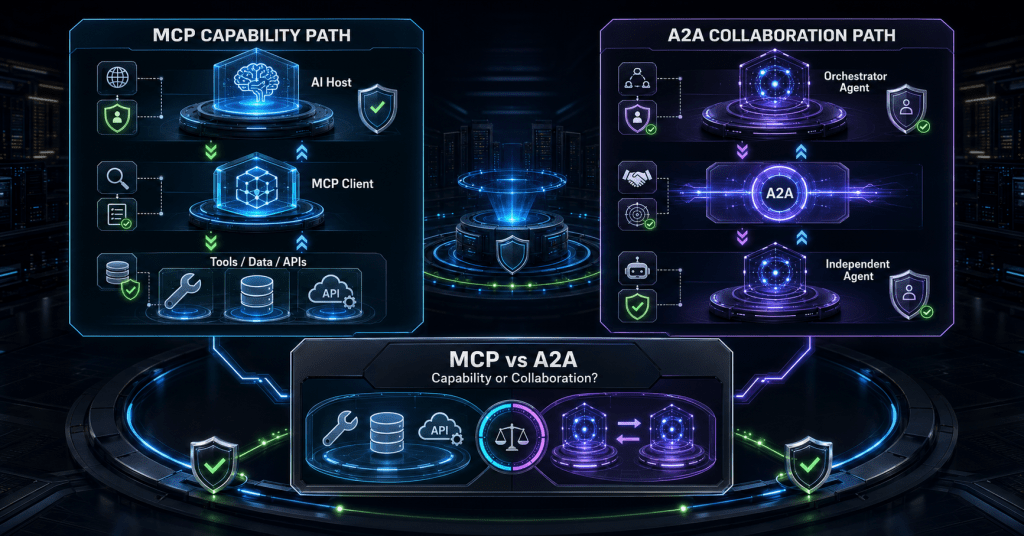
The practical distinction is more precise than “models use MCP and agents use A2A.” MCP standardizes the capability boundary between an AI host and an MCP server. A2A standardizes the collaboration boundary between independently operated agentic applications.
Many production architectures need both. A coordinating agent may use A2A to delegate a procurement task to a procurement agent. The procurement agent may then use MCP to query an ERP platform, check policy, and create a purchase request.
The wrong decision is usually not choosing one protocol instead of the other. It is forcing one protocol to carry responsibilities that belong to a different architectural layer.
Introduction
MCP versus A2A has become one of the most common architecture questions in enterprise AI.
The confusion is understandable. Both protocols emerged during the rapid expansion of agentic systems. Both address interoperability. Both may use familiar web technologies, structured messages, authentication, streaming, discovery, and long-running operations.
That surface overlap makes them look like competing solutions.
They are not.
MCP is primarily about connecting an AI application to capabilities and context. A2A is primarily about connecting independently implemented agents so they can collaborate without exposing their internal reasoning, memory, tools, or implementation details.
That difference changes how architects should design identity, state, retries, ownership, authorization, observability, failure handling, and policy enforcement.
It also determines whether a system remains a manageable AI application or quietly turns into a distributed multi-agent platform.
As of July 20, 2026, the current stable MCP specification is dated November 25, 2025. A2A 1.0.0 is the current stable A2A specification. These are the technical baselines used for this comparison.
Why This Comparison Matters in Enterprise Practice
Protocol selection looks like a development decision until the first production incident.
A team may begin with a support agent that reads tickets and searches a knowledge base. MCP is a natural fit because the agent needs governed access to tools and context.
Six months later, the organization introduces a separate change-management agent, security-analysis agent, finance agent, and procurement agent. Those agents may be:
- Owned by different teams
- Built with different frameworks
- Hosted on different platforms
- Released on different schedules
- Governed by different policies
- Responsible for different business outcomes
The original support agent now needs to delegate work across organizational and runtime boundaries.
At that point, tool integration is no longer the only problem. The architecture needs agent discovery, task ownership, asynchronous progress, artifact exchange, version negotiation, workload identity, and failure handling between independently operated systems.
That is where A2A becomes relevant.
The architecture decision should begin with the boundary being crossed:
- Is the caller trying to invoke a capability?
- Is the caller delegating an outcome to another autonomous service?
- Does the remote system expose a bounded operation?
- Does the remote system own reasoning and workflow state?
- Who owns retries, completion, and failure recovery?
- Is the interaction expected to finish as a request, or continue as a managed task?
Those questions are more useful than comparing protocol feature lists.
Scope and Terminology Guardrails
This comparison focuses on the roles MCP and A2A play in production AI architecture.
It does not compare agent frameworks, model providers, workflow engines, message brokers, service meshes, API gateways, or cloud platforms as products.
Several terminology guardrails matter.
MCP Does Not Mean the Model Connects Directly to Everything
The common shorthand says MCP connects models to tools.
That is directionally useful, but architecturally incomplete.
MCP defines a host, client, and server model:
- The AI application is the MCP host.
- The host creates MCP clients.
- Each client connects to an MCP server.
- The MCP server exposes context or capabilities.
The language model may influence tool selection, but the host remains responsible for connection management, user interaction, policy, execution controls, and result handling.
A production design should never treat the language model itself as the security principal or network client.
A2A Does Not Mean Uncontrolled Agent Swarms
A2A standardizes communication between agentic applications.
It does not require an unrestricted swarm, shared memory, unlimited autonomy, or decentralized control.
One agent acts as the client for an interaction. Another agent acts as the remote service. The protocol defines how they discover capabilities, exchange messages, create tasks, report status, and return artifacts.
The remote agent can remain opaque. It does not need to expose its prompt, model, memory, internal graph, private tools, or reasoning process.
Neither Protocol Replaces Orchestration
MCP and A2A define interoperable contracts.
They do not decide:
- The business workflow
- Risk classification
- Approval requirements
- Timeout budgets
- Compensation logic
- Escalation paths
- Cost limits
- Operational ownership
Those responsibilities remain part of the application architecture and enterprise control plane.
The Shortest Correct Mental Model
The simplest useful distinction is:
- MCP equips an agent.
- A2A connects agents.
The following diagram shows the boundary difference. MCP terminates at a capability server. A2A terminates at another agentic application that owns its own execution and task lifecycle.
The practical lesson is that a tool call and a delegated task are not the same contract.
A tool call says:
Perform this defined operation and return the result.
An agent delegation says:
Own this outcome within an agreed scope, manage the work, report status, and return one or more results.
What MCP Actually Standardizes
MCP standardizes how an AI host connects to servers that expose context and capabilities.
The stable protocol uses JSON-RPC messages and defines lifecycle negotiation, capability discovery, requests, responses, notifications, progress, cancellation, logging, and transport behavior.
Standard transport patterns include local standard input and output connectivity and remote Streamable HTTP connectivity.
The most important architecture elements are the capabilities exposed by MCP servers.
Tools Represent Callable Operations
Tools expose actions with names, descriptions, input schemas, and result contracts.
An MCP server may wrap:
- A database query
- A ticket update
- An infrastructure command
- A search operation
- A business API
- Code execution
- A workflow trigger
- A document-management operation
The implementation behind a tool can be complex, but the caller still interacts through a bounded operation.
This makes MCP useful for standardizing tool access across multiple AI hosts without building a unique connector for every model, assistant, framework, and backend system.
Resources Represent Contextual Data
Resources expose information such as files, records, schemas, configuration, application state, or domain-specific content.
They allow the host to retrieve context through a standard protocol rather than embedding every data source directly into the AI application.
Resources are especially useful when the application needs governed data access but should not receive broad database, storage, or file-system credentials.
Prompts Represent Reusable Interaction Templates
Prompts allow MCP servers to publish structured templates for recurring interactions.
They can help standardize:
- Domain-specific instructions
- Required arguments
- Common workflow entry points
- Reusable message structures
An exposed prompt is still an artifact that requires governance. Publishing a prompt through MCP does not make that prompt automatically safe, accurate, or approved.
The Host Owns the MCP Control Boundary
The host decides:
- Which MCP servers are trusted
- Which capabilities are visible
- Which identity applies
- Which tools the model can see
- Whether human approval is required
- How arguments are validated
- How returned data enters model context
- Which telemetry is retained
MCP should therefore be treated as an integration standard, not as permission to connect every server directly to every AI application.
What A2A Actually Standardizes
A2A standardizes how independent agentic applications discover each other and collaborate through messages and managed tasks.
The protocol is designed for agents that may use different frameworks, languages, models, vendors, and deployment platforms.
The calling agent does not need access to the remote agent’s internal implementation. It needs a reliable description of what that agent can do and a contract for assigning and tracking work.
Agent Cards Support Discovery
An Agent Card describes the agent and its supported interaction boundary.
Depending on the implementation, it may describe:
- Provider information
- Supported protocol interfaces
- Protocol versions
- Capabilities
- Skills
- Input and output media types
- Security schemes
- Extended authenticated metadata
This is more than a tool schema.
It is a service description for an autonomous application boundary.
A skill describes work the agent is expected to perform. It does not necessarily represent a deterministic function or expose the agent’s internal operations.
Messages Carry Interaction Context
Messages carry text, files, or structured data between a client agent and a remote agent.
A message may:
- Start an interaction
- Supply task instructions
- Add context
- Answer a clarification request
- Continue a multi-turn exchange
The remote agent may interpret the request within its declared scope. That flexibility is useful, but it requires stronger delegation policy than a narrowly defined API call.
Tasks Carry Lifecycle and Ownership
Tasks are a core A2A concept.
A remote agent can accept work and move it through states such as:
- Submitted
- Working
- Input required
- Completed
- Failed
- Canceled
- Rejected
A client can retrieve task status, subscribe to updates, or attempt cancellation when the task supports it.
This lifecycle is one reason A2A fits long-running and asynchronous collaboration better than a basic capability invocation.
Artifacts Carry Results
Artifacts represent task outputs.
They may contain:
- Text
- Structured data
- Files
- Reports
- Generated configurations
- Other media types
A production architecture should treat artifacts as governed outputs. The receiving system should validate provenance, classification, integrity, and policy before using an artifact in another tool call or agent delegation.
MCP vs A2A Side by Side
| Comparison criterion | MCP | A2A |
|---|---|---|
| Primary purpose | Connect an AI host to tools, resources, prompts, and external capabilities | Connect independent agents for discovery, delegation, collaboration, and task management |
| Main boundary | AI application to capability server | Agentic application to agentic application |
| Remote abstraction | Tool, resource, prompt, API facade, data source, or workflow adapter | Opaque agent with skills, state, policy, tools, and execution logic |
| Interaction model | Capability discovery and client-server requests | Messages, tasks, status updates, artifacts, streaming, and push notifications |
| State ownership | Usually retained by the host or underlying service | Each agent may own internal state while task and context identifiers coordinate interaction |
| Best-fit duration | Short or bounded operations, with progress and experimental task support where required | Short responses through long-running asynchronous work |
| Discovery unit | Server capabilities and MCP primitives | Agent Card, supported interfaces, capabilities, and skills |
| Delegation semantics | The host selects and invokes a capability | The client agent delegates an outcome to a remote agent |
| Implementation opacity | Server internals may be hidden, but exposed operations are explicit | Remote agent intentionally hides internal reasoning, memory, tools, and implementation |
| Security emphasis | Server trust, user authorization, tool scope, resource access, consent, and execution policy | Agent identity, service trust, delegation scope, task authorization, tenant isolation, and artifact provenance |
| Operational ownership | Host team and capability-server owners | Multiple agent owners with an explicit cross-service contract |
| Common misuse | Treating an MCP server as an unrestricted autonomous agent | Using a remote agent for deterministic work that should remain a tool or API |
This is not a scorecard.
A2A is not a more advanced replacement for MCP. MCP is not a lightweight version of A2A. They standardize different boundaries.
Where MCP Fits Best
Use MCP when the remote side is primarily a capability provider.
Common examples include:
- An operations assistant querying monitoring data and opening an incident
- A developer agent reading repositories and creating pull requests
- A finance assistant retrieving approved ledger information
- A support agent reading tickets and searching a knowledge base
- A private AI platform exposing approved data and workflows to several AI hosts
MCP becomes especially valuable when multiple AI applications need access to the same systems.
Instead of embedding bespoke connectors into every assistant, the organization can create governed MCP servers around approved capability boundaries.
The host still needs to filter what is exposed. The model should not receive every tool from every connected server. Tool and resource visibility should be limited by the current:
- User
- Workload
- Environment
- Business purpose
- Data classification
- Risk tier
Where A2A Fits Best
Use A2A when the remote side is an independently operated agent that owns a meaningful portion of the work.
Common examples include:
- A service-desk agent delegating malware analysis to a security agent
- A sales agent asking a pricing agent to produce an approved quote
- A procurement agent requesting supplier-risk analysis from a compliance agent
- A cloud operations agent delegating investigation to a platform-specific agent
- A customer-service agent transferring a regulated request to a specialist agent
A2A becomes more useful when teams need independent ownership.
The remote agent may:
- Run a different framework
- Use different models
- Maintain specialized memory
- Enforce its own policy
- Operate in another tenant or platform
- Follow a different release schedule
- Require separate operational support
The calling agent should not need to know how the work is performed. It should know what the remote agent claims it can do, how to authenticate, how to submit work, how to observe task state, and how to validate the result.
Where You Need Both Protocols
The most realistic enterprise pattern uses A2A for delegation and MCP for capability access inside each agent boundary.
Consider a change-planning workflow:
The orchestrator does not need direct access to every security and infrastructure tool.
It delegates specialized outcomes to agents that own those domains. Each specialist agent then uses MCP to access the tools, resources, and workflows it requires.
This pattern can improve separation of duties. It also introduces more identities, network paths, failure modes, dependencies, and audit requirements.
The architecture becomes safer only when those boundaries are governed deliberately.
Why Feature Overlap Does Not Make the Protocols Interchangeable
The comparison becomes less obvious when teams notice that MCP includes progress, cancellation, sampling, and experimental tasks, while A2A exposes skills that may resemble tools.
The feature overlap is real.
The architectural purpose is still different.
MCP Tasks Do Not Turn Every MCP Server Into an A2A Agent
The November 25, 2025 MCP specification introduced experimental task support.
That support can help an MCP operation continue beyond a single immediate response. It does not automatically create an independently operated agent boundary with:
- Agent Card discovery
- Agent skills
- Cross-agent collaboration semantics
- Independent reasoning ownership
- Task artifact exchange
- Separate agent operating ownership
Use MCP tasks when a capability server needs durable or asynchronous execution within an MCP relationship.
Use A2A when another agent owns the delegated outcome as an independently operated service.
A2A Skills Do Not Turn Every Agent Into a Tool Server
An A2A skill describes work an agent can perform.
The implementation may involve reasoning, planning, tools, human review, or several internal workflow stages.
A deterministic operation with a strict schema, narrow permissions, and immediate output is usually better exposed as a tool.
Wrapping every API call in a remote agent increases latency, cost, state, and troubleshooting complexity without necessarily creating useful autonomy.
The Architecture Decision Framework
The decision should start with ownership rather than protocol features.
Several practical rules follow from this decision path.
Choose MCP When the Caller Retains Orchestration Authority
The host:
- Selects the capability
- Supplies the arguments
- Validates the response
- Decides the next workflow step
- Retains business-process authority
The remote server performs a defined operation or provides context.
Choose A2A When the Remote Agent Owns the Subtask
The calling agent defines the goal and constraints.
The remote agent then:
- Plans its execution
- Manages its task state
- Selects its internal tools
- Requests additional input when required
- Returns progress and artifacts
- Owns success or failure for the delegated scope
Choose Neither When the Problem Is Normal Application Integration
Not every integration needs an AI protocol.
Use a conventional API when the contract is stable and deterministic.
Use a workflow engine when process state, retries, timers, approval stages, and compensation are the primary concerns.
Use a message broker when event delivery, fan-out, buffering, or decoupling is the main requirement.
Protocol enthusiasm should not replace basic distributed-system design.
Security Boundaries Are Different
Both protocols can participate in secure systems.
Neither protocol makes the system secure automatically.
MCP Security Centers on Capability Access
For remote HTTP deployments, the stable MCP authorization specification defines an OAuth-based authorization model and protected-resource discovery pattern.
Production controls should still include:
- Explicit trust decisions for every MCP server
- Token audience validation
- Per-user or workload identity
- Narrow scopes
- Tool filtering before model exposure
- Argument validation
- Human approval for high-impact actions
- Result validation before data re-enters model context
- Auditing of identity, tool, arguments, approval, execution, and outcome
An MCP server should not trust a request merely because it came through an approved host. Authorization must still be enforced at the capability boundary.
A2A Security Centers on Delegation and Agent Trust
A2A Agent Cards can declare supported security schemes, capabilities, interfaces, and skills.
A2A 1.0 also defines signing support for Agent Cards, allowing clients to verify authenticity and integrity when signatures are used.
The enterprise still needs to decide which agents are trusted and what they may request.
Production controls should include:
- Verified remote-agent identity
- Authenticated client-agent identity
- Delegation scopes tied to skills and business purpose
- Tenant and user-context isolation
- Authorization checks when task scope changes
- Limits on task duration, retries, cost, and artifact size
- Validation of files and structured artifacts
- Protection for push-notification endpoints
- Cancellation, timeout, and dead-letter handling
- End-to-end audit correlation
A remote agent should not receive broad authority merely because its Agent Card advertises a useful skill.
Combined Architectures Need Identity Propagation Rules
The most dangerous gap appears when an A2A agent calls MCP tools.
The organization must decide whether the specialist agent acts:
- As itself
- On behalf of the initiating user
- On behalf of the calling agent
- Through a constrained delegated token
- Through a service identity with separate approval
That choice affects accountability and least privilege.
Identity should not be copied blindly across boundaries. A remote agent should not receive the caller’s broad token simply because it is participating in the same workflow.
Observability Must Follow the Full Delegation Chain
A production trace should connect:
- User intent
- Agent selection
- Delegated task
- Task state changes
- MCP tool calls
- Policy decisions
- Approvals
- Returned artifacts
- Final business outcome
For MCP interactions, capture at minimum:
- Host identity
- MCP server identity
- User or workload identity
- Tool or resource selected
- Schema or capability version
- Redacted arguments
- Authorization decision
- Approval decision
- Execution status
- Latency
- Result classification
For A2A interactions, also capture:
- Calling-agent identity
- Remote-agent identity
- Agent Card version
- Protocol version
- Skill selected
- Task identifier
- Context identifier
- State transitions
- Artifact metadata
- Retry and cancellation events
- Push-notification events
- Cost and latency by agent boundary
A correlation identifier should survive both protocols.
Without end-to-end correlation, operators may see one trace for the A2A delegation, another trace for the remote agent, and several unrelated MCP calls. That is not enough to reconstruct the decision chain during an incident or audit.
Reliability and Cost Implications
A2A introduces a distributed system between reasoning systems.
Every remote agent may add:
- Another model call
- Another context window
- Another planning loop
- Additional network latency
- Independent retries
- Additional state persistence
- More complex timeout behavior
- More telemetry and artifact storage
- Another operational owner
That overhead is justified when the remote agent owns specialized reasoning, policy, data, or organizational responsibility.
It is wasteful when the remote side only wraps a deterministic function.
MCP can also create cost and reliability problems when hosts expose oversized tool catalogs, return excessive tool output, or retrieve unnecessary resources.
Tool filtering, result bounding, caching, context budgeting, and schema quality remain important.
The governing rule is:
Use the least autonomous boundary that still matches the work.
A Practical Protocol Routing Policy
The following YAML is an architecture-policy example. It is not an official MCP or A2A configuration format.
It shows how a platform team can make protocol selection reviewable instead of leaving it to individual developers.
protocol_routing_policy:
  version: 1
  default: deny

  rules:
    - name: bounded-capability
      when:
        remote_type: tool_or_resource
        caller_owns_workflow: true
        remote_owns_reasoning: false
      use: mcp
      require:
        - approved_mcp_server
        - scoped_identity
        - tool_risk_tier
        - argument_validation
        - audit_trace

    - name: independent-agent-delegation
      when:
        remote_type: independent_agent
        remote_owns_reasoning: true
        remote_owns_task_state: true
      use: a2a
      require:
        - verified_agent_card
        - trusted_agent_identity
        - allowed_skill
        - task_timeout
        - artifact_validation
        - audit_trace

    - name: agent-with-governed-tools
      when:
        remote_type: independent_agent
        remote_agent_requires_enterprise_capabilities: true
      use: a2a_plus_mcp
      require:
        - delegated_identity_policy
        - cross_protocol_correlation_id
        - separate_agent_and_tool_authorization
        - end_to_end_cost_budget

  prohibit:
    - shared_unscoped_bearer_tokens
    - direct_model_credentials
    - automatic_trust_from_discovery_metadata
    - unrestricted_tool_catalogs
    - unbounded_agent_delegation
The values should be replaced with controls from the organization’s identity, gateway, policy, registry, tracing, and security platforms.
A successful policy implementation means an architecture review can explain:
- Why a boundary uses MCP, A2A, both, or neither
- Which identity is presented
- Which scopes are allowed
- Which controls are mandatory
- Which evidence is retained
- How the integration can be disabled
Common Architecture Mistakes
Treating Every Tool as an Agent
A database lookup, ticket update, schema validation, or API call rarely needs its own reasoning identity and task lifecycle.
Turning deterministic capabilities into agents increases cost and makes behavior harder to test.
Treating Every Agent as an MCP Server
An independently operated agent could expose one MCP tool that says “complete this task.”
The caller would then need to invent:
- Agent discovery
- Progress semantics
- Durable task state
- Clarification messages
- Artifact handling
- Agent ownership
- Version negotiation
- Collaboration rules
That custom glue is a sign that the boundary may belong to A2A.
Confusing Discovery With Trust
An MCP catalog or A2A Agent Card can describe what is available.
It does not prove the capability is:
- Safe
- Approved
- Accurate
- Untampered
- Authorized for the current user
- Suitable for the current business purpose
Discovery metadata is input to policy. It is not a substitute for policy.
Forwarding User Tokens Across Boundaries
A token issued for one resource should not be passed to another service and assumed to remain valid or properly scoped.
Use explicit delegation, token exchange, or separate constrained workload identities where supported.
Letting the Protocol Own Business State
MCP tasks, A2A task identifiers, and context identifiers support protocol interaction.
They should not become the only source of truth for:
- Business-process state
- Regulatory evidence
- Approval history
- Financial commitments
- Compensation logic
- Incident ownership
The application still needs a durable system of record.
Ignoring Version Negotiation
Both protocols continue to evolve.
Pin and record protocol versions, validate capability negotiation, test compatibility, and avoid silent fallback when older behavior would remove required security or functionality.
Deployment Checklist for Architects
Before approving an MCP, A2A, or combined design, confirm:
- Boundary: Is the remote side a capability server or an independent agent?
- Ownership: Who owns reasoning, state, retries, and completion?
- Identity: Which human or workload identity is used at every hop?
- Authorization: Are permissions scoped to the exact tool, resource, skill, and target?
- Discovery: How are MCP servers and Agent Cards registered, verified, versioned, and revoked?
- Policy: Which operations require filtering, approval, denial, or escalation?
- State: Where are task state, business state, approvals, and artifacts persisted?
- Observability: Can one correlation identifier follow the complete workflow?
- Failure handling: Are timeouts, retries, cancellation, partial results, and compensation defined?
- Data controls: Are messages, resources, tool results, and artifacts classified and validated?
- Cost: Are model calls, delegation depth, task duration, and tool use budgeted?
- Lifecycle: Can the organization disable a server, agent, skill, tool, version, or credential quickly?
A protocol decision is not ready for production until these questions have owners and evidence.
Decision Guidance
Choose MCP only when an AI host or orchestrator needs governed access to tools and context, and the caller should retain workflow authority.
Choose A2A only when independently operated agents need to collaborate and the remote agent can complete its work without standardized MCP capability access.
Choose A2A plus MCP when specialist agents collaborate across ownership boundaries and each agent needs governed access to enterprise tools, data, or workflows.
Choose neither when a standard API, workflow engine, message broker, or service contract solves the problem more directly.
Do not use both protocols everywhere simply because both are available.
Use each protocol where its semantics match the responsibility being transferred.
Conclusion
MCP versus A2A is not a contest between two interchangeable agent protocols.
MCP standardizes how an AI application connects to capabilities and context. A2A standardizes how independent agentic applications discover each other, delegate work, manage tasks, communicate status, and exchange artifacts.
That distinction becomes operationally important as soon as the system crosses team, platform, identity, or state boundaries.
A tool server and a remote agent may both accept structured requests, but they do not represent the same ownership contract. A tool performs a bounded operation. A remote agent owns a delegated outcome.
Start with the boundary.
Decide who owns reasoning, state, authorization, retries, completion, and evidence. Then choose MCP, A2A, both, or neither.
For many enterprise architectures, the cleanest pattern will be A2A between independently operated agents and MCP inside each agent boundary for governed access to tools and data.
That pattern is not automatically better. It is structurally honest. It separates collaboration from capability access and gives architecture, security, and operations teams clearer control points.
