


Amazon Elastic VMware Service is not automatically a cloud strategy.
Sometimes it is a landing zone. Sometimes it is a disaster recovery target. Sometimes it is a practical way to avoid a data center deadline. Sometimes it is a temporary bridge while application teams decide what to modernize.
And sometimes it is just a cloud escape hatch.
That phrase is not an insult.
An escape hatch can be valuable when the business has a real constraint. A data center contract may be ending. Hardware may be aging. A merger may create a short migration window. A facility risk may force faster movement than the application roadmap can support.
The mistake is not using an escape hatch.
The mistake is pretending the escape hatch is a long-term platform strategy without doing the workload-placement work.
This article compares Amazon EVS and Private VMware Cloud Foundation from that operating-model perspective. The goal is not to declare one good and the other bad. The goal is to separate three different decisions that often get mixed together:
- Where do we move VMware workloads under time pressure?
- Which workloads need AWS adjacency?
- Which workloads still belong in a private VCF platform?
Those are different questions.
They deserve different answers.
Scope and Assumptions
For this article:
- Amazon EVS means Amazon Elastic VMware Service running VMware Cloud Foundation inside an AWS environment.
- Private VCF means customer-operated VMware Cloud Foundation running in a private data center, colo, hosted private cloud, or dedicated infrastructure model.
- This is not a VMware Cloud on AWS article.
- This is not a claim that private cloud is always cheaper or cloud is always more modern.
- This is not a recommendation to keep every workload on VMware forever.
- Product versions, regional availability, licensing, support boundaries, and pricing should be rechecked before any production decision.
The comparison is about operating model fit.
EVS and Private VCF can both be valid. They solve different problems when used intentionally.
Why This Comparison Matters
A lot of VMware strategy conversations start with the wrong question.
“Should we move VMware to AWS?”
That question is too broad.
It hides the actual drivers:
- Are we leaving a data center?
- Are we avoiding a hardware refresh?
- Are we trying to preserve VMware skills?
- Are we placing workloads near AWS services?
- Are we buying time before modernization?
- Are we trying to reduce private infrastructure ownership?
- Are we keeping workloads private for locality, sovereignty, latency, or control?
- Are we modernizing applications or only relocating them?
EVS can help with several of those drivers, but not all of them.
Private VCF can also be the better answer when the organization needs control, locality, hardware flexibility, predictable utilization, newer VCF capabilities, or a deliberate private cloud platform.
The comparison only becomes useful when the organization names the actual driver.
Decision Model at a Glance
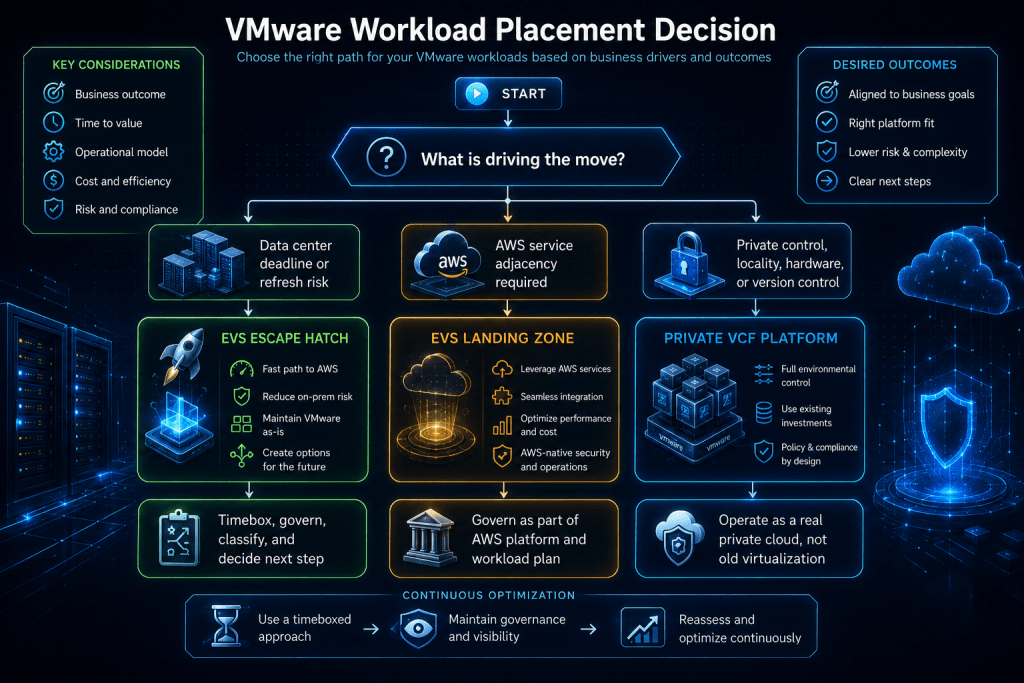
The diagram below separates three common workload paths: EVS as an escape hatch, EVS as a landing zone, and Private VCF as a long-term private cloud platform.

The important point is that EVS can play more than one role.
If EVS is an escape hatch, define the exit criteria. If EVS is a landing zone, design the AWS operating model. If Private VCF is the destination, operate it like a platform and not like a collection of legacy clusters.
Detailed Comparison
| Decision Area | Amazon EVS | Private VCF | Practical Signal |
|---|---|---|---|
| Primary value | VMware continuity inside AWS | VMware continuity under private infrastructure control | Are you optimizing for AWS adjacency or private control? |
| Best use | AWS-adjacent VMware landing zone or migration bridge | Long-term private cloud platform | Is the destination cloud-integrated or private-controlled? |
| Escape-hatch fit | Strong when timelines force data center exit before application modernization | Useful when stabilizing or consolidating private infrastructure | Is the pressure external or strategic? |
| Governance model | AWS account, VPC, IAM, routing, billing, plus VCF operations | Private infrastructure governance plus VCF operations | Which control plane does your organization operate better? |
| Network model | AWS VPC underlay with NSX overlay for workloads | Customer-designed physical and software-defined network | Do you need AWS routing integration or private network control? |
| Security model | AWS controls plus NSX controls | Enterprise private controls plus NSX controls | Where should enforcement and audit evidence live? |
| Lifecycle model | AWS service boundary plus customer-managed VCF lifecycle | Customer-managed hardware and VCF lifecycle | Do you need service integration or maximum release control? |
| Version control | Limited to versions supported by EVS | More direct control, assuming hardware and support compatibility | Do newer VCF features matter now? |
| Cost model | AWS consumption model plus VCF licensing and operations | Hardware, facilities, support, VCF licensing, and operations | Is the workload temporary, elastic, steady-state, or capacity-heavy? |
| Skills model | VMware skills remain, AWS skills become mandatory | VMware and private infrastructure skills remain mandatory | Which skill gap is easier to close? |
| Workload fit | VMware workloads that need AWS proximity or migration runway | Workloads needing locality, sovereignty, customization, or predictable private capacity | What does the workload actually require? |
| Main risk | Moving platform debt into AWS with no post-landing plan | Rebranding legacy virtualization as private cloud | Which operating failure mode is more likely? |
This table is not meant to pick the answer for every environment.
It is meant to prevent lazy architecture.
When EVS Is a Good Escape Hatch
EVS can be the right answer when the business has a hard deadline and the application estate is not ready for immediate modernization.
Common examples include:
- A data center lease is ending.
- A hardware refresh is not funded.
- A facility risk forces relocation.
- A merger or divestiture creates a short migration timeline.
- Application dependencies make refactoring unrealistic in the current window.
- The VMware team needs to preserve operational continuity during a move.
- The business wants AWS proximity but cannot rewrite applications yet.
In these cases, EVS can reduce the amount of change required at the application layer.
That does not make the move simple. It just changes the kind of complexity.
Instead of redesigning every application, the organization must govern the new platform boundary.
That includes:
- AWS account placement
- VPC design
- Route Server and route propagation
- Transit Gateway, Direct Connect, or VPN connectivity
- DNS and NTP
- NSX overlay design
- NSX Distributed Firewall policy
- Backup and recovery
- Monitoring and logging
- Cost allocation
- Migration cutover and rollback
- Lifecycle and maintenance responsibility
An escape hatch without governance is not a controlled migration.
It is a relocation of risk.
The Escape-Hatch Control Plan
If EVS is being used as a temporary bridge, the program needs controls that prevent “temporary” from becoming permanent by accident.
| Control | Why It Matters |
|---|---|
| Workload cohorting | Prevents every VM from becoming an EVS candidate by default |
| Business driver per cohort | Separates data center exit, AWS adjacency, DR, and modernization runway use cases |
| Timebox | Forces a decision after landing |
| Cost baseline | Compares pre-move and post-move run cost realistically |
| Application owner signoff | Keeps the migration from being infrastructure-only |
| Security pattern | Defines AWS and NSX enforcement points before cutover |
| Network ownership | Avoids confusion between AWS routing and NSX routing |
| Modernization trigger | Identifies when the workload should refactor, retire, remain, or move again |
| Exit criteria | Defines whether EVS is a destination, bridge, or temporary holding pattern |
The exit criteria are the most important part.
Every workload moved into EVS should eventually land in one of five states:
| Post-EVS Decision | Meaning |
|---|---|
| Remain on EVS | The workload has a valid long-term AWS-adjacent VMware reason |
| Refactor to native AWS | The workload is ready for cloud-native services |
| Move to Private VCF | The workload requires private control or better private economics |
| Move to SaaS | The business capability no longer needs platform ownership |
| Retire | The workload no longer has a valid business function |
Without those lanes, EVS becomes a parking lot.
When Private VCF Is the Better Destination
Private VCF is still the better answer when the workload’s requirements point toward private control.
That can include:
- Data sovereignty
- Regulatory locality
- Low-latency dependencies
- High data gravity
- Specialized hardware
- Custom storage design
- Custom physical network design
- Predictable steady-state utilization
- Existing private cloud investment
- Strong private operations maturity
- Need for newer VCF capabilities before EVS supports them
Private VCF is not automatically legacy.
A private VCF platform can be modern when it includes:
- SDDC Manager lifecycle discipline
- NSX segmentation and policy ownership
- vSAN design standards
- Automated provisioning
- API-driven operations
- Observability
- Backup and recovery patterns
- Identity boundaries
- Showback or chargeback
- Standard workload domain design
- Clear tenant or application ownership
- Platform engineering practices
The problem is not private infrastructure.
The problem is private infrastructure pretending to be cloud while still operating like ticket-driven virtualization.
A private VCF platform earns its role when it provides a governed, automated, lifecycle-managed platform for workloads that belong under private control.
Version and Lifecycle Control
Version control is one of the practical differences between EVS and Private VCF.
EVS operates inside a supported AWS service envelope. That envelope determines which VCF versions, ESX versions, and EC2 bare-metal instance types are available for EVS environment creation. That can be acceptable for many workloads, especially when the goal is migration runway or AWS adjacency.
Private VCF gives the organization more direct control over the VCF release path, assuming the hardware, firmware, compatibility, support matrix, operational readiness, and upgrade plan are all in place.
That control has value.
It also has cost.
Private VCF teams must own:
- Hardware lifecycle
- Firmware and driver alignment
- Physical network dependencies
- Storage design
- SDDC Manager lifecycle
- NSX upgrades
- vCenter upgrades
- vSAN lifecycle
- Backup compatibility
- Monitoring compatibility
- Maintenance windows
- Rollback planning
- Change governance
EVS does not remove VCF lifecycle responsibility either. Customers still need to manage the VCF software stack within the EVS service boundary.
The difference is where the infrastructure boundary sits.
With EVS, the organization reduces private hardware ownership but adds AWS integration responsibility.
With Private VCF, the organization retains more control but owns more of the full platform burden.
Cost Is Not Just Price
EVS and Private VCF cost models are different enough that simple comparisons can mislead.
EVS cost modeling should include:
- EC2 bare-metal instances
- EVS control plane usage
- VPC Route Server endpoints
- VMware Cloud Foundation licensing
- Windows licensing where applicable
- Optional storage services
- Backup tooling
- Data transfer
- Monitoring and logging
- AWS support
- Migration tooling
- Partner or managed services
- Operational staffing
Private VCF cost modeling should include:
- Server hardware
- Storage hardware
- Network hardware
- Facilities or colo
- Power and cooling
- Support contracts
- VMware Cloud Foundation licensing
- Backup tooling
- Monitoring tooling
- Lifecycle labor
- Spare capacity
- Refresh cycles
- Operational staffing
- Disaster recovery footprint
The useful comparison is not “cloud versus data center.”
The useful comparison is:
- How long will the workload run there?
- Is the workload steady-state or variable?
- Does the workload need AWS services?
- Does the workload need private locality?
- How much capacity is actually used?
- What operational work is being avoided?
- What new operational work is being added?
- Who pays for unused capacity?
- Who pays for migration, backup, and network changes?
EVS can be attractive for speed, placement, and AWS adjacency.
Private VCF can be attractive for predictable utilization, control, and locality.
Both can be expensive when used for the wrong workloads.
Workload Placement Matrix
The best platform decision usually starts by removing workloads that should not be migrated at all.
Retirement is the most underrated migration strategy.

Decision Guidance
Choose Amazon EVS when:
- AWS is a strategic platform.
- VMware workloads need AWS proximity.
- A data center exit or migration deadline is real.
- Application teams are not ready to refactor.
- VMware skills continuity matters.
- The EVS-supported version and feature envelope is acceptable.
- The organization can operate AWS and VMware control planes together.
- Cost governance is defined.
- The post-landing plan is explicit.
Choose Private VCF when:
- Private control is a hard requirement.
- Locality, sovereignty, or latency dominates the decision.
- Hardware or network customization matters.
- Predictable utilization supports private economics.
- The organization needs direct control over newer VCF capabilities.
- The private platform team has mature lifecycle and automation practices.
- AWS adjacency is not the primary workload requirement.
- The organization is building a long-term private cloud platform.
Choose native AWS services when:
- The application is ready to refactor.
- VMware compatibility is no longer a requirement.
- Managed databases, containers, serverless, analytics, storage, or integration services provide a better architecture.
- The migration would otherwise preserve unnecessary platform debt.
Choose retirement when:
- The workload has no active business owner.
- Dependencies can be removed.
- The cost of migration exceeds the value of the application.
- The workload exists only because nobody has challenged it.
Conclusion
Amazon EVS and Private VCF are not enemies.
They are different operating models.
EVS is powerful when it gives VMware workloads a governed path into AWS, supports a data center exit, creates AWS service adjacency, or buys time for modernization. But when it is used as an escape hatch, the organization needs timeboxes, workload classification, cost baselines, security patterns, and exit criteria.
Private VCF remains valuable when workloads need private control, locality, sovereignty, hardware flexibility, predictable capacity, or more direct release-path control. But Private VCF only earns that role when it is operated as a real private cloud platform.
The decision is not simply EVS versus Private VCF.
The better decision is workload by workload:
- Does it need AWS adjacency?
- Does it need private control?
- Does it need a temporary bridge?
- Is it ready for native cloud?
- Should it be retired?
That is the architecture conversation that prevents both cloud sprawl and private cloud stagnation.
