


# Introduction
The barrier to entry for learning artificial intelligence has never been lower, but the signal-to-noise ratio has never been worse. With thousands of “AI bootcamps” promising to teach you everything in a weekend for a steep fee, it’s easy to get overwhelmed. The truth is, the best AI education in 2026 is entirely free. The organizations actually building the frontier models and frameworks have open-sourced their educational materials.
If you already have a basic understanding of Python and want to transition into an AI practitioner, you don’t need an expensive degree. You just need the right curriculum.
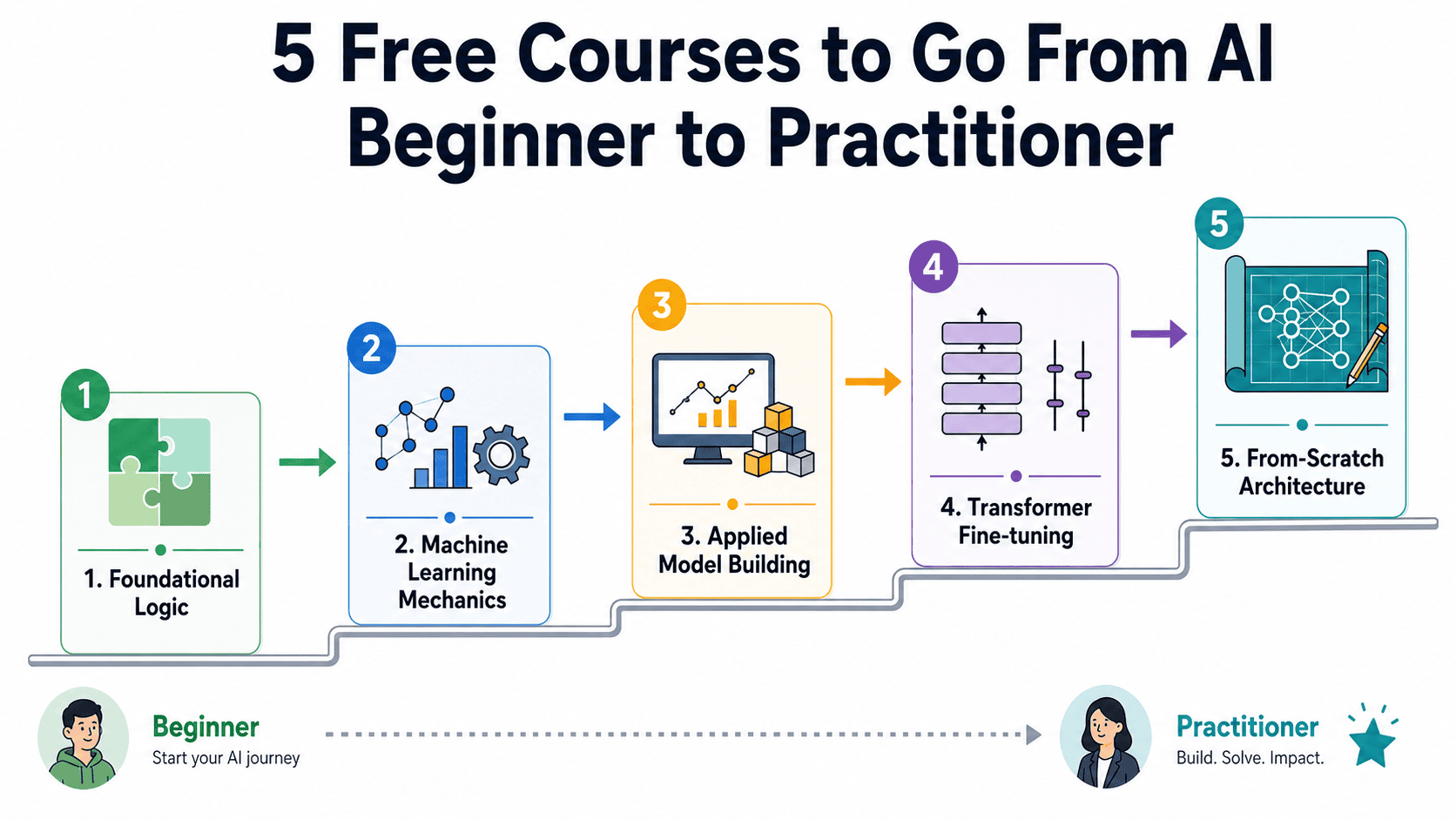
In this article, we’ll walk through a sequential, five-course roadmap that takes you from basic AI algorithms all the way to building modern large language models (LLMs) from scratch. These courses are verified to be free, highly practical, and respected by hiring managers across the industry.
The first step in any serious AI education isn’t installing a library or calling an API. It’s building a mental model for how AI systems reason about problems. The two courses in this section (the first and second in our list) establish that foundation, moving from classical AI logic to the core mathematics of machine learning. Skipping this layer is the most common mistake self-taught practitioners make, and it consistently shows up in technical interviews.
Once the theory is in place, the goal shifts to building things. The two courses in this section (courses number 3 and 4) are where most learners experience their biggest leap forward, because they force you to ship working models rather than just read about them. By the end of this layer, you should be able to train, evaluate, and deploy a model on a dataset of your own choosing.
The final layer is where practitioners become engineers. Building on top of frameworks is one skill; understanding what those frameworks are doing underneath is a different level entirely. Our final course strips away every abstraction and forces you to reconstruct the architecture from first principles. It’s not the easiest material in this roadmap, but it’s the most clarifying.
# 1. Harvard’s CS50: Introduction to AI with Python
Before you start importing massive neural networks, you need to understand the core logic of artificial intelligence. Harvard’s CS50 AI course provides a well-constructed bridge between standard software engineering and machine learning, focusing heavily on how AI systems actually think and make decisions.
Here’s what makes the CS50 AI course essential:
- Focuses on the core concepts that pre-date the deep learning boom, such as graph search algorithms, probability, and adversarial search.
- Requires you to write actual Python code to solve classic AI problems, like building an AI to play tic-tac-toe or solve logic puzzles.
- Lays the theoretical groundwork for modern machine learning, ensuring you understand why a model works, not just how to call it via an API.
You can audit CS50’s Introduction to AI with Python for free on edX or directly through Harvard’s OpenCourseWare platform.
# 2. Google’s Machine Learning Crash Course
Once you understand basic AI logic, it’s time to learn how machines actually learn from data. Google’s Machine Learning Crash Course is the fastest, most efficient way to understand the core mathematics and mechanics of modern machine learning. It’s the exact same course Google uses to upskill its internal engineering teams.
Key takeaways from Google’s crash course:
- Provides highly visual, interactive lessons on core machine learning concepts like gradient descent, loss functions, and regularization.
- Transitions you into TensorFlow and Keras, teaching you how to build basic models using industry-standard libraries.
- Focuses heavily on feature engineering and data preparation, which is where practicing data scientists spend the majority of their time.
Access the Google Machine Learning Crash Course directly on their developer portal. No sign-up is required to access the interactive modules and Colab notebooks.
# 3. fast.ai’s Practical Deep Learning for Coders
Most courses teach you the math first and let you build a model weeks later. Jeremy Howard’s fast.ai flips this entirely. This course is well known for its top-down approach, having you train a state-of-the-art deep learning model in the very first lesson, then spending the rest of the course explaining how it works.
Why fast.ai is the ultimate practitioner’s course:
- Designed for coders: if you know Python, you can immediately start building computer vision, natural language processing (NLP), and tabular data models.
- Teaches practical, production-ready skills, including how to scrape your own datasets, train models on cloud GPUs, and deploy them to the web.
- Uses the PyTorch-based fastai library, significantly reducing the boilerplate code required to train world-class neural networks.
Dive into Practical Deep Learning for Coders on the fast.ai website, where all lectures and Jupyter notebooks are completely free.
# 4. The Hugging Face NLP Course
If you want to work with modern generative AI, you need to understand Transformers. Hugging Face is the central hub for open-source AI, and their official NLP course is the definitive guide to using their ecosystem. It takes you from a working understanding of NLP directly into fine-tuning the models powering today’s AI applications.
What you’ll get from the Hugging Face course:
- A deep dive into the Transformer architecture, explaining self-attention mechanisms and how models process and represent text.
- Hands-on tutorials on using the
transformersanddatasetslibraries to pull pre-trained models and adapt them to your specific use case. - Practical experience with fine-tuning techniques, enabling you to take an open-source model and train it on your own private data efficiently.
The completely free and interactive Hugging Face NLP Course is available directly on their platform, with no subscription required.
# 5. ndrej Karpathy’s Neural Networks: Zero to Hero
To truly move from beginner to high-level practitioner, you need to strip away the frameworks and build the architecture yourself. Andrej Karpathy, former Director of AI at Tesla and founding member of OpenAI, created this series to teach you how to build a neural network and eventually a Generative Pre-trained Transformer (GPT) level LLM completely from scratch.
Why this series stands apart:
- You’ll write the backpropagation algorithm from scratch, ensuring you permanently understand the calculus that makes deep learning possible.
- It builds up to creating a scaled-down version of the GPT architecture, writing every single line of code live on screen with detailed explanations at each step.
- It bridges the gap between high-level library usage and the low-level optimizations required for serious AI engineering, making you a far more effective debugger and researcher.
Dedicate a few weekends to the Neural Networks: Zero to Hero playlist on YouTube. It’s arguably the most valuable free AI content available today.
# Wrapping Up
You don’t need to spend thousands of dollars to become a proficient AI engineer. This five-course sequence is designed to be followed in order, with each layer building directly on the one before it. CS50 gives you the logical foundation. Google’s crash course gives you the mathematical mechanics. fast.ai gets you building and shipping. Hugging Face puts the open-source ecosystem in your hands. Karpathy shows you what’s happening underneath all of it.
The full sequence takes roughly three to five months for someone studying part-time, but the depth of understanding it produces is solid. Most paid programs charge a significant amount for a similar outcome, and few of them are more thorough than what’s linked here for free.
Start with CS50, work through it at your own pace, and don’t rush the foundations. The rest of the roadmap will make a lot more sense when you do.
Happy learning!
Vinod Chugani is an AI and data science educator who bridges the gap between emerging AI technologies and practical application for working professionals. His focus areas include agentic AI, machine learning applications, and automation workflows. Through his work as a technical mentor and instructor, Vinod has supported data professionals through skill development and career transitions. He brings analytical expertise from quantitative finance to his hands-on teaching approach. His content emphasizes actionable strategies and frameworks that professionals can apply immediately.
