

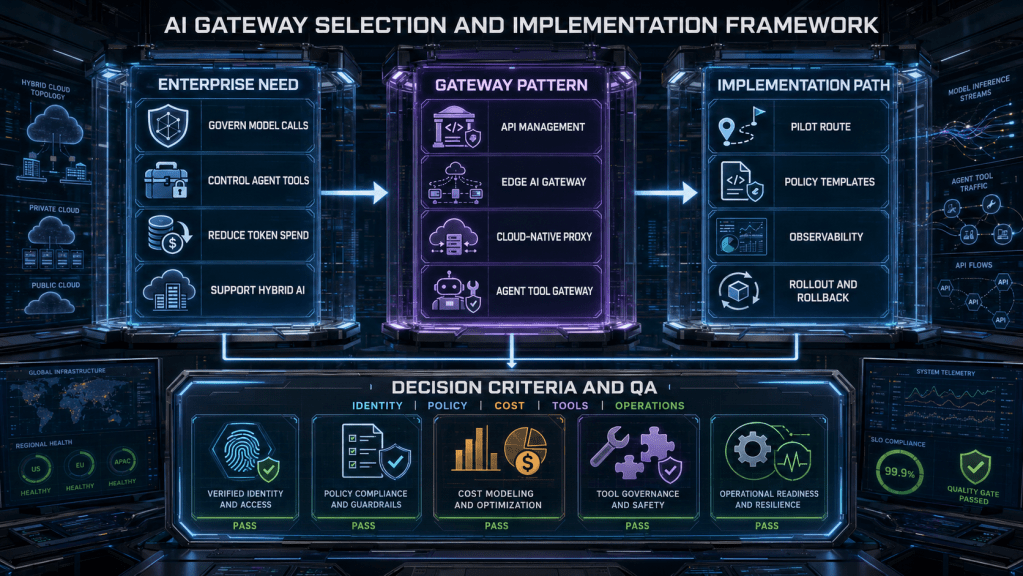


TL;DR
There is no single AI gateway pattern that fits every enterprise. Some teams need API management extended to AI traffic. Some need fast provider abstraction and traffic controls at the edge. Some need Kubernetes-native routing close to workloads. Some need an agent tool gateway that governs MCP servers, enterprise APIs, and tool access.
The right choice depends on the control problem you are solving. If your main issue is API governance, start with API management. If your main issue is model routing, caching, and token visibility, evaluate an LLM gateway or edge gateway. If your main issue is agent access to tools, prioritize identity, inbound authorization, outbound authorization, tool registry, approval, and audit. If your workloads are platform-engineering heavy, a cloud-native gateway may fit better than a managed API platform.
The implementation path should start small: one route, one production-relevant use case, clear owners, route policy, telemetry, budget controls, fallback testing, and rollback. Scale only after the operating model works.
Introduction
The AI gateway conversation has moved quickly. A year ago, many teams were still deciding whether they needed a gateway at all. Now the harder question is which gateway pattern actually fits the enterprise architecture.
That distinction matters.
A traditional API management platform with AI gateway capabilities is not the same thing as an edge AI gateway. An LLM proxy is not the same thing as an agent tool gateway. A Kubernetes-native AI gateway is not the same thing as a vendor-hosted control point. A gateway that is strong for model routing may be weak for tool authorization. A gateway that fits centralized governance may feel heavy for a platform engineering team trying to expose models to internal services.
The wrong selection process turns AI gateway design into a product comparison. The better process starts with control boundaries, traffic patterns, identity requirements, model strategy, tool access, observability, cost ownership, deployment constraints, and operational maturity.
This final article in the series provides a decision framework and implementation path for choosing the right AI gateway pattern.
The Gateway Decision Starts With the Control Problem
Before comparing products, define the problem the gateway must solve. Most enterprise teams need more than one capability, but one control problem usually dominates the design.
Some organizations are trying to prevent every development team from connecting directly to model providers. Some are trying to centralize logging and token cost reporting. Some are trying to expose internal APIs as tools to agents. Some are trying to build a model routing layer across public and private inference endpoints. Some are trying to bring existing API governance into AI workloads.
Those are related problems, but they do not always lead to the same architecture.

The key is sequencing. You do not need every gateway pattern on day one. You need the pattern that creates the right control boundary for the next stage of enterprise AI adoption.
The Main AI Gateway Patterns
Most enterprise gateway options fall into a handful of practical patterns. The names vary by vendor, but the architecture decision is usually one of these.
| Gateway Pattern | Best Fit | Primary Strength | Main Caveat |
|---|---|---|---|
| API management AI gateway | Organizations extending existing API governance into AI traffic | Enterprise API lifecycle, developer onboarding, policy, quota, analytics | May require extra design for agent tool authorization and model-specific workflows |
| Edge AI gateway | Teams that need fast model provider abstraction, caching, rate limiting, retries, fallback, and centralized AI traffic visibility | Quick onboarding, operational visibility, traffic controls, provider abstraction | Must validate identity depth, data retention, regional needs, and enterprise policy integration |
| LLM proxy or model gateway | Teams routing across many model providers or deployments | Unified model access, provider abstraction, cost controls, rate limits, routing | Can become isolated from broader enterprise API governance if not integrated |
| Cloud-native AI gateway | Platform teams operating Kubernetes, service mesh, or Envoy-style infrastructure | Fits platform engineering, GitOps, policy-as-code, workload proximity | Requires strong internal platform ownership and operational maturity |
| Agent tool gateway | Agentic systems that need controlled access to tools, APIs, MCP servers, and enterprise systems | Tool governance, inbound and outbound authorization, audit, safer agent integration | Must handle blast radius, approval, tool registry, and privileged action controls |
| Embedded application gateway | Smaller teams centralizing model calls inside a shared application service | Simpler first step, faster experimentation, limited platform footprint | Can become a bottleneck and may lack cross-enterprise governance |
The important point is not that one pattern is universally better. The important point is that each pattern optimizes for a different operating model.
API Management AI Gateway Pattern
The API management AI gateway pattern makes sense when the organization already treats APIs as governed products. It is especially useful when AI traffic should follow similar lifecycle controls as other enterprise APIs: onboarding, authentication, authorization, quota, developer access, analytics, versioning, and policy enforcement.
This pattern is useful for enterprises that already have API teams, developer portals, API governance, product owners, and security review workflows. AI becomes an extension of the API platform rather than a parallel integration estate.
Where It Fits
Use this pattern when:
- existing API management is already part of the enterprise architecture
- teams need governed access to model endpoints through standard API onboarding
- token limits, quota, semantic caching, content safety, routing, and observability should live near API policy
- developer access should be managed through familiar API products and subscriptions
- the organization wants to expose existing services as agent-accessible APIs or tools
What to Watch
API management does not automatically solve every AI-specific concern. Agent tool governance, MCP server registration, per-tool authorization, tool-call audit, and human approval workflows may still require additional components or design work.
The practical question is whether the API platform can govern the AI traffic you actually expect, not only whether it can proxy a model endpoint.
Edge AI Gateway Pattern
The edge AI gateway pattern is attractive when teams want a fast way to route AI traffic through a common control point without redesigning the entire application architecture. It often focuses on model provider abstraction, caching, rate limiting, retries, fallback, analytics, and centralized visibility.
This can be a good first production control point for organizations that have many small AI applications or need to stop unmanaged direct calls to model providers.
Where It Fits
Use this pattern when:
- teams need quick onboarding for multiple AI applications
- provider abstraction is more important than full API lifecycle governance
- caching, retries, fallback, and rate limiting are immediate needs
- AI traffic visibility is currently fragmented
- the organization wants a practical first control point before building a larger platform
What to Watch
Edge gateways need careful review around data handling, log retention, identity propagation, regional routing, compliance boundaries, and integration with enterprise security operations. A gateway can provide visibility, but the organization still has to decide what may be logged, who can view it, and how long it is retained.
LLM Proxy or Model Gateway Pattern
The LLM proxy pattern is useful when the main problem is model access across many providers. These gateways often provide a unified interface across different model APIs, model routing, budgets, rate limits, virtual keys, spend tracking, and fallback behavior.
This pattern is often attractive to engineering teams that want flexibility across hosted models, private inference endpoints, and internal experimentation.
Where It Fits
Use this pattern when:
- teams use several model providers
- application code should not be tightly coupled to one model API
- model routing, cost routing, latency routing, and fallback matter
- token budgets and per-user or per-key spend limits are required
- developers need a consistent model access interface
What to Watch
An LLM proxy can become a shadow platform if it is not integrated into enterprise identity, logging, incident response, and governance. The selection question should include who owns it, how routes are approved, how keys are issued, how budgets are enforced, and how production changes are rolled back.
Cloud-Native AI Gateway Pattern
A cloud-native AI gateway pattern fits organizations that already run platform engineering around Kubernetes, service mesh, Envoy, GitOps, policy-as-code, and internal developer platforms. It places the AI traffic control point close to application workloads and infrastructure automation.
This pattern can be powerful because it aligns AI traffic management with the same mechanisms used for other platform services.
Where It Fits
Use this pattern when:
- AI workloads run inside Kubernetes or platform-engineered environments
- route configuration should be managed as code
- platform teams already operate ingress, service mesh, gateway APIs, or Envoy-based infrastructure
- model traffic should be governed close to workloads
- self-hosted models, private endpoints, and public providers must coexist
What to Watch
Cloud-native does not mean automatically easier. The organization needs skilled platform owners, operational runbooks, observability integration, and release discipline. Without that, a cloud-native gateway can become another complex layer that few teams understand.
The agent tool gateway pattern is the most important pattern when agents are allowed to act. Model access is one problem. Tool access is a different and usually higher-risk problem.
A tool gateway governs how agents discover, authenticate to, invoke, and audit external capabilities. This may include MCP servers, internal APIs, SaaS systems, databases, ticketing systems, code repositories, automation platforms, and operational tools.
Where It Fits
Use this pattern when:
- agents need access to enterprise tools or APIs
- MCP servers are being introduced into production workflows
- inbound and outbound authorization must be separated
- tools need approval tiers, allowlists, deny lists, audit, and ownership
- the enterprise must control which agents can read data, write records, or trigger actions
What to Watch
Tool gateways should be designed around blast radius. A read-only knowledge lookup is not the same as a tool that updates a customer record, opens a change request, modifies infrastructure, or writes to a production repository.
The enterprise should classify tools by impact before exposing them to agents.
A Practical Gateway Selection Matrix
A simple selection matrix helps keep the discussion focused. The goal is not to score products prematurely. The goal is to identify which architecture pattern deserves deeper evaluation.
| Requirement | Strongest Pattern Fit |
|---|---|
| Extend existing API governance into AI workloads | API management AI gateway |
| Centralize model traffic quickly across several apps | Edge AI gateway |
| Route across many models and providers | LLM proxy or model gateway |
| Manage budgets, virtual keys, and spend by consumer | LLM proxy or API management AI gateway |
| Govern MCP tools and agent tool access | Agent tool gateway |
| Operate AI traffic inside Kubernetes platform architecture | Cloud-native AI gateway |
| Expose existing enterprise APIs as agent-consumable tools | API management AI gateway or agent tool gateway |
| Support private AI and public model fallback | LLM proxy, cloud-native gateway, or API management gateway |
| Enforce policy-as-code through platform pipelines | Cloud-native AI gateway |
| Start with minimum operational change | Edge AI gateway or embedded application gateway |
The best answer may be a combination. For example, an organization may use API management for enterprise API governance, an LLM proxy for multi-provider model routing, and an agent tool gateway for MCP server access. That is acceptable if ownership and integration boundaries are explicit.
Decision Flow for Choosing a Pattern
The following decision flow is a practical starting point for architecture discussions.
This flow intentionally starts with tool access. Agent tool access changes the risk profile more than basic model completion traffic. If tools are in scope, design for that boundary first.
Implementation Architecture
A production-ready implementation should separate consumers, gateway enforcement, model backends, tool backends, and telemetry. Even if the first deployment is small, the design should leave room for policy, observability, and ownership to mature.
The design should make two paths visible. The model path handles inference traffic. The tool path handles actions, data access, and external capabilities. Those paths may share the same gateway platform, but they should not share the same risk model.
Implementation Phases
A gateway rollout should not start with every team, every model, every tool, and every policy at once. That creates too many variables and makes it difficult to know whether the gateway, the application, the model, or the operating model failed.
Phase: Discovery and Control Boundary
Start by inventorying current AI traffic. Identify direct provider calls, embedded API keys, model endpoints, agent tools, MCP servers, data sources, and application owners.
The output should be a control-boundary decision:
- which traffic must go through the gateway first
- which workloads are out of scope for the pilot
- which models are approved
- which tools are blocked by default
- which data classes are allowed
- which owners must approve production access
Phase: Pilot Route
Choose one production-relevant route. Good candidates include ticket summarization, internal knowledge search, document classification, developer assistant routing, or operational assistant read-only workflows.
The pilot should include:
- one primary route
- one fallback behavior
- one business owner
- one technical owner
- token and cost logging
- route-level policy
- non-production and production environments
- a rollback path
The pilot should prove the gateway path and operating model, not every advanced capability.
Phase: Policy Templates
After the pilot works, create reusable policy templates. At minimum, define templates for:
- low-risk read-only model calls
- retrieval-augmented generation workflows
- high-cost model access
- sensitive data handling
- agent read-only tool access
- agent write-action tool access
- non-production experimentation
Templates reduce friction and make governance repeatable.
Phase: Observability and Cost Governance
Add dashboards and alerts before broad rollout. The gateway should show usage by route, application, model, owner, environment, token consumption, fallback rate, error rate, policy blocks, and estimated cost.
Do not wait for the monthly cloud bill to discover that a workflow is too expensive.
Phase: Tool Governance
Introduce agent tool access only after the model gateway path is stable. Start with read-only tools, then move to sensitive read tools, then low-impact write tools, and only later consider privileged actions with approval paths.
For MCP-based integration, define server registration, authorization, ownership, tool allowlists, and audit expectations before production use.
Phase: Scale and Self-Service
Once the gateway and operating model are stable, expand through controlled self-service. Application teams should be able to request routes, select approved templates, attach owners, test in lower environments, and promote through review.
Self-service without guardrails recreates the problem the gateway was meant to solve.
Gateway Configuration Checklist
A route should not move to production until the required configuration is explicit.
gateway_route_readiness:
  route:
    name: example-route
    business_owner: required
    technical_owner: required
    production_support_team: required

  identity:
    application_identity: required
    user_context: required_if_user_triggered
    agent_identity: required_if_agentic
    shared_api_key_exception: denied_by_default

  models:
    primary_model: approved_only
    fallback_model: tested_before_enablement
    private_model_required_for_sensitive_data: evaluate_by_data_class

  tools:
    tool_access_default: deny
    read_only_tools: allow_with_logging
    write_tools: approval_required
    privileged_tools: blocked_unless_exception_approved

  controls:
    max_input_tokens: required
    max_output_tokens: required
    budget_owner: required
    quota_period: required
    prompt_retention: documented
    response_retention: documented

  observability:
    token_metrics: required
    cost_metrics: required
    policy_events: required
    traces: required_for_production
    alert_owner: required

  release:
    lower_environment_test: required
    rollback_plan: required
    policy_versioning: required
    emergency_disable: required
This checklist is intentionally practical. It is the kind of route readiness gate that prevents AI gateway adoption from becoming another unmanaged shared service.
Common Implementation Mistakes
Choosing by Feature List Instead of Operating Fit
A product may have strong AI gateway features and still be the wrong operational fit. If your platform team cannot operate it, your security team cannot review it, or your application teams cannot onboard cleanly, the feature list does not matter.
Treating Model and Tool Traffic the Same
Model calls and tool calls have different risk profiles. Tool calls can change systems. They need stronger authorization, approval, audit, and blast-radius controls.
Logging Full Payloads by Default
Full prompt and response logging can help debugging, but it can also create a sensitive data repository. Start with redacted metadata and define approved exceptions for deeper troubleshooting.
Skipping Fallback Validation
Fallback is not only an uptime feature. A fallback model may produce different output, ignore structure, behave differently with tools, or change cost. Test fallback before production.
Building a Gateway Without a Route Catalog
A gateway with no route catalog becomes difficult to govern. The route catalog should show route purpose, owner, model, tools, data class, policy version, budget, and support status.
Letting Every Team Create Its Own Gateway
A small number of gateway patterns can coexist. Dozens of disconnected gateways recreate integration sprawl with better branding.
What Good Looks Like
A mature AI gateway implementation has visible operating discipline.
The platform team can show every production route, owner, model, fallback behavior, token budget, tool permission, policy version, and rollback option. Security can review tool access and policy exceptions. Finance can see cost by route and owner. Application teams have a documented onboarding path. Operators can troubleshoot latency, error rates, fallback, throttling, and policy blocks. Architects can explain how AI traffic moves across identity, gateway, model, tool, and telemetry layers.
That is the goal. Not just a proxy. Not just a new product. A governed control point that makes enterprise AI safer to scale.
Conclusion
Choosing an AI gateway is not a single-product decision. It is an architecture decision about where the enterprise wants to place control over model traffic, tool access, identity, policy, observability, cost, and operations.
API management gateways fit organizations that already govern APIs as products. Edge AI gateways can provide fast traffic visibility, caching, rate limiting, and fallback. LLM proxies help teams abstract model providers and manage budgets. Cloud-native gateways fit platform engineering environments that want policy-as-code and workload-proximate routing. Agent tool gateways matter when agents begin using MCP servers, internal APIs, and enterprise tools.
The right path is to start with the control problem, select the gateway pattern that matches it, pilot one route, prove telemetry and ownership, build reusable policy templates, then scale gradually. The gateway should make AI adoption more governable, not simply move complexity to a new layer.
This series started with the gateway as the AI control point, moved into the operating model, and ends with selection and implementation. The practical takeaway is straightforward: enterprise AI does not need more unmanaged connections. It needs clear control boundaries, route ownership, policy enforcement, observability, cost accountability, and rollback.
