



TL;DR
Neoclouds may begin by selling access to scarce GPU capacity, but long-term differentiation requires more than racks, drivers, and a booking portal. A production AI cloud must convert bare-metal servers, virtual machines, GPU pools, storage, networks, and external cloud resources into secure, repeatable, tenant-aware services.
The missing layer is vendor-neutral AI infrastructure orchestration. It should accept a customer or platform intent, select an appropriate substrate, provision Kubernetes and supporting services, enforce isolation, manage accelerator lifecycle and placement, collect operational evidence, and retire the environment safely. The goal is not to hide every hardware difference. The goal is to create a portable control plane over a hardware-aware data plane.
Introduction
A neocloud can own thousands of high-value accelerators and still fail to operate like a cloud.
Hardware inventory answers one question: what capacity exists? A cloud platform must answer a much larger set of questions. Who is allowed to consume that capacity? How quickly can a secure environment be created? Which tenant is responsible for the workload? What data and network boundaries apply? Which GPU sharing model is permitted? How are upgrades, failures, metering, recovery, and evidence handled? What happens when a workload must move to a different hardware generation, site, or provider?
These questions become more important as neoclouds move beyond large, dedicated training reservations and begin serving enterprise inference, regulated workloads, internal AI platforms, and sovereign AI programs. A long-running enterprise service is not a one-time allocation. It is a lifecycle commitment.
That is why the next competitive boundary for neoclouds is orchestration.
The useful architecture is not a thin portal placed in front of GPU servers. It is software that can turn bare metal, accelerators, virtual machines, and cloud capacity into governed Kubernetes and AI platform services without forcing the provider or customer into one hardware vendor’s operating model.
A Neocloud Must Sell a Platform, Not Just Capacity
A specialized GPU provider can create early value through availability, price, and performance. Those advantages matter, but they are difficult to defend forever. Hardware supply changes. New accelerator vendors emerge. Hyperscalers adjust pricing. Customers move from training projects to persistent inference services. Enterprise buyers expect identity integration, service levels, audit evidence, support boundaries, and predictable lifecycle management.
The operating model must therefore evolve from a resource business into a platform business.
| Capability | Capacity Provider | AI Cloud Platform |
|---|---|---|
| Customer request | Reserve servers or GPUs | Request an approved service class |
| Provisioning | Allocate existing machines | Reconcile compute, network, storage, cluster, policy, and AI services |
| Isolation | Dedicated hardware when available | Explicit namespace, control-plane, cluster, network, storage, and hardware boundaries |
| GPU access | Device attached to a host | Governed accelerator classes, health, sharing, topology, quotas, and queue policy |
| Lifecycle | Customer-managed or ticket-driven | Automated build, upgrade, validation, recovery, and retirement |
| Operations | Infrastructure health | End-to-end service health and tenant-visible objectives |
| Economics | GPU-hour consumption | Cost per service class, workload, outcome, reservation, and supporting resource |
| Portability | Rebuild for each provider | Stable service contract with substrate-specific adapters |
The difference is not cosmetic. A portal can make a manual process look modern. Orchestration changes the process itself.
A real orchestration layer continuously compares desired state with actual state. It notices failed provisioning, unhealthy GPUs, drifted configuration, missing policy, exhausted quotas, broken dependencies, or unsupported combinations. It then corrects the condition, blocks the request, or escalates with enough evidence for an operator to act.
Scope and Assumptions
This article focuses on neoclouds and enterprise platform teams that need to deliver Kubernetes and AI services across a mixture of bare-metal servers, virtual machines, accelerator pools, and public or partner cloud resources.
The architecture assumes the following:
- Kubernetes is a primary platform API and workload substrate, but it is not the entire cloud.
- Some customers can share infrastructure safely, while others require a dedicated control plane, cluster, or physical host.
- Accelerator types, interconnects, drivers, firmware, and sharing capabilities will remain heterogeneous.
- Private AI and sovereign AI are service-placement and control models, not simply product labels.
- Vendor neutrality means replaceable integrations and portable contracts, not pretending that all hardware behaves identically.
- The provider is responsible for day-2 operations, including upgrades, observability, incident response, recovery, and evidence retention.
The goal is not to prescribe one product stack. It is to define the capabilities the orchestration layer must provide and the operating decisions it must make visible.
The Orchestration Layer at a Glance
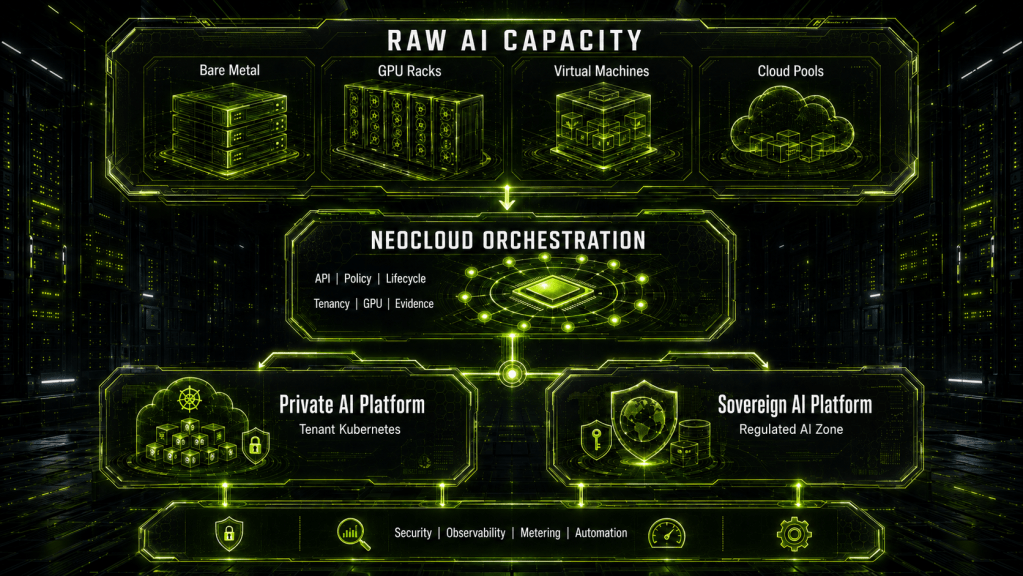
The important point in the following diagram is where the abstraction boundary sits. Customers should request a service outcome. The orchestration layer should translate that outcome into infrastructure-specific actions while preserving the constraints that make the workload secure and operable.
This architecture treats orchestration as a provider control plane, not as a single scheduler. Kubernetes scheduling is one component. Cluster creation, hardware preparation, tenant isolation, GPU software lifecycle, workload admission, policy enforcement, telemetry, billing context, and recovery all sit around it.
Orchestration Is More Than Scheduling
A scheduler decides where an admitted workload should run. An orchestration platform decides whether the environment should exist, how it should be built, which controls apply, how it changes over time, and what evidence proves that the service is healthy.
| Question | Scheduler | Orchestration Layer |
|---|---|---|
| Which node can run this pod? | Yes | Uses the result |
| Should this tenant receive a shared or dedicated cluster? | No | Yes |
| Which jurisdiction and site are allowed? | Limited labels and policy | Yes, as a service constraint |
| Is the server correctly inspected, imaged, patched, and attached to the right fabric? | No | Yes |
| Is GPU sharing permitted for this workload class? | Consumes exposed resources | Defines and enforces the policy |
| Can the request borrow capacity from another pool? | Sometimes, within configured rules | Defines cross-pool and commercial policy |
| Are logs, metrics, traces, and billing records attached to the tenant? | No | Yes |
| Can the platform upgrade or rebuild the environment safely? | No | Yes |
| Can the service be reproduced on another substrate? | No | Yes, through adapters and portable contracts |
This distinction prevents a common architecture mistake: installing Kubernetes, adding a GPU device plugin, and declaring the result to be an AI cloud.
That stack may run a workload. It does not yet provide a governed service.
The Six Planes a Neocloud Must Unify
A useful orchestration architecture can be understood as six connected planes. These planes can be implemented by several products and controllers, but they must behave as one service system.
Capacity and Infrastructure Plane
The capacity plane turns physical and virtual resources into trustworthy inventory. For bare metal, that includes out-of-band management, hardware inspection, firmware and BIOS state, RAID configuration, disk cleaning, operating-system imaging, network attachment, and health remediation. For virtual machines and external cloud instances, it includes image selection, instance lifecycle, networking, storage, quotas, and provider-specific failure handling.
This plane must know more than the number of GPUs in a rack. It needs CPU architecture, system memory, NUMA layout, local NVMe, NIC type, fabric location, power state, firmware compatibility, accelerator health, and maintenance status. A distributed training job may require eight healthy GPUs in one fabric domain, not eight arbitrary devices spread across a region.
The orchestration layer should expose this infrastructure through normalized capability classes while retaining the topology and compatibility data needed for correct placement.
Cluster and Runtime Plane
The cluster plane creates and maintains Kubernetes control planes, worker pools, networking, storage integrations, ingress, registries, secrets services, policy engines, and baseline observability.
Cluster lifecycle must be declarative. A provider should be able to state that a tenant needs a dedicated production cluster in a specific region with an approved Kubernetes channel, GPU-enabled worker pools, default-deny networking, backup, and a validated add-on bundle. Controllers then reconcile the environment and report whether it is ready.
This plane also owns upgrades, conformance testing, drift detection, certificate rotation, control-plane backup, worker replacement, and add-on compatibility. Without that lifecycle discipline, each customer environment becomes a snowflake that grows harder to patch and support.
Tenant and Security Plane
Kubernetes provides useful isolation primitives, but it does not provide a complete tenant model by itself. A neocloud must define the tenant as a first-class platform object and carry that identity through infrastructure, clusters, namespaces, networks, storage, secrets, telemetry, support, and billing.
The tenant plane decides:
- whether the customer receives a namespace, virtual control plane, dedicated cluster, or dedicated hardware
- which identity provider and roles apply
- which networks and endpoints are reachable
- whether egress is denied, inspected, or allow-listed
- where secrets and encryption keys live
- which images, models, and registries are approved
- which administrators can use break-glass access
- how tenant data, logs, snapshots, and deleted disks are handled
Isolation is not one switch. It is a bundle of boundaries with different strengths and costs.
Accelerator and AI Workload Plane
GPU operations are a lifecycle problem. Drivers, container runtimes, device plugins, health agents, firmware, partitioning modes, topology labels, telemetry, and scheduler integrations must remain compatible.
The orchestration layer should translate customer intent into an accelerator service class. A request might need exclusive devices, hardware-partitioned instances, time-shared access, a specific memory floor, a same-rack topology, or preemptible capacity. The platform should validate that the requested combination is supported before the workload is admitted.
For batch, training, and HPC-style AI jobs, queueing and quota policy are as important as node placement. The platform needs admission control, priority, borrowing, preemption, gang behavior, topology-aware placement, and clear queue-time objectives. For inference, it also needs replica placement, autoscaling, model-loading behavior, cold-start measurement, and service latency objectives.
AI Services and Delivery Plane
Enterprise customers rarely want raw Kubernetes alone. They may need managed notebooks, training jobs, distributed frameworks, model registries, inference endpoints, data connectors, vector services, model gateways, evaluation pipelines, or approved runtime images.
The orchestration layer should package these capabilities as versioned service components. Each component needs an owner, support boundary, upgrade path, security baseline, observability contract, and rollback method.
This is where a neocloud becomes more than GPU infrastructure. It creates repeatable platform outcomes that customers can consume without rebuilding the same AI stack for every project.
Evidence and Economics Plane
A provider cannot govern or price what it cannot attribute.
Every resource and event should carry tenant, environment, service class, workload, region, hardware pool, and owner context. Metrics, logs, traces, audit records, queue events, GPU health, network performance, storage behavior, and lifecycle actions must be correlated.
The same context should support showback, chargeback, capacity planning, incident review, and service-level reporting. A GPU-hour is not a sufficient economic unit when the service also reserves high-speed fabric, local storage, object storage, CPU, memory, power, software subscriptions, and operational support.
A stronger unit is cost per useful service outcome, such as completed training run, million inference requests, successful batch, protected endpoint, or tenant service class.
Treat the Platform as a Compiler for Infrastructure Intent
The cleanest mental model is to treat the orchestration layer as a compiler.
A customer or platform team submits intent. The platform validates policy, resolves the request into infrastructure and service components, executes the plan through controllers, and produces both a running environment and an evidence record.
This model has an important operational benefit. Failure becomes structured. Instead of returning a generic provisioning error, the platform can report that the requested topology is unavailable, the selected GPU partitioning mode conflicts with the isolation class, the region lacks approved storage, or the tenant has exceeded reserved capacity.
The customer receives a reason and a supported alternative. The operator receives the controller state and evidence needed to diagnose the condition.
A Practical AI Environment Service Contract
The following YAML is a conceptual platform contract, not a standard Kubernetes resource that can be installed as written. It demonstrates the level of intent a neocloud should capture before selecting servers or creating a cluster.
apiVersion: platform.dtd.example/v1alpha1
kind: AIEnvironment
metadata:
  name: claims-inference-prod
  namespace: tenant-acme
spec:
  serviceClass: regulated-inference

  placement:
    jurisdiction: eu
    allowedSubstrates:
      - bareMetal
      - privateVirtualization
    externalBursting: denied

  isolation:
    cluster: dedicated
    hardware: sharedWithProtectedSlices
    network: defaultDeny
    tenantManagedKeys: required

  accelerator:
    capabilityClass: high-memory
    count: 8
    allocation: exclusive
    topology: same-fabric-domain

  kubernetes:
    releaseChannel: stable
    lifecycleWindow: monthly
    controlPlaneBackup: daily

  data:
    residency: eu-only
    approvedStorageClass: encrypted-performance
    modelRegistry: private

  observability:
    tenantMetrics: enabled
    workloadTracing: enabled
    auditRetentionDays: 365

  recovery:
    workloadRpoMinutes: 60
    environmentRebuildTargetMinutes: 120
The reader should notice that the request does not name a server model, cloud instance, or GPU vendor. It expresses the capabilities and controls the workload requires. Provider-specific adapters remain free to map that contract to supported hardware.
The platform implementation must add several things around this object:
- admission rules that reject unsupported or noncompliant combinations
- controllers that provision infrastructure, clusters, policies, and AI services
- status conditions that report capacity, health, security, and readiness
- a versioned service-class catalog that limits arbitrary combinations
- rollback and cleanup behavior for partially completed requests
- evidence that records what was selected and which policies were applied
Successful execution should produce more than a Ready state. It should prove that the correct region, isolation tier, GPU topology, network policy, storage class, observability bundle, and recovery controls were validated.
Multi-Tenancy Is the Product Boundary
The most important neocloud design decision may be the isolation unit offered to customers.
Sharing increases utilization and can reduce cost, but it also expands the number of components that must enforce fairness and security. Dedicated environments cost more, but they simplify several trust and performance questions. The orchestration layer should make this an explicit service-class choice rather than an informal engineering decision.
| Isolation Model | Best Fit | Main Strength | Main Risk |
|---|---|---|---|
| Shared namespace in a shared cluster | Cooperative internal teams and lower-risk development | Highest density and simplest fleet count | Shared kernel, cluster-wide resources, noisy neighbors, and complex policy dependencies |
| Isolated tenant control plane on shared workers | Teams needing more API autonomy without dedicated hardware | Better control-plane separation with shared capacity | Worker and data-plane isolation still require careful design |
| Dedicated Kubernetes cluster | Enterprise customers, regulated workloads, stronger administrative separation | Clear ownership, lifecycle, and policy boundary | More control-plane and operational overhead |
| Dedicated cluster on dedicated hardware | Hostile multi-tenancy, high assurance, strict performance, or contractual isolation | Strongest infrastructure and performance boundary | Lowest density and highest reserved-capacity cost |
Namespaces remain useful, but they are not a complete security boundary. Cluster-scoped objects, shared nodes, kernel exposure, storage systems, network plugins, privileged workloads, and administrative access all affect the real isolation level.
A provider should therefore define an isolation profile that includes at least:
- control-plane boundary
- worker-node boundary
- network and egress policy
- storage and backup boundary
- secrets and key ownership
- privileged workload policy
- accelerator sharing mode
- observability and log visibility
- operator access and break-glass process
- deletion, disk cleaning, and evidence-retention behavior
The commercial catalog should price these differences. A dedicated cluster with exclusive GPUs and tenant-owned keys is a different service from a shared development namespace using time-sliced accelerators.
GPU Management Must Become a Service-Class Problem
A neocloud cannot treat every GPU request as count: 1.
Accelerator requirements include memory, supported numeric formats, interconnect, CPU and NUMA locality, network fabric, storage throughput, driver branch, runtime compatibility, partitioning capability, and failure behavior. The orchestration layer must preserve those requirements while still presenting a usable service catalog.
| Accelerator Service Class | Best Fit | Isolation and Performance | Operational Caveat |
|---|---|---|---|
| Exclusive whole GPU | Production inference, fine-tuning, performance-sensitive jobs | Predictable access and simple accounting | Can create low utilization and fragmentation |
| Hardware-partitioned GPU | Smaller production workloads needing stronger isolation than time sharing | Hardware-backed memory and fault isolation on supported devices | Fixed profiles, hardware support, and reconfiguration constraints |
| Time-shared GPU | Development, notebooks, light inference, bursty experiments | Higher density and broad sharing | No equivalent memory or fault isolation between time slices |
| Topology-constrained multi-GPU pool | Distributed training and tightly coupled inference | Preserves high-bandwidth locality | Capacity may exist but still be unplaceable because it is fragmented across topology domains |
| Heterogeneous capability pool | Portable workloads across vendors or generations | Greater supply flexibility | Workload validation must account for runtime, performance, and feature differences |
The platform should separate four decisions that are often collapsed:
- Eligibility: Which accelerator families can run the workload?
- Allocation: Does the workload receive a whole device, partition, or shared slot?
- Admission: When is the job allowed to consume capacity, and can it borrow or preempt?
- Placement: Which host, rack, fabric domain, site, or provider can meet the topology and service objective?
Kubernetes device frameworks can expose hardware, and queueing systems can govern admission. The neocloud orchestration layer must connect those mechanisms to tenant contracts, hardware health, lifecycle compatibility, and commercial policy.
Sovereign AI Requires More Than Local Hardware
A provider can place GPUs inside a national boundary and still deliver a weak sovereign AI service.
Sovereignty depends on who can operate, change, inspect, recover, and exit the platform. A credible sovereign AI service class should define:
- where data, prompts, models, embeddings, logs, backups, and support artifacts may reside
- which legal entities and operators can access the environment
- who controls identity roots, encryption keys, certificates, and break-glass credentials
- where container images, model artifacts, packages, and updates originate
- who can approve platform upgrades and emergency changes
- whether telemetry leaves the jurisdiction
- how remote vendor support is brokered and recorded
- how the customer can export workloads, data, evidence, and configuration
- how the service can be restored when an external dependency is unavailable
This is another reason orchestration must sit above individual hardware and cloud providers. Private and sovereign environments should be expressed as policy and placement classes that can be implemented on approved substrates.
The strongest design does not guess one permanent destination for every AI workload. It preserves the ability to place workloads on premises, in a regional neocloud, in a private environment, or across approved clouds while maintaining reproducible operations and visible control boundaries.
Hardware Neutrality Must Preserve Hardware Awareness
Vendor neutrality is frequently misunderstood as removing vendor-specific information. That approach creates a lowest-common-denominator platform and can damage performance, reliability, and supportability.
The better pattern is a portable control plane over a hardware-aware data plane.
The service contract should use capability language such as:
- high-memory accelerator
- low-latency fabric domain
- hardware-isolated accelerator slice
- confidential-compute capable node
- high-throughput inference class
- distributed-training topology class
- approved sovereign supply-chain profile
Adapters then map those capabilities to supported combinations of servers, accelerators, NICs, storage, drivers, and runtimes. The mapping should be versioned and tested.
Customers gain portability because they request capabilities rather than vendor SKUs. Operators retain accuracy because the platform still knows which implementations satisfy the contract.
This design also creates a practical exit strategy. Replacing a server vendor, introducing a new accelerator, or adding another cloud provider should require a new adapter and validation profile, not a rewrite of every customer workflow.
The Operating Model Behind the Platform
Orchestration does not remove ownership. It makes ownership executable.
| Role | Primary Responsibility |
|---|---|
| Platform product owner | Service catalog, customer experience, objectives, roadmap, and commercial fit |
| Infrastructure operations | Racks, power, BMCs, firmware, servers, networks, storage, and physical remediation |
| Kubernetes fleet team | Cluster lifecycle, add-ons, conformance, upgrades, backup, and drift |
| AI platform team | Accelerator services, queues, runtimes, model services, and AI workflow integrations |
| Security and sovereignty owner | Identity, isolation profiles, supply-chain policy, key control, evidence, and exceptions |
| SRE or NOC | Service telemetry, alerting, incidents, capacity signals, and recovery coordination |
| FinOps or service economics | Rate cards, reservations, showback, unit cost, and margin visibility |
| Tenant or customer team | Workload definition, data classification, resource intent, application health, and approved use |
A frequent failure pattern is assigning all of this to a small Kubernetes team. That team may understand clusters, but it cannot alone own firmware, physical networking, customer contracts, sovereignty, AI runtime compatibility, security exceptions, and service economics.
The orchestration layer should reflect these boundaries through APIs, approvals, policy ownership, dashboards, and escalation paths.
A Phased Implementation Path
The platform should be built from the infrastructure inward. Starting with a polished self-service portal creates demand before the backend can deliver safely.
| Phase | Objective | Exit Criteria |
|---|---|---|
| Normalize capacity | Create trusted inventory and automated lifecycle for bare metal, VMs, cloud instances, networks, storage, and accelerators | Resources have health, topology, ownership, firmware, and lifecycle state that controllers can reconcile |
| Define service classes | Convert arbitrary infrastructure requests into a limited catalog of supported outcomes | Each class has isolation, accelerator, network, storage, lifecycle, SLO, support, and cost definitions |
| Automate tenant landing zones | Provision identity, cluster, namespace, network, storage, policy, secrets, and baseline telemetry together | A tenant environment can be built and deleted repeatedly with evidence and no manual configuration drift |
| Add AI workload governance | Integrate GPU lifecycle, queueing, quotas, topology, runtime bundles, and workload admission | Jobs are placed by service policy, not first-come manual allocation |
| Add evidence and economics | Correlate tenant, workload, infrastructure, telemetry, audit, reservation, and cost context | Operators and customers can explain performance, failures, usage, and unit cost |
| Extend placement and sovereignty | Add approved sites, providers, private environments, and sovereign profiles through adapters | The same service intent can be reproduced on more than one validated substrate |
Each phase should include failure testing. Provisioning success in a clean lab is not enough. Test exhausted IP pools, unavailable topology, unhealthy GPUs, failed image pulls, expired certificates, lost management connectivity, partial cluster creation, storage latency, policy rejection, and cleanup after aborted requests.
A platform becomes trustworthy when failure is expected, bounded, observable, and recoverable.
What Neoclouds Should Measure
GPU utilization alone cannot show whether the platform is delivering a good service.
| Metric | What It Reveals |
|---|---|
| Request-to-ready time by service class | Whether orchestration is removing delivery friction |
| Successful reconciliation rate | Whether desired state becomes actual state reliably |
| Ready GPU yield | How much installed accelerator capacity is healthy, compatible, and schedulable |
| P95 queue time by workload class | Whether admission policy and capacity match customer commitments |
| Placement failure and fragmentation rate | Whether topology, memory, or resource shape is blocking otherwise available capacity |
| Useful work per allocated GPU-hour | Whether reserved capacity produces training, inference, or batch outcomes |
| Cold-start and model-load time | Whether storage, registry, network, and runtime dependencies meet service objectives |
| Tenant policy exception rate | Whether standard service classes fit real workloads without weakening controls |
| Change failure and recovery time | Whether upgrades and automation are safe to operate |
| Evidence completeness | Whether every material action can be attributed and audited |
| Cost per service outcome | Whether the neocloud is improving customer economics and provider margin |
Two simple ratios are especially useful:
Useful Accelerator Efficiency = Useful Workload Time
                                --------------------
                                Allocated GPU Time

Provisioning Reliability = Successfully Ready Environments
                           -------------------------------
                           Total Accepted Requests
These ratios should be interpreted by service class. A reserved training cluster and a shared development pool should not have the same utilization target or queue objective.
Common Failure Modes and Caveats
Treating Kubernetes as the Complete Cloud
Kubernetes orchestrates workloads and exposes powerful APIs, but it does not automatically provide tenant contracts, bare-metal lifecycle, sovereign controls, service economics, customer support, or recovery ownership. Those capabilities must be designed around it.
Using Namespaces as the Default Answer for Every Tenant
Shared clusters can be efficient, but they require strong policy, network, storage, runtime, and administrative controls. Higher-risk tenants may need a dedicated control plane, cluster, or host. Isolation should be selected from workload and trust requirements, not from a desire to maximize density.
Hiding Hardware Differences Too Aggressively
Accelerators and fabrics differ in memory, features, topology, drivers, runtime support, and performance. A generic gpu label is not enough. Portability should come from capability contracts and adapters, not from discarding information the scheduler and operator need.
Automating Provisioning but Not Lifecycle
Day-0 automation creates an environment. Day-2 orchestration patches, rotates certificates, replaces failed nodes, upgrades operators, validates compatibility, backs up control planes, recovers service, and retires resources safely. The latter determines whether the cloud remains supportable.
Building Self-Service Before Guardrails
A portal without service classes, quotas, policy, and backend reconciliation accelerates sprawl. Self-service should expose supported outcomes, not every infrastructure knob.
Measuring Infrastructure Without Tenant Context
Cluster-wide metrics can show that a GPU is busy without showing which customer, workload, queue, service objective, or commercial commitment is affected. Tenant and service-class context must be attached at ingestion.
Calling a Region Sovereign Without Testing Control
Local placement is only one sovereignty input. Identity, keys, operators, software supply chain, telemetry, support access, recovery, and exit all matter. The service must prove those controls through architecture and evidence.
Centralizing the Control Plane Without Designing Its Failure Domain
A fleet-wide orchestration layer can become a high-impact dependency. Separate management and workload planes, protect credentials, back up desired state, test controller failure, limit blast radius, and define degraded operating modes.
A Decision Framework for Selecting an Orchestration Platform
A neocloud should evaluate orchestration software against operating evidence, not a feature checklist or demonstration.
| Criterion | Proof to Request | Red Flag |
|---|---|---|
| Declarative reconciliation | Failed-state handling, idempotency, drift correction, status conditions, and cleanup | Workflow automation that stops after issuing API calls |
| Substrate coverage | Validated bare-metal, VM, and cloud adapters with clear support boundaries | A claim of multicloud that depends on custom scripts for every environment |
| Tenant isolation | Multiple isolation tiers, policy bundles, identity integration, and tested boundary behavior | Namespace creation presented as complete multi-tenancy |
| Accelerator lifecycle | Drivers, device frameworks, health, partitioning, topology, queueing, and upgrade validation | GPU scheduling reduced to static node labels |
| AI workload support | Batch, training, inference, notebooks, distributed jobs, and runtime lifecycle | A Kubernetes service with no AI-specific admission or observability model |
| Observability and metering | Tenant-correlated metrics, logs, traces, events, audit, and cost attribution | Infrastructure dashboards with no workload or customer context |
| Sovereignty controls | Placement, keys, operator access, supply chain, telemetry, recovery, and exit evidence | A local data-center location used as the only sovereignty proof |
| Lifecycle and recovery | Upgrade plans, compatibility testing, rollback, backup, rebuild, and failure drills | Strong deployment automation with weak day-2 ownership |
| Extensibility and exit | Open APIs, custom resources, adapter model, exportable desired state, and migration path | Customer workflows tied directly to one hardware or cloud API |
| Supportability | Version matrix, escalation model, evidence collection, and multi-vendor triage | Ambiguous responsibility between hardware, Kubernetes, AI, and networking vendors |
The best platform is not the one that claims to abstract the most. It is the one that turns real service intent into a reliable environment while preserving the information needed for performance, security, support, and change.
Conclusion
Neoclouds were able to enter the market by solving an urgent capacity problem. The next stage is harder. Enterprise and sovereign AI customers need repeatable services, not just access to accelerators.
That requires an orchestration layer that treats bare metal, virtual machines, cloud resources, Kubernetes clusters, GPU pools, policies, and AI services as parts of one reconciled system. It must provision environments, isolate tenants, govern workload admission, preserve topology, manage lifecycle, collect evidence, and connect consumption to service economics.
Kubernetes is a strong foundation because it provides declarative APIs, extensibility, workload orchestration, and a broad ecosystem. It is not sufficient by itself. The neocloud must add the tenant model, service catalog, policy system, hardware lifecycle, accelerator governance, observability, recovery, and commercial context that turn infrastructure into a cloud platform.
The durable architectural position is straightforward: build a portable control plane over a hardware-aware data plane. That lets the neocloud introduce new servers, accelerators, sites, and cloud partners without rewriting the customer experience, while still respecting the differences that determine whether AI workloads perform and remain supportable.
GPUs are valuable capacity. Orchestration is what turns that capacity into a business.
