



TL;DR
AI ROI is a monitored condition, not a permanent project status. A production AI use case should be described as currently realized and certified only while its baseline, outcome, complete cost, quality, risk, and operating assumptions remain valid.
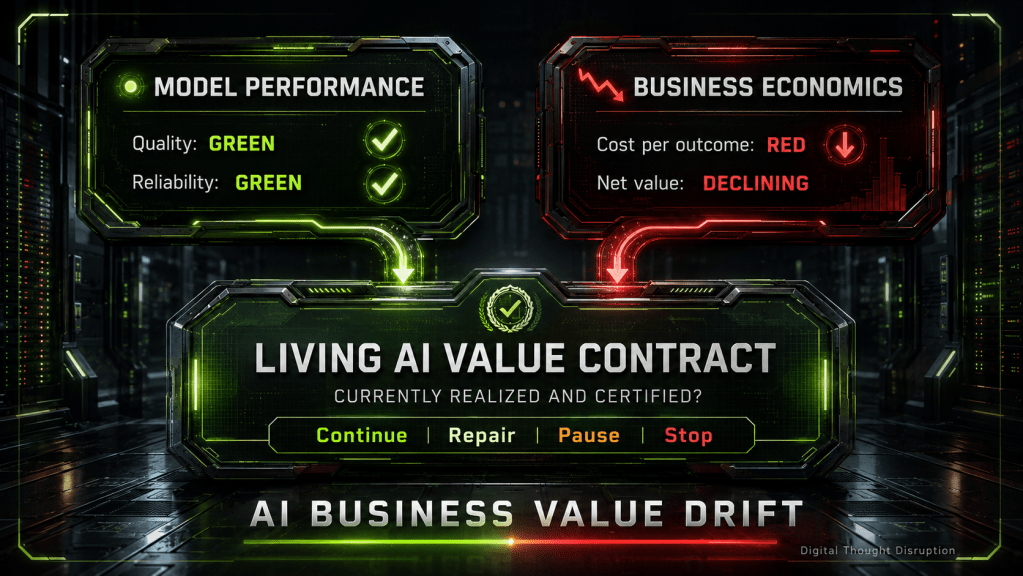
An AI system can remain technically healthy while its business case deteriorates. Provider pricing can change. Prompts can grow. Retries and tool calls can multiply. More cases can require human review. The workflow can absorb lower-value or more complex work. Controls can become more expensive. None of those changes must cause an obvious decline in model quality, yet all of them can push cost per successful outcome beyond the approved business case.
The practical response is a living AI value contract: a versioned record that names the outcome unit, baseline, complete cost per outcome, benefit treatment, quality and risk thresholds, evidence sources, certification period, material-change triggers, and business process owner responsible for reopening the assessment. The AI team supplies the evidence. It does not grade its own business case.
Introduction
An AI use case can pass its pilot, reach production, and deliver measurable value in its first month.
By month four, the model may still meet its quality target. Users may still be active. The workflow may still appear healthy on the operations dashboard. Latency is acceptable. Error rates are controlled. Evaluations remain within tolerance.
But the provider has changed its pricing. Prompts contain more context. Retry rates have increased. The agent now makes more tool calls. More cases require human review. The workflow is handling a more difficult mix of requests, and downstream teams are correcting work that the original pilot did not include.
Nothing has technically failed.
The ROI has.
This is the weakness in treating realized AI value as a permanent state. AI systems do not hold still after deployment. Models change, providers change, workflows expand, user behavior shifts, controls mature, case mix changes, and previously hidden support work becomes visible. A business case that was credible at launch can become stale while the technical service remains green.
The earlier Digital Thought Disruption article, Why AI ROI Is Stalling: A CEO and CIO Guide to Turning Pilots into Operating Results, focused on proving value before an organization scales an AI investment. This follow-up begins where that gate ends: what happens after the use case reaches production and the organization quietly assumes that the approved business case will remain valid.
The monitoring disciplines already contain many of the required pieces. NIST’s AI Risk Management Framework playbook treats post-deployment tracking of risks and benefits as a lifecycle responsibility. Microsoft’s generative AI observability guidance covers production signals such as token consumption, latency, errors, quality, and model and tool traces. Google Cloud and the FinOps Foundation extend the economic side through continuous cost-and-return monitoring, assigned owners, fully loaded unit metrics, and business outcome measures beyond tokens.
The operational gap is the control that joins those disciplines and asks a recurring question:
Does this production AI use case still create enough risk-adjusted business value to justify its complete cost?
The answer should not be assumed because the use case cleared a funding gate once. It should be observable, owned, time-stamped, and open to revocation.
AI Business Value Drift Is a Production Risk
For this article, I use AI business value drift to mean:
The material divergence between an AI use case’s certified business case and its current economic, operational, or risk-adjusted performance.
The word material matters. Normal variation does not require an executive review every time token use moves or a weekly outcome rate changes. Each organization must define local thresholds that distinguish ordinary operating noise from a change significant enough to challenge the certified value case.
The definition also carries three important guardrails.
First, business value drift can occur while model quality remains stable. The system can continue to produce acceptable answers while the complete cost of those answers rises beyond the approved ceiling.
Second, value drift is not limited to spend. It can affect benefit, risk, operating burden, and attribution. A use case may cost the same but create less value because automation declines, users reject more outputs, downstream rework grows, or the baseline no longer reflects the process being measured.
Third, realized value expires when the evidence supporting it is no longer current or comparable. That does not automatically mean the use case should be stopped. It means the organization no longer has sufficient evidence to keep calling the original business case realized without reopening it.
This is why currently realized and certified is a more accurate production status than simply successful. It describes a condition that remains true only while the evidence remains valid.
Realized AI Value Is Not Permanent
The initial AI business case is a set of linked assumptions. It may look like a single ROI number in an approval document, but underneath that number are technical, operational, financial, and risk conditions that can change independently.
| Original business-case dependency | What can change in production | Effect on the value claim |
|---|---|---|
| Provider, model, and commercial terms | Repricing, model substitution, discount expiration, regional or service-tier changes | Execution cost changes without a workflow redesign |
| Prompt, context, and retrieval design | Longer system instructions, larger histories, additional retrieved content, more validation calls | Cost and latency rise even when response quality holds |
| Expected retry and tool-call behavior | More transient failures, loops, tool retries, verification steps, or multi-agent handoffs | One business transaction consumes more AI executions |
| Workflow volume and case mix | Harder cases enter the system, seasonal demand changes, low-value work expands | The original average no longer represents current work |
| Automation, acceptance, or deflection rate | More exceptions, user rejection, human escalation, or downstream correction | Benefit per transaction falls while activity remains high |
| Human-review requirement | Review expands because risk, quality, or policy concerns increase | Labor cost and completion time rise outside model billing |
| Quality and risk threshold | Customer expectations, loss exposure, policy, or regulatory requirements change | The same output may require stronger controls or no longer be acceptable |
| Financial baseline | Staffing, vendor, product, service-level, demand, or accounting treatment changes | The comparison point becomes less credible |
This is not unique to AI. Any production investment can suffer from changing costs, demand, process design, and assumptions. AI makes the problem easier to miss because the technical system can change through configuration, provider behavior, context growth, agent loops, routing, retrieval, and controls without a conventional application release.
The business case therefore needs a validity boundary. It should say which workflow, population, period, provider arrangement, outcome definition, cost scope, and risk posture were certified. When a material part of that boundary changes, the original conclusion should be reopened rather than silently carried forward.
Model Drift and Business Value Drift Are Different Problems
Model drift asks whether the AI system’s technical behavior, performance, or quality has changed. Depending on the use case, teams may monitor accuracy, groundedness, safety, reliability, latency, refusal behavior, tool-selection quality, or other evaluation measures.
Business value drift asks whether the entire workflow still produces enough risk-adjusted benefit to justify its complete cost.
Those questions are related, but they are not interchangeable. The following diagram shows why two independently governed paths are required.
The important state is the bottom one. A model dashboard can remain green while the economic case has turned red.
| Technical state | Business-value state | Operational interpretation |
|---|---|---|
| Green | Green | The use case remains within its technical and value contract |
| Red | Green | The workflow may still be valuable, but quality or risk requires immediate repair or containment |
| Green | Red | The model still works, but cost, benefit, risk, or attribution no longer supports the certified case |
| Red | Red | Both technical fitness and business justification require reopening; pause or stop may be appropriate |
The third state is the one many governance models miss. Technical operations may see no incident. The model team may have no quality regression to report. Users may still complete work. Yet the organization is spending more, receiving less, carrying more risk, or relying on an invalid baseline.
A production AI scorecard should therefore preserve two separate statuses:
- Technical fitness: Is the system behaving within approved quality, reliability, safety, and performance thresholds?
- Business certification: Is the use case still producing sufficient risk-adjusted value under a current and comparable baseline?
Neither status should be allowed to substitute for the other.
The Four Forms of AI Business Value Drift
Business value drift usually appears through more than one mechanism. Separating the mechanisms helps teams diagnose the cause instead of treating every unfavorable variance as a model-cost problem.
Cost Drift
Cost drift occurs when the complete cost of producing the same outcome rises.
Provider repricing is the obvious example, but it is not the only one. A prompt can accumulate more policy text, conversation history, retrieved documents, examples, and tool schemas. An agent can take additional turns or retry a tool more often. A validation step can become a second model workflow. Observability, evaluation, storage, security, and compliance controls can add legitimate operating cost. Human reviewers can spend more time resolving exceptions.
The complete cost path should include more than the model invoice. It may include:
- model and inference consumption
- retrieval, vector, search, and data-processing services
- tool and API consumption
- orchestration and platform services
- observability, tracing, evaluation, and evidence retention
- human review, escalation, and exception handling
- downstream rework and correction
- support, incident, and reliability effort
- security, privacy, compliance, and audit controls
- allocated shared platform and enterprise service costs
A team that reports only token spend can optimize the smallest visible part of the workflow while missing the labor and operational cost created around it.
Outcome Drift
Outcome drift occurs when the workflow continues to operate but the business value of its output declines.
A customer-service assistant may still answer questions accurately while deflecting fewer contacts. A coding assistant may generate more suggestions while fewer changes are accepted without material rework. A document-processing system may continue extracting fields while exception rates rise. A sales assistant may create more leads but fewer qualified opportunities.
Common causes include lower user acceptance, more exceptions, reduced automation, a shift toward lower-value work, downstream bottlenecks, or a change in customer behavior. Activity can remain high while useful outcomes fall.
This is why usage is not value. Requests, active users, tokens, outputs, and completed agent runs describe system activity. They do not prove that the workflow produced the business outcome for which it was funded.
Risk and Control Drift
Risk and control drift occurs when the cost or exposure associated with operating the AI system changes.
A workflow may be granted broader authority. It may begin handling more sensitive data. A new incident may justify additional human approval. Policy may require stronger evaluation, evidence retention, access controls, or oversight. The potential loss from an incorrect action may increase as the system moves from recommendation to execution.
The model can be just as accurate as it was before while the acceptable operating boundary becomes narrower or more expensive.
Risk must therefore be part of the value equation rather than a separate dashboard reviewed after the financial case has been approved. A use case that saves time but creates a larger expected loss, control burden, or remediation exposure may no longer have the same risk-adjusted value.
Attribution Drift
Attribution drift occurs when the baseline no longer supports a credible comparison.
The surrounding process may have been redesigned. Workforce levels may have changed. A vendor may have been replaced. Customer demand may be seasonal. Product mix, pricing, service levels, staffing, or accounting treatment may have shifted. Another automation initiative may now be producing part of the measured improvement.
A changing baseline does not prove the AI use case failed. It proves that the original attribution method may no longer be valid.
The correct response is not to preserve the old comparison because it produces a favorable result. The organization should version the baseline, explain what changed, choose an updated comparison method, and report the confidence and limitations of the new estimate.
Cost per Outcome Is the Connecting Metric
Engineering teams need low-level consumption metrics. Tokens, requests, model tiers, cache hits, tool calls, retries, GPU time, latency, and trace spans are necessary for diagnosis and optimization.
Executives and business owners need a different unit. They need to know what it costs to produce a successful business outcome.
The chain matters because an inexpensive model call can still produce an expensive outcome. A smaller model may create more retries. A narrower context may reduce one execution’s cost but increase errors and human review. A low-cost agent path may fail more often and require escalation to a stronger model. A more expensive model may have better unit economics if it reduces repeated calls, rework, delay, or customer friction.
A practical calculation is:
Complete cost per successful outcome = complete attributable workflow cost divided by the number of successful outcomes.
The numerator should include the cost categories that materially support the workflow. The denominator should count outcomes that meet the agreed completion and quality conditions, not every execution that reached a terminal state.
Examples include:
- cost per support case resolved without avoidable escalation
- cost per invoice processed without material exception
- cost per qualified sales opportunity accepted by the sales process
- cost per code change accepted without material rework
- cost per claim correctly routed and completed
- cost per incident successfully contained
- cost per customer retained through the supported workflow
A second calculation makes the value decision explicit:
Risk-adjusted net value per outcome = verified benefit per outcome minus complete cost per successful outcome minus expected risk cost per outcome.
That equation does not require false precision. Benefit and expected risk can be reported as ranges with assumptions and confidence levels. The purpose is to prevent visible cloud or model spend from becoming the entire economics discussion.
Protect the Denominator
Cost per outcome can be manipulated unintentionally through a weak denominator. Teams may count every drafted answer as a success even when a person rewrites it. They may count resolved cases without separating those that reopened. They may compare a pilot’s routine cases with a production population containing more complex work.
The outcome definition should specify:
- the business event that counts as success
- required quality and control conditions
- the eligible population
- exclusion rules
- the measurement window
- treatment of retries, rework, reopening, and abandonment
- treatment of human-assisted and fully automated outcomes
- segmentation by case type or consequence where economics differ materially
Measure distributions as well as averages. Median cost can describe the normal path, while high-percentile cost can expose runaway agent loops, hard cases, or repeated human intervention. A single blended average can hide a small population consuming a disproportionate share of spend.
Make Shared Cost Allocation Explicit
AI workflows frequently use shared retrieval services, evaluation platforms, gateways, observability, security controls, and platform teams. Those costs should not disappear merely because they are not charged directly to the use case.
The allocation method does not need to be perfect, but it needs to be consistent, documented, and validated by Finance or FinOps. A charge based on requests, compute time, active workflows, storage, or another driver may be appropriate depending on the service. The important point is that the business owner sees a complete enough cost to make a responsible decision.
Replace the Static Business Case With a Living AI Value Contract
A static business case is usually optimized for approval. A living AI value contract is optimized for continued operation.
The contract does not replace the financial model, architecture record, risk assessment, or production telemetry. It connects them. It tells the organization which outcome is being purchased, which evidence proves it, which assumptions bound the conclusion, when the certification expires, and who must act when conditions change.
The following vendor-neutral YAML illustrates the minimum structure. Every threshold and value is intentionally a placeholder. There is no universal percentage that makes an AI use case valuable or safe.
use_case: id: customer-service-assist status: currently-realized-and-certified outcome_unit: resolved-customer-case scope:ownership: business_process_owner: finance_validator: platform_evidence_owner: risk_validator: recertification_owner: executive_escalation: baseline: version: effective_date: measurement_period: population: comparison_method: valid_until: economics: benefit_per_successful_outcome: complete_cost_per_successful_outcome: maximum_cost_per_successful_outcome: shared_cost_allocation_method: confidence: guardrails: minimum_quality: maximum_retry_rate: maximum_human_review_minutes: maximum_rework_rate: maximum_control_exception_rate: evidence: outcome_source: cost_source: telemetry_source: last_refreshed: evidence_owner: certification: last_certified: valid_until: decision: reopen_triggers: - material_model_or_provider_change - pricing_or_commercial_change - cost_per_outcome_threshold_breach - workflow_volume_or_case_mix_change - retry_or_tool_call_change - human_review_or_rework_breach - quality_or_risk_threshold_breach - baseline_no_longer_comparable decision_options: - scale - continue - repair - pause - stop
This is a governance schema, not a decorative configuration file. The organization should store it in a controlled registry or repository, version it with material architecture and workflow changes, and connect its evidence fields to authoritative systems wherever possible.
The reader should modify the outcome unit, scope, comparison method, allocation model, thresholds, evidence sources, review period, and decision authority. Successful implementation means an operating review can reconstruct the current value claim from traceable evidence without asking the AI team to create a one-off presentation.
What can go wrong is equally important. The contract can become paperwork if evidence remains manual, ownership fields contain committees instead of named roles, thresholds have no action attached, or certification dates pass without consequence. A living contract must influence funding, scale, change approval, and stop decisions or it is not a control.
Re-Certification Should Be Event-Driven
Annual reviews are too slow for a production AI system that can change through provider updates, model routing, pricing, prompt configuration, retrieval, tool behavior, policy, workload mix, or organizational process changes.
A mature control model uses both scheduled and event-driven review.
- Scheduled review confirms at a defined cadence that evidence remains current, thresholds remain appropriate, and the baseline is still comparable.
- Event-driven review reopens the value contract when a material model, provider, cost, workflow, outcome, quality, risk, or baseline change occurs.
The operational flow should be explicit.
Three trigger classes are useful in practice.
Threshold Breach
A measured condition crosses a locally approved boundary. Examples include complete cost per outcome, automation rate, review minutes, retry rate, rework, control exceptions, quality, reliability, or expected loss.
The first breach may trigger investigation rather than an immediate shutdown. The contract should state whether action occurs on a single event, a sustained interval, a statistical trend, or repeated failures. That prevents both alert fatigue and indefinite tolerance of a deteriorating case.
Structural Change
The system or operating context changes in a way that makes previous evidence less representative. Examples include a new model or provider, new commercial terms, a major prompt or retrieval redesign, additional tool authority, expansion to a new population, workflow integration, or a different human-review model.
A structural change can require reopening even when no threshold has yet been breached. The concern is comparability: the organization may be operating a materially different system from the one that was certified.
Evidence Invalidation
The baseline, outcome source, attribution method, allocation rule, or measurement pipeline is no longer trustworthy. This is a control failure in its own right. The use case may still be valuable, but its certified status should be suspended or qualified until the evidence is repaired.
Re-certification should end with an explicit decision. Continue means no material correction is required. Scale means the evidence supports broader investment. Repair means the use case remains potentially valuable but requires changes and a new validation period. Pause limits exposure while evidence or controls are restored. Stop retires the workflow because the value case no longer supports continued operation.
The Ownership Model Is Where the Framework Lives or Dies
A value contract without an owner becomes a shared document that everyone can observe and no one must reopen.
The accountable role should normally be the business process owner. That person already owns the workflow’s service level, staffing, budget, exceptions, operating outcomes, and process design. Re-certification belongs with the role that can change those conditions, not with the team that operates the model.
| Role | Primary responsibility in value certification | Boundary that preserves independence |
|---|---|---|
| Business process owner | Own the intended outcome, decide when the assessment is reopened, and choose scale, continue, repair, pause, or stop | Cannot rely on unvalidated benefit assumptions or ignore threshold breaches |
| Finance or FP&A | Validate the baseline, benefit treatment, allocation, attribution, confidence, and recognized economic value | Does not own model quality or workflow telemetry generation |
| AI platform or engineering team | Supply model versions, usage, retries, tool calls, latency, failures, traces, evaluations, and cost evidence | Does not approve its own business case |
| Risk, security, privacy, or governance | Validate material changes in authority, controls, exposure, exceptions, and residual risk | Does not substitute risk avoidance for the business decision |
| Executive sponsor | Resolve cross-functional disputes, approve major exceptions, and exercise escalation or stop authority | Should not become the day-to-day evidence owner |
The governing principle is simple:
The AI team supplies evidence. It does not grade its own business case.
This protects both sides. The platform team should not be blamed for a business process whose benefit was never defined, and the business owner should not be allowed to preserve an ROI claim by treating model usage as proof of value.
Do Not Create a Separate AI Value Owner by Default
A central AI value office may sound cleaner than distributed ownership, but it can weaken accountability. A central group usually cannot redesign the customer-service workflow, change staffing, alter service levels, narrow the eligible population, accept operational risk, or stop a process owned by another executive.
Central AI, Finance, FinOps, and governance teams should provide standards, telemetry, validation, challenge, and portfolio visibility. They should not become substitute owners for business outcomes they cannot directly change.
The practical staffing model is to attach re-certification to existing process ownership and make four conditions non-negotiable:
- The accountable role is named, not represented by a committee or department.
- The role has authority to change workflow scope, budget, staffing, provider choice, escalation, or operating design.
- Evidence is refreshed through normal platform and business telemetry rather than quarterly spreadsheet reconstruction.
- Continued scale funding requires an active owner and a current certification.
A strong funding gate is:
If no business process owner accepts accountability for reopening the value assessment, the use case does not receive continued scale funding.
That rule is intentionally uncomfortable. It prevents organizations from funding AI as a technical asset while leaving the claimed business outcome ownerless.
Illustrative Scenario: A Customer-Service AI Assistant
Consider a customer-service AI assistant that summarizes case history, retrieves approved guidance, drafts a response, and recommends a resolution path.
At initial certification, Finance validates the baseline. The business owner confirms the eligible case population and outcome definition. The model exceeds the approved quality threshold. Handling time declines. Routine cases are deflected or completed faster. Human review remains within the designed limit. Complete cost per resolved case supports the business case.
Four months later, the operational picture has changed.
| Value-contract element | Initial certification | Four months later |
|---|---|---|
| Model quality | Above approved threshold | Still above approved threshold |
| Prompt and retrieved context | Within designed envelope | Expanded to cover more policy and case history |
| Retries and tool calls | Stable | Increasing for complex requests |
| Human review | Within approved limit | More cases and more minutes per case |
| Automation or deflection | Supports the baseline | Declining as harder cases enter the workflow |
| Downstream rework | Limited | More corrections by senior agents |
| Complete cost per resolved case | Below approved ceiling | Above approved ceiling |
| Certification status | Currently realized and certified | Reopen required |
The technical dashboard can remain green throughout this change. Quality has not crossed its threshold. The service is available. Users are active. The assistant still produces acceptable responses.
The correct response is not to declare a technical success and move on. It is to reopen the value contract and identify the cause of the economic divergence.
Possible repair actions include narrowing the eligible case population, routing routine work to a lower-cost path, reserving stronger models for complex cases, reducing repeated context, fixing tool failures, redesigning review criteria, improving retrieval, removing low-value workflow steps, renegotiating commercial terms, or changing the service promise.
The organization may also conclude that the more complex case mix creates enough additional benefit to justify a higher cost ceiling. That is a valid decision only if the new benefit, baseline, risk, and scope are explicitly re-certified. Moving the threshold after a breach without changing the underlying value evidence is not re-certification. It is target manipulation.
A Practical 30-Day Implementation Path
A company does not need a new enterprise platform before it can begin. It needs one measurable production workflow, a credible owner, and enough telemetry to connect cost to outcome.
| Period | Action | Deliverable and exit condition |
|---|---|---|
| Days 1–5 | Inventory production AI use cases claiming realized value | List the business process, owner, baseline, outcome unit, evidence source, current cost scope, and last certification date for each use case |
| Days 6–10 | Select one high-value, high-volume workflow | Choose a use case with measurable outcomes, visible AI consumption, material economics, and an owner able to change the process |
| Days 11–17 | Instrument the complete outcome path | Connect provider billing, requests, tokens, model routes, retries, tool calls, workflow completion, human review, rework, and the business system of record |
| Days 18–23 | Define the first value contract | Approve the baseline version, successful-outcome definition, cost allocation, local thresholds, evidence owners, validity period, and reopen triggers |
| Days 24–30 | Run the first re-certification | Recalculate complete cost and risk-adjusted value per outcome, document confidence and variance, and record a scale, continue, repair, pause, or stop decision |
Start With an Inventory, Not a Dashboard
The first question is not which visualization tool to buy. It is which production use cases are currently described as valuable and what evidence supports that status.
For each use case, capture the business process, accountable owner, certified baseline, outcome unit, complete cost scope, technical and risk thresholds, last certification date, and evidence location. Missing fields are findings. A use case with no owner, no outcome unit, or no current baseline is not ready for value certification regardless of how mature its model dashboard appears.
Select One Workflow With a Measurable Boundary
Choose a use case with enough volume to observe, an identifiable population, visible consumption, a meaningful outcome, and an owner with authority. Avoid beginning with a broad enterprise assistant whose benefits are diffuse and whose use spans many unrelated tasks.
A narrow workflow produces a better first implementation because cost, outcome, human intervention, and case mix can be connected without pretending that every interaction has the same value.
Instrument From Execution to Outcome
The telemetry chain should connect technical events to the business system of record. Traces should show model routes, tool calls, retries, latency, failures, and token or compute consumption. Workflow records should show completion, exception, escalation, review, and rework. Business data should show whether the intended result occurred.
No single team will own all of those systems. The implementation therefore needs stable identifiers that allow an execution, workflow instance, review event, and business outcome to be joined without copying sensitive content into every analytics platform.
Establish Materiality Without Creating Alert Fatigue
Thresholds should be sensitive enough to detect a deteriorating case before the next annual budget cycle but stable enough to avoid reopening the contract for normal variance.
Use representative production data to define the first limits. Consider sustained breaches, trends, confidence intervals, case-type segmentation, and high-percentile behavior. Document which triggers require investigation, which require immediate reopening, and which require pause or containment.
Make the First Decision Explicit
The first re-certification is valuable even when it confirms the existing business case. It exposes whether cost allocation is complete, outcome data is trustworthy, ownership is real, and evidence can be refreshed without a special project.
The output should be a recorded decision with a date, evidence period, baseline version, known limitations, next scheduled review, and event triggers. “Continue monitoring” is not a decision unless the contract states what is being monitored, by whom, and what will happen when a threshold changes.
Risks and Caveats
A value-assurance framework can create its own failure modes. The control should remain proportional to the consequence and economics of the use case.
Excessive Governance
Reopening every contract for minor variation will create delay, alert fatigue, and incentives to suppress telemetry. Materiality thresholds should focus attention on changes that can alter the decision, not every fluctuation that can be measured.
Low-cost, low-risk drafting tools may need a lighter review cadence than systems that approve transactions, change customer records, make high-value recommendations, or control technical infrastructure. The framework should scale with spend, authority, exposure, and reversibility.
False Precision
Some AI benefits cannot be reduced to a single exact dollar value. Better decision quality, faster access to context, improved consistency, or reduced risk may require ranges, proxy measures, sensitivity analysis, and confidence statements.
A transparent range is more credible than a precise number built on weak attribution. The contract should show assumptions and identify which changes would materially alter the conclusion.
Ownership Without Authority
Naming a business process owner is insufficient if that person cannot change the workflow, budget, staffing, provider, scope, or service level. Accountability without authority turns re-certification into escalation theater.
The role should have direct decision rights or a defined executive path that can act within the review period. Repeated inability to remediate a breached contract is itself evidence that the operating model is not fit for scale.
Cost Optimization That Harms Outcomes
Reducing token use, switching models, limiting context, or removing review can lower one cost line while increasing errors, retries, escalations, customer friction, or expected loss.
Optimize the complete risk-adjusted value per outcome, not the cheapest model call. Every cost change should be evaluated against accepted outcomes, high-percentile failures, review demand, rework, and control performance.
Baseline Manipulation
A team can preserve a favorable ROI claim by redefining the comparison population, excluding difficult cases, moving shared costs elsewhere, shortening the measurement window, or changing the outcome definition after results are known.
Finance validation and baseline versioning are safeguards against this behavior. A changed baseline may be legitimate, but the reason, method, impact, and confidence should be visible. The old and new conclusions should not be blended as though they were directly comparable.
Conclusion
AI value is not something an organization proves once. It is something the organization must remain capable of proving.
A production AI use case should retain its realized status only while the underlying baseline, economics, outcomes, quality, risk, and operating assumptions remain valid. When those conditions change materially, the burden should remain on the organization to reopen the contract and demonstrate that the value still exists.
The practical control is not another isolated AI dashboard. It is a living value contract connected to technical telemetry, business outcomes, fully loaded cost, financial validation, risk evidence, material-change triggers, and an accountable business process owner. That contract should produce an explicit scale, continue, repair, pause, or stop decision.
The phrase currently realized and certified keeps the burden of proof where it belongs. It acknowledges that production value is conditional, time-bound, and revocable.
An AI system should not remain classified as valuable because it cleared a gate once. The business case must remain observable, owned, and open to revocation.
