



TL;DR
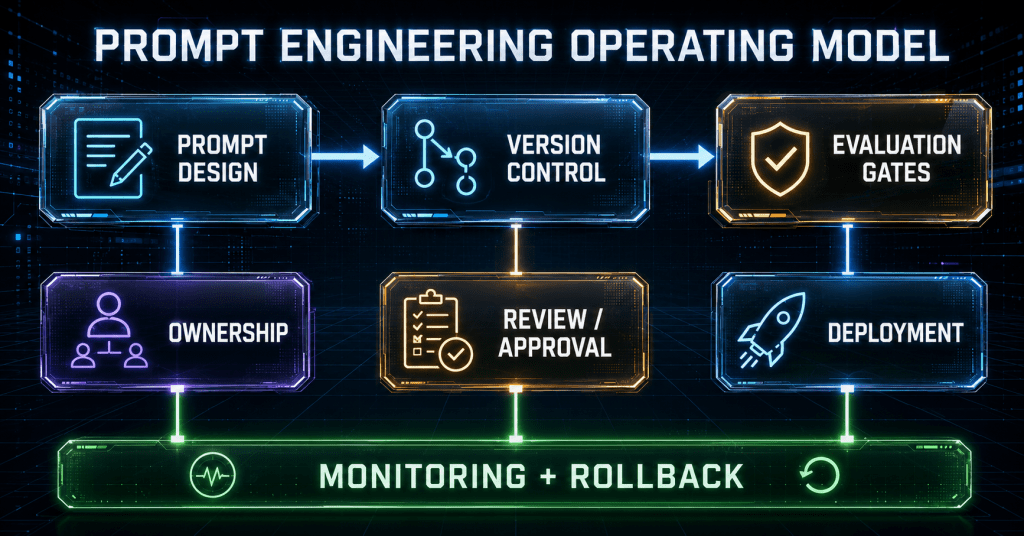
Prompt engineering becomes an enterprise operating model when prompts influence production behavior. Prompts need owners, versions, review gates, evaluation tests, deployment controls, monitoring, and rollback. A prompt that controls support answers, tool use, routing, security behavior, or customer communication should be treated like production logic, not a note in a shared document.
Introduction
Prompt engineering is often treated like clever wording. That is fine for experimentation. It is not enough for enterprise operations.
When prompts influence customer responses, internal decisions, workflow routing, summarization, code generation, or agent tool use, prompts become production artifacts. They need ownership, versioning, review, testing, deployment, monitoring, and rollback.
The practical shift is this: prompt engineering should move from individual technique to operating model.
Why the Concept Matters in Enterprise Practice
An enterprise prompt is not only a message sent to a model. It is a control surface. It shapes how the AI interprets user intent, handles evidence, refuses unsafe requests, formats output, uses tools, and escalates uncertainty.
That means prompt changes can create incidents just like code changes. A small wording change can affect refusal behavior, citation discipline, tool selection, or output structure.
If prompts are copied between notebooks, pasted into low-code tools, and modified without traceability, the organization will eventually lose control of its AI behavior.
Prompt Lifecycle at a Glance
The diagram below shows prompts as managed artifacts moving through a delivery lifecycle. The important point is that prompt design is only one step. Testing, review, deployment, monitoring, and rollback are part of the same control path.
This lifecycle is not bureaucracy. It is how AI behavior becomes supportable.
Prompt Risk Map
Not every prompt needs the same level of governance. A personal brainstorming prompt does not require the same operating model as a prompt that controls customer communication or agent tool selection. The diagram below shows a practical risk ladder.
Prompt Governance Map

Low risk
  - brainstorming
  - personal drafting
  - internal formatting

Medium risk
  - internal summaries
  - knowledge assistant responses
  - support recommendations

High risk
  - customer-facing responses
  - security or compliance guidance
  - agent tool selection

Critical risk
  - privileged actions
  - production remediation
  - access changes
Governance should match impact. The mistake is treating all prompts as harmless text.
Separate Prompt Template from Runtime Context
A production prompt should separate stable instructions from runtime variables.
Stable instructions include:
- assistant role
- task boundaries
- evidence requirements
- citation rules
- refusal behavior
- output format
- escalation conditions
Runtime variables include:
- user question
- user role
- retrieved context
- environment
- service name
- tool results
- conversation history
This separation makes prompts easier to test and reduces the risk of mixing policy with transient user input.
A prompt template should be stable enough to version and review. Runtime context should be injected in a controlled way so the assistant can use current evidence without allowing user input or retrieved text to silently override system behavior.
Version Prompts Like Code
Every production prompt should have:
- owner
- version
- changelog
- intended use case
- model compatibility notes
- required tools
- required retrieval behavior
- evaluation results
- rollback version
A prompt update should not be a silent edit in a UI. It should be a controlled change.
Versioning also gives operations teams a way to answer a basic incident question: what prompt version produced this behavior? Without that answer, troubleshooting becomes archaeology.
Use Evaluation Gates
Prompt evaluation should include more than happy-path examples.
| Test Type | What It Catches |
|---|---|
| Golden answer tests | Incorrect or incomplete answers |
| Citation tests | Unsupported claims or weak grounding |
| Format tests | Output structure regressions |
| Refusal tests | Unsafe or unsupported responses |
| Role tests | Access-control and persona errors |
| Adversarial tests | Prompt injection and instruction conflicts |
| Tool-selection tests | Wrong action or excessive agency |
A prompt that cannot pass regression tests should not be promoted.
The evaluation suite does not need to be perfect on day one. It needs to exist, grow from incidents, and become part of the deployment path. Each real failure should become a future test case.
Make Prompt Ownership Explicit
Prompt ownership should not default to whoever wrote the first version. Ownership depends on what the prompt controls.
| Prompt Type | Likely Owner |
|---|---|
| IT runbook assistant prompt | Platform operations |
| Security policy assistant prompt | Security governance |
| Customer support answer prompt | Support operations |
| Agent tool-selection prompt | Platform engineering or AI platform team |
| Content generation prompt | Editorial or communications owner |
The AI platform team may provide standards and tooling, but domain owners must own domain behavior.
This is especially important for prompts that interpret policy, summarize operational evidence, recommend escalation, or decide whether a tool should be called. The AI team may know the platform, but the domain owner understands the consequences.
Example Prompt Manifest
A simple manifest can bring discipline to prompt management. This example is intentionally lightweight and can be adapted to Git, CI/CD, or an internal AI platform.
prompt_manifest:
  id: platform-runbook-answer-v1
  owner: platform-operations
  status: production
  version: 1.3.0
  model_profile: approved-enterprise-chat
  retrieval_required: true
  citation_required: true
  allowed_tools:
    - search_runbooks
    - create_ticket_draft
  blocked_actions:
    - execute_remediation
    - grant_access
  output_format: markdown
  escalation_rules:
    - missing_evidence
    - production_change_requested
    - user_reports_outage
  eval_suite:
    golden_tests: 42
    adversarial_tests: 18
    format_tests: 12
  rollback_version: 1.2.4
This is not about creating paperwork. It is about making the prompt observable, reviewable, and reversible.
Governance Considerations
Prompt governance should define:
- who can create prompts
- who can approve production prompts
- which prompts require security review
- how prompt changes are tested
- how prompt versions map to model deployments
- how prompt incidents are reported
- how retired prompts are archived
Prompt libraries are useful only if they are curated. A folder full of outdated prompts becomes another source of operational risk.
Governance should also cover tool-connected prompts. If a prompt influences tool use, the prompt is part of the execution boundary. That means it should be reviewed alongside tool permissions, policy gates, approval behavior, and audit requirements.
Practical Implementation Notes
Start with the prompts that control production-facing behavior. Do not try to govern every experimental prompt on day one.
A practical sequence looks like this:
- inventory prompts used in production or near-production systems
- classify prompts by risk and business function
- move high-risk prompts into version control
- add a manifest for owner, version, model, tools, and evaluation suite
- build a small regression test set
- require review before promotion
- monitor failures and feed them back into tests
This is prompt engineering as platform practice.
Operational Signals to Monitor
Prompt operations should monitor more than whether the system is online. The team should inspect behavioral signals.
Useful signals include:
- unsupported claims
- missing citations
- refusal rate changes
- handoff rate changes
- repeated formatting failures
- tool-selection errors
- user corrections
- incident-linked prompt versions
- latency changes after prompt updates
- evaluation regressions
A prompt can fail even when the application is healthy. That is why prompt observability needs to focus on behavior, not only infrastructure.
When Prompt Engineering Is Not Enough
Prompting cannot fix every issue. A prompt may be blamed when the real problem is weak retrieval, missing metadata, broad permissions, unclear workflow ownership, poor tool contracts, or incomplete policy design.
Before rewriting the prompt, ask:
- Did the system retrieve the right evidence?
- Did the user have the right access?
- Was the tool contract clear?
- Was the task too broad?
- Was the escalation path missing?
- Was the prompt asked to compensate for unmanaged content?
Prompt engineering is powerful, but it is not a substitute for architecture.
Conclusion
Prompt engineering is still a craft, but enterprise prompt engineering must also be an operating model.
The organization needs prompt templates, version control, evaluation gates, ownership, deployment discipline, telemetry, and rollback. Without those controls, prompts become invisible production logic.
Treat prompts like governed artifacts, and AI systems become easier to trust, troubleshoot, and improve.
External References
