



Introduction
Multicloud is often treated as a resilience shortcut. The argument sounds reasonable: if one cloud provider fails, workloads can continue in another. A second provider appears to remove concentration risk, reduce dependence on one vendor, and create an escape path from a major outage.
That conclusion is only valid when the application, data, traffic, identity, security, deployment, and operating model can survive the failure independently. In many real environments, the second cloud hosts idle infrastructure while the same DNS provider, identity provider, certificate process, software-as-a-service control plane, network hub, deployment pipeline, database authority, or incident team remains a shared dependency. The architecture has two providers, but it still has one failure path.
Recent cloud incidents reinforce the point. A 2025 AWS disruption began with a DNS-management defect affecting DynamoDB in the US-EAST-1 Region and cascaded into dependent services. A 2025 Azure Front Door incident produced connection timeouts and DNS-resolution problems across multiple regions and affected customer workloads, management portals, and other Microsoft services. A July 2025 Google Cloud incident affected multiple products in a single region. These events do not prove that multicloud is always necessary. They prove that architects must identify the actual failure domain rather than infer resilience from the number of provider logos in a diagram [8]-[10]. The three community threads supplied as starting sources are useful records of practitioner-visible symptoms and concerns, but the official incident reports remain the authority for the technical causes and timelines [20]-[22].
TL;DR
Multicloud does not create resilience by itself. It can reduce provider-level concentration risk when the business has a defined need to survive a provider-wide or provider-specific failure and is willing to fund independent traffic management, data protection, identity, deployment, observability, staffing, and recovery testing. For most applications, multi-zone or multi-region design within one provider is the more practical first step because it addresses common infrastructure failures without duplicating every operational plane.
The deciding evidence is not cloud count. It is whether the service repeatedly meets its RTO and RPO while preserving data integrity during tested failures of regions, providers, traffic services, identity systems, network paths, deployment tools, and shared SaaS dependencies.
The Provider-Counting Fallacy
A service running in two clouds is not necessarily a resilient service. It might be a distributed service with twice the number of configuration surfaces and more ways to fail.
The provider-counting fallacy begins when an organization substitutes a topology statement for a recovery claim:
- “We use two cloud providers” becomes shorthand for “we can survive a cloud outage.”
- “The application runs in Kubernetes” becomes shorthand for “the application is portable.”
- “The infrastructure is defined in Terraform” becomes shorthand for “we can redeploy anywhere.”
- “The database replicates” becomes shorthand for “we can fail over without data loss.”
- “We have global DNS” becomes shorthand for “traffic will move correctly.”
Each statement describes a capability, not an outcome. Resilience exists only when those capabilities operate together under failure and produce an acceptable service result.
A defensible resilience claim should answer five questions:
- Which failure are we designing to survive? A process crash, availability-zone loss, regional outage, provider control-plane failure, identity outage, network partition, data corruption, or provider-wide loss are different events.
- What service state must remain available? Read-only service, degraded transactions, full read/write service, administrative access, and customer access are not equivalent.
- What are the measured RTO and RPO? Recovery expectations must be expressed in business time and data-loss terms, not architecture adjectives.
- Which dependencies remain outside the protected boundary? DNS, identity, certificates, secrets, observability, support portals, deployment systems, and third-party APIs often sit outside the application topology.
- What test evidence proves the claim? A design review, a successful infrastructure deployment, and a database replica status page do not prove end-to-end recovery.
Microsoft’s current disaster-recovery guidance explicitly frames DR as a structured, tested, and documented plan aligned with recovery targets. AWS similarly distinguishes backup and restore, pilot light, standby, and active-active patterns by cost, complexity, and recovery behavior. Those models are useful because they connect investment to measurable recovery outcomes [1], [4].
Multi-Region and Multicloud Solve Different Problems
Multi-region and multicloud are related, but they protect against different scopes of failure.
A multi-zone design primarily protects against failures inside one region. A multi-region design protects against a regional failure while retaining one provider’s service model, identity structure, network constructs, observability platform, deployment semantics, and support boundary. A multicloud design can protect against a provider-specific failure, but only if the implementation avoids shared dependencies that preserve the original failure domain.
| Architecture | Primary failure scope addressed | Main advantage | Main limitation | Typical operational burden |
|---|---|---|---|---|
| Single region, multi-zone | Host, rack, zone, localized infrastructure | Lowest complexity for meaningful infrastructure redundancy | Region and provider dependencies remain | Moderate |
| Single provider, multi-region | Region loss and regional service disruption | Native replication, common tooling, one support model | Provider-global and shared-service dependencies can remain | High |
| Multicloud, partitioned applications | Portfolio concentration and placement requirements | Limits the share of the portfolio exposed to one provider | Does not make each application fail over | High across the portfolio |
| Multicloud, active-passive | Provider-level recovery for selected services | Clear primary and recovery authority | Duplicate platforms, data movement, failover runbooks, standby cost | Very high |
| Multicloud, active-active | Concurrent service across providers | Potentially minimizes traffic interruption | Hardest data, routing, consistency, security, and operations model | Extreme |
| Portable redeployment | Provider exit or long-duration recovery | Lower standby cost than active-active | Slow and uncertain recovery unless continuously exercised | High during activation |
Microsoft’s architecture guidance notes that multi-region deployments cost more and are more complicated to manage than single-region designs, and that zone redundancy is often the best tradeoff for many workloads [3]. That observation becomes even more important when moving from multi-region to multicloud. The second provider adds a new resource model, new quotas, new networking behavior, new identity integration, new managed-service semantics, and a second operational ecosystem. Google Cloud’s multicloud deployment guidance explicitly calls out redundant storage and data-transfer cost, underutilized resources, cross-cloud connectivity, security-skill differences, and increased provisioning effort [6].
The practical sequence for most workloads is therefore:
Skipping directly to multicloud can leave basic application, data, and operational weaknesses unresolved. A fragile single-region application usually becomes a fragile two-cloud application.
Resilience Patterns and What They Really Buy
The architecture pattern should be selected from business recovery requirements, not from a desire to describe the platform as active-active. Terminology varies between providers, so this article uses the following practical definitions.
Active-Active Across Clouds
Both clouds serve production traffic at the same time. Capacity exists in each environment, and the traffic layer continuously distributes requests between them.
This pattern can reduce traffic-interruption time, but it introduces the hardest state-management problem. If both sides accept writes, the design must define consistency, conflict handling, transaction boundaries, identifier generation, duplicate-event handling, and reconciliation after a partition. If only one side owns writes, the architecture is not fully active-active at the state layer, even if both application tiers serve traffic.
Active-active is most defensible when:
- the application is stateless or uses a database explicitly designed for geographically distributed writes;
- requests can be routed by data ownership, tenant, region, or shard;
- temporary inconsistency is acceptable and visible to the business;
- each cloud can absorb the other cloud’s traffic;
- traffic, identity, secrets, telemetry, and deployment paths remain available during a provider failure;
- the organization operates both environments continuously rather than treating one as an occasional DR site.
AWS describes multi-site active-active as its most complex and costly DR approach, and it still requires backup and recovery testing for data disasters such as corruption [4]. Its current multi-region serverless guidance also cautions that active-active is expensive and does not inherently cover every disaster-recovery failure mode [5]. Active-active removes some failover steps. It does not remove the need for recovery.
Active-Passive Across Clouds
One cloud serves production while the second cloud maintains enough infrastructure, data, and operational readiness to assume service.
This is often the strongest multicloud resilience pattern because it preserves a single write authority during normal operations. The passive side may be fully provisioned as hot standby or run at reduced capacity as warm standby. The central design questions are:
- How current is the replicated data?
- How quickly can the secondary scale?
- Which service promotes the database or write authority?
- What prevents split brain?
- How does traffic move?
- Which identities and secrets already exist in the secondary?
- Can operators access the secondary when the primary provider’s portal, identity integration, or support channel is unavailable?
- How is failback performed after the primary recovers?
Active-passive trades some recovery speed for simpler state authority. It is often more realistic than cross-cloud active-active for transactional enterprise applications.
Pilot Light
The pilot-light pattern keeps the minimum critical foundation running in the recovery cloud. Data replication, account structure, networking, security controls, images, artifacts, and selected control services exist before the disaster. Most application capacity is created or scaled during activation.
Pilot light can reduce standby cost, but the RTO includes more than deployment time. It includes:
- detecting and declaring the disaster;
- validating the recovery cloud;
- promoting or restoring data;
- creating or scaling compute;
- attaching network and security controls;
- distributing secrets and certificates;
- moving traffic;
- validating the application;
- communicating the operating state;
- confirming that the new environment can handle production load.
AWS recommends continuous data replication for lower-RPO pilot-light designs and emphasizes that scaled-down workload infrastructure still needs to be deployed in the DR region [4]. Across providers, the same principle applies, but the infrastructure definition, service substitutions, image pipeline, and recovery orchestration must support two different platforms.
Portable Redeployment
Portable redeployment assumes the application can be rebuilt in another cloud from source, artifacts, images, infrastructure definitions, configuration, and protected data. The recovery cloud may have little or no application infrastructure before the event.
This pattern is frequently described as cloud portability. In resilience terms, it is closer to a rebuild-and-restore strategy. The RTO is controlled by the slowest of the following:
- account, subscription, project, and organization readiness;
- quota and capacity availability;
- network and DNS setup;
- artifact and image availability;
- service substitutions;
- infrastructure deployment duration;
- data restore or synchronization;
- security approval and key access;
- application validation;
- business acceptance.
Portable redeployment is appropriate when recovery can take many hours or days, when the main requirement is provider exit rather than continuous availability, or when keeping warm standby capacity is unjustified. It should not be presented as rapid failover unless timed exercises prove it.
Pattern Comparison
Pattern                Normal State          State Model          Recovery Speed       Cost
--------------------------------------------------------------------------------------------
Active-active          Both clouds serving  Dual or partitioned  Fastest potential    Highest
Active-passive         One serving           Single authority     Fast to moderate     High
Pilot light            Minimal recovery run  Replicated/restore   Moderate             Medium
Portable redeployment  Little/no app runtime Backup/restore       Slowest              Lowest runtime

Complexity and evidence required increase as RTO approaches zero.
Microsoft’s multi-region guidance shows the same basic relationship inside one provider: active-active targets seconds, active-passive targets minutes, and cold recovery targets hours, with cost decreasing as recovery time increases [2]. Multicloud does not change that relationship. It adds translation work between platforms.
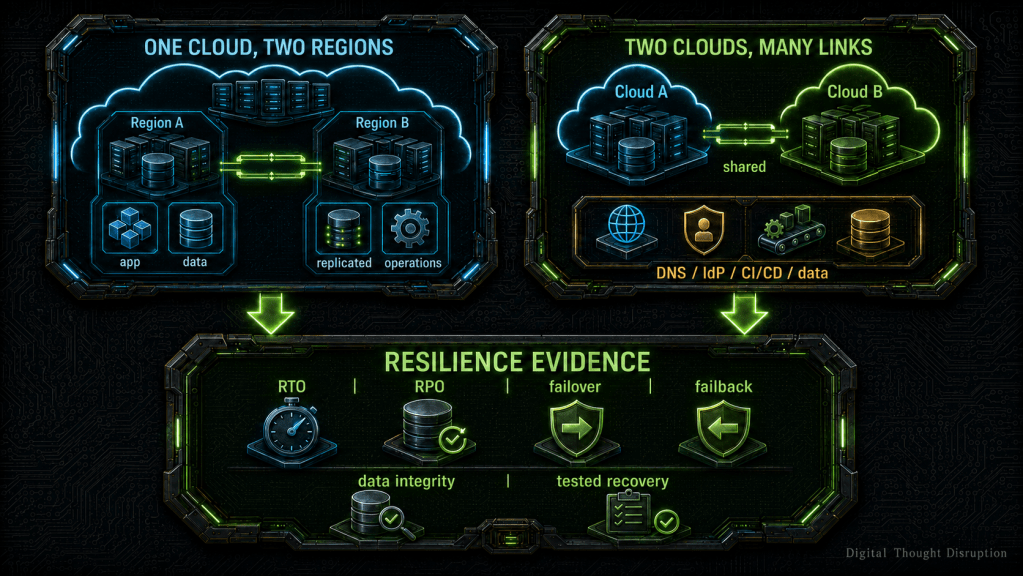
Two Clouds Can Still Share One Failure Path
The most important multicloud architecture diagram is not the one that shows two application stacks. It is the one that shows everything both stacks still share.
The diagram contains two clouds, but many failure modes remain common:
- A DNS or global traffic service can prevent users from reaching either cloud.
- A centralized identity provider can prevent customer login or operator access.
- A shared secrets broker or external key service can stop new workloads from starting.
- A single artifact registry or CI/CD SaaS platform can prevent recovery deployments.
- A common observability platform can make the recovery environment invisible.
- A shared database, message broker, or data-control plane can preserve the original outage.
- A common network transit hub or colocation facility can isolate both clouds.
- One incident team can become the human bottleneck.
Recent incidents illustrate why this dependency mapping matters. The October 2025 Azure Front Door incident affected a globally distributed ingress service and numerous dependent services, including the Azure portal and identity-related components [9]. The October 2025 AWS incident began with a regional DNS-management failure for DynamoDB and propagated through dependent services and infrastructure operations [8]. These were not simply “a VM failed” events. They were dependency-chain failures.
The Traffic Layer Can Become the Common Failure Domain
A multicloud service needs a traffic mechanism that can direct users to healthy endpoints. That mechanism is often treated as an implementation detail, but it can become the highest-level common dependency in the design.
DNS-Based Failover
DNS failover is attractive because it is broadly compatible across providers. It also has limits:
- resolvers and clients cache answers according to TTL and sometimes beyond the intended behavior;
- health checks can report the health of the probe path rather than the end-user path;
- failover can be delayed by detection intervals, evaluation logic, propagation, and cached records;
- DNS can move new connections but cannot repair existing sessions;
- a DNS control-plane outage may prevent configuration changes even if existing answers continue to resolve;
- a single authoritative DNS provider can remain a common point of failure.
RFC 2182 has long emphasized that physical and topological diversity matter when selecting secondary DNS servers [11]. The same principle applies to modern global traffic architecture: independent nameservers are only useful if network, account, operational, and control-plane dependencies are also diverse.
Global Load Balancers, CDNs, and WAFs
A global load balancer or CDN can provide faster detection and richer traffic control than basic DNS, but it can also centralize failure. If both clouds sit behind one global ingress provider, an ingress outage can make both backends irrelevant.
Health-check semantics require special scrutiny. A probe can succeed from one geography while users elsewhere cannot reach the service. Microsoft’s Azure Front Door high-availability guidance warns that Traffic Manager probes originating from US-based regions can reach US points of presence and fail to validate the global health of non-US anycast locations [12]. That is a concrete example of a broader rule:
A health check proves only what the probe path tested.
For a cross-cloud design, traffic testing should include:
- multiple geographic probes;
- public and private network paths;
- authenticated transactions, not just TCP or HTTP status;
- dependency checks for database writes, queues, identity, and external APIs;
- fail-open and fail-closed behavior;
- capacity-aware routing;
- manual override when automated health interpretation is uncertain.
Independent Traffic Control
A provider-level recovery claim is stronger when the traffic-control plane is not operationally trapped in the failed provider. That may mean:
- authoritative DNS hosted outside both application clouds;
- secondary DNS with independent network and account boundaries;
- pre-created records and routing policies;
- break-glass credentials stored and tested independently;
- certificates available for an alternate ingress path;
- documented manual routing procedures;
- a status and communication channel that does not depend on the failed platform.
The goal is not to add vendors for appearance. It is to ensure that the mechanism required to activate the second cloud remains usable during the failure being mitigated.
State Is the Hard Part
Stateless compute is usually the easiest part of multicloud. State determines whether failover produces a working business service or merely a healthy set of containers.
Synchronous Replication
Synchronous replication acknowledges a write only after multiple locations commit it. It can reduce or eliminate data loss for the protected transaction, but cross-cloud latency enters the application’s write path.
This creates several consequences:
- user latency increases with inter-cloud round-trip time;
- transient network loss can block writes even when both databases are healthy;
- link congestion becomes an application-availability problem;
- the system must decide what happens during a partition;
- cross-provider private connectivity still traverses distinct operational domains;
- performance may vary by geography and route.
Synchronous cross-cloud replication is therefore suitable only when the database supports the model, the latency budget tolerates it, and the application’s consistency requirements justify the availability tradeoff.
Asynchronous Replication
Asynchronous replication commits locally and transfers changes afterward. It protects application latency and often improves availability, but creates a non-zero RPO.
The architecture must define:
- the maximum acceptable replication lag;
- the monitoring signal used to measure lag;
- the point at which failover is blocked because the replica is too far behind;
- how in-flight events are replayed;
- how duplicates are detected;
- how orphaned writes are handled after failover;
- whether failback requires reverse replication or a full resynchronization.
The phrase “the database replicates” is incomplete. A useful statement is: “The secondary is asynchronously replicated, monitored against a five-minute RPO, promoted by an approved runbook, and reconciled before failback.”
Dual-Write and Multi-Writer Designs
Writing to two independent databases from the application appears portable but shifts distributed-systems complexity into business code. Partial success is inevitable: one write succeeds, the other fails, or acknowledgments arrive out of order.
A production design needs:
- idempotency keys;
- durable queues or logs;
- retry policies with bounded behavior;
- conflict-resolution rules;
- causal or version metadata;
- reconciliation jobs;
- visibility into divergence;
- business ownership of conflict outcomes.
For many transactional systems, a single-writer active-passive design is safer than unrestricted multi-writer operation.
Backups Still Matter
Replication reproduces legitimate changes, accidental deletions, and some forms of corruption. Active-active systems can distribute a bad write faster than they distribute availability.
AWS explicitly notes that data corruption may still require backups even in multi-site active-active designs [4]. A complete multicloud data strategy therefore needs:
- immutable or logically isolated backups;
- point-in-time recovery;
- tested restoration into the recovery cloud;
- retention independent of the primary account or tenant;
- encryption keys available during recovery;
- integrity validation before service activation.
RPO for infrastructure loss and RPO for corruption are not always the same. The resilience decision should record both.
Cross-Cloud Data Consistency Is a Business Decision
Consistency is often described as a database setting, but the consequences belong to the business.
Consider an order platform operating in two clouds. During a partition, both sides accept an order against the last unit of inventory. The database may resolve the technical conflict using timestamps or last-writer-wins logic. The business still has two customers who were promised the same item.
Architects need explicit answers for:
- Can both clouds accept writes during a partition?
- Which records can tolerate eventual consistency?
- Which transactions require a single authority?
- Can tenants or geographies be partitioned to avoid conflicting writes?
- What is the user experience when data is stale?
- Who approves reconciliation rules?
- How are financial, inventory, identity, and audit records corrected?
A useful pattern is to classify state:
| State class | Examples | Cross-cloud strategy | Key risk |
|---|---|---|---|
| Reconstructable | Caches, search indexes, derived analytics | Rebuild from authoritative source | Recovery duration |
| Append-oriented | Logs, events, telemetry | Replicate stream or object data | Duplicate and ordering behavior |
| Reference data | Product catalogs, configuration | Asynchronous replication | Staleness |
| Transactional | Orders, payments, reservations | Single writer, partitioned ownership, or purpose-built distributed database | Conflict and integrity |
| Security state | Identities, entitlements, keys, revocation | Federated or independently recoverable control plane | Unauthorized access or lockout |
Multicloud is easiest when most state is reconstructable, append-oriented, or partitionable. It is hardest when every request requires strongly consistent writes to a large shared transactional dataset.
Identity, Secrets, Certificates, and Keys Must Survive the Same Failure
The application can be healthy in the second cloud and still be unusable because the trust chain was not recovered.
Customer Identity
A shared external identity provider can be a deliberate choice. It reduces duplication and keeps authentication consistent across clouds. It also becomes a common dependency.
The design should determine:
- whether existing sessions remain valid during an identity outage;
- whether token validation requires live calls or can use cached signing keys;
- how long cached keys and metadata remain usable;
- whether emergency access is permitted;
- whether customer login can degrade while existing sessions continue;
- whether identity configuration is recoverable from version-controlled definitions.
Running two application stacks behind one unavailable identity plane does not provide full service resilience.
Workforce and Operator Identity
Provider consoles and APIs may depend on federation through the same enterprise identity system. If that system fails, operators can lose access to both clouds at the moment they need to execute recovery.
Each recovery environment should have:
- tested break-glass identities;
- hardware-protected credentials;
- limited, audited permissions;
- independent storage and retrieval procedures;
- a review and rotation process;
- exercises that prove access without the primary identity provider.
Secrets and Certificates
Secrets copied at deployment time can become stale. Secrets fetched dynamically from one central vault can become unavailable. Certificates managed entirely by one ingress provider may not work on the alternate path.
Multicloud recovery requires decisions about:
- secret ownership and replication;
- certificate issuance and renewal;
- certificate private-key custody;
- revocation checking;
- trust-store consistency;
- emergency rotation;
- audit evidence across providers.
Microsoft’s Front Door high-availability guidance specifically calls for bring-your-own certificates when maintaining an alternate ingress path, because the certificate must remain consistent regardless of which service handles traffic [12]. The operational implication is broader: trust material must be portable before the outage, not requested during it.
Encryption Keys
Cross-cloud data recovery fails if the recovery environment cannot decrypt the protected data. A key-management design should identify:
- whether keys are provider-native or externally managed;
- whether key material can be imported or restored;
- whether the recovery cloud has permission to use it;
- how key rotation affects replicas and backups;
- whether key access depends on the primary provider;
- how emergency use is logged and reviewed.
Key independence must be balanced against security. Exportable keys improve portability but expand custody risk. The right answer depends on threat model, regulation, and recovery objective.
Network Physics and the Egress Tax
Multicloud architecture cannot abstract away distance, latency, throughput, packet loss, and billing.
Latency Becomes a Design Constraint
Cross-cloud traffic commonly travels through public or private interconnects, carrier networks, exchange points, and provider edge systems. Even when the path is private, it spans multiple administrative domains.
Latency affects:
- synchronous database commits;
- chatty service-to-service calls;
- distributed locks;
- consensus protocols;
- cache invalidation;
- storage access;
- API gateways that call services in the other cloud;
- observability pipelines that centralize telemetry.
A workload may be portable but not distributable. A monolith can run in either cloud while still performing poorly if its web tier, database, and file services are split across clouds.
Bandwidth Must Cover Failure Conditions
Replication is usually sized for normal change rate. Recovery can require more:
- backlog catch-up after a link interruption;
- full data resynchronization;
- reverse replication after failover;
- backup restoration;
- log and forensic export;
- simultaneous production traffic and recovery traffic.
A link operating at 60 percent during normal conditions may saturate during failover. Saturation increases replication lag, which worsens RPO precisely when the organization needs the secondary most.
Egress Is a Recurring Architecture Cost
Cloud providers publish separate pricing for inter-region and internet data transfer. The exact rates and free allowances change, but the design implication is stable: continuous replication, cross-cloud service calls, centralized logging, backup movement, and failback traffic create ongoing data-transfer cost [16], [17]. The FinOps Foundation also identifies data transfer and egress as material inputs to public-cloud total cost of ownership [18].
The cost model should separate:
- steady-state replication;
- cross-cloud application traffic;
- telemetry export;
- backup copies;
- test-failover traffic;
- full recovery activation;
- failback and resynchronization;
- private connectivity, ports, cross-connects, and carrier services;
- security inspection and network appliances.
The expensive surprise is often not the standby compute. It is the continuous movement required to keep the standby credible.
Data Gravity Limits Portability
Large datasets create operational inertia. The more data a service owns, the harder it is to recreate or move within its RTO. A portable application package does not solve a multi-terabyte transactional database, a petabyte-scale object store, or a regulated data boundary.
The most resilient design may be to partition services by data ownership rather than replicate everything everywhere. That could mean separate regional systems, tenant placement, immutable event exchange, or business-level degradation instead of full cross-cloud failover.
Portability Is Not a Deployment Plan
Infrastructure as code and containers improve repeatability, but they do not make two clouds equivalent.
Five Kinds of Portability
| Portability dimension | What it means | Common false assumption |
|---|---|---|
| Compute portability | The executable can run on another platform | A container image makes the whole service portable |
| Infrastructure portability | Resources can be declared and created | One IaC module maps cleanly to every provider |
| Data portability | Data can be copied, restored, and interpreted | Replication guarantees recoverability |
| Security portability | Identity, policy, secrets, keys, and evidence transfer | Equivalent controls behave identically |
| Operational portability | Teams can deploy, monitor, diagnose, recover, and support | Familiar dashboards and runbooks are optional |
A service is recovery-portable only when all five are sufficient for the required RTO and RPO.
Infrastructure as Code Still Needs Provider-Specific Modules
A common orchestration language can standardize workflow, naming, policy checks, and state handling. It does not eliminate provider-specific resources.
A realistic repository often contains:
platform/
  common/
    service-contracts/
    policy-tests/
    release-metadata/
  cloud-a/
    network/
    kubernetes-or-compute/
    database/
    identity/
    observability/
  cloud-b/
    network/
    kubernetes-or-compute/
    database/
    identity/
    observability/
  recovery/
    activation-runbook/
    validation-tests/
    failback/
Trying to force every resource into one lowest-common-denominator module can hide meaningful differences. The better objective is consistent intent with explicit provider implementations.
Deployment Pipelines Need Independent Recovery Paths
A second cloud is not recoverable if deployment depends on a pipeline that cannot run during the primary failure.
Review the entire release chain:
- source-control availability;
- runners and agents;
- artifact and container registries;
- signing services;
- policy engines;
- secrets retrieval;
- provider API access;
- infrastructure state storage;
- approval workflow;
- release telemetry;
- rollback artifacts.
At least one tested recovery path should work when the normal pipeline or its primary cloud integration is unavailable. That may be a separate runner pool, mirrored artifacts, offline-signed releases, replicated state, or a controlled break-glass deployment process.
Capacity Is Not Guaranteed by a Template
A deployment can be syntactically portable and still fail because the target region lacks quota, instance capacity, accelerator inventory, IP space, service availability, or approved subscriptions.
Pilot-light and portable-redeployment tests must therefore include real resource creation. A successful planning command is not evidence that production capacity will be available during a broad outage.
Operations Fragment Before Architecture Does
The second cloud introduces a second operating model before it delivers a second recovery path.
Monitoring and Telemetry
Teams must decide whether to centralize or federate observability.
A centralized platform provides one operational view but becomes a shared dependency. A federated model preserves local visibility but requires cross-platform correlation, common identifiers, synchronized time, and an incident process that can combine evidence.
A mature design usually retains local provider telemetry while exporting a normalized subset to an independent or cross-cloud view. Critical recovery dashboards should show:
- end-user transaction success;
- traffic-routing state;
- replication lag;
- database write authority;
- queue depth and replay state;
- certificate and secret health;
- capacity in each cloud;
- dependency status;
- RTO and RPO timers;
- data-integrity validation;
- failback readiness.
Incident Response
Incident response becomes harder when alerts, logs, support cases, dashboards, and administrative tools are split across platforms.
The runbook needs explicit ownership:
- Who declares a provider-level disaster?
- Who has authority to move traffic?
- Who promotes the database?
- Who confirms legal or regulatory constraints?
- Who opens provider support cases?
- Who validates customer-facing transactions?
- Who approves failback?
- Who owns post-incident reconciliation?
The recovery plan should also identify what happens when provider support portals or normal communication tools are affected. The 2025 AWS and Azure incidents both affected management or support-related capabilities in addition to customer services [8], [9].
Skills and Staffing
Multicloud resilience requires depth, not résumé-level familiarity, in both platforms. The team must understand:
- networking and routing;
- identity and access;
- database recovery;
- managed-service behavior;
- infrastructure as code;
- observability;
- security operations;
- cost management;
- provider support escalation;
- application behavior under partition and failover.
A staffing model that relies on one specialist per cloud creates key-person risk. Production support requires overlapping coverage, common runbooks, cross-training, and exercises where the primary expert is intentionally unavailable.
Configuration and Policy Drift
Equivalent controls can drift even when they share a policy objective. Examples include:
- firewall and security-group rules;
- identity roles;
- network routes;
- logging retention;
- backup schedules;
- encryption settings;
- image versions;
- Kubernetes policies;
- vulnerability exceptions;
- resource quotas.
The organization needs control equivalence, not merely control presence. Evidence should show that each cloud enforces the intended outcome and that exceptions are tracked consistently.
Shared SaaS and Control Planes Can Defeat Multicloud
Cloud diversity is frequently undermined by concentration in adjacent services.
A dependency register should include at least:
| Shared service | Potential failure effect | Resilience question |
|---|---|---|
| Authoritative DNS | Users cannot resolve or route to either cloud | Is there independent secondary service and tested control? |
| CDN or WAF | Both cloud origins become unreachable | Can traffic bypass or switch ingress safely? |
| Enterprise IdP | Customers or operators cannot authenticate | What continues with cached trust, and what is the break-glass path? |
| Source control and CI/CD SaaS | Recovery deployment cannot run | Are artifacts, runners, and state independently available? |
| Artifact registry | New instances cannot start | Are images mirrored and signatures verifiable? |
| Secrets or PKI service | Workloads cannot initialize or renew trust | Are required secrets and certificates pre-positioned? |
| Observability and paging | Teams cannot see or coordinate the incident | Is there local telemetry and alternate communication? |
| SD-WAN, carrier, or colocation hub | Both clouds lose enterprise connectivity | Are network paths physically and operationally diverse? |
| External payment, messaging, or identity API | Business service remains unavailable | Can the application degrade or queue work? |
| Central database or SaaS data platform | Application tiers survive but state does not | Is data independently protected and recoverable? |
This is why “two clouds” can be less resilient than a well-designed single-provider multi-region service. The multicloud design may add more cross-platform dependencies while preserving the same external bottlenecks.
Independent Applications Across Multiple Clouds Are Not Automatically Resilient
An enterprise may run application A in Azure, application B in AWS, and analytics in Google Cloud. That is multicloud at the portfolio level. It can reduce the percentage of the portfolio exposed to one provider, but it does not make application A resilient to Azure failure or application B resilient to AWS failure.
This distinction matters in executive reporting.
Portfolio diversification means different services use different providers. A provider outage affects only the services placed there, assuming cross-service dependencies do not propagate the failure.
Application resilience means one business service can continue or recover when its hosting provider or critical dependency fails.
A portfolio can be diversified while a critical application remains single-region. Conversely, a business can use one cloud provider and operate a highly resilient multi-region application.
The correct metric is not “percentage of workloads in multiple clouds.” Better metrics include:
- percentage of critical business services with tested recovery plans;
- percentage meeting measured RTO and RPO;
- percentage with validated dependency maps;
- percentage with independent backups and tested restores;
- percentage with successful failback exercises;
- percentage with identified common-mode dependencies;
- recovery capacity available during the last test.
Provider diversity can be part of risk management. It should not be reported as proof of service continuity.
When a Second Cloud Is Justified
A second cloud is justified when it mitigates a material risk that cannot be reduced more economically through zones, regions, application redesign, backup, contractual controls, or operational improvement.
Provider-Level Concentration Is an Explicit Business Risk
Some organizations cannot accept a single provider as the recovery boundary for a critical service. The reason may be regulatory interpretation, customer contract, government policy, systemic-risk management, or an internal concentration limit.
In that case, multicloud is not a generic best practice. It is a control selected against a named risk. The decision record should identify:
- the prohibited concentration scenario;
- the required provider independence;
- the RTO and RPO;
- the services in scope;
- accepted shared dependencies;
- evidence required by risk or audit teams;
- cost and staffing approved for the control.
The Application Has a Provider-Neutral Architecture
Multicloud is more credible when the service already has:
- stateless or partitionable application tiers;
- portable artifacts;
- explicit service contracts;
- asynchronous integration;
- externally routable endpoints;
- a database designed for the required replication model;
- independent security and deployment automation;
- automated validation.
This does not require avoiding every managed service. It requires knowing which managed services are strategic dependencies and how they affect recovery.
A Provider-Specific Failure Is Within the Threat Model
The second cloud may protect against:
- provider-wide identity or account-control failure;
- a global ingress or control-plane problem;
- a prolonged provider outage;
- suspension or commercial dispute;
- service retirement or material platform change;
- regional capacity unavailability across the preferred provider;
- geopolitical or jurisdictional constraints.
Each scenario produces a different architecture. A rapid outage failover requires warm capacity and current data. A provider-exit strategy may tolerate a slower portable-redeployment model.
The Secondary Cloud Has Independent Operational Value
The economics improve when the second environment is not entirely idle. It might serve:
- regional users with partitioned data ownership;
- a distinct product or tenant segment;
- batch, analytics, or reporting workloads;
- development and recovery validation;
- regulated workloads requiring separate placement;
- a standby environment that is continuously exercised with synthetic or low-risk traffic.
However, using the secondary for unrelated work can consume recovery capacity. The design must reserve or reclaim enough resources to meet the DR load.
The Organization Will Test It
A second cloud without recurring failover and failback exercises is an unverified option. Multicloud is justified only when the organization funds the ongoing evidence program, not merely the initial build.
When Multi-Region Within One Provider Is Better
For many workloads, one-provider multi-region architecture provides the strongest balance of resilience, complexity, cost, and operational support.
It is usually the better choice when:
- the required failure scope is a zone or region, not the provider;
- native data replication meets RPO;
- provider-global services are acceptable dependencies;
- the application relies heavily on provider-native databases, messaging, identity, or security services;
- the team has deep operational maturity in one platform;
- recovery must be fast but the budget does not support duplicate cloud operating models;
- regulatory requirements allow the selected regions and provider;
- the organization can independently protect backups, keys, traffic controls, and operator access.
Google Cloud’s DR guidance notes that overall application resilience depends on backend redundancy, not only the global load balancer [7]. Microsoft similarly recommends considering multi-region design when business requirements justify region-outage protection and the organization can accept the cost and complexity [3]. The same reasoning supports a default hierarchy:
- remove avoidable single points of failure;
- design for instance and service failure;
- use availability zones;
- use multiple regions when region loss is in scope;
- add another provider only when the residual provider-level risk exceeds the added complexity and cost.
A second provider is not the natural next step after a second region. It is a separate risk decision.
Resilience Decision Matrix
The matrix below is a starting point. It does not replace application dependency analysis or business-impact assessment.
| Business and technical condition | RTO / RPO profile | Application and data fit | Preferred pattern | Why |
|---|---|---|---|---|
| Local infrastructure failure is the main concern | Minutes / near-zero to minutes | Standard cloud-native or VM workload | Multi-zone in one region | Lowest complexity that addresses the actual failure scope |
| Region loss must be survived | Seconds to hours / seconds to hours | Native regional replication available | Single-provider multi-region active-active or active-passive | Common platform semantics and mature native services |
| Provider-level outage is a named, funded risk | Minutes to hours / seconds to minutes | Stateless or partitionable app, recoverable data | Multicloud active-passive | Reduces provider concentration while preserving one write authority |
| Provider exit is required, rapid failover is not | Many hours to days / backup-defined | Portable artifacts and documented service substitutions | Portable redeployment | Avoids full standby cost while preserving an exit path |
| Regulatory policy requires provider diversity | Defined by policy and business impact | Data placement and control equivalence are feasible | Partitioned multicloud or active-passive for selected services | Treats provider diversity as a compliance control |
| Global low-latency service with partitionable data | Seconds / near-zero to seconds | Tenant, geography, or shard ownership can be separated | Multicloud active-active by partition | Avoids unrestricted cross-cloud write conflicts |
| Strongly consistent monolith with chatty dependencies | Tight RTO and RPO | Poor cross-cloud fit | Refactor or use single-provider multi-region first | Multicloud would add latency and failure modes without credible recovery |
| Low-criticality internal application | Hours to days / hours | Backup and rebuild acceptable | Backup and restore, possibly portable redeployment | Aligns spend to business impact |
| Independent apps already use different clouds | Varies per application | No failover relationship | Portfolio multicloud, not resilience claim | Reduces portfolio concentration but not per-service downtime |
| Shared SaaS, IdP, DNS, or data plane remains dominant | Any | Common dependency not protected | Fix dependency architecture before adding cloud | Second provider does not address the real failure domain |
Decision Criteria That Should Be Weighted Explicitly
A formal decision should score at least:
- required RTO;
- required RPO for infrastructure loss;
- required RPO for corruption;
- provider-level risk in scope;
- regulatory and contractual requirements;
- application state model;
- consistency requirements;
- data volume and change rate;
- cross-cloud latency;
- data-transfer and egress cost;
- availability of equivalent managed services;
- traffic-management independence;
- identity and key-management independence;
- IaC and pipeline readiness;
- observability and incident maturity;
- staffing and on-call coverage;
- test frequency and evidence expectations;
- failback complexity;
- five-year operating cost.
The decision should also state the threshold that changes the answer. For example: “Adopt multicloud active-passive only if the risk committee requires provider-level recovery under four hours and the application demonstrates a thirty-minute RPO in two consecutive exercises.”
Practical Example: A Global Order API
Consider a global order API with web clients, application services, inventory, payment orchestration, and a transactional order database.
Option A: One Provider, Two Regions
Both regions run the application tier. A native global traffic service directs users. The database uses provider-supported cross-region replication with one write region and a promoted secondary. Secrets, identity, logging, and deployment use the same provider’s regional or global services.
Strengths:
- fastest implementation path;
- common identity, networking, deployment, and support model;
- mature native replication;
- lower staffing burden;
- simpler failback.
Risks:
- provider-global ingress, identity, or control-plane dependencies may remain;
- provider-level commercial or systemic risk remains;
- a shared application defect or data corruption can affect both regions.
Best fit: Region-outage protection is required, provider-level independence is not.
Option B: Two Clouds, Active-Passive
Cloud A serves production. Cloud B runs a reduced application stack, independent ingress, mirrored images, local secrets, local monitoring, and an asynchronously replicated or continuously restored database. A recovery controller promotes the secondary write authority and moves traffic after validation.
Strengths:
- protects against selected provider-level failures;
- simpler state model than dual-write active-active;
- secondary environment can be tested without serving all production traffic.
Risks:
- replication and failback are complex;
- service substitutions and IaC modules must remain current;
- standby capacity and data transfer create recurring cost;
- operator access, certificates, keys, and traffic controls must be independently recoverable.
Best fit: Provider-level recovery is a funded requirement with an RTO measured in tens of minutes or hours.
Option C: Two Clouds, Active-Active
Both clouds accept user traffic. Orders are assigned to an owning region, tenant, or shard. Each partition has one write authority, and events are exchanged asynchronously for global views. Payments use idempotency keys, and inventory allocation prevents conflicting ownership.
Strengths:
- both environments are continuously exercised;
- traffic can continue when one cloud is lost;
- capacity is productive in both clouds.
Risks:
- application architecture must encode partition ownership;
- global views can be stale;
- transaction and reconciliation logic becomes a core product capability;
- operations, security, and testing are substantially more demanding.
Best fit: Global service, partitionable state, very low RTO, and a business model that supports the engineering investment.
The important lesson is that Option C is not merely Option A deployed twice. It is a different application and operating model.
Failure Injection and Recovery Testing Requirements
Resilience must be demonstrated under controlled failure. NIST contingency-planning guidance connects recovery planning to business impact, recovery priorities, and practical testing [19]. Microsoft recommends fault injection and chaos engineering to build confidence by deliberately introducing failures and observing workload behavior [13]. Azure Chaos Studio and AWS Fault Injection Service provide managed mechanisms for controlled disruption in their respective environments [14], [15]. Tools help, but the test design must span the whole service.
The Recovery Evidence Loop
Minimum Test Scenarios
A credible multicloud program should test more than complete provider loss.
| Test scenario | What it validates |
|---|---|
| Application instance and node failure | Local self-healing and capacity behavior |
| Availability-zone loss | Zone isolation, balancing, data quorum, and capacity |
| Region isolation | Traffic shift, regional state promotion, and dependency placement |
| Cloud-provider API or portal unavailable | Ability to operate through existing data planes and alternate access |
| Global DNS or ingress failure | Alternate routing path and certificate readiness |
| Identity-provider outage | Session behavior, token validation, operator break-glass access |
| Secrets or key service unavailable | Startup behavior, caching, rotation, and emergency access |
| Cross-cloud link failure | Replication lag, partition behavior, queueing, and write authority |
| Database primary loss | Promotion, fencing, integrity, and application reconnect |
| Data corruption or accidental deletion | Backup isolation, point-in-time restore, and validation |
| CI/CD or artifact service outage | Independent deployment and rollback path |
| Observability or paging outage | Local diagnostics and alternate coordination |
| Recovery-cloud capacity shortfall | Quota, scaling, degraded service, and prioritization |
| Failback after extended operation | Reverse replication, reconciliation, traffic return, and cleanup |
Measure the Whole Timeline
RTO should be decomposed into observable intervals:
RTO = detection
    + decision and declaration
    + traffic-control action
    + data promotion or restore
    + compute scale or deployment
    + dependency recovery
    + application validation
    + business acceptance
This prevents teams from reporting only the database promotion time or infrastructure deployment time as the service RTO.
RPO should also be measured, not inferred from the replication feature:
Measured RPO = time between the last durable, validated business transaction
               in the recovery environment and the failure boundary
Required Evidence Pack
After each exercise, retain:
- scenario and hypothesis;
- architecture and dependency version;
- start and stop conditions;
- exact timestamps;
- monitoring and alert evidence;
- replication lag before and during the event;
- traffic-routing evidence;
- database authority changes;
- transaction-validation results;
- lost, duplicated, delayed, or reconciled records;
- operator actions and approvals;
- provider support interactions;
- RTO and RPO achieved;
- failback results;
- capacity and cost observations;
- defects, owners, and due dates.
A successful exercise is not one where the team eventually restored service. It is one where the measured result met the approved objective and the data remained trustworthy.
Test Frequency
Frequency should match change rate and criticality. As a practical baseline:
- automated component and dependency tests run with normal delivery pipelines;
- traffic and regional failover tests run several times per year for critical services;
- provider-level multicloud activation and failback run at least annually, and more often for very low RTO services;
- backup restoration and corruption scenarios run independently from infrastructure-outage tests;
- a material change to data architecture, ingress, identity, certificates, IaC, or deployment tooling triggers a targeted retest.
An annual tabletop is not sufficient evidence for an automated thirty-minute recovery claim.
The Operational Cost Model
A multicloud resilience decision should include a five-year cost model without pretending that one generic price applies to every application.
Direct Platform Cost
Include:
- standby or active compute;
- storage and replicated data;
- databases, messaging, caches, and managed services;
- global traffic, DNS, CDN, WAF, and load balancing;
- backup and archive;
- security, key management, and secrets;
- observability and log retention;
- private connectivity and network appliances;
- data transfer and egress;
- test environments and test traffic.
Engineering and Operations Cost
Include:
- provider-specific IaC modules;
- duplicate deployment and image pipelines;
- service abstraction or substitution code;
- cross-cloud data engineering;
- security-control mapping;
- monitoring normalization;
- on-call staffing and training;
- runbook maintenance;
- incident exercises;
- audit evidence;
- provider support plans.
Transition and Lifecycle Cost
Include:
- initial architecture and migration;
- application refactoring;
- data seeding;
- contract and procurement work;
- certification and compliance review;
- periodic platform upgrades;
- deprecation and service-replacement work;
- failback and resynchronization after real events;
- eventual exit from one provider.
Risk Allowance
The model should compare not only platform cost but also residual risk:
Five-year resilience cost = platform cost
                          + network and data movement
                          + engineering and operations
                          + testing and assurance
                          + transition and lifecycle
                          + residual-risk allowance
A lower-cost design that cannot meet the business RTO is not economical. A high-cost multicloud design that protects an unapproved provider-level scenario is not economical either.
A Practical Architecture Review Checklist
Before approving multicloud as a resilience control, require clear answers to the following.
Scope and Outcomes
- What exact failure is in scope?
- Is provider-wide failure materially different from regional failure for this service?
- What are the approved RTO and RPO?
- Is there a separate corruption-recovery objective?
- Which business functions may degrade during recovery?
Traffic and Access
- Can users reach the recovery cloud if the primary ingress service fails?
- Are DNS, health probes, routing policies, and manual overrides tested?
- Are certificates available on every path?
- Can operators access both clouds without the normal enterprise identity path?
Application and Data
- Is the application stateless, partitioned, single-writer, or multi-writer?
- How is replication lag measured?
- What prevents split brain?
- How are duplicate events and conflicting writes reconciled?
- Are backups isolated from both production environments?
- Has restoration into the secondary cloud been tested?
Security and Governance
- Are secrets, keys, roles, and policies equivalent and independently usable?
- Is evidence retained across both providers?
- Are exceptions tracked consistently?
- Do regulatory requirements mandate diversity, residency, or provider independence?
Delivery and Operations
- Can the recovery environment be deployed without the primary pipeline?
- Are images and artifacts mirrored?
- Are quotas and capacity reserved or validated?
- Can local telemetry operate if the central platform fails?
- Is there sufficient staffing in both clouds?
- Who declares failover, promotes data, moves traffic, and approves failback?
Evidence
- When was the last end-to-end failover and failback?
- What RTO and RPO were measured?
- What data loss, duplication, or reconciliation occurred?
- Did the recovery cloud sustain production load?
- Which unresolved defects remain?
- What architecture change would invalidate the evidence?
If the answers are mostly product names rather than measured behaviors, the design is not ready.
Conclusion
Multicloud can improve enterprise resilience, but only when it is selected against a specific provider-level risk and engineered as an independent recovery system. The second cloud must have usable traffic control, current and trustworthy data, functioning identity and secrets, sufficient capacity, deployable artifacts, observable operations, trained staff, and a tested failback path. Without those elements, provider diversity is cosmetic.
For most workloads, the better first investment is application reliability, multi-zone design, tested backups, and multi-region recovery within one provider. That path removes common infrastructure failure modes while preserving one platform model. A second provider becomes rational when the residual provider-level risk is explicitly unacceptable, the application architecture can support the pattern, and the organization is prepared to operate two production-grade control and data planes.
The final test is simple: remove the provider names from the architecture diagram. If the remaining design cannot explain the failure boundary, write authority, traffic path, RTO, RPO, dependency independence, recovery sequence, and evidence from the last exercise, it is not a resilience architecture. It is a provider-counting exercise.
