


Private AI is not just a question of where to place GPUs.
That is where the conversation often begins, but it is not where the real architecture work lives. The harder problem is deciding how private AI will be operated, governed, secured, monitored, scaled, and recovered once it moves beyond the proof of concept stage.
That is why VMware Cloud Foundation 9.1 deserves a serious place in the private AI discussion.
VCF 9.1 is not interesting only because it can run AI workloads. It is interesting because it gives infrastructure teams a way to treat AI as part of the private cloud operating model. That means AI services can inherit familiar enterprise controls around tenancy, lifecycle, networking, storage, observability, access control, and platform governance.
For organizations already invested in VMware Cloud Foundation, the real question is not whether VCF can host an AI workload.
The better question is whether private AI should become a governed platform service inside the same operating model that already supports enterprise applications.
That is where VCF 9.1 becomes more than a product release. It becomes an architecture decision.
The Private AI Problem Most Teams Underestimate
Most private AI programs start with a simple request.
A business team wants an internal chatbot. A data science team wants GPU capacity. An application team wants an inference endpoint. A security team wants data to remain inside the enterprise boundary. An infrastructure team is asked to make it all work.
At first, that sounds like a capacity problem.
In practice, it quickly becomes an operating model problem.
Who approves access to internal data sources?
Who decides which models are allowed?
Who owns the model endpoint after deployment?
Who monitors GPU utilization?
Who responds when inference latency spikes?
Who patches the platform?
Who reviews network access?
Who pays for idle accelerator capacity?
Who signs off before a model is promoted into production?
A GPU server cannot answer those questions.
A model endpoint cannot answer those questions.
A proof of concept cannot answer those questions.
The platform has to answer those questions.
That is the architectural role VCF 9.1 can play. It gives private AI a place to live inside a governed private cloud instead of becoming another isolated technical island.
Private AI Needs a Platform Boundary
A useful private AI platform creates a clear boundary between consumers and operators.
Application teams, data scientists, and automation teams should be able to consume approved AI services without needing to understand every detail of the underlying GPU hosts, storage policies, networking paths, Kubernetes services, certificates, and runtime components.
At the same time, infrastructure and platform teams need enough control to enforce security, capacity, lifecycle, availability, and operational standards.
That is the balance VCF 9.1 is built to support.
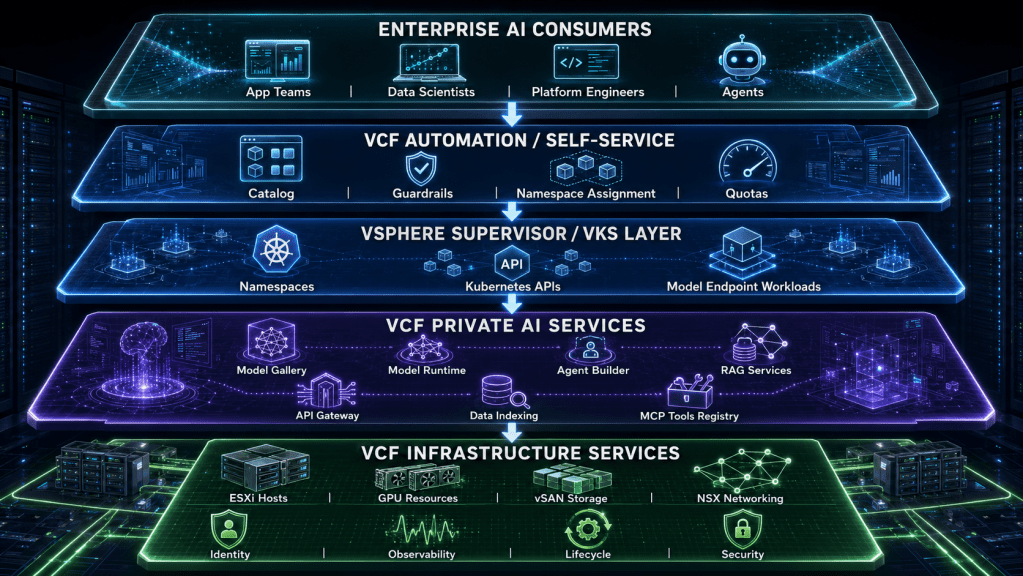
The diagram below shows the basic operating model. The important point is not the number of components. The important point is the separation of responsibilities.

What this diagram shows is the difference between running AI on infrastructure and operating AI as a private cloud service.
The consumer should see a controlled service. The platform team should see the operational machinery underneath it. VCF 9.1 matters because it gives both sides a more structured way to interact.
What VCF 9.1 Is Really Solving
VCF 9.1 should not be treated as a feature checklist for AI.
The stronger way to think about it is as an operating model foundation for private AI workloads.
That operating model includes several practical layers.
The first layer is infrastructure consistency. AI workloads need compute, GPUs, storage, networking, lifecycle management, and observability. In many environments, those capabilities already exist in some form inside the VMware estate. VCF 9.1 gives teams a way to extend that estate toward AI without building a completely separate platform from scratch.
The second layer is controlled consumption. AI teams need faster access to services, but enterprise teams still need approval paths, quotas, identity boundaries, and deployment standards. This is where self-service matters, but only when it is paired with governance.
The third layer is workload placement. Private AI workloads are sensitive to accelerator availability, memory, network paths, storage performance, and data proximity. Placement decisions are not just about where something can run. They are about where it should run.
The fourth layer is operational visibility. Private AI introduces new signals that traditional infrastructure dashboards do not always capture well. GPU utilization, model latency, token throughput, endpoint health, and model-level behavior become part of the operating picture.
The fifth layer is lifecycle discipline. AI infrastructure still needs patching, upgrades, certificate management, backup strategy, recovery planning, and support boundaries. Private AI does not remove those responsibilities. It increases the cost of ignoring them.
That is why VCF 9.1 is not just an AI runtime conversation. It is a platform operations conversation.
Where VCF Private AI Services Fit
VCF Private AI Services sit between the private cloud foundation and the AI application experience.
This is the layer that helps make AI consumable instead of forcing every project team to assemble its own runtime, model endpoint pattern, knowledge base workflow, and access path.
In practical terms, Private AI Services are aimed at capabilities such as model runtime, model endpoints, model management, agent building, data indexing, retrieval, and integration with private enterprise content. The purpose is to help teams move from “we can run a model” to “we can deliver a repeatable private AI service.”
That distinction matters.
A model running in a lab proves technical feasibility. A governed model endpoint proves that the organization can expose AI as a service. A repeatable deployment pattern proves that the platform can scale beyond the first project.
VCF Private AI Services are valuable because they connect the AI workflow back to the platform workflow. The platform team can prepare the Supervisor, namespaces, GPU resources, storage policies, network paths, registries, certificates, and identity model. AI consumers can then work closer to models, endpoints, agents, and data workflows without rebuilding the infrastructure foundation every time.
This is the right direction for enterprise private AI.
Architecture Decisions That Should Be Made Early
Private AI architecture becomes messy when every project makes its own platform decisions.
A serious VCF 9.1 private AI design should define a small number of standard patterns before onboarding multiple teams.
The most important decisions are shown below.
| Design Area | Decision to Make Early |
|---|---|
| Platform placement | Decide whether AI runs in an existing workload domain, a dedicated AI-focused domain, or a purpose-built private AI environment. |
| GPU strategy | Decide which hosts receive GPUs, how GPU access is allocated, and whether workloads require shared or exclusive accelerator access. |
| Tenancy model | Decide how namespaces map to teams, applications, environments, and business units. |
| Network model | Decide how AI workloads reach applications, data sources, APIs, observability tools, and internal users. |
| Storage policy | Decide where model artifacts, runtime data, indexed content, logs, and application data should live. |
| Identity and access | Decide how users, service accounts, automation workflows, and administrators are authenticated and authorized. |
| Model governance | Decide how models are approved, versioned, promoted, retired, and audited. |
| Observability | Decide how platform metrics, GPU metrics, model metrics, endpoint health, and application signals are collected. |
| Recovery | Decide how the platform, AI services, model configurations, and supporting data services are protected and restored. |
The goal is not to design every possible use case in advance.
The goal is to prevent private AI from becoming a collection of one-off exceptions.
A good VCF design gives teams a paved road. It defines the patterns that should be reused, the decisions that require approval, and the areas where application teams can still move quickly.
The Network Design Matters More Than It First Appears
Private AI traffic is not ordinary application traffic.
A single AI workflow may touch user prompts, retrieved documents, embeddings, model endpoints, application APIs, internal databases, observability systems, and external tool connectors. Even when the model runs on-prem, the surrounding data path can become complicated quickly.
That makes network design a first-order architecture decision.

The wrong answer is to let every project decide for itself.
The better answer is to define standard network patterns for common AI workload types. For example, an internal summarization service may need a different network pattern than a developer assistant, a regulated document search tool, or an agent that can interact with operational systems.
Private AI should not flatten those differences. It should make them explicit.
The Operating Model Is the Real Architecture
VCF 9.1 can provide the technical platform, but the organization still has to define ownership.
That ownership model is often where private AI succeeds or fails.
A practical responsibility model looks like this:
| Layer | Primary Owner | Responsibility |
|---|---|---|
| VCF foundation | Infrastructure team | Hosts, clusters, lifecycle, availability, storage, networking, and platform health. |
| AI platform services | Platform engineering | Catalogs, namespaces, automation patterns, service templates, and guardrails. |
| GPU capacity | Infrastructure and platform teams | Placement, allocation, utilization, cost visibility, and growth planning. |
| Models | AI, data science, or MLOps team | Model selection, validation, versioning, promotion, retirement, and testing. |
| Data sources | Data owners | Access approval, classification, quality, retention, and lineage. |
| Security controls | Security architecture | Identity, segmentation, audit, policy enforcement, and risk review. |
| Applications | Application teams | Business workflow, integration, user experience, and application reliability. |
| Day-2 operations | Shared operating team | Monitoring, incident response, change control, rollback, and capacity review. |
This table is not just administrative detail. It is the private AI architecture in operational form.
If ownership is unclear, AI becomes a support problem. If ownership is defined, AI becomes a platform service.
That is why VCF 9.1 should be evaluated through an operating model lens, not just a feature lens.
Where VCF 9.1 Is a Strong Fit
VCF 9.1 is a strong private AI fit when the organization already operates VMware as a strategic private cloud platform.
It is especially compelling when the enterprise wants AI workloads to inherit existing operational discipline instead of creating a separate stack with separate tooling, separate support paths, and separate governance.
VCF 9.1 is a strong fit when:
The organization already runs VMware Cloud Foundation at meaningful scale.
AI workloads need to stay close to private enterprise data.
Security teams require strong control over data location, access, and network paths.
Application teams need self-service, but not uncontrolled self-service.
The platform team wants AI, Kubernetes, VMs, storage, networking, and observability under one operating model.
GPU capacity needs to be shared and governed across teams.
The organization wants a private cloud foundation for both traditional workloads and modern AI workloads.
In those situations, VCF 9.1 gives the enterprise a more consistent way to bring AI into the platform instead of building a disconnected AI island.
Where VCF 9.1 Is Not Enough by Itself
VCF 9.1 should not be positioned as a magic shortcut.
Private AI still requires data preparation, model governance, security review, application integration, operational monitoring, cost management, and organizational alignment. VCF can provide the foundation, but it does not remove the need for architecture discipline.
VCF 9.1 may not be the cleanest fit when the organization only needs a small standalone inference environment, has limited VMware operational maturity, lacks Kubernetes skills, or wants a heavily packaged AI appliance experience with minimal platform engineering.
It may also be a poor fit if the business expects private AI to be “easy” simply because it is on-prem.
On-prem gives you more control. It also gives you more responsibility.
The best VCF private AI programs will treat the platform as production infrastructure from the beginning. The weakest ones will treat it as a GPU-backed experiment and then wonder why the operating model breaks later.
A Practical Readiness Checklist
Before positioning VCF 9.1 as the private AI platform, the architecture team should be able to answer these questions clearly.
| Readiness Area | Question |
|---|---|
| Platform readiness | Is the VCF environment ready for AI workloads from a version, lifecycle, capacity, and support perspective? |
| GPU readiness | Are accelerator models, drivers, access modes, and capacity plans validated? |
| Kubernetes readiness | Is the Supervisor and VKS operating model understood by the platform team? |
| Network readiness | Are model endpoint, data source, and user access paths designed and segmented? |
| Identity readiness | Are user roles, service accounts, approval paths, and privileged access controls defined? |
| Data readiness | Are data sources classified, approved, indexed, retained, and governed correctly? |
| Model readiness | Are model selection, versioning, validation, promotion, and retirement processes defined? |
| Operations readiness | Are monitoring, alerting, incident response, backup, recovery, and rollback expectations documented? |
| Cost readiness | Is GPU usage visible enough to support capacity planning, chargeback, or showback? |
This checklist should happen before the platform is opened broadly.
The most expensive private AI mistakes are rarely caused by the first workload. They are caused by the fifth, tenth, and twentieth workload arriving before the operating model is ready.
Conclusion
VCF 9.1 matters in private AI because it changes the conversation from isolated AI infrastructure to governed private cloud operations.
That is the right conversation for enterprises.
A production private AI platform needs more than GPUs. It needs tenancy, identity, networking, storage policy, lifecycle management, model governance, observability, recovery planning, and clear ownership. Without those pieces, the platform may run models, but it will not operate well.
For VMware-heavy organizations, VCF 9.1 is strongest when private AI needs to become part of the enterprise private cloud, not a disconnected experiment running beside it.
The decision should not start with “Can VCF run AI?”
It should start with a better question:
Do we want private AI to inherit the same operating model as the rest of our private cloud?
If the answer is yes, VCF 9.1 deserves to be on the short list.
External References
VMware Cloud Foundation 9.1: The Secure, Cost-Effective Private Cloud Platform for Production AI
https://blogs.vmware.com/cloud-foundation/2026/05/05/vcf-9-1-secure-cost-effective-private-cloud-platform-for-production-ai/
Streamline, Simplify and Protect All Your AI Workloads with VCF 9.1
https://blogs.vmware.com/cloud-foundation/2026/05/05/streamline-simplify-and-protect-all-your-ai-workloads-with-vcf-9-1/
Deploying VMware Cloud Foundation Private AI Services: Navigating Supervisor Networking Stack
https://blogs.vmware.com/cloud-foundation/2026/06/11/deploying-vmware-cloud-foundation-private-ai-services-navigating-supervisor-networking-stack/
Private AI Services: New in VMware Private AI Foundation with NVIDIA in VCF 9.0
https://blogs.vmware.com/cloud-foundation/2025/06/19/private-ai-services-new-in-vmware-private-ai-foundation-with-nvidia-in-vcf-9-0/
VMware Private AI Foundation with NVIDIA Documentation
https://techdocs.broadcom.com/us/en/vmware-cis/private-ai/foundation-with-nvidia/9-1.html
