

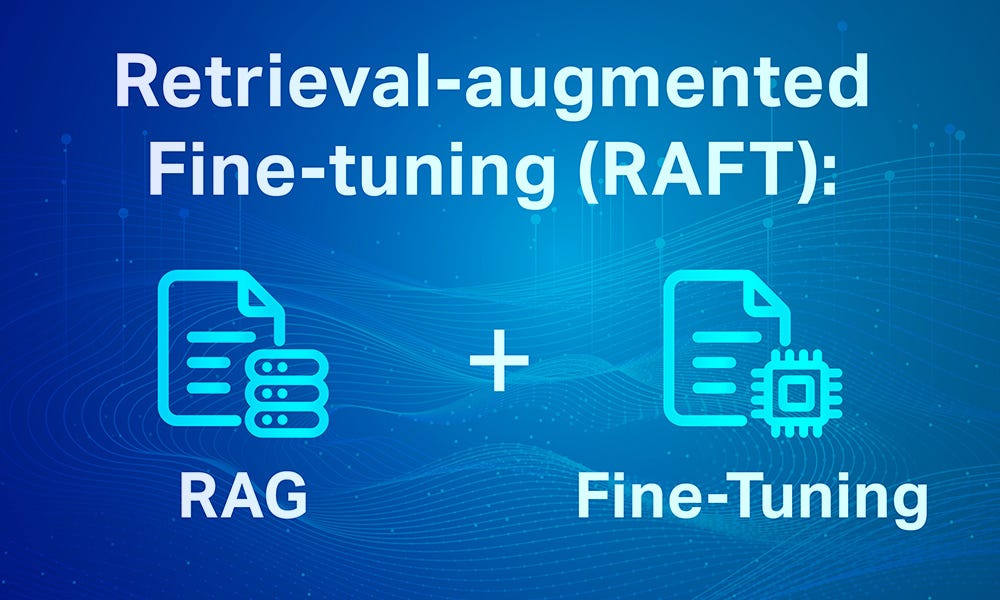

In simple terms, retrieval-augmented fine-tuning, or RAFT, is an advanced AI technique in which retrieval-augmented generation is joined with fine-tuning to enhance generative responses from a large language model for specific applications in that particular domain.
It allows the large language models to provide more accurate, contextually relevant, and robust results, especially for targeted sectors like healthcare, law, and finance, by integrating RAG and fine-tuning.
Components of RAFT
1. Retrieval-augmented Generation
The technique enhances LLMs by permitting them to access external data sources during inference. Therefore, rather than static pre-trained knowledge as with many others, RAG enables the model to actively search a database or knowledge repository for information within two clicks to respond to user queries. It is almost like an open-book exam, in which the model consults the most recent external references or other domain-relevant facts. That is to say, unless coupled with some form of training that refines the model’s capacity to reason about or prioritize the information retrieved; RAG by itself does not refine the former capabilities.
Features of RAG:
- Dynamic Knowledge Access: Includes real-time information gathered from external information sources.
- Domain-Specific Adaptability: Answers are based on targeted datasets.
Limitation: Does not contain built-in mechanisms for discriminating between relevant and irrelevant content retrieved.
2. Fine-Tuning
Fine-tuning is training an LLM that’s been pre-trained on domain-specific datasets to develop it for specialized tasks. This is an opportunity to change the parameters of the model to better understand domain-specific terms, context, and nuances. Although fine-tuning refines the model’s accuracy concerning a specific domain, external data is not at all utilized during inference, which limits its reusability when it comes to productively reproducing evolving knowledge.
Features of Fine-Tuning:
- Specialization: Suits a specific industry or task for a particular model.
- Better Inference Accuracy: Enhances the precision in the generation of domain-relevant responses.
Limitations: Less effective dynamic update capabilities in building knowledge.
How RAFT Combines RAG and Fine-Tuning
It combines the strengths of RAG and tuning into one anchored package. The resulting LLMs do not simply retrieve relevant documents but successfully integrate that information back into their reasoning process. This hybrid approach guarantees that the model is well-versed in domain knowledge (via tuning) while also being able to dynamically access outside knowledge (via RAG).
Mechanics of RAFT

Training Data Composition:
- Questions are coupled with relevant documents and distractor documents (irrelevant).
- Chain-of-thought answers linking retrieved pieces of information to the final answer.
Dual Training Objectives:
Teach the model how to rank a relevant document above all the distractors and enhance reasoning skills by asking it for step-by-step explanations tied back to source documents.
Inference Phase:
- Models retrieve the top-ranked documents through a RAG process.
- Fine-tuning guides accurate reasoning and merges the retrieved data with the main responses.
Advantages of RAFT
Less Error Rates Merging
Augmenting fine-tuned development causes RAFT to remarkably improve the accuracy of specialized tasks. Instead, its performance in many benchmarks, such as TorchHub, earned gains of up to 76% against ordinary fine-tuning techniques.
Robustness Against Errors
RAFT trains models in modifying irrelevant information before setting incorrect inferences stemming from wrong retrievals.
Live Data
Unlike fine-tuned static models, LLMs with RAFT can ingest new information dynamically, making them a great fit for industries like medicine or technology that require quick adaptation.
Efficiently uses resources
RAFT handles domain adaptation very cost-effectively due to its use of external knowledge sources for training and inference, thus reducing dependency on huge labeled datasets.
Applications of RAFT in Domain-Specific AI Applications
1. Healthcare:
- Summarizing medical papers.
- Supporting clinical decision-making by merging patient records with updated guidelines.
2. Legal Services:
- Doing legal research and statute analysis.
- Simplifying contract review.
3. Finance:
- Providing financial insights based on market trends.
- Risk assessment using real-time economic data.
4. Technical Documentation:
- Writing effective API reference material.
- Answering developer questions with code references.
Challenges in Implementing RAFT
The Complexity of Data
High-quality domain-specific datasets are required, which can often be cumbersome to curate.
Integration issues
Seamless integration of external knowledge into the model’s reasoning process requires sophisticated engineering.
High resource consumption
Training of the models of RAFT demands a heavy amount of turn-around in computing power and infrastructure.
How Shaip Helps Adapt RAFT Challenges:
Shaip stands uniquely in favor of arresting the challenges differing from the Retrieval-Augmented Fine-Tuning (RAFT) features in providing quality datasets, eminent domain-specific datasets, and competent data services.
The end-to-end AI data supervision platform assures that these companies have a diversity of datasets, simultaneously endorsed by ethical practices, well-annotated for training large language models (LLMs) the right way.
Shaip specializes in providing high-quality, domain-specific data services tailored for industries like healthcare, finance, and legal services. Using the Shaip Manage platform, project managers set clear data collection parameters, diversity quotas, and domain-specific requirements, ensuring models like RAFT receive both relevant documents and irrelevant distractors for effective training. Built-in data deidentification ensures compliance with privacy regulations like HIPAA.
Shaip also offers advanced annotation across text, audio, image, and video, guaranteeing top-tier quality for AI training. With a network of over 30,000 contributors and expert-managed teams, Shaip scales efficiently while maintaining precision. By tackling challenges like diversity, ethical sourcing, and scalability, Shaip helps clients unlock the full potential of AI models like RAFT for impactful.
Originally published at https://www.shaip.com.

What is RAFT? RAG + Fine-Tuning was originally published in Becoming Human: Artificial Intelligence Magazine on Medium, where people are continuing the conversation by highlighting and responding to this story.
