



TL;DR
Azure Local is best understood as a distributed infrastructure platform governed through a common Azure control plane. The electrical grid metaphor works because applications, data, and compute remain close to the locations consuming them, while identity, policy, monitoring, security, and automation provide consistent operating standards across the estate.
The metaphor also needs boundaries. Centralized management does not eliminate local dependencies, guarantee application availability, or turn every infrastructure platform into Azure Local. A successful design treats each site as an intentional failure domain, separates governance from execution, and selects Azure Local only where local infrastructure provides a measurable operational benefit.
Introduction
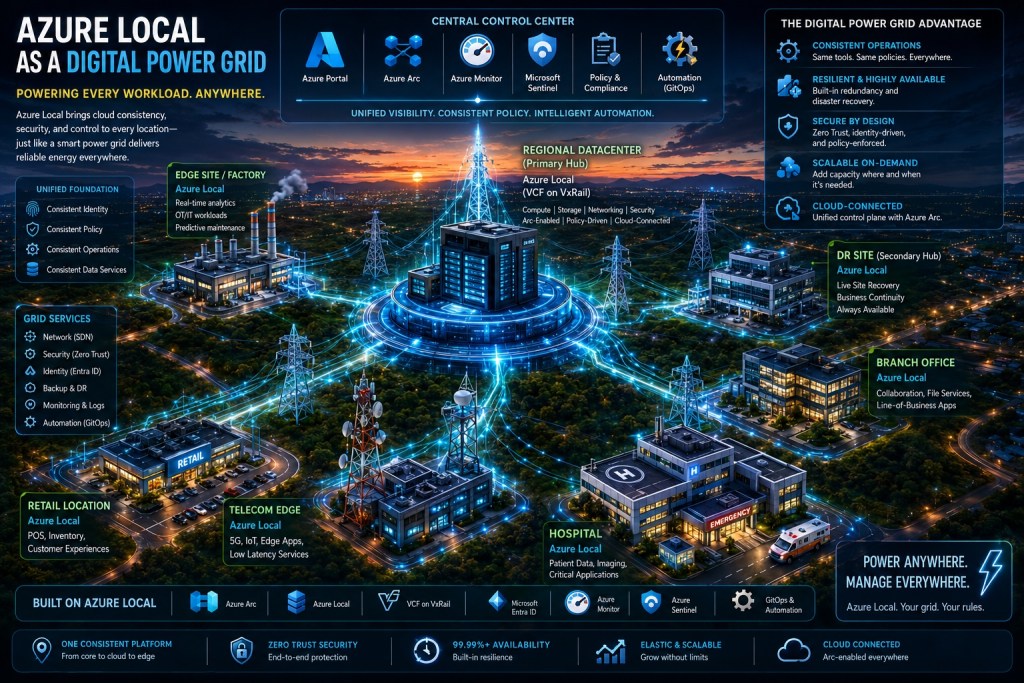
The uploaded architecture image presents Azure Local as a digital power grid. A regional datacenter acts as the primary hub, smaller sites consume infrastructure services at the edge, and a central control center provides policy, monitoring, security, and automation.
That visual is more than an attractive metaphor. It captures an important change in hybrid infrastructure architecture.
Traditional datacenter design placed most computing capacity in one or two central facilities. Remote locations connected back to those facilities and depended on the wide-area network for applications, identity, data, and management. That model becomes difficult when factories need real-time analytics, hospitals need locally available clinical systems, retailers need resilient point-of-sale services, and remote locations cannot tolerate unpredictable WAN performance.
Azure Local changes the placement decision. Compute and data can remain close to the workload, while Azure Arc projects infrastructure and selected resources into the Azure management plane. The result is not one enormous distributed cluster. It is a fleet of locally executing infrastructure systems governed through shared operational standards.
That distinction is the foundation of the digital power grid model.
An electrical grid does not move the power plant into every building. It distributes capacity through substations, transmission systems, protection controls, operating standards, and local delivery infrastructure.
Distributed computing requires a similar model.
| Power grid concept | Azure Local architecture equivalent | Operational meaning |
|---|---|---|
| Central control center | Azure portal, Azure Arc, Azure Policy, Azure Monitor, Defender for Cloud, Microsoft Sentinel | Central visibility, governance, security posture, and operational coordination |
| Regional substation | Regional Azure Local instance | Concentrated compute, storage, networking, and shared services |
| Local substation | Factory, branch, retail, healthcare, or telecom deployment | Workload execution near users, devices, or data |
| Transmission network | Enterprise WAN, private connectivity, internet egress, and Arc connectivity | Carries management traffic, telemetry, application traffic, and replication |
| Protection relay | RBAC, security baselines, segmentation, policy, and drift controls | Prevents one fault or unauthorized action from affecting the wider environment |
| Metering and telemetry | Azure Monitor, logs, metrics, alerts, and health signals | Measures availability, capacity, performance, and security events |
| Dispatch automation | Infrastructure as code, pipelines, update orchestration, and Kubernetes GitOps | Reconciles environments toward an approved configuration |
| Reserve capacity | Cluster redundancy, workload replicas, backup, and disaster recovery | Preserves service when components or sites fail |
The most useful lesson is not that Azure Local behaves exactly like an electrical utility. It is that distributed infrastructure needs common standards without requiring every workload to execute centrally.
Azure Local combines local infrastructure with an Azure-integrated management experience. Virtual machines, containers, and selected Azure services execute on customer-owned infrastructure, while Azure Arc provides the connection between local resources and Azure management capabilities.
The control relationship can be simplified into three planes.

The management plane expresses intent. It defines who may perform an operation, which policies apply, what telemetry is collected, and how resources are represented.
The local platform control plane translates that intent into infrastructure operations. It manages cluster resources, virtual machines, storage, networking, updates, and health.
The workload plane performs the actual business function. It processes transactions, runs industrial applications, stores local data, serves users, and continues operating according to the dependencies available at that location.
Confusing these planes leads to poor designs. Azure Arc can provide a common governance experience, but it does not remove the need to design local networks, identity dependencies, recovery procedures, capacity reserves, and administrative access.
A Fleet of Systems, Not One Giant Cluster
The image appears to connect every location into one unified fabric. Architecturally, the better interpretation is a fleet of independently scoped Azure Local instances.
A factory instance and a hospital instance may inherit the same naming conventions, security policies, monitoring rules, and deployment templates. They should not necessarily share the same failure domain, maintenance schedule, network topology, or recovery model.
Fleet design provides several advantages:
- A failure at one location does not automatically become a platform-wide failure.
- Sites can be sized according to local workload demand.
- Maintenance can move through controlled deployment rings.
- Regulatory and data-location requirements can be addressed per site.
- Policy can be standardized while exceptions remain visible and governed.
- Hardware configurations can be aligned to site archetypes instead of improvised for every deployment.
The unit of consistency is not the physical cluster configuration alone. It is the combination of architecture standards, policy, identity, automation, lifecycle practices, and evidence.
Central Control Without Centralizing Every Workload
The strongest Azure Local use cases begin with a workload requirement, not a desire to install infrastructure in more locations.
Local execution becomes valuable when an application has one or more of the following constraints:
- Latency between the workload and its users or devices must remain predictable.
- Operations must continue during degraded WAN connectivity.
- Data must remain within a facility, jurisdiction, or organizational boundary.
- Large data volumes would be inefficient to transfer continuously.
- Existing applications require local virtual machines or infrastructure dependencies.
- Industrial, healthcare, retail, or telecommunications systems interact with local equipment.
- A cloud-connected management model is desirable, but public cloud execution is not appropriate for every component.
Different locations can therefore use the same platform while optimizing for different outcomes.
| Site archetype | Why execution remains local | Dominant risk | Primary design priority |
|---|---|---|---|
| Regional datacenter | Consolidated enterprise applications and shared services | Capacity or management-domain failure | Scalable topology, lifecycle coordination, and recovery |
| Factory or industrial site | Machine integration, analytics, and real-time control | WAN loss or production interruption | Local survivability and deterministic connectivity |
| Branch office | File, identity-adjacent, and line-of-business services | Limited local IT support | Simplicity, remote operations, and repeatability |
| Retail location | Point of sale, inventory, video, and customer applications | Transaction disruption | Small footprint, rapid recovery, and secure remote management |
| Telecom edge | Low-latency network and application services | Network partition or capacity spikes | Performance, automation, and distributed observability |
| Hospital or clinical site | Imaging, patient systems, and critical applications | Safety-impacting service interruption | Availability, security, and tested recovery |
| Disaster recovery site | Recovery capacity and business continuity | Unvalidated failover assumptions | Replication, dependency mapping, and recovery exercises |
The common platform does not erase these differences. It makes them easier to manage through repeatable site patterns.
The Grid Services Layer
The image places identity, policy, networking, security, monitoring, backup, and automation into a shared services layer. That is the correct direction, provided each service is treated as an operational capability rather than a logo on an architecture diagram.
Identity and Access
Azure role-based access control can provide scoped permissions for Azure Local resources and workloads represented through Azure.
That does not mean every local identity dependency disappears. Platform deployment, emergency access, guest operating systems, local applications, Active Directory, service accounts, certificates, secrets, and network devices may still rely on services operating outside the Azure management plane.
A production design should define at least three administrative boundaries:
- Cloud governance administrators, who manage subscriptions, policy, resource hierarchy, and Arc-related services.
- Platform administrators, who manage Azure Local infrastructure, hardware, updates, storage, networking, and local recovery.
- Workload operators, who manage virtual machines, Kubernetes resources, applications, and workload-specific controls.
These roles should not automatically receive interchangeable permissions.
Policy and Configuration
Azure Policy can audit or enforce approved settings across supported Azure Local and Azure Arc resources. Local platform security baselines and drift protection add another layer of configuration control.
Policy is most effective when assignments follow a deliberate hierarchy:

A policy assignment is not the same as compliance. Teams still need remediation ownership, exception handling, evidence retention, and validation that the policy evaluates the intended resource.
Monitoring and Security Operations
Azure Monitor can collect and analyze infrastructure health, performance metrics, logs, alerts, and workload telemetry. Azure Local Insights can provide visibility into nodes, virtual machines, storage, network use, latency, throughput, and other operational signals.
The image uses the former Azure Sentinel name. The current product name is Microsoft Sentinel.
Microsoft Sentinel should be treated as a centralized security analytics and incident-management layer. It does not replace endpoint controls, network segmentation, host hardening, identity protection, or local containment procedures.
A useful monitoring hierarchy is:
- Platform health, including nodes, storage, networking, cluster services, and update state.
- Workload health, including operating systems, applications, databases, and Kubernetes services.
- User or process outcomes, including transaction success, production throughput, clinical workflow availability, or point-of-sale completion.
- Security evidence, including identity events, endpoint detections, configuration drift, policy status, and network events.
A green infrastructure dashboard does not prove that the business service is healthy.
Automation and GitOps
Automation should match the resource being controlled.
Azure Local virtual machine resources can be deployed and managed using Azure Resource Manager templates, Bicep, Terraform, Azure CLI, PowerShell, APIs, and deployment pipelines.
GitOps has a more specific role. For Azure Arc-enabled Kubernetes and AKS environments, Flux can reconcile cluster configuration and application deployments from a declared source of truth. GitOps should not be used as a vague label for every infrastructure operation.
A practical automation model separates:
- Platform deployment and update orchestration
- Virtual machine infrastructure as code
- Kubernetes cluster configuration
- Application deployment
- Policy assignment
- Monitoring and alert configuration
- Site-specific secrets and protected values
Each automation path needs version control, approval gates, validation, rollback, and ownership.
Networking and SDN
Networking is where the power grid metaphor can become misleading. Lines on a diagram do not represent a validated network architecture.
Azure Local supports logical networking and software-defined networking capabilities, but the supported resources and management methods depend on the deployment and SDN approach. Arc-managed SDN and locally managed SDN should not be mixed casually. Some advanced services, including particular gateway and load-balancing scenarios, may require different management tooling or architecture choices.
Before deployment, teams should define:
- Management, storage, compute, and workload network intents
- VLANs, address pools, gateways, and DNS dependencies
- North-south traffic inspection
- East-west segmentation
- Load-balancing requirements
- Remote access paths
- Replication and backup traffic
- Arc and Azure service connectivity
- Operations during WAN degradation
- Ownership of physical and virtual network layers
Networking must be designed as infrastructure, not inferred from the Azure portal experience.
Resilience Is Engineered, Not Inherited
The image promotes high availability as a platform advantage. Azure Local provides building blocks for resilient infrastructure, but a percentage such as 99.99 percent is not automatically inherited by every workload.
Workload availability depends on the complete service chain.
A highly available cluster cannot compensate for an application running as a single virtual machine. Redundant nodes cannot fix a dependency on one remote DNS server. A secondary site does not provide disaster recovery until replication, sequencing, identity, network changes, data integrity, and business validation have been tested.
Depending on the workload and topology, recovery options may include local cluster high availability, application-level replication, stretched-cluster designs, Azure Site Recovery, backup and restore, or recovery into another environment.
The correct design begins with workload objectives:
- What is the required recovery time?
- How much data loss is acceptable?
- Which services must remain available during a WAN outage?
- Which dependencies must exist locally?
- Can the workload run in a degraded mode?
- Who declares a disaster?
- How is failback performed?
- How often is recovery tested?
The architecture diagram is only the starting point. Recovery evidence is what makes the design credible.
Connected, Degraded, and Disconnected Operations Are Different Modes
The phrase “power anywhere, manage everywhere” can imply that cloud connectivity no longer matters. That conclusion would be unsafe.
A conventional Azure-connected deployment depends on connectivity for portions of management, governance, telemetry, licensing, and integrated Azure services. Local workloads may continue during a temporary network interruption when their dependencies are available locally, but cloud-based management functions can be reduced or unavailable.
Disconnected operations is a separate Azure Local deployment model. It provides a local control plane and supports selected Azure Arc-enabled services without requiring a connection to the Azure public cloud. It also introduces additional infrastructure, capacity, lifecycle, and operational requirements.
These modes should not be treated as interchangeable:
| Operating mode | Management location | Primary use |
|---|---|---|
| Connected | Azure control plane with local platform execution | Standard enterprise, datacenter, branch, and edge deployments |
| Temporarily degraded | Local workload execution with reduced cloud management | Short connectivity interruptions and survivability scenarios |
| Disconnected operations | Locally hosted control plane with selected Azure capabilities | Sovereign, isolated, highly regulated, or remote environments |
A site that must operate indefinitely without Azure connectivity should be designed for disconnected operations from the beginning. It should not rely on an accidental interpretation of WAN survivability.
Do Not Confuse Unified Governance with a Unified Platform
One element in the image requires an explicit architecture correction. The regional datacenter is labeled in a way that visually combines Azure Local with VCF on VxRail.
Azure Local and VMware Cloud Foundation on VxRail are separate infrastructure platforms. One does not run as a feature of the other.
Azure Arc-enabled VMware vSphere can project VMware inventory into Azure and provide selected VM lifecycle, governance, security, monitoring, and automation experiences. That can create a common operational view across Azure, Azure Local, and VMware environments.
It does not convert VCF on VxRail into Azure Local or replace the VMware and Dell platform lifecycle.
| Concern | Azure Local | VCF on VxRail | Potential shared layer |
|---|---|---|---|
| Infrastructure stack | Microsoft distributed infrastructure on validated hardware | VMware Cloud Foundation integrated with Dell VxRail | Azure Arc resource representation |
| Virtualization management | Azure Local and Azure-integrated management | VMware vCenter and VCF management tooling | Selected VM inventory and operations through Arc-enabled VMware |
| Network platform | Azure Local logical networking and supported SDN options | VMware vSphere networking and NSX | Guest-level governance and centralized visibility |
| Platform lifecycle | Azure Local update and OEM-integrated processes | VMware and VxRail lifecycle processes | Reporting, policy evidence, and automation coordination |
| Support boundary | Microsoft and the Azure Local hardware ecosystem | Broadcom and Dell Technologies | Remains platform-specific |
| Failure domain | Azure Local instance and its dependencies | VCF workload domains, clusters, and VxRail dependencies | Must still be modeled separately |
The correct interpretation of the image is coexistence under broader governance, not a merged platform.
This distinction matters during incidents. A common dashboard does not create a common support boundary. Operators still need to know which platform owns the failure, which lifecycle tool is authoritative, and which vendor support process applies.
Designing the Azure Local Operating Model
A digital power grid is primarily an operating model. The hardware matters, but fleet consistency comes from repeatable decisions and controls.
Define Site Archetypes
Do not design every location independently. Establish a small catalog of approved patterns, such as:
- Regional datacenter
- Medium edge site
- Small branch
- Industrial site
- Regulated or disconnected site
- Disaster recovery site
Each archetype should include hardware profiles, network topology, capacity ranges, management dependencies, security controls, recovery expectations, and support ownership.
Establish the Governance Hierarchy
Resource groups and subscriptions should reflect operational boundaries, not simply organizational charts.
Decide how the following will be separated:
- Production and nonproduction
- Platform and workload administration
- Geographic or regulatory boundaries
- Connected and disconnected environments
- Business units
- Cost ownership
- Policy exceptions
- Monitoring workspaces
- Disaster recovery resources
The hierarchy determines where policy, RBAC, budgets, monitoring rules, and automation permissions apply.
Build a Minimum Platform Baseline
Every deployment should begin from an approved baseline covering:
- Validated hardware and firmware
- Network intents and IP planning
- Identity integration
- RBAC
- Security settings
- Encryption and key recovery
- Monitoring and alerts
- Log collection
- Backup integration
- Update process
- Administrative access
- Automation interfaces
- Configuration and deployment evidence
Site-specific additions can follow, but the baseline should not be reinvented.
Pilot One Complete Site Pattern
A successful proof of concept demonstrates more than virtual machine creation.
The pilot should prove:
- Deployment repeatability
- Policy evaluation and remediation
- Monitoring and alert routing
- Backup and restore
- Platform updates
- Capacity expansion
- Network segmentation
- Administrator separation
- WAN interruption behavior
- Incident escalation
- Workload recovery
- Documentation quality
A pilot that ends after a successful installation has tested deployment, not operations.
Scale Through Deployment Rings
Treat platform expansion like a controlled software release.
| Ring | Scope | Purpose | Exit criteria |
|---|---|---|---|
| Engineering | Lab and validation environment | Test releases, automation, and policy changes | Automated tests pass and rollback is documented |
| Pilot | One representative production site | Validate real dependencies and operating procedures | Stable operations through an agreed observation period |
| Early adoption | Small group of lower-risk sites | Confirm repeatability across different locations | No unresolved systemic defects |
| Broad rollout | Standard site archetypes | Scale through approved automation and runbooks | Compliance and health remain within thresholds |
| Restricted sites | Critical, regulated, or disconnected environments | Apply additional controls and validation | Site-specific acceptance and recovery tests pass |
This approach reduces the risk of using every remote site as a test environment.
Common Failure Patterns
The digital grid model can fail even when every Azure Local instance is technically healthy.
Treating the Portal as the Operating Model
A single pane of glass improves visibility. It does not define ownership, escalation, maintenance windows, recovery authority, or support boundaries.
Managing the Same Resource Through Conflicting Paths
Changes performed locally may not always be reflected in Azure-managed resource representations. Teams must establish an authoritative management path for each resource type.
Standardizing Hardware but Not Dependencies
Identical nodes do not create identical service behavior when sites use different WAN circuits, DNS services, identity paths, firewalls, backup systems, or application dependencies.
Calling All Automation GitOps
GitOps is valuable for Kubernetes reconciliation. Virtual machine provisioning, hardware lifecycle, policy, and platform deployment require their own automation patterns.
Assuming SDN Capabilities Are Universal
Supported networking resources differ by SDN approach and management method. Mixing Arc-managed and locally managed workflows can create unsupported or unpredictable configurations.
Collecting Everything Without an Observability Strategy
Centralized logs and metrics can become expensive and noisy. Collection rules, retention, alert severity, routing, and ownership should be designed around operational decisions.
Confusing Disconnected Operations with WAN Tolerance
A connected system surviving a brief outage is not the same as a platform designed to operate without public cloud connectivity.
Ignoring the Resource Bridge and Management Dependencies
Management appliances and Arc integration components are critical infrastructure. They require capacity planning, protection, monitoring, and documented recovery procedures.
Does Every Site Need Azure Local?
Azure Local is not the automatic answer for every on-premises server or branch office.
The following decision path separates platform need from governance need.
Use Azure Local when the organization needs both local execution and a full infrastructure platform aligned to Azure management.
Use Azure Arc without Azure Local when an existing platform remains appropriate and the primary requirement is consistent governance, inventory, monitoring, security, or selected lifecycle operations.
Use public Azure when local execution does not provide a measurable latency, continuity, compliance, sovereignty, integration, or economic advantage.
The architecture should follow the workload constraint.
Conclusion
The digital power grid metaphor provides a useful mental model for Azure Local. Central policy, identity, monitoring, security, and automation create common operating standards, while compute and data remain close to the people, equipment, and applications consuming them.
The most important design principle is separation. Separate the management plane from the workload plane. Separate fleet governance from site execution. Separate connected survivability from true disconnected operations. Separate a unified Azure view from the lifecycle and support boundaries of the platforms being represented.
Azure Local becomes valuable when it is deployed as part of a deliberate distributed operating model. That model requires site archetypes, validated networking, policy hierarchy, automation, observability, recovery testing, and clear ownership.
The digital grid is not created by drawing glowing connections between datacenters. It is created when every location can operate locally, be governed consistently, fail predictably, recover deliberately, and remain understandable to the teams responsible for running it.
