


Retrieval-augmented generation became popular because it solved a real problem. Large language models do not automatically know your internal policies, diagrams, runbooks, tickets, contracts, architecture decisions, or platform standards. RAG gives the model a way to answer with enterprise context instead of relying only on training data.
That is the promise.
The production reality is more complicated. Many RAG systems work well in demos and degrade when the document estate becomes messy, duplicated, permissioned, stale, contradictory, or operationally important.
The failure is not always the model. Often, the failure is retrieval architecture.
If the wrong context reaches the prompt, the model may still produce a polished answer. That is what makes weak RAG dangerous. It does not always fail loudly. Sometimes it fails with confidence.
Why RAG Failure Is An Operations Problem
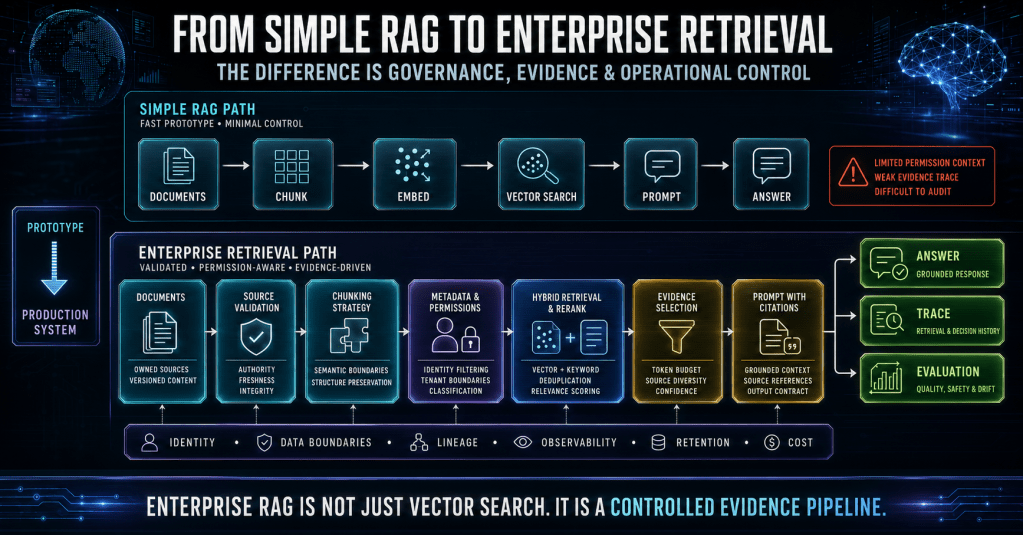
A basic RAG pipeline usually follows a simple path. Ingest documents, chunk them, embed the chunks, store them in a vector index, retrieve similar chunks, place them in the prompt, generate an answer.
That pattern can work. It can also hide several operational problems.
The source document may be outdated. The chunk may be semantically similar but factually irrelevant. The index may contain multiple versions of the same policy. The user may not have permission to see the retrieved content. The answer may blend conflicting sources. The system may not capture enough evidence to debug what happened.
This is why RAG should not be treated as a one-time implementation pattern. It should be treated like a production system with quality gates, lifecycle management, monitoring, and incident response.
The Basic Pipeline And The Production Gap
The diagram below shows the difference between a simple RAG path and an enterprise-ready retrieval path.

The difference is not cosmetic. The enterprise path adds control points where the system can prevent bad context from reaching the model or at least leave enough evidence to diagnose failure.
Common Failure Modes
Production RAG systems tend to fail in predictable ways.
| Failure Mode | What Happens | Practical Impact |
|---|---|---|
| Stale retrieval | Old content ranks higher than current content | Users receive outdated policy or process guidance |
| Duplicate versions | Multiple versions of a document appear in the same answer | The model blends conflicting information |
| Weak chunking | Chunks are too small or too large for the question | Retrieval misses context or injects noise |
| Permission leakage | Retrieved content ignores user authorization | Sensitive data appears in responses |
| Semantic mismatch | Similar language does not mean relevant evidence | Confident but incorrect answers |
| No retrieval evaluation | Nobody knows whether retrieval is improving | Teams tune prompts instead of fixing retrieval |
| Missing traceability | The answer cannot be tied back to sources | Incidents become opinion debates |
| Unclear fallback | The model answers when evidence is weak | Users trust unsupported output |
These are not exotic edge cases. They are normal enterprise data conditions.
Retrieval Needs A Quality Gate
The model should not receive retrieved content just because vector similarity returned something. Retrieval should pass through a quality gate.
That gate can include:
- Source freshness
- Source authority
- Permission check
- Metadata match
- Score threshold
- Reranking result
- Duplicate suppression
- Conflict detection
- Citation requirement
- Evidence sufficiency
The quality gate does not have to be perfect to be useful. Even simple checks can prevent obvious failures, such as mixing retired runbooks with current procedures.
A Practical RAG Decision Flow
The diagram below shows a production decision path. It is intentionally conservative because enterprise systems should prefer “not enough evidence” over fabricated certainty.

What matters here is the fail-closed behavior. A production RAG system should be allowed to say that it does not have enough evidence. That is not a weakness. It is a control.
Many RAG problems are caused by treating documents as plain text blobs. Enterprise documents need metadata.
Useful metadata may include:
- Document owner
- Business unit
- System or platform
- Environment
- Version
- Effective date
- Expiration date
- Confidentiality level
- Approved audience
- Source system
- Document type
- Review status
Without metadata, the retriever has no way to know whether a chunk belongs to the correct platform, audience, environment, or time period.
A vCF operations runbook, an Azure SDN design note, and a deprecated NSX migration plan may share vocabulary. Metadata helps the retrieval system understand that similarity is not enough.
A RAG Control Policy Example
The following YAML shows how a team might describe retrieval controls. This is not tied to a specific product. It is a practical pattern for making RAG behavior reviewable.
rag_policy:
  name: enterprise-knowledge-assistant
  retrieval:
    allowed_sources:
      - architecture_repository
      - approved_runbooks
      - service_catalog
    blocked_sources:
      - draft_documents
      - archived_wikis
    freshness:
      require_effective_date: true
      max_age_days_for_runbooks: 180
    permissions:
      enforce_user_acl: true
      deny_on_unknown_acl: true
    ranking:
      hybrid_search: true
      rerank_top_k: 20
      minimum_evidence_count: 2
    conflict_handling:
      detect_duplicate_versions: true
      prefer_latest_approved: true
      escalate_on_conflict: true
  response:
    require_citations: true
    allow_answer_without_evidence: false
    fallback_message: "I do not have enough approved evidence to answer this safely."
  observability:
    log_retrieved_chunks: true
    log_scores: true
    log_metadata: true
    retain_days: 180
The policy makes the intent visible. It also gives architecture, security, and operations teams something concrete to review.
Evaluation Should Test Retrieval Separately
A common mistake is evaluating only the final answer. That misses the most important part of the system.
RAG evaluation should separate at least three layers:
| Evaluation Layer | Question To Answer |
|---|---|
| Retrieval quality | Did the system retrieve the right evidence? |
| Context assembly | Did the prompt include enough usable context without noise? |
| Response quality | Did the answer correctly use the evidence and avoid unsupported claims? |
If the answer is wrong, teams need to know whether the model ignored good evidence or the retriever supplied bad evidence. Those are different problems with different fixes.
Retrieval metrics such as hit rate, precision, and mean reciprocal rank can help, but enterprise teams should also build scenario tests from real questions. For DTD-style architecture and operations content, that means testing real runbook questions, migration questions, version-specific questions, and failure scenarios.
Operational Ownership
A production RAG system needs owners beyond the AI team.
Content owners must decide which documents are authoritative. Security teams must define access boundaries. Platform teams must operate the index, pipeline, and runtime. Application owners must validate domain answers. Operations teams must investigate bad answers when users report them.
A useful ownership model looks like this:
Content Owner       -> source quality, approval, retirement
Security Team       -> ACLs, sensitive data, audit requirements
Platform Team       -> ingestion, index, runtime, monitoring
AI Team             -> retrieval strategy, evaluation, prompt behavior
Application Owner   -> domain validation and acceptance tests
Operations Team     -> incident handling and service reliability
Without this ownership split, RAG becomes an AI feature that nobody fully owns. That is how stale content and silent failures accumulate.
Practical Implementation Notes
Start with a narrow scope. One domain with known documents is better than indexing the entire company.
Create a source registry before building the index. If you cannot name the authoritative systems, the retriever cannot either.
Do not ingest everything. Excluding bad content is as important as including good content.
Use metadata from the beginning. Retrofitting metadata after users lose trust is much harder.
Test with real questions. Synthetic questions help, but operational users will ask messy, specific, context-heavy questions.
Log retrieval decisions. You should be able to reconstruct which chunks were retrieved, why they ranked, and how they shaped the answer.
Define fallback behavior. The system should know when not to answer.
Review failed answers as incidents. A bad answer from a production RAG system is not just a prompt issue. It may indicate content drift, permission failure, indexing problems, or retrieval regression.
Conclusion
RAG is not useless. Weak RAG is useless.
The difference is operational discipline. Enterprise retrieval needs source authority, metadata, access control, ranking strategy, evaluation, observability, and ownership. Without those controls, the model becomes the polished front end for a messy evidence pipeline.
Treat retrieval like a production system. Monitor it. Test it. Govern it. Give it owners. Build fallback behavior when evidence is weak.
That is how RAG becomes useful beyond the demo.
External References
LlamaIndex Introduction to RAG
https://developers.llamaindex.ai/python/framework/understanding/rag/
LlamaIndex Retrieval Evaluation
https://developers.llamaindex.ai/python/framework/module_guides/evaluating/
LlamaIndex Advanced Retrieval Strategies
https://developers.llamaindex.ai/python/framework/optimizing/advanced_retrieval/advanced_retrieval/
LlamaIndex VectorStoreIndex
https://developers.llamaindex.ai/python/framework/module_guides/indexing/vector_store_index/
NIST AI Risk Management Framework
https://www.nist.gov/itl/ai-risk-management-framework
NIST Generative AI Profile
https://nvlpubs.nist.gov/nistpubs/ai/NIST.AI.600-1.pdf
