


Most enterprise AI teams eventually run into the same problem. The model can reason, summarize, draft, and plan, but the business value appears when it can interact with real systems.
That is also where the risk starts.
An agent that can only answer questions is one class of system. An agent that can query a database, search a code repository, create a ticket, open a pull request, update a record, or trigger a workflow is something else entirely. At that point, the agent is no longer just generating text. It is crossing an enterprise boundary.
Model Context Protocol, commonly called MCP, is important because it gives teams a cleaner way to expose tools and context to AI systems. But the enterprise opportunity is not just easier integration. The bigger opportunity is standardizing the boundary between agents and the systems they touch.
Why MCP Matters Beyond Developer Convenience
Without a standard tool interface, every agent integration becomes custom glue. One team writes a wrapper for GitHub. Another writes a different wrapper for ServiceNow. Another writes a database connector. Each wrapper handles authentication, parameters, errors, logging, and permissions differently.
That approach does not scale. It also makes governance harder because the real control logic is scattered across scripts, notebooks, plugins, and application code.
MCP changes the conversation. Instead of wiring each model directly to each tool, teams can expose tools through MCP servers and let compatible clients discover and call those tools through a standard protocol.
That sounds like an integration pattern, and it is. But for enterprise architecture, it should also be treated as a control point.
The MCP Boundary At A Glance
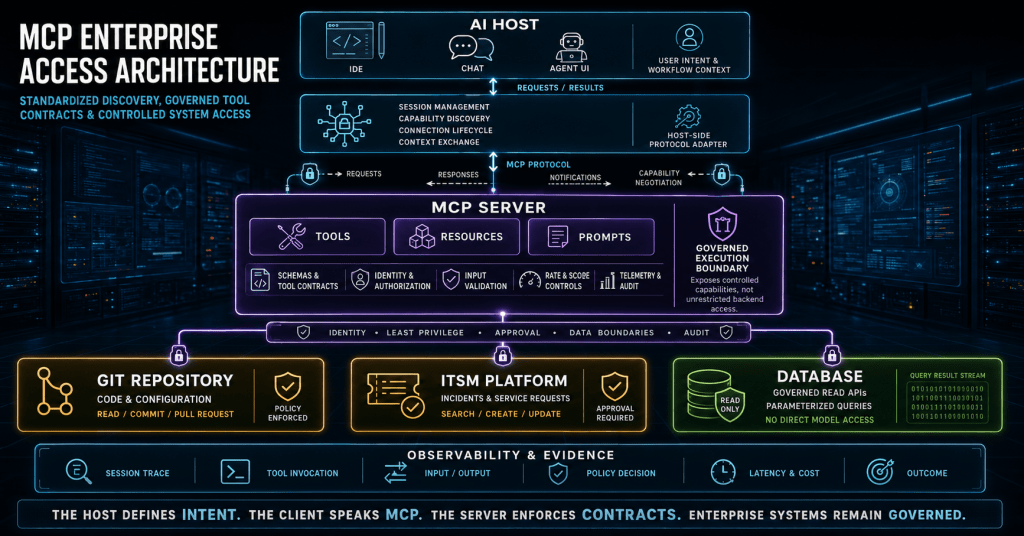
The diagram below shows the basic enterprise pattern. The AI host and client do not directly own every tool integration. MCP servers expose tools, resources, and prompts through a governed boundary.

The important point is not that MCP makes tool calls possible. Teams already had ways to make tool calls possible. The important point is that MCP gives architects a place to define contracts, permissions, logging, and lifecycle expectations.
A common mistake is treating MCP as a plug-in catalog. That is dangerous.
If every useful tool is exposed to every agent, the organization has created a new shadow integration layer. It may be more modern than the scripts it replaced, but it still has the same governance problem.
The better pattern is to treat MCP servers as governed interfaces. Each MCP server should have a scope, owner, authentication model, approval requirement, and logging expectation.
A production MCP tool should answer questions like:
- Who owns this tool contract?
- Which agents can discover it?
- Which identities can execute it?
- Is the tool read-only or read-write?
- What parameters are allowed?
- What happens when the tool fails?
- Is human approval required?
- Where is the execution logged?
- Can the action be rolled back?
Those answers should live outside the prompt.
A Practical MCP Control Model
The following model separates the model, the agent runtime, the MCP boundary, and the enterprise systems behind it. This keeps the agent from becoming the place where every control is hidden.
The architecture should make it obvious where policy is evaluated and where evidence is captured. If MCP is only used as a connectivity shortcut, the enterprise misses the most important design opportunity.
MCP tool contracts should be boring on purpose. The more powerful the agent, the more predictable the tool interface needs to be.
A useful tool contract should include:
| Contract Area | What To Define |
|---|---|
| Purpose | What the tool does and what it must not do |
| Inputs | Required fields, allowed values, validation rules |
| Identity | Whether the tool uses user identity, service identity, or delegated identity |
| Permission | Which agents or roles may call it |
| Approval | Whether a human must approve before execution |
| Side effects | Whether the tool changes system state |
| Evidence | What gets logged before and after execution |
| Failure behavior | Retry, fail closed, escalate, or require manual review |
| Rollback | Whether changes can be reversed |
This is where enterprise teams can avoid turning agents into unpredictable integration code. The contract narrows the agent’s action space.
The example below is not an MCP specification file. It is a practical governance wrapper that a platform team could maintain around MCP tool registration.
mcp_tool_registration:
  tool_name: create_change_request
  owner: platform-operations
  environment: production
  system_of_record: ITSM
  access_model:
    allowed_agents:
      - change-advisor-agent
      - release-coordinator-agent
    identity_mode: delegated_user
  execution:
    mode: write
    approval_required: true
    approval_group: change-managers
    timeout_minutes: 30
  validation:
    required_fields:
      - service
      - risk_level
      - implementation_plan
      - rollback_plan
    blocked_values:
      risk_level:
        - emergency_without_approval
  evidence:
    log_tool_input: true
    log_tool_output: true
    attach_trace_id: true
    retain_days: 365
  rollback:
    required: true
    rollback_field: rollback_plan
This is the kind of control metadata that makes MCP useful in an enterprise environment. The agent can still reason. The tool can still be reusable. But access and accountability are no longer hidden in prompt text.
Local AI And MCP Are A Natural Pair
MCP becomes even more interesting when paired with local or private AI systems.
Many organizations want local models for privacy, cost control, lower dependency on external APIs, or lab experimentation. But local models still need access to useful tools. Without a standard protocol, every local model stack becomes its own island of custom integrations.
MCP helps reduce that isolation. A local coding assistant, a private knowledge agent, and a cloud-hosted agent can potentially interact with the same governed tool boundary, assuming the clients and servers support the protocol and the organization has designed the security model correctly.
This does not mean every MCP server should be exposed to every local model. It means the integration boundary can become reusable while policy remains strict.
Security And Operations Caveats
MCP does not remove the need for security architecture. It gives security architecture a better place to attach.
The first caveat is identity. A tool call should not become anonymous just because a model initiated it. Enterprises need to decide whether MCP tools execute as the user, as a service account, or through delegated authorization.
The second caveat is tool poisoning and prompt injection. If an agent reads untrusted content and then calls tools, the system needs boundaries that prevent malicious instructions from becoming actions.
The third caveat is discoverability. Tool discovery is powerful, but broad discovery can become accidental privilege expansion. Agents should discover only the tools appropriate for their role and environment.
The fourth caveat is observability. Tool calls need trace IDs, input capture, output capture, error capture, and correlation back to the agent session.
The fifth caveat is lifecycle. MCP servers are software. They need versioning, testing, deployment controls, rollback, and ownership.
Where MCP Fits In A DTD Enterprise Architecture
For DTD readers, the useful mental model is simple: MCP is not the agent. MCP is not the model. MCP is the interface layer that can help agents interact with enterprise systems in a more standardized way.
That makes it adjacent to API gateways, service catalogs, platform engineering portals, and automation runbooks.
A mature enterprise MCP pattern should include:
- A tool registry
- An approval model for tool publication
- A permission model for tool discovery
- Environment separation
- Input and output validation
- Audit logging
- Versioned tool contracts
- Secure secret handling
- Incident response procedures
- Retirement process for unsafe or unused tools
This is how MCP moves from developer convenience to enterprise platform capability.
Conclusion
MCP is valuable because it simplifies agent integration. But its bigger value is architectural. It gives enterprise teams a place to standardize how agents discover tools, call tools, receive context, and leave evidence behind.
The danger is treating MCP as a shortcut around governance. The opportunity is treating MCP as the governed boundary between reasoning systems and enterprise action.
If your agent can touch a system that matters, MCP should not be introduced as a random connector. It should be introduced as part of the platform control plane.
That is where MCP becomes more than a protocol. It becomes part of the operating model for enterprise AI.
External References
KDnuggets, Building Local AI Systems: Qwen3.6 + MCPs
https://www.kdnuggets.com/building-local-ai-systems-qwen3-6-mcps
Model Context Protocol Introduction
https://modelcontextprotocol.io/docs/getting-started/intro
Model Context Protocol Architecture
https://modelcontextprotocol.io/docs/learn/architecture
Model Context Protocol Specification
https://modelcontextprotocol.io/specification/2025-11-25
Model Context Protocol Tools Specification
https://modelcontextprotocol.io/specification/2025-11-25/server/tools
Google ADK MCP Tools
https://google.github.io/adk-docs/tools/mcp-tools/
OpenAI Agents SDK
https://openai.github.io/openai-agents-python/
NIST AI Risk Management Framework
https://www.nist.gov/itl/ai-risk-management-framework
