



TL;DR
AI cost governance is not primarily an invoice-analysis problem. It is an identity, entitlement, and unit-economics problem.
A provider may identify the account, project, workspace, model, or API key that generated consumption. That still does not tell the enterprise which employee sponsored the work, which agent acted, which workflow caused the expense, which contract entitlement applied, or whether the run produced a useful business result.
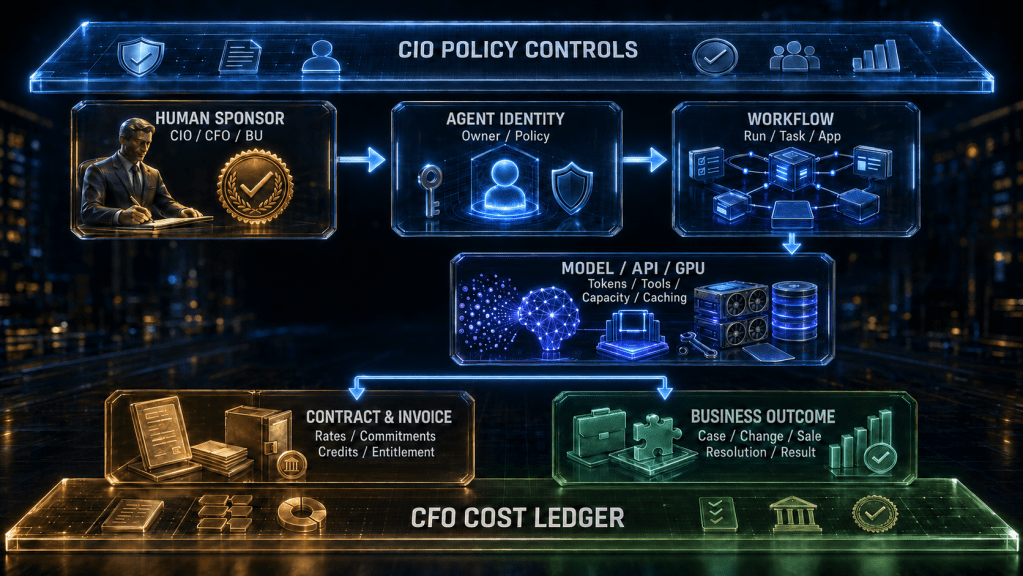
The CIO and CFO need a shared cost-governance chain that connects a named human sponsor to an agent identity, workflow, model or GPU resource, contract, invoice, and measurable outcome. That chain should be enforced through workload tagging, model tiering, premium-model approvals, run-level quotas, semantic caching, GPU allocation policies, showback, selective chargeback, and contract-to-inference reconciliation.
The goal is not simply to reduce tokens. It is to make every material AI cost explainable, governable, and economically defensible.
Introduction
Most enterprises can identify which vendor sent the AI invoice.
Far fewer can identify who truly caused the consumption.
A shared model account may support twenty applications. One application may host ten agents. An agent may execute several planning steps, retrieve documents, call tools, invoke specialist models, repeat failed operations, and use a GPU-backed service before returning one answer to the user.
Finance sees a provider invoice.
The platform team sees model endpoints and infrastructure.
The application team sees workflows.
The observability platform sees traces.
The business sponsor sees an outcome, or sometimes no outcome at all.
Each view is valid, but none provides the complete economic chain.
This is why AI cost forecasting becomes unreliable even when the provider bill is technically accurate. The invoice records consumption at the provider boundary. It does not automatically preserve the enterprise context that gave the consumption meaning.
A durable CIO-CFO framework must answer five questions:
- Who authorized the work?
- Which identity and workflow consumed the resources?
- Which entitlement or contract applied?
- What was the effective cost of the complete run?
- What business outcome justified that cost?
Until those questions can be answered together, the AI bill has no real owner.
The Invoice Is Not an Ownership Model
Cloud and AI platforms are improving their cost-management capabilities.
OpenAI exposes organization cost data that can be grouped by dimensions such as project, API key, and line item. Anthropic provides workspace controls, usage reporting, cost reporting, spend limits, and rate limits. Microsoft Foundry supports project-level cost views and chargeback patterns. Amazon Bedrock supports combinations of identity attribution, application inference profiles, tags, projects, and request metadata. Google Cloud allows custom metadata labels to be attached to generative AI requests.
These capabilities are useful, but they are provider-level fragments of a larger enterprise model.
A project identifier does not necessarily reveal the business sponsor.
An API key does not prove which agent or workflow used it.
A model name does not explain why a premium model was selected.
A token count does not show whether the run succeeded.
A GPU utilization metric does not reveal which business result the accelerator produced.
A cost-allocation tag does not prove that the tag was correct, current, or authorized.
The enterprise therefore needs an internal attribution layer that enriches provider billing data with identity, workflow, contract, and outcome evidence.
The key architectural principle is straightforward:
Billing dimensions describe where consumption was recorded. Governance dimensions explain why the consumption was allowed and who is accountable for it.
The CIO-CFO AI Cost Governance Chain
The following model connects technical consumption to financial and business accountability.
The most important feature of this model is not the final cost calculation. It is the preservation of ownership across every boundary.
| Governance layer | Required evidence | Primary accountability |
|---|---|---|
| Human sponsor | Named business owner, budget, purpose, acceptable risk | Business leader |
| Agent identity | Agent ID, version, runtime identity, owner | Agent or application owner |
| Workflow | Workflow ID, run ID, task class, environment | Product or process owner |
| Consumption | Tokens, model calls, tools, APIs, storage, GPU allocation | AI platform and engineering teams |
| Contract | Provider, rate card, commitment, credits, entitlement | Procurement, FinOps, and finance |
| Outcome | Success state, quality gate, reversal, human acceptance | Business service owner |
| Unit economics | Effective cost per accepted outcome | CIO, CFO, and business sponsor |
A missing link weakens the entire chain.
When multiple agents share one API key, attribution breaks at the identity layer. When every run is labeled only as production, attribution breaks at the workflow layer. When the business outcome is not recorded, the organization can optimize consumption but cannot prove value.
Assign Named Ownership Before Granting Consumption
Every production AI service should have a named owner before it receives a production credential, premium model entitlement, or GPU allocation.
The ownership model should distinguish at least three roles.
The business sponsor owns the reason the AI capability exists. This person approves the intended outcome, acceptable service level, funding source, and tolerance for cost variability.
The sponsor should be able to answer:
- What business process is being improved?
- What outcome is expected?
- What is the maximum acceptable unit cost?
- Which failures require escalation?
- When should the capability be stopped?
Service owner
The service owner is accountable for the end-to-end AI application or agent. This owner coordinates the model, orchestration, retrieval, tools, telemetry, release process, and operational support.
A platform team may operate the shared runtime, but it should not automatically become financially accountable for every workload using that runtime.
Financial owner
The financial owner approves the cost center, budget, forecast, contract treatment, and showback or chargeback method.
In some organizations, the business sponsor and financial owner will be the same person. In others, the roles will be separate. What matters is that the records are explicit.
A shared mailbox, team name, or generic innovation budget is not sufficient ownership for a production agent.
Treat Agent Identity as a Financial Control
Agent identity is normally discussed as a security concern. It should also be treated as a financial control.
A production agent should have a stable identifier that survives across:
- model providers
- API gateways
- orchestration services
- tool brokers
- observability platforms
- cloud accounts
- Kubernetes namespaces
- GPU schedulers
- cost-management systems
- business-process systems
The agent identifier should be paired with its version because a new version can materially change consumption. Adding retrieval, a tool catalog, another planning loop, longer context, or a specialist-agent handoff can change the cost profile even when the agent name remains the same.
The runtime should also preserve the identity of the requesting user, application, or upstream agent. That allows the enterprise to distinguish between:
- agent-owned consumption
- user-delegated consumption
- scheduled workflow consumption
- system-initiated consumption
- multi-agent delegated consumption
This does not mean exposing personal data throughout the billing system. Organizations can use governed internal identifiers, pseudonymous user references, or approved aggregation boundaries.
The important point is that the cost event must remain tied to a governed actor.
Tag the Workload Before It Consumes
Tagging should happen when the request enters the governed AI path, not during month-end cleanup.
A practical AI cost-attribution schema should include fields such as:
| Dimension | Purpose |
|---|---|
business_unit |
Identifies the organizational consumer |
cost_center |
Connects usage to financial reporting |
sponsor_id |
Identifies the accountable business sponsor |
agent_id |
Identifies the agent or AI service |
agent_version |
Distinguishes materially different releases |
workflow_id |
Identifies the business or technical workflow |
run_id |
Correlates individual execution activity |
environment |
Separates development, test, and production |
task_class |
Supports model routing and unit economics |
model_tier |
Identifies standard, advanced, or premium access |
provider |
Identifies the model or infrastructure provider |
contract_id |
Connects usage to contractual terms |
outcome_type |
Defines the expected business result |
tenant_id |
Supports customer or tenant attribution where appropriate |
data_classification |
Controls caching, logging, and approved processing paths |
Not every dimension belongs in every provider tag.
Cloud and monitoring platforms may limit the number of dimensions, the allowed cardinality, or how tags flow into billing records. High-cardinality identifiers such as individual run IDs may belong in traces and a cost-event lake rather than in the provider’s native billing tags.
A good pattern uses several linked records:
- Low-cardinality business and ownership tags in provider billing
- Agent and workflow metadata at the AI gateway
- Run-level identifiers in traces and invocation logs
- Outcome evidence in the business system of record
- Contract and invoice data in the FinOps or finance platform
The correlation identifier connects the records without forcing every system to store every dimension.
Measure Cost per Business Outcome
Cost per token is useful for engineering analysis.
It is not the final business metric.
An agent workflow may use fewer tokens while producing more failed actions. A smaller model may reduce the price of each call but increase retries, escalations, or human rework. A premium model may cost more per request while reducing the number of total steps required to complete the task.
The complete economic unit should include all material costs associated with delivering the outcome.
Total AI Workflow Cost =
    model input cost
  + model output cost
  + cached token reads and writes
  + embedding and retrieval cost
  + vector database cost
  + tool and external API cost
  + orchestration and sandbox cost
  + observability and evaluation cost
  + allocated GPU or infrastructure cost
  + human review and rework cost
  + failed run and retry cost
The primary unit-economic metric should then be:
Cost per Accepted Outcome =
    Total Attributable AI Workflow Cost
    -----------------------------------
    Number of Outcomes Accepted by the Business
The denominator matters as much as the numerator.
An accepted outcome could be:
- a customer case resolved without reopening
- an incident accurately triaged
- a remediation successfully executed and validated
- a software change merged after review
- an invoice processed without correction
- a document approved by the responsible employee
- a qualified lead created
- a compliance review completed with sufficient evidence
The metric should include quality or reversal conditions. A customer case that reopens two hours later should not necessarily count as a successful resolution. An agent-generated change that must be rolled back should not count as a clean deployment outcome.
Unit economics gives the CIO and CFO a shared language. Engineering can still optimize tokens, latency, and cache hits, while finance can evaluate cost per useful result.
Model Tiering Should Be an Entitlement
Model selection should not be an unrestricted application preference.
The enterprise should define model tiers based on cost, capability, latency, context, data controls, and service characteristics.
| Model tier | Intended use | Default access | Governance |
|---|---|---|---|
| Standard | Classification, extraction, summarization, routine assistance | Broad, within quotas | Automatic routing and monitoring |
| Advanced | Complex synthesis, difficult reasoning, higher-risk decisions | Approved workflows | Routing criteria and evaluation evidence |
| Premium | Long-context, high-cost, priority, or highest-capability workloads | Restricted | Explicit entitlement, budget, and approval |
| Specialized | Fine-tuned, private, domain, or regulated models | Use-case specific | Model owner, contract, lifecycle, and validation controls |
The correct goal is not always to select the cheapest model.
The goal is to select the lowest-cost model that meets the required quality, safety, latency, and reliability criteria for that task.
Premium-model approval should be represented as a governed entitlement containing:
- approved agent or workflow
- authorized task classes
- business sponsor
- cost center
- maximum run cost
- monthly or quarterly allowance
- approval start and expiration dates
- permitted environments
- escalation criteria
- fallback model
- exception owner
This avoids forcing a human to approve every individual prompt while still preventing unlimited premium access.
A routing engine can then use task class, confidence, risk, and quality criteria to decide when escalation is justified. The decision and selected model tier should be recorded in the trace.
Put Quotas at the Workflow Boundary
Provider-level quotas are necessary, but they are not enough.
An organization-wide spend limit can stop the total bill from growing indefinitely. It cannot prevent one poorly designed agent from exhausting the shared allowance and disrupting every other workload.
Quotas should exist at several levels:
- organization
- business unit
- project or workspace
- application
- agent
- workflow
- individual run
- user or tenant, where appropriate
- model tier
- contract entitlement
- GPU service class
The run boundary is particularly important for agentic systems.
One user request may trigger multiple model calls, tool calls, retries, validation steps, retrieval operations, and delegated agents. Limiting only the tokens in one model request does not control the total workflow cost.
A run-level budget can enforce limits for:
- cumulative input and output tokens
- cached token reads and writes
- total model calls
- premium model calls
- tool calls
- retrieval volume
- delegation depth
- retries
- elapsed runtime
- sandbox or code-execution time
- external API expense
- GPU time
- estimated total cost
When a limit is reached, the system should follow an explicit policy:
- return the best partial result
- route to a lower-cost model
- request human approval
- pause the workflow
- create an exception
- stop execution
- transfer the task to a human
A quota without a defined exhaustion path creates a new failure mode.
Use Semantic Caching Selectively
Caching can reduce repeated model work, but it must be governed as part of the application design.
There are several distinct patterns:
Provider prompt caching
Provider prompt caching can reduce the cost of repeatedly processing stable instructions or shared context. It is useful when a large prefix is reused across requests.
Exact response caching
Exact caching returns a stored response when the request and relevant context are identical. This is generally easier to reason about than similarity-based caching.
Semantic response caching
Semantic caching can return a prior response for a new request that is judged sufficiently similar. This can avoid a model invocation and reduce latency, but it introduces additional correctness, freshness, privacy, and tenant-isolation concerns.
Semantic caching should define:
- eligible task classes
- similarity threshold
- cache partition
- tenant and identity boundary
- data classification
- maximum age
- invalidation event
- model and prompt version
- quality validation
- prohibited use cases
Do not use semantic caching merely because it improves the cache-hit rate.
It may be unsuitable for:
- current account balances
- live infrastructure state
- privileged action decisions
- regulatory interpretations
- security findings
- rapidly changing policies
- personalized sensitive data
- workflows where a stale answer could trigger action
Cache savings should also be measured honestly. Track avoided backend calls, cache storage and embedding cost, false-hit rate, invalidation overhead, and any human rework caused by stale or incorrect responses.
Treat GPU Cost as Capacity Allocation
Token-based services are metered per request.
GPU platforms often have a different economic structure.
The organization may own the hardware, lease it, reserve cloud capacity, purchase provisioned throughput, or operate a shared private AI platform. A large portion of the cost may exist whether the GPU is busy or idle.
A defensible GPU service cost should include:
GPU Service Cost =
    amortized hardware or committed capacity
  + support and software
  + facilities, power, and cooling
  + platform engineering and operations
  + storage and networking
  + resilience and maintenance reserve
The enterprise must then decide how to allocate that service cost.
Possible allocation measures include:
- dedicated GPU-hours
- scheduled GPU-hours
- active GPU time
- GPU memory residency
- MIG instance-hours
- provisioned endpoint-hours
- reserved capacity
- queue priority
- service-class entitlement
- completed training or inference work
- a blended weighted unit
No single measure is correct for every platform.
A training job that reserves eight GPUs for six hours has a different cost profile from a time-sliced notebook that intermittently uses one shared accelerator. An online inference endpoint may require idle headroom to preserve latency. A regulated workload may require dedicated capacity even when utilization is low.
That idle capacity may be a deliberate service requirement, not waste.
The cost model should distinguish:
- workload consumption
- platform overhead
- resilience reserve
- unallocated idle capacity
- strategic capacity held for future demand
- stranded capacity caused by placement or fragmentation
Do not promise precise workload chargeback when the platform cannot produce precise workload telemetry. For example, some GPU sharing configurations can reduce container-level metric attribution. In those cases, showback based on reservation or scheduler allocation may be more honest than a false usage-based calculation.
Use Showback Before Chargeback
Showback makes costs visible without directly transferring them to the consuming team.
Chargeback assigns the cost to the team’s financial records.
Both approaches can change behavior, but chargeback requires stronger evidence.
Showback is appropriate when
- the attribution model is still maturing
- shared infrastructure costs require estimates
- ownership metadata is incomplete
- teams need time to validate reports
- disputes are expected
- the goal is behavioral awareness
- the organization is still defining unit economics
Chargeback is appropriate when
- named ownership coverage is high
- tag and identity enforcement is reliable
- shared-cost allocation rules are documented
- effective contract rates are available
- outcome definitions are stable
- corrections and disputes have an owner
- teams can influence the cost they are being charged
- the allocation method is repeatable and auditable
Chargeback should not punish teams for platform costs they cannot control.
A business unit should not receive the full cost of idle failover capacity unless it requested a dedicated resilience profile. A workload should not be charged based on list pricing when the enterprise receives a negotiated effective rate. A project should not absorb another team’s untagged consumption simply because it shares the same account.
Start with showback, improve the evidence, and move to chargeback only where the allocation is defensible.
Reconcile the Contract to the Inference Event
List-price estimates are not the same as effective cost.
AI contracts may contain:
- committed spend
- prepaid credits
- volume tiers
- negotiated discounts
- minimum usage
- provisioned throughput
- reserved capacity
- priority service tiers
- regional differences
- cached token rates
- batch rates
- marketplace fees
- expiration rules
- overage pricing
- unused commitment treatment
The enterprise needs contract-to-inference reconciliation, not just invoice ingestion.
A practical reconciliation flow looks like this:
FOCUS provides an increasingly useful vendor-neutral foundation for cost, usage, contract commitment, and invoice reconciliation. Its contract and invoice datasets can help finance connect billed charges to commitments and payable invoices.
That does not eliminate the need for an enterprise AI extension.
The internal cost record still needs dimensions such as:
- agent ID
- workflow ID
- model identity
- model tier
- token categories
- cache behavior
- request metadata
- tool consumption
- GPU allocation
- business outcome
- human acceptance
The provider invoice should be reconciled to the internal event model, not treated as a substitute for it.
Build One Cost Event Model Across Providers
A multi-provider enterprise should avoid creating a completely different economic model for each AI platform.
The ingestion details will vary, but the normalized event should be consistent.
A useful internal event could contain:
cost_event:
  event_id: "evt-7f3d2"
  timestamp: "2026-07-31T14:42:18Z"

  ownership:
    business_unit: "customer-operations"
    cost_center: "CC-2040"
    sponsor_id: "sponsor-184"
    service_owner: "ai-service-operations"

  workload:
    agent_id: "case-resolution-agent"
    agent_version: "3.4.1"
    workflow_id: "resolve-customer-case"
    run_id: "run-928471"
    environment: "production"
    task_class: "case-resolution"

  entitlement:
    model_tier: "advanced"
    contract_id: "ai-contract-07"
    premium_approval_id: null

  consumption:
    provider: "provider-a"
    model_id: "advanced-reasoning-model"
    input_tokens: 18420
    output_tokens: 2360
    cached_input_tokens: 10400
    model_calls: 4
    tool_calls: 3
    gpu_seconds: 0

  outcome:
    outcome_type: "case-resolved"
    outcome_status: "accepted"
    quality_gate: "passed"
    human_rework_minutes: 0

  finance:
    estimated_cost: 0.184
    effective_cost: 0.161
    currency: "USD"
    allocation_method: "direct"
This is an enterprise schema example, not a vendor-specific configuration.
The important behavior is that the record can be joined to:
- the execution trace
- the agent registry
- the identity system
- the model catalog
- the contract register
- the provider invoice
- the business outcome system
Enforce Cost Governance as Policy
Cost controls should be applied before and during execution, not only reviewed after the invoice arrives.
The following generic policy contract shows how ownership, entitlements, quotas, routing, caching, and outcome evidence can be combined.
policy_id: AI-COST-001
name: Govern production agent consumption
owner: CIO-CFO AI Cost Council
default_action: deny

scope:
  environments:
    - production
  workload_types:
    - agent
    - generative-ai-application
    - gpu-inference-service

required_attribution:
  - business_unit
  - cost_center
  - sponsor_id
  - agent_id
  - agent_version
  - workflow_id
  - run_id
  - task_class
  - contract_id
  - outcome_type

model_entitlements:
  standard:
    approval_required: false
  advanced:
    approval_required: false
    allowed_task_classes:
      - complex-synthesis
      - case-resolution
      - incident-triage
  premium:
    approval_required: true
    approval_ttl_days: 30
    maximum_run_cost_usd: 5.00

run_limits:
  maximum_model_calls: 12
  maximum_tool_calls: 20
  maximum_retries: 2
  maximum_delegation_depth: 3
  maximum_estimated_cost_usd: 3.00
  maximum_elapsed_seconds: 300

routing:
  default_tier: standard
  escalate_on:
    - evaluation_threshold_not_met
    - approved_high_risk_task
  fallback_tier: standard

caching:
  semantic_cache_allowed: true
  prohibited_data_classes:
    - restricted
    - regulated
  require_tenant_partition: true
  maximum_age_seconds: 900

outcome_evidence:
  required: true
  accepted_statuses:
    - accepted
    - completed
    - validated

on_violation:
  - stop_run
  - emit_cost_governance_event
  - notify_service_owner
The exact enforcement points will vary by platform.
Controls may be implemented through:
- AI gateways
- API management
- model routers
- agent runtimes
- Kubernetes admission controls
- GPU schedulers
- identity policies
- workflow engines
- CI/CD release gates
- FinOps platforms
- observability collectors
The policy should remain portable even when the implementation changes.
Define the CIO-CFO Operating Model
AI cost governance is not owned exclusively by finance or IT.
It requires coordinated decision rights.
| Role | Primary responsibility |
|---|---|
| CIO | Platform strategy, engineering controls, operating model, technical accountability |
| CFO | Financial policy, forecasting, materiality, chargeback rules, executive reporting |
| Business sponsor | Outcome, budget, acceptable unit cost, continuation decision |
| FinOps team | Allocation, anomaly analysis, effective rates, unit economics, forecasting |
| Procurement | Contract terms, commitments, credits, renewal and termination rights |
| AI platform team | Gateways, routing, quotas, telemetry, shared services, cost-event pipeline |
| Agent or application owner | Workflow efficiency, release changes, quality, run-level budgets |
| Infrastructure team | GPU capacity, allocation, platform overhead, utilization, resilience reserve |
| Security and identity teams | Workload identity, entitlement, privileged access, policy evidence |
| Data owners | Data access, classification, caching restrictions, retention |
| Internal audit or risk | Control testing, evidence review, exception oversight |
The CIO and CFO should jointly govern the economic control plane, but the business sponsor must remain accountable for whether the outcome is worth funding.
Shared governance cannot mean anonymous accountability.
Implement the Framework in Phases
An enterprise does not need perfect cost attribution before taking action.
It does need a deliberate progression.
Discover anonymous consumption
Inventory:
- provider accounts and subscriptions
- projects and workspaces
- API keys and service accounts
- agents and applications
- model endpoints
- premium model access
- GPU clusters and schedulers
- contracts and commitments
- current cost reports
- untagged or shared usage
The first objective is to identify consumption that has no named owner.
Establish identity and required dimensions
Create a registry connecting:
- sponsor
- service owner
- agent identity
- workflow
- environment
- cost center
- model entitlement
- contract
- outcome definition
Block new production onboarding when required ownership fields are missing.
Enforce the governed consumption path
Route production model traffic through approved gateways, runtimes, or brokers that can apply:
- identity
- attribution metadata
- quotas
- model routing
- caching policy
- telemetry
- anomaly detection
- shutdown controls
Avoid direct provider keys embedded across applications.
Build unit economics and showback
Start with a small set of important workflows.
Calculate:
- cost per run
- cost per successful run
- cost per accepted outcome
- failure and retry cost
- premium-model percentage
- cache savings
- GPU allocation
- human rework
Publish showback reports to owners before transferring costs.
Reconcile contracts and invoices
Join normalized consumption to:
- effective rates
- discounts
- commitments
- credits
- reservations
- invoice line items
- adjustments
- unused capacity
Investigate material differences between estimated and billed cost.
Introduce selective chargeback
Apply chargeback only where:
- ownership is complete
- allocation is explainable
- rates are reconciled
- shared costs have documented rules
- owners can influence consumption
- disputes can be resolved
- business outcomes are defined
Keep genuinely shared platform services in a separate platform-cost pool when direct allocation would create false precision.
Questions the CIO and CFO Should Review Together
A quarterly AI cost-governance review should be able to answer:
- What percentage of AI spend has a named business sponsor?
- What percentage can be attributed to a production agent or application?
- Which workflows use premium models, and why?
- What is the effective cost per accepted business outcome?
- How much spend is associated with failed runs, retries, and rework?
- Which agents have no enforceable run-level budget?
- Which GPU costs are direct, shared, idle reserve, or unallocated?
- How much contract commitment remains unused?
- Are invoice costs reconciling to normalized usage?
- Which caches produce verified savings without unacceptable quality risk?
- Which teams receive showback, and which costs are mature enough for chargeback?
- Which agents should be optimized, redesigned, suspended, or retired?
An executive dashboard that cannot answer these questions is a spend dashboard, not a governance system.
Conclusion
The AI bill is only the end of the economic chain.
The governance work begins upstream, where a human sponsor authorizes an agent, the agent enters a workflow, the workflow selects models and tools, and the platform allocates tokens, APIs, storage, or GPU capacity.
The CIO-CFO framework should preserve that chain all the way from identity to outcome. Named ownership, workload tagging, model entitlements, run-level quotas, selective caching, GPU allocation, unit economics, and contract reconciliation are not separate optimization projects. They are parts of one AI cost control plane.
The practical objective is not to make every model call cheap.
It is to ensure that material AI consumption is authorized, attributed, bounded, reconciled, and connected to a result the business considers worth paying for.
When the enterprise can explain who sponsored the work, which agent acted, what resources were consumed, which contract applied, and what outcome was achieved, the AI bill finally has an owner.
