

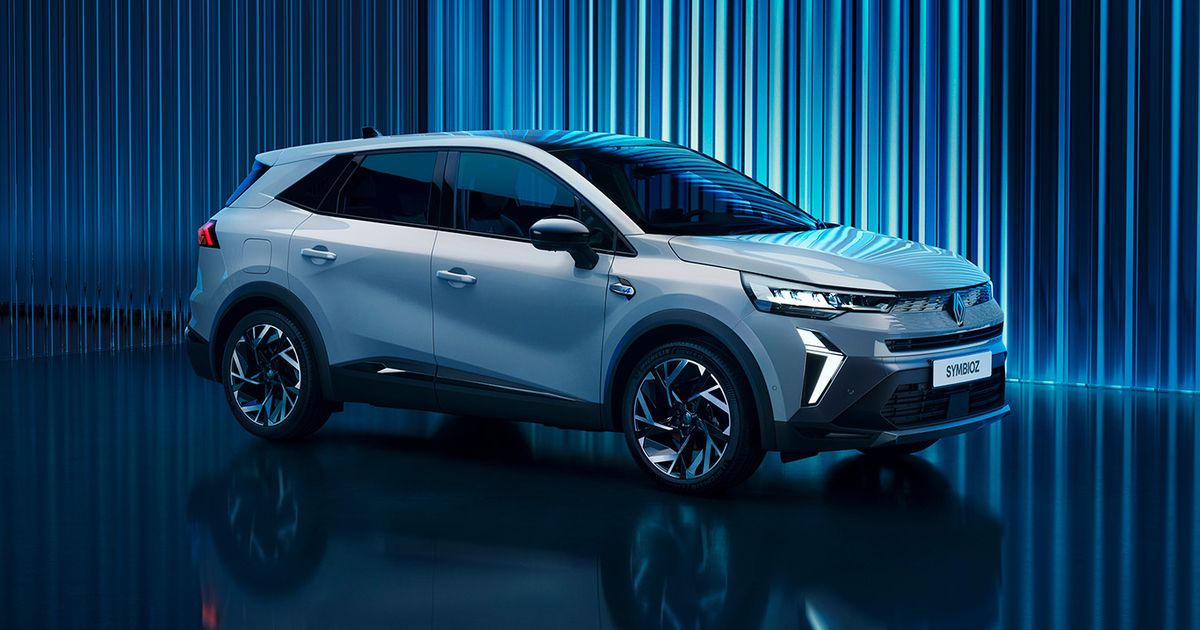

Renault has launched a new small SUV in Australia, and now it has provided a brief insight as to why it’s gone for an entirely new model and not an updated version of an existing nameplate.
The Symbioz is that SUV, and it arrives as part of an 18-month model onslaught for the French brand in Australia, where it effectively replaces the Renault Captur, for which a substantial update was expected to arrive locally in late 2025 – but never eventuated.
Of course, the updated Captur did technically arrive here in the form of the new Mitsubishi ASX, but Renault itself had been without an up-to-date small SUV until the arrival of the Symbioz this month.
Despite the radio silence surrounding the Captur, Renault Australia general manager Glen Sealey stated it hasn’t been ruled out permanently – it just isn’t the correct vehicle at this time.

“It’s never off. There’s a great catalogue of cars that we can draw upon,” he told media at the Australian launch of the Symbioz.
“But when we looked at Captur, and we looked at Symbioz – and we look at the range that we have today when you consider we have Duster, we have Arkana, we have Megane E-Tech, and we have Scenic – certainly the better positioning for us was with Symbioz as opposed to Captur.
“It had a much better fit in our model range than Captur. That doesn’t mean Captur will never be there, but today we will stick with Symbioz.”
Indeed, several factors are working in favour of the Symbioz, one being that it’s noticeably larger than the Captur. The Symbioz is 4412mm long compared to 4238mm for the Captur, giving it a more spacious interior – its boot capacity is almost 100 litres larger.
That places it in closer contention with segment leaders like the Toyota Corolla Cross Hybrid, especially so given it’s also Renault’s first model in Australia with a plugless hybrid powertrain.
The Symbioz is available at launch with both mild- and full-hybrid powertrains, the latter of which incorporates a 1.4kWh lithium-ion battery and can be driven on electric power alone. While hybrid powertrains exist for the Captur overseas, the Symbioz’s larger size was likely more appealing to Renault Australia.
But a key consideration will also have been the Captur-based Mitsubishi ASX. The Japanese brand hasn’t been able to spark the same success the ASX nameplate once did – it sold just 1110 examples of the more expensive new Renault-based ASX in the first seven months of 2026, a massive 85.2 per cent year-on-year decline.
Importantly, the new Symbioz also has a cheaper entry price than the ASX. It starts at $36,990 before on-road costs in mild-hybrid guise, while the base ASX starts at $37,740 plus on-roads.
Those factors line up with statements made by Mr Sealey when the Symbioz was confirmed for Australia earlier this year.
“We know not everyone wants to drive a ‘same-same’ SUV and we know this car will earn its place in this market,” he said at the time. “We have worked very hard with the factory to ensure the new Renault Symbioz is well equipped, delivers excellent real-world fuel economy, and will be available at an attainable price point.”
With Renault’s model revitalisation in full swing, Mr Sealey said he’s satisfied with the breadth of the brand’s models now available in local showrooms. Alongside the Symbioz are models like the Duster, the electric Scenic E-Tech, and most recently, the new-generation Master van.
“We’re very happy with the lineup we’ve got. Very happy with having a mix of [petrol and diesel power], mild-hybrid, hybrid, and full electrification, and given the size of our brand, we don’t want it too complex either,” he said.
MORE: 2026 Renault Symbioz – New small SUV locked in for Australia with hybrid power
MORE: Explore the Renault Symbioz showroom
