


# Introduction
Something has shifted at the intersection of AI and data science, and it’s changed how practitioners work. The systems deployed today don’t just generate a response and stop. They plan. They execute multi-step tasks. They call external tools, evaluate their own outputs, and loop back when results fall short.
We’re not entering the agentic era anymore. We’re living in it. This period is defined by AI systems executing autonomous, goal-directed behavior, and it has rewritten what data scientists actually do day-to-day.
The role has always demanded a rare combination of statistical thinking, programming ability, and domain expertise. A fourth dimension is now the baseline: the ability to design, deploy, and evaluate systems that act independently on behalf of users. Ignore this shift, and your productivity will fall behind your peers. Engage with it seriously, and your effectiveness compounds across everything you touch.
# Redefining the Baseline
To understand what’s at stake, let’s look at what an AI agent actually does in production today. An agent is a system that perceives its environment, reasons about its next move, takes actions using available tools, and evaluates the results.
Unlike a traditional large language model (LLM) interaction, where you submit a prompt and receive a single static response, an agent operates in continuous, iterative loops. It receives a goal, selects a tool, observes the result, updates its reasoning, and either pivots or pushes forward. This cycle can unfold across dozens of discrete steps behind the scenes.
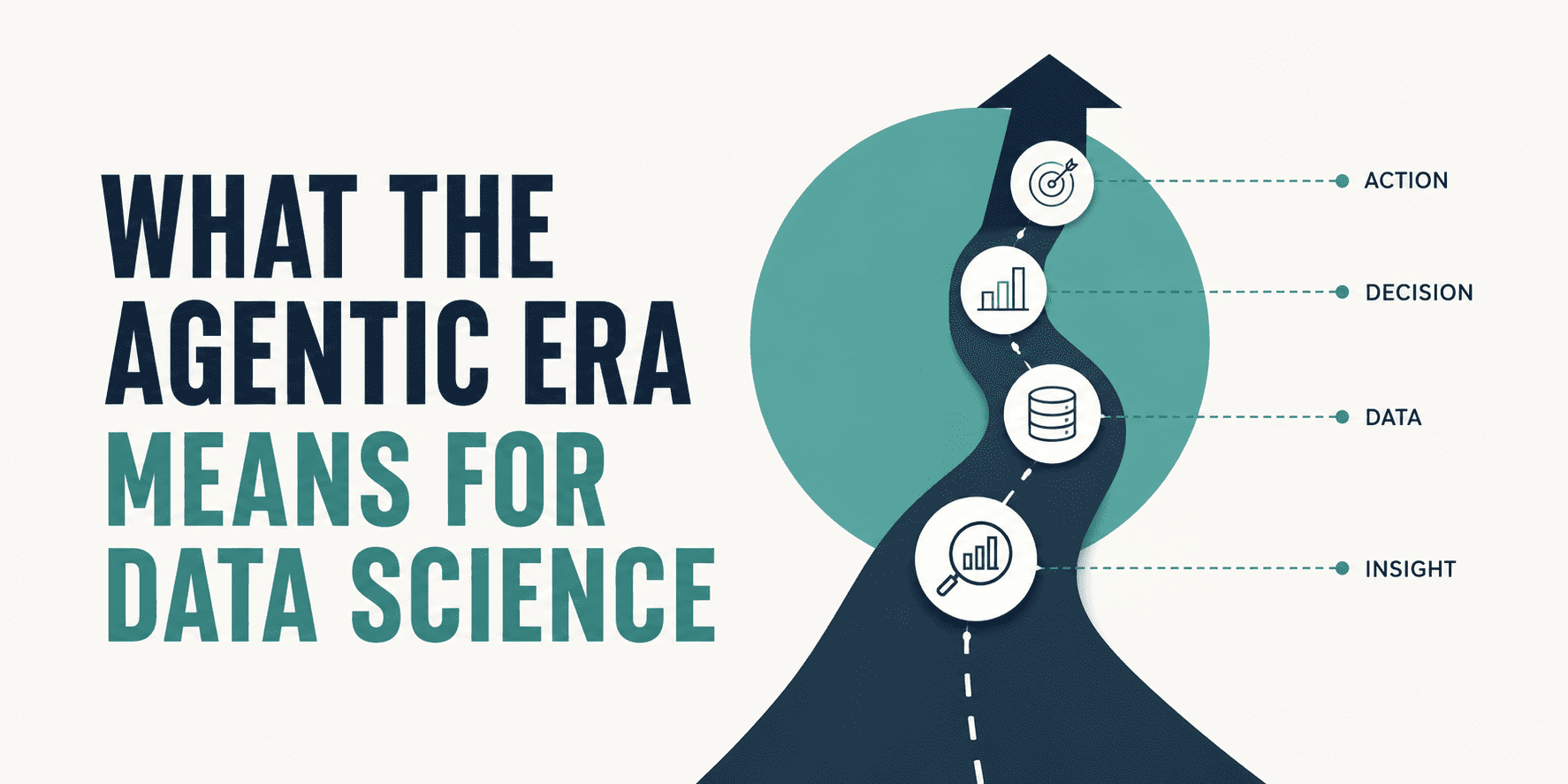
What makes this paradigm distinct is native tool integration. In a modern data science context, an agent can retrieve a dataset, scrub it, run exploratory analysis, train a baseline model, evaluate results, and produce a structured report — all without human intervention during the procedural steps.
# The Orchestration Ecosystem
The frameworks making this possible have matured from experimental libraries into production-grade orchestrators. They all operate on the same core principle — giving a model structured access to tools and the reasoning engine to use them — but they take distinct approaches depending on the workflow.
| Framework | Design Philosophy | Primary Data Science Use Case | 2026 Context |
|---|---|---|---|
| LangGraph | Graph-based workflow orchestration. | Complex, conditional pipelines requiring state management. | Industry standard for production-grade workflows, both single- and multi-agent, where explicit state management and conditional branching are required. |
| AutoGen | Multi-agent conversational patterns. | Collaborative scenarios where agents debate or verify outputs. | Good fit for built-in review steps, where a critic agent interrogates a coder agent’s reasoning. Note: the v0.2 and v0.4/AG2 architectures differ significantly, so check which version your documentation targets before diving in. |
| smolagents | Code-first, minimalist execution. | Code-heavy tasks using the full Python scientific stack. | A natural fit for data scientists already comfortable in pure Python environments. |
# Shifting the Workflow: From Procedural to Evaluative
The most immediate impact on daily work is the automation of routine workflows. Take a standard exploratory data analysis (EDA) pipeline. A data scientist used to manually import data, generate summary statistics, visualize distributions, and hunt for outliers. Today, a well-designed agent executes every one of those steps on instruction, documents observations in structured formats, and flags anomalies for human review.
This extends into machine learning engineering too. Pipelines that once demanded manual iteration across preprocessing choices, model selection, and hyperparameter tuning are now largely managed by agentic orchestration, reducing — but not eliminating — the need for human judgment at key decision points.
That last part matters. This doesn’t eliminate the data scientist. It reshapes the role toward higher-order decisions. Agents absorb the procedural weight; you retain the evaluative weight. Agents handle the “how do I do this again” repetition that consumes hours. You handle the “is this the right thing to do” judgment that no model can replicate.
# The 2026 Skill Stack
Technical proficiency in Python, statistics, and machine learning remains the irreducible foundation. But the agentic reality demands a new tier of competencies built on top of that base.
- System Design and Prompt Engineering: Agents follow instructions, and the architecture of those instructions sets the ceiling on output quality. This goes well beyond writing a clear prompt. When designing an agent, you’re making decisions that determine how it behaves across hundreds of different inputs: how to decompose a high-level objective into executable sub-tasks, how to define constraints so the agent doesn’t fill in gaps on its own, and how to specify output formats so downstream steps can consume results without ambiguity. Treat prompt engineering the same way you treat software design. Version your prompts, test them against edge cases, and document your reasoning. A prompt that works on ten examples but breaks on the eleventh isn’t production-ready.
- Tool Design and Integration: Agents are only as capable as the tools they can use. A tool is any function an agent can call to interact with the outside world: a database query, a web scraper, an API call, or a script that runs a statistical test. If your tool accepts bad inputs silently or returns ambiguous outputs, the agent will propagate those errors through every subsequent step. Good tool design means typed inputs, structured error messages the agent can reason about, and consistent return formats. Think of each tool as a contract: here’s what I accept, here’s what I return, here’s what happens when something goes wrong.
- Agent Observability: When an agent executes a long chain of sequential steps, debugging requires structured evaluation frameworks. Agent failures are often non-obvious. A traditional software bug produces an error at a specific line. An agent failure might look like a perfectly reasonable sequence of steps that produces a subtly wrong result several stages later. Without tracing, you have no way to reconstruct what actually happened. At minimum, log the inputs and outputs at each tool call, the agent’s reasoning at each decision point, and the final output alongside the original goal. Tools like LangSmith and Langfuse are worth knowing here. With that data, you can build systematic evaluations and identify where the agent tends to go off track.
- Multi-Agent Architecture: Complex tasks are routinely split across specialized agents — such as a data retriever, a statistical analyzer, and a report generator. The reason isn’t novelty; it’s the same reason you modularize code. Specialized components are easier to test and easier to reason about in isolation. The design challenge is coordination. Agents need to pass information to each other in ways that stay coherent through the pipeline, which means defining clear interfaces between agents upfront. Failure handling needs to be decided at design time too: if one agent fails partway through, does the system retry, fall back, or surface the failure to a human reviewer? Getting this right from the start saves significant rework later.
# The Evolution of Roles
None of this is eliminating data science jobs. It’s raising the ceiling on what an individual practitioner can ship. The roles emerging from this shift reflect a clear divide between those who use agents and those who build them.
- AI Systems Designers specify agent behavior, define evaluation criteria, and oversee multi-agent pipelines, blending deep data science knowledge with systems thinking.
- AgentOps Engineers represent a specialized evolution of machine learning operations (MLOps), focused on the deployment, tracing, and monitoring of autonomous workflows in production, where failure modes are far less predictable than in traditional machine learning.
- Domain-Specialized Agent Developers occupy the most defensible niche: a data scientist with deep financial or healthcare expertise who builds agentic pipelines for their specific industry. It’s a combination that’s hard to replicate.
# Keeping Pace
For practitioners still catching up, the practical starting point is deliberately modest. Don’t try to automate your entire job tomorrow.
Start with a single-agent system using smolagents or LangGraph. Give it access to two tools relevant to a task you already do manually, and run it against a problem where you know the expected outcome. Evaluate it honestly. Once it works reliably, introduce a second agent to handle a different specialization. Set up your logging, define your success criteria, and run systematic tests.
The data scientists who will thrive here are the ones who build hands-on intuition with these tools and develop the evaluative thinking required to deploy autonomous systems responsibly. The only way to keep pace is to participate in building it.
Vinod Chugani is an AI and data science educator who bridges the gap between emerging AI technologies and practical application for working professionals. His focus areas include agentic AI, machine learning applications, and automation workflows. Through his work as a technical mentor and instructor, Vinod has supported data professionals through skill development and career transitions. He brings analytical expertise from quantitative finance to his hands-on teaching approach. His content emphasizes actionable strategies and frameworks that professionals can apply immediately.
