

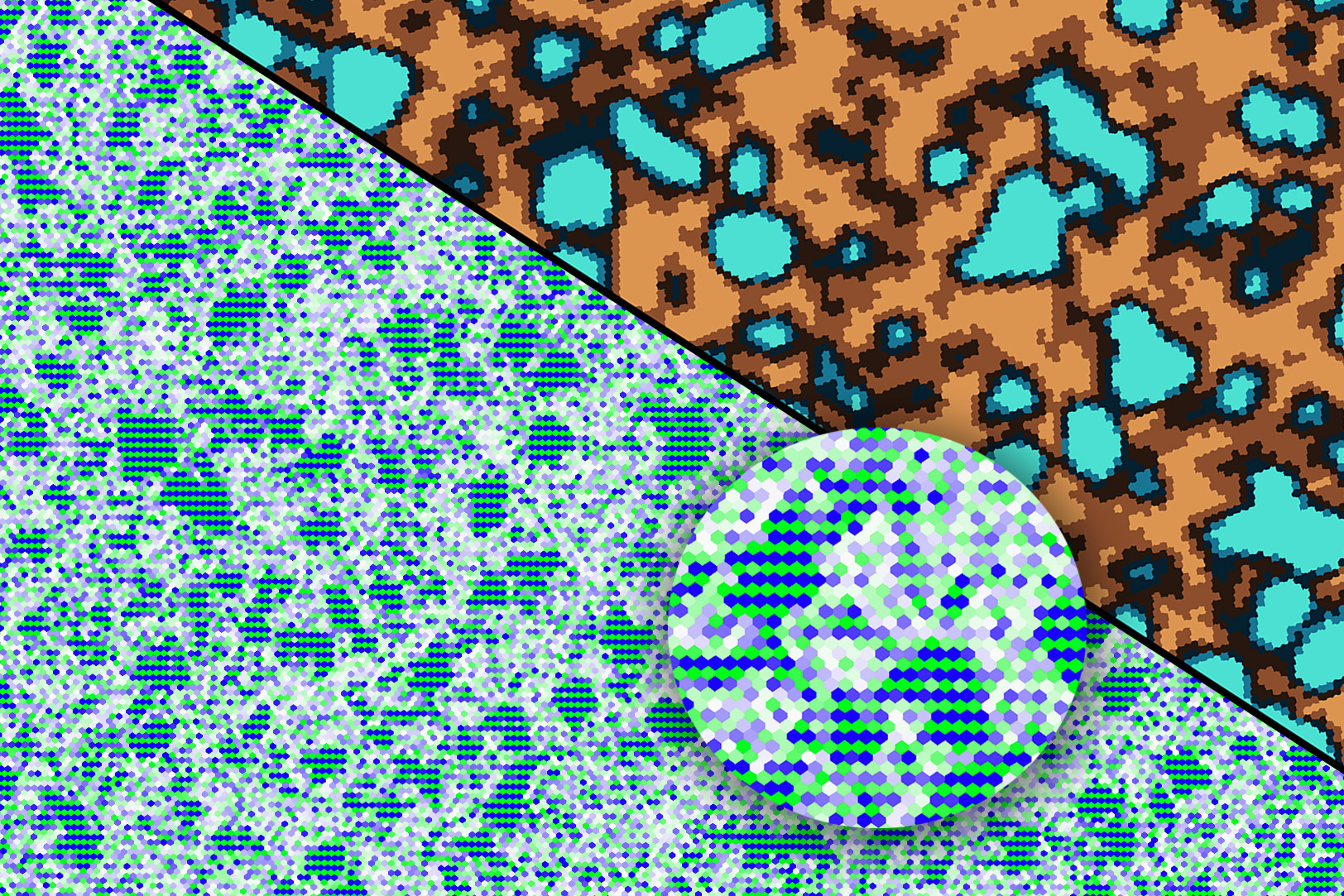


MIT engineers have developed a printable aluminum alloy that can withstand high temperatures and is five times stronger than traditionally manufactured aluminum.
The new printable metal is made from a mix of aluminum and other elements that the team identified using a combination of simulations and machine learning, which significantly pruned the number of possible combinations of materials to search through. While traditional methods would require simulating over 1 million possible combinations of materials, the team’s new machine learning-based approach needed only to evaluate 40 possible compositions before identifying an ideal mix for a high-strength, printable aluminum alloy.
When they printed the alloy and tested the resulting material, the team confirmed that, as predicted, the aluminum alloy was as strong as the strongest aluminum alloys that are manufactured today using traditional casting methods.
The researchers envision that the new printable aluminum could be made into stronger, more lightweight and temperature-resistant products, such as fan blades in jet engines. Fan blades are traditionally cast from titanium — a material that is more than 50 percent heavier and up to 10 times costlier than aluminum — or made from advanced composites.
“If we can use lighter, high-strength material, this would save a considerable amount of energy for the transportation industry,” says Mohadeseh Taheri-Mousavi, who led the work as a postdoc at MIT and is now an assistant professor at Carnegie Mellon University.
“Because 3D printing can produce complex geometries, save material, and enable unique designs, we see this printable alloy as something that could also be used in advanced vacuum pumps, high-end automobiles, and cooling devices for data centers,” adds John Hart, the Class of 1922 Professor and head of the Department of Mechanical Engineering at MIT.
Hart and Taheri-Mousavi provide details on the new printable aluminum design in a paper published in the journal Advanced Materials. The paper’s MIT co-authors include Michael Xu, Clay Houser, Shaolou Wei, James LeBeau, and Greg Olson, along with Florian Hengsbach and Mirko Schaper of Paderborn University in Germany, and Zhaoxuan Ge and Benjamin Glaser of Carnegie Mellon University.
Micro-sizing
The new work grew out of an MIT class that Taheri-Mousavi took in 2020, which was taught by Greg Olson, professor of the practice in the Department of Materials Science and Engineering. As part of the class, students learned to use computational simulations to design high-performance alloys. Alloys are materials that are made from a mix of different elements, the combination of which imparts exceptional strength and other unique properties to the material as a whole.
Olson challenged the class to design an aluminum alloy that would be stronger than the strongest printable aluminum alloy designed to date. As with most materials, the strength of aluminum depends in large part on its microstructure: The smaller and more densely packed its microscopic constituents, or “precipitates,” the stronger the alloy would be.
With this in mind, the class used computer simulations to methodically combine aluminum with various types and concentrations of elements, to simulate and predict the resulting alloy’s strength. However, the exercise failed to produce a stronger result. At the end of the class, Taheri-Mousavi wondered: Could machine learning do better?
“At some point, there are a lot of things that contribute nonlinearly to a material’s properties, and you are lost,” Taheri-Mousavi says. “With machine-learning tools, they can point you to where you need to focus, and tell you for example, these two elements are controlling this feature. It lets you explore the design space more efficiently.”
Layer by layer
In the new study, Taheri-Mousavi continued where Olson’s class left off, this time looking to identify a stronger recipe for aluminum alloy. This time, she used machine-learning techniques designed to efficiently comb through data such as the properties of elements, to identify key connections and correlations that should lead to a more desirable outcome or product.
She found that, using just 40 compositions mixing aluminum with different elements, their machine-learning approach quickly homed in on a recipe for an aluminum alloy with higher volume fraction of small precipitates, and therefore higher strength, than what the previous studies identified. The alloy’s strength was even higher than what they could identify after simulating over 1 million possibilities without using machine learning.
To physically produce this new strong, small-precipitate alloy, the team realized 3D printing would be the way to go instead of traditional metal casting, in which molten liquid aluminum is poured into a mold and is left to cool and harden. The longer this cooling time is, the more likely the individual precipitate is to grow.
The researchers showed that 3D printing, broadly also known as additive manufacturing, can be a faster way to cool and solidify the aluminum alloy. Specifically, they considered laser bed powder fusion (LBPF) — a technique by which a powder is deposited, layer by layer, on a surface in a desired pattern and then quickly melted by a laser that traces over the pattern. The melted pattern is thin enough that it solidfies quickly before another layer is deposited and similarly “printed.” The team found that LBPF’s inherently rapid cooling and solidification enabled the small-precipitate, high-strength aluminum alloy that their machine learning method predicted.
“Sometimes we have to think about how to get a material to be compatible with 3D printing,” says study co-author John Hart. “Here, 3D printing opens a new door because of the unique characteristics of the process — particularly, the fast cooling rate. Very rapid freezing of the alloy after it’s melted by the laser creates this special set of properties.”
Putting their idea into practice, the researchers ordered a formulation of printable powder, based on their new aluminum alloy recipe. They sent the powder — a mix of aluminum and five other elements — to collaborators in Germany, who printed small samples of the alloy using their in-house LPBF system. The samples were then sent to MIT where the team ran multiple tests to measure the alloy’s strength and image the samples’ microstructure.
Their results confirmed the predictions made by their initial machine learning search: The printed alloy was five times stronger than a casted counterpart and 50 percent stronger than alloys designed using conventional simulations without machine learning. The new alloy’s microstructure also consisted of a higher volume fraction of small precipitates, and was stable at high temperatures of up to 400 degrees Celsius — a very high temperature for aluminum alloys.
The researchers are applying similar machine-learning techniques to further optimize other properties of the alloy.
“Our methodology opens new doors for anyone who wants to do 3D printing alloy design,” Taheri-Mousavi says. “My dream is that one day, passengers looking out their airplane window will see fan blades of engines made from our aluminum alloys.”
This work was carried out, in part, using MIT.nano’s characterization facilities.
