


Why you can trust TechRadar
We spend hours testing every product or service we review, so you can be sure you’re buying the best. Find out more about how we test.
OSCAL Pilot 6: 30-second review
The Oscal Pilot 6 is a rugged Android phone designed for anyone working outdoors who needs a phone that can withstand far more than a standard commercial model. The design is rugged and, whilst it’s slightly larger than a standard phone, its plastic reinforced casing keeps it from being overly large, and it will just about slip into a pocket.
The bulk and weight, while more than your average consumer phone, is still less than many other larger rugged smartphones. Still, it’s nicely designed with the usual industrial design aesthetic synonymous with rugged smartphones. It’s comfortable to hold and use, and when it comes to that ruggedness, it offers IP68/IP69 and MIL-STD-810H ratings, highlighting that it can withstand significant abuse.
What makes this phone stand out against many of the other rugged smartphones is that it not only features all the usual camera specifications, including a massive 108-million-pixel camera, but also a thermal camera, which makes it great for trade, and a large 10,000mAh battery, which ensures that it can last for days in between charging. This battery can also be wirelessly charged at 15W and supports reverse charging for topping up other devices.
When used to navigate productivity apps, the handset’s speed is okay, just held back a little by the MediaTek Helio G100, which is really a mid-range CPU, backed again by a mid-range Mali-G57 MC2 GPU. So, whilst it’s usable for updating documents and browsing the internet, it’s not the fastest on the market. What is nice, though, is that it’s all fronted by a 6.78-inch 120Hz screen, which is perfectly viewable in all conditions.
Also, what I really liked was that it has a built-in 98dB speaker that produces relatively decent audio quality. If you’re working on-site and want to listen to music, then this could be the perfect option.
For the consumer market, this phone is a little large for the general user. However, in trade, engineering, and surveying, the features, build quality, and size make it one of the best rugged phones I’ve tested. It’s just a little bit of a shame that it’s limited to 4G.
OSCAL Pilot 6: Price and availability
- How much does it cost? £330/$294
- When is it out? Now
- Where can you get it? Directly from Oscal or Amazon
At present, the Pilot 6 is available on Blackview’s fficial website, with the 12GB/256GB model priced at $558.99 / £319. But keep an eye on the website as the price does change.

OSCAL Pilot 6: Specs
CPU: MediaTek Helio G100, octa-core, up to 2.2GHz
Graphics: Mali-G57
RAM: 12GB LPDDR4X, expandable virtually up to 36GB
Storage: 256GB UFS 2.1, microSD/TF expansion up to 2TB
Ports: USB-C
Connectivity: 4G, Wi-Fi 802.11 a/b/g/n/ac, Bluetooth 5.2, NFC, GPS/GLONASS/Galileo/Beidou/QZSS
Audio: 4.5W 98dB Smart-PA BOX speaker, USB-C earphone support
Camera: 108MP Samsung ISOCELL HM6 rear, 50MP Samsung ISOCELL JN1 front, 160×120 thermal camera
Size: 182.8 × 82 × 18.1mm; 410.8g
OS Installed: DokeOS 5.0 based on Android 16
Accessories: Manual, USB cable, SIM ejector pin, and lanyard
OSCAL Pilot 6: Design
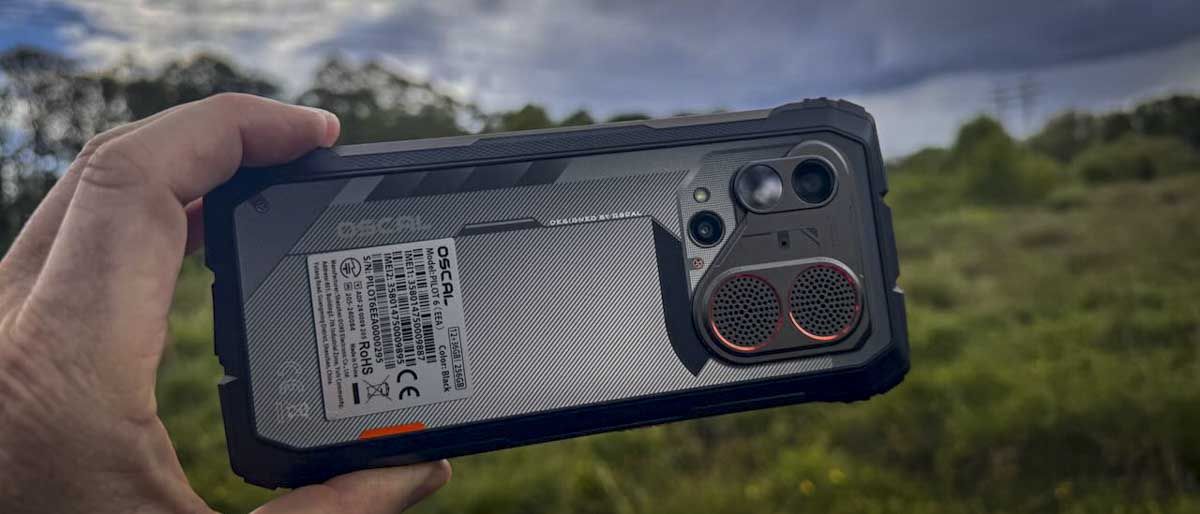
As I removed the Pilot 6 from the packaging, it was unmistakably a rugged smartphone with the usual industrial design, with credentials, including IP68, IP69K, and MIL-STD-810H. Sure enough, in the hand it feels good and rugged, and whilst it’s larger than most consumer-model smartphones, it’s not overly cumbersome, and it’s easy enough to handle, measuring 182.8 x 82 x 18.1mm and weighing 410.8g.
Whilst the size and weight do make it a little bit more bulky than a consumer phone, such as an iPhone, it’s still not overly large. If you do need to put it in a jacket or pocket, then whilst it’s going to be relatively bulky, it’s possible.
Checking through some of the build materials, it does look like OSCAL has really put a lot of thought into the rugged design, with an Al-Ti alloy used for the metal frame bracket, aluminium side strips, and the shockproof plastic base, which thankfully stays in one piece if dropped from a height.
It’s also good to see that the large 6.78-inch screen uses Gorilla Glass 5, and throughout the test, it withstood being dropped and submerged in water with no damage other than a little grime on the body, which was easily wiped away.
That screen offers a decent brightness of 750 nits, which makes it more than viewable in almost all sunny conditions, and throughout the test, which was conducted in the late spring in the UK, that brightness was made it easy to read documents and website content easily enough.
Alongside the impressive 108-million-pixel camera, which is backed by a Samsung sensor, is an infrared camera that enables you to pick up heat signatures, which will be especially of interest to anybody working in trades. This feature, along with the torch that sits at the top of the handset, is activated through dedicated apps that are all pre-installed.
The torch offers 93 lumens of brightness, and being mounted at the top of the handset rather than the back makes it very easy to use. There’s no ability to focus it, so whilst it’s relatively bright and great for looking into crevices, it isn’t a replacement for a standard flashlight that has a focused beam.
Another feature I liked was the 98dB speaker on the back, which you can see clearly on the phone. This produces very loud audio, which is great for listening to music whilst you’re busy at work.
And ensuring it runs all day, even if you can’t charge up, there’s that huge 10,000mAh battery, which charges relatively quickly but has more than enough capacity to last all day without a charge.
OSCAL Pilot 6: Features
The Oscal Pilot 6 is packed with features, with the main headline being the 160 x 120 thermal imaging camera that can detect heat signatures between -15°C and 550°C. Whilst that resolution might not seem that great, when it comes to detecting everything from wildlife hiding in the bushes if you’re out shooting photographs to detecting where piping and wiring might be if you work in the trade, a thermal camera like this on your smartphone can be a real use.
The camera is activated through the thermal app, with a 25Hz frame rate that provides a relatively smooth live view, and it offers under 50 mK thermal sensitivity alongside measurement and reporting tools, giving you a complete suite in this one relatively small mobile phone.
Alongside the headline thermal camera is a 108-million-pixel HM6 main camera, capable of capturing high-resolution images perfect for surveys and site visits, as well as for video conferencing. There’s a 50-million-pixel Samsung JN1 front camera that also offers decent resolution and frame rate.
The mobile phone is powered by a 10,000 mAh battery. This offers plenty of usage time and features 27W fast charging, 15W wireless charging, and 10W reverse charging, if you need to top up other devices.
Interestingly, another main feature of the smartphone is the 98dB loudspeaker, which is visible on the back of the phone near the camera array, and it is perfectly good for listening to music on-site. As long as you’re not too bothered about high-fidelity music, it is perfectly good, but where it really comes into its own is through speakerphone calls, because that speaker makes it far easier to hear if there’s a group of you on a conference call, utilising the phone.
When it comes to rugged credentials, they’re pretty impressive, with IP68 and IP69K ratings alongside MIL-STD-810H, meaning it can survive being underwater for a period of time, as well as being dropped and generally not looked after quite as carefully as you would with a standard consumer-level mobile phone.
When it comes to connectivity, this phone is only 4G; however, it offers NFC, Wi-Fi 802.11, 2.4 GHz and 5 GHz, and Bluetooth 5.2. When it comes to network connectivity, whilst it doesn’t offer 5G, it is backwards-compatible with 2G and 3G.
Inside, powering the smartphone is a MediaTek octa-core Helio G100, 6nm, up to 2.2GHz, paired with a Mali-G57 MC2 GPU and 12GB of LPDDR4X RAM and 256GB of UFS 2.1 ROM. Whilst built-in storage is quite limited, as is the RAM, the RAM can be expanded to 36GB using virtual RAM, and, with a TF card or microSD card, you can expand the internal storage up to a huge 2TB.
The 6.78-inch 2.4K 120Hz screen is nice and bright, reaching 750 nits. That 1080 x 2460 resolution lets you see plenty on the screen, so if you do need to update documents, it’s a good resolution and brightness for doing so, even out in the field.
Checking through the specifications and features, it is quite obvious that this phone has been designed primarily for field use, by trade and industry, rather than consumer phone users. Still, with those loudspeakers, which, used in moderation, are pretty good, and with that large bright screen and decent resolution, it is equally good for watching back media and taking pictures if needed.
OSCAL Pilot 6: Performance
The first thing you notice about the phone compared to my phone is its size and bulk. Whilst it is smaller than many rugged smartphones, it is considerably bigger than a standard iPhone, in my case, an iPhone 15 Pro. Still, it is of a decent size, and you can easily hold it in one hand with no issue.
It’s not as bulky and cumbersome as some rugged smartphones, so if you do want to use it as an everyday phone, then it is a good size. Likewise, the bulk is bigger than most consumer-level smartphones, mainly due to the reinforcement that makes it rugged, and whilst it will fit into a jacket or trouser pocket, it is worth considering that it is that much larger than a standard phone.
For everyday use, making calls, even though it is restricted to 4G connectivity, that connectivity is good and strong, and actually, in many situations, was better than my iPhone 15 Pro when it came to making standard calls. Obviously, the internet connectivity wasn’t as good, limited by that 4G connection.
As I’ve seen with other Oscal and Blackview phones, the Android 16 version that is used on the device is DokeOS 5.0, a slightly customised version for this brand of phone, and to be honest, it works exceptionally well for most uses, including many bespoke apps that enable a lot of functionality, including the torch, thermal camera and that speaker system. Alongside the custom apps, you also have all the usual Android applications, so if you want to download Google Docs, it’s already installed on the phone.
Once you get up and running, accessing my standard applications, say Google Chrome for browsing and Google Docs, the phone can handle that quite well, and that larger-resolution screen enables everything to fit on quite nicely. This is quite an upgrade from many of the standard HD phones on the market, and whilst limited by the 4G connectivity, that screen resolution is absolutely ideal, giving plenty of real estate when you do need to edit or read documents.
The screen speed is also relatively good, although not quite as responsive as some other rugged smartphones. What I did note in the feature set is that there is a glove mode, so if you’re wearing gloves for work and still need to use that connectivity, you can activate it and still use the phone. This can be really handy both at work and when you’re out cycling and need to use a phone without removing your gloves.
In use, switching between apps, the phone was more than able to handle it, and whilst there were a few slight pauses, the overall workflow was quite smooth. What impressed me was the camera app; whilst it isn’t fully featured, it does offer a pro mode and plenty of flexibility over the images you take. That image quality, whilst not high-end, is also pretty good, and if you want to use it for something other than taking detailed site photos, then it’s actually far better than I had anticipated.
On the phone, there are a variety of apps, including AI Chat, AI Video, AI Photos and AI Music. All of these are pre-installed but require you to sign up for relatively expensive subscription plans. Likewise, some of the other applications that are pre-installed offer wallpaper options, but there’s advertising always integrated that wants to take you over to Temu, and there were several occasions when, for no reason whatsoever, an advert for a game would suddenly pop up on the screen, which I found incredibly annoying.
As the initial review went on, I actually went through and deleted a huge volume of the pre-installed apps, just because I kept getting notifications about products and Temu, or about games I didn’t want to play when I was least expecting them.
One of the app options that was quite good was AI Photo, which lets you use a bit for free before you need to pay. You can enhance several pictures for free before any cost is involved, and I would’ve preferred a non-AI app pre-installed that let me play around with some images, rather than almost every single option on this phone trying to get me into some other subscription model.
Once I had settled all the apps on the phone and gone through and deleted a lot of them, the phone itself was actually pretty good, very much aimed at the mid-range, with a Helio G100 being perfectly good for all of the standard Android apps, navigation, messaging, watching media and quite a lot of other work apps, even able to download CapCut and utilise that to edit short video clips without any issue.
I also really like the headline features. The thermal imaging camera is really good and easy to use, and whilst the resolution is pretty low, with all the different colour overlays that you can use, it’s really good for spotting animals and creatures hiding in the bushes, and if you do want to detect pipes and electronics that are hidden behind walls and plaster, then it’s perfectly possible to do that as well. More of a guide than anything else, but it’s nice to have that feature built into the phone.
The small torch on the top of the phone was also good. Whilst it isn’t focused, the brightness is sufficient to be able to look inside cavities or the back of cupboards to discover things in the same way that you would with a standard flashlight. It’s a bit of a shame that it’s not focusable, but the brightness is there and is pretty decent.
The battery life is also superb, and it’s only after this first week of testing that I realised I still hadn’t charged the phone and just how good having such a large battery is. Essentially, you just keep the phone in your bag on standby, and you know that it’s going to be there, ready to go when you need it.
Overall, as a business phone, the Pilot 6 is a great option. It is slightly larger than a consumer-level phone, with a thermal camera, a high-resolution main camera, and that torch, and it all comes together with the ability to make calls, making it a useful addition for anyone working out in the field.
OSCAL Pilot 6: Final verdict
The Oscal Pilot 6 is a great smartphone option for anyone working in industry or trade. The thermal camera and high-resolution main camera let you detect piping, wiring, and other heat-related objects that other cameras can’t, and, as it’s built into a smartphone, it is a good, quick indicator for on-site visits.
Backing up the thermal camera is a very decent 108-million-pixel main camera, which is good for taking detailed site images that are first-rate in tone and, compared with some other high-resolution cameras, maintain quality. I was just impressed with the overall tone, detail and clarity this small camera was able to produce.
The torch is a nice addition, but it’s not the best smartphone torch I’ve seen. The fact that it is mounted at the top of the smartphone does make it a little more useful and versatile, but with no ability to focus and, to be honest, limited brightness, it’s great for looking in cupboards and other things that are close. But if you’re thinking of using it as a flashlight, then its power just isn’t quite up to it.
As a slightly left-field feature, the speakers are actually pretty decent. If you’re on a conference call with people on site, this phone is well-suited to that use, and you can hear things above the ambient sounds of a building site, which could be exceptionally useful.
But then you come onto some of the downsides of this phone, and primarily that is the fact that many of the apps require a subscription or take you to some advertising randomly when you least expect it, and after a day of testing, I decided to sit down and delete all of the apps on the phone that would automatically take me elsewhere.
Once the OS was cleaned, it’s a relatively decent system, and DokeOS, as ever, is nice and stable and proved fast enough, even with a 4G network connection.
The CPU and GPU are mid-range. Whilst they’re good for productivity, they’re not ideal for multimedia editing or gaming. Still, if you want to do a bit of light gaming or multimedia editing, to be honest, most phones are powerful enough these days.
By the end of the test, it was clear that if you’re working in the trade or industry and looking for a rugged, thermal-cameras smartphone, this is a great option. If you’re into outdoor activities, then whilst this is a good mid-range phone, it probably won’t fully meet your needs. Whilst that camera is good, there are better options out there.
Should I buy the OSCAL Pilot 6?
|
Value |
Great value for a phone, with high-resolution and thermal cameras in one relatively compact unit. |
4/5 |
|
Design |
Usual tough, rugged design with industrial aesthetics that enable this phone to stand up to more than most. |
3.5/5 |
|
Features |
A very decent set of features for a smartphone, with the added interest of that thermal camera. |
4/5 |
|
Performance |
Very capable mid-range smartphone, just limited by 4G connectivity and slightly intrusive apps. |
3.5/5 |
|
Overall |
With the apps cleaned, this is a decent rugged smartphone that can withstand more than most and offers decent performance. |
4/5 |
Buy it if…
Don’t buy it if…
For more durable devices, we’ve tested the best rugged tablets and the best rugged laptops.
