



Introduction
Enterprise inference standardization often begins with a benchmark chart. That is usually where the first mistake occurs.
A team runs one model on one GPU configuration, increases concurrency until the system saturates, records the highest tokens-per-second result, and declares a winner. The result may be technically repeatable while still being operationally irrelevant. It says little about how the runtime behaves under production latency objectives, mixed prompt lengths, model updates, node failures, autoscaling events, cold starts, or security controls.
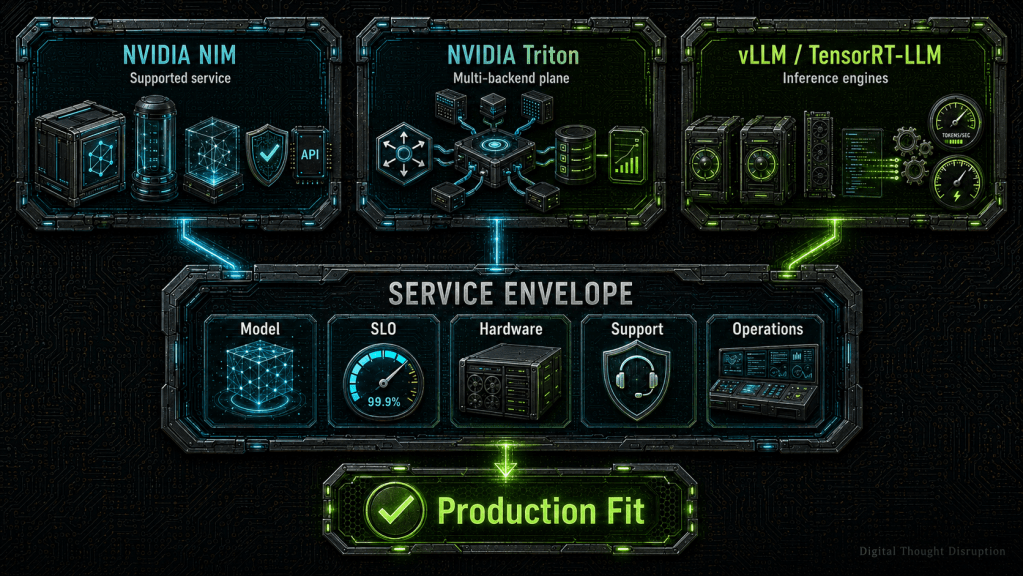
The comparison is also frequently framed incorrectly. NVIDIA NIM, NVIDIA Triton Inference Server, vLLM, and TensorRT-LLM are not four equivalent inference engines. Current NVIDIA NIM for large language models packages vLLM inside a supported service container. Triton is a general-purpose model server capable of using multiple backends, including vLLM and TensorRT-LLM. vLLM is an LLM-focused inference engine and server. TensorRT-LLM is an NVIDIA-optimized inference library that can be used directly or placed behind a serving layer. [1], [9], [11], [19]
The enterprise decision is therefore not simply which product produces the highest number. The real question is which combination of runtime, packaging, deployment model, hardware, support arrangement, and operational controls can satisfy a defined service envelope.
This article uses a research baseline of July 23, 2026. Runtime behavior, supported models, container compatibility, and lifecycle policies are version-sensitive and should be revalidated before an implementation decision.
TL;DR
An enterprise should rarely standardize on one inference binary for every AI workload.
- Use NVIDIA NIM when the priority is a validated, packaged, NVIDIA-supported LLM service with curated model profiles and a defined enterprise lifecycle.
- Use Triton Inference Server when the platform must serve a mixed estate of traditional machine-learning models, preprocessing pipelines, TensorRT engines, ONNX models, PyTorch models, vLLM workloads, or TensorRT-LLM workloads.
- Use vLLM directly when rapid model enablement, open-source flexibility, OpenAI-compatible APIs, and broader hardware choice outweigh the value of a curated vendor support path.
- Use TensorRT-LLM when a valuable NVIDIA-based workload justifies additional performance engineering, topology tuning, quantization work, and lifecycle control.
The right standard is a small portfolio of approved runtime profiles backed by common APIs, benchmark methods, telemetry, release controls, security requirements, and rollback procedures.
The Products Are Not Equivalent Layers
The first step is to identify what each option actually does.
| Option | What it actually is | Primary workload scope | Main operational value | Main tradeoff |
|---|---|---|---|---|
| NVIDIA NIM | A production-oriented, supported service container that currently packages vLLM for LLM inference | Supported LLM, embedding, and selected multimodal services | Curated model profiles, validated configurations, health management, observability, security hardening, and enterprise support alignment | Restricted to supported models, hardware, profiles, and NVIDIA lifecycle boundaries |
| NVIDIA Triton Inference Server | A general model-serving plane with pluggable backends | Traditional ML, deep learning, ensembles, preprocessing, LLMs, embeddings, ranking, and custom backends | One serving framework for heterogeneous models and execution backends | More configuration, backend compatibility work, and platform ownership |
| vLLM | An open-source LLM inference engine and API server | Generative LLMs, embeddings, pooling, and selected multimodal workloads | Rapid model support, continuous batching, paged KV-cache management, open APIs, and flexibility | The enterprise owns qualification, upgrades, security, packaging, and support integration |
| TensorRT-LLM | An open-source NVIDIA library for optimizing LLM inference | Performance-sensitive LLM and multimodal inference on NVIDIA GPUs | Extensive NVIDIA-specific optimizations, quantization, parallelism, and performance controls | Greater specialization, hardware dependence, configuration sensitivity, and lifecycle coupling |
This distinction changes the decision.
Comparing NIM with vLLM is primarily a comparison between a supported productized service and its underlying open-source engine. Comparing Triton with vLLM is a comparison between a serving plane and an engine that Triton can host. Comparing Triton with TensorRT-LLM is a comparison between a model server and an execution backend that can run beneath it.
A benchmark that ignores these layer differences can compare deployment stacks without acknowledging that it is doing so.
Start With the Service Envelope
A service envelope defines the conditions under which an inference service must operate successfully. It should be documented before products are benchmarked.
At minimum, define:
- model family, parameter count, modality, and artifact format
- approved quantization and its quality threshold
- input and output token distributions
- maximum context length
- expected concurrency and request arrival pattern
- streaming and non-streaming behavior
- time-to-first-token objective
- inter-token-latency objective
- end-to-end latency objective
- throughput and completion-rate objective
- availability and recovery objectives
- required hardware and permitted hardware diversity
- scale-up and scale-out assumptions
- autoscaling response requirements
- support and lifecycle expectations
- observability and audit requirements
- deployment environment, including Kubernetes, virtual machine, or bare metal
- operational skills available to the platform team
The service envelope prevents a runtime from winning because a test was designed around its strengths rather than the application’s requirements.
An interactive assistant with a strict time-to-first-token objective should not be optimized using the same traffic profile as overnight document generation. A long-context retrieval service should not be represented by short synthetic prompts. A reasoning model with long decode sequences should not be assessed using a prefill-heavy summarization workload.
How the Inference Layers Fit Together
The most important relationship to understand is where packaging ends and execution begins.
The diagram highlights three different decisions:
- Packaging decision: Does the enterprise want a curated and supported NIM service, or does it want to assemble and maintain the platform components itself?
- Serving-plane decision: Does the environment require Triton’s multi-model APIs, model repository, schedulers, ensembles, and backend abstraction?
- Execution-engine decision: Should the workload run on vLLM, TensorRT-LLM, or another backend?
Treating all three as one decision hides important operational consequences.
Supported Model Types and Workload Fit
NVIDIA NIM
NIM is strongest when the required model and hardware combination appears in NVIDIA’s supported or certified path. Its model profiles describe validated combinations of model variant, precision, hardware compatibility, memory requirements, and parallelism. NIM can automatically select a compatible profile or use an explicitly pinned profile for deterministic deployment. [2], [3]
This is valuable when platform teams want to reduce the number of variables they must qualify independently. The tradeoff is that a newly released model, unusual quantization, unsupported GPU, or custom model architecture may not immediately fit the certified path.
NIM should be evaluated as a supported product profile, not as unrestricted access to every capability that happens to exist in upstream vLLM.
Triton Inference Server
Triton is the broadest option in this comparison.
Its backend architecture can execute models through TensorRT, PyTorch, ONNX Runtime, OpenVINO, Python, vLLM, TensorRT-LLM, and custom implementations. This makes Triton appropriate for environments that must serve more than generative language models. [8], [9]
Examples include:
- computer-vision models
- forecasting models
- recommendation models
- fraud-detection models
- preprocessing and postprocessing pipelines
- embedding and ranking models
- LLMs using vLLM
- highly optimized LLMs using TensorRT-LLM
- ensembles that connect multiple model stages
Triton’s main advantage is not that it makes every model faster. Its advantage is that it creates a consistent serving and management plane across different execution backends.
vLLM
vLLM is purpose-built around modern generative inference. Its capabilities include continuous batching, PagedAttention-based KV-cache management, chunked prefill, prefix caching, speculative decoding, quantization, distributed execution, and OpenAI-compatible serving. [15]
It is a strong fit for organizations that need:
- fast support for new open models
- direct control over engine parameters
- OpenAI-compatible endpoints
- rapid experimentation with quantization
- high-throughput LLM serving
- direct integration with open orchestration projects
- a path beyond NVIDIA-only hardware
Its expanding hardware support includes NVIDIA CUDA, AMD ROCm, Intel XPU, and community-supported Apple Silicon options. That does not imply identical maturity, performance, model coverage, or support across every platform. Each hardware path still requires its own qualification. [15]
TensorRT-LLM
TensorRT-LLM is focused on extracting high inference performance from NVIDIA GPUs. It supports single-GPU, multi-GPU, and multi-node configurations, along with tensor, pipeline, and other parallelism strategies. [19]
It is most relevant when:
- the workload is committed to NVIDIA GPUs
- model demand is large and stable enough to justify optimization
- performance has measurable business value
- the team can manage model-specific tuning
- quantization can be validated carefully
- serving topology can be engineered for the target hardware
TensorRT-LLM should not automatically be treated as a complete enterprise serving platform. It can be used through its own serving interfaces, but larger deployments often place it behind Triton, NVIDIA Dynamo, or another orchestration layer.
Current TensorRT-LLM documentation also marks the older checkpoint-to-engine-build workflow as legacy for new projects. New implementations should evaluate the current LLM API and trtllm-serve workflow rather than assuming that every deployment requires the historical manual engine-building process. [21]
Packaging and Deployment
Container and Virtual-Machine Deployment
All four options can participate in containerized deployment patterns, but the amount of assembly differs.
NIM provides a prepackaged service container with the inference backend, proxy, health endpoints, API behavior, model-profile logic, and observability integration assembled together. [1]
Triton provides released server containers containing selected backends. The enterprise still owns the model repository, backend configuration, model configuration, version compatibility, and supporting service design.
vLLM can be deployed directly from project or vendor containers, but the enterprise must decide how to handle:
- base-image approval
- model downloads
- health endpoints
- TLS
- authentication
- telemetry
- configuration management
- secrets
- autoscaling
- release pinning
- vulnerability remediation
TensorRT-LLM similarly requires a defined serving and packaging approach. Its current APIs simplify model loading and serving compared with older workflows, but production integration remains an enterprise responsibility.
Virtual machines can host any of these container-based patterns. A VM does not remove the need to control GPU drivers, container runtime components, CUDA compatibility, model cache persistence, networking, and service supervision.
Kubernetes Deployment
Kubernetes introduces several additional decisions:
- GPU discovery and scheduling
- persistent model caching
- node selection and topology
- readiness and startup probes
- secrets and registry credentials
- service exposure
- rolling updates
- autoscaling signals
- gang scheduling for distributed replicas
- disruption budgets
- model download and cold-start behavior
The NIM Operator manages NIM-specific resources such as model caches and NIM services. It can handle pod creation, health probes, service exposure, persistent caching, authentication secrets, and GPU resource scheduling. [4]
Triton provides Kubernetes deployment examples, but the operator must define the model repository, backend containers, deployment controller, metrics, service, scaling logic, and distributed-model behavior. [14]
vLLM has native Kubernetes and Helm deployment guidance and can integrate with KServe, KubeRay, Dynamo, llm-d, AIBrix, and other serving projects. This provides flexibility, but it also forces the platform team to choose and own an orchestration pattern. [18]
For TensorRT-LLM, Kubernetes becomes particularly important when a single model replica spans several GPUs or nodes. The deployment may require coordinated pod groups, topology-aware scheduling, gang scheduling, and a serving layer capable of treating several pods as one model replica.
Model Profiles Are Not the Same as Model Repositories
The term profile means different things across these products.
A NIM model profile represents a curated combination of model variant, precision, backend behavior, GPU compatibility, memory requirements, and parallelism. Profiles reduce configuration uncertainty and allow automatic or explicit selection. [2]
A Triton model repository organizes models, versions, configuration files, and backend selections. The model configuration controls dimensions such as batching, instance groups, inputs, outputs, and backend parameters.
A vLLM runtime configuration is generally expressed through command-line arguments, configuration files, environment variables, or orchestration definitions. It exposes more engine-level control but does not inherently provide a vendor-certified profile.
A TensorRT-LLM deployment configuration defines model loading, quantization, parallelism, KV-cache behavior, scheduling, and serving options for the target NVIDIA topology.
These mechanisms solve related problems, but they do not offer the same assurance. A configuration that starts successfully is not automatically a validated enterprise profile.
Batching, Concurrency, and Replica Design
Batching terminology is one of the most common sources of misleading comparisons.
| Mechanism | Meaning | Typical use |
|---|---|---|
| Explicit batching | The client submits a tensor or collection containing several inputs as one request | Offline inference or models designed around fixed batches |
| Dynamic batching | The server combines independent requests into an execution batch | Traditional models served by Triton |
| Continuous or in-flight batching | The engine continuously schedules prefill and decode work from requests at different stages | Online LLM inference |
| Request concurrency | The number of requests simultaneously active against the service | Load generation and service-capacity planning |
| Independent replicas | Separate model copies serving traffic in parallel | Horizontal scale, availability, and throughput |
| Tensor parallelism | One model replica is divided across multiple GPUs | Fitting or accelerating a model that cannot use one GPU efficiently |
Triton Batching
Triton’s dynamic batcher combines independent requests into batches up to a configured maximum size. Operators can tune batch delay and maximum batch size to trade latency for throughput. Triton recommends measuring whether additional delay remains inside the application’s latency budget. [10]
When Triton uses its vLLM backend, requests are submitted to the vLLM asynchronous engine, and vLLM handles in-flight batching and paged attention. Adding Triton does not replace vLLM’s LLM scheduler with Triton’s traditional dynamic batcher. [11]
The same principle applies to the TensorRT-LLM backend. Triton provides the serving layer, while TensorRT-LLM performs the LLM execution and in-flight scheduling.
NIM and vLLM Batching
The normal NIM LLM and vLLM online-service model accepts independent OpenAI-style requests. The engine then schedules them through continuous batching.
A client sending several prompts in one payload should not automatically be treated as equivalent to a Triton tensor batch or to several independently scheduled streaming requests. Endpoint-specific batch APIs may be available, but the benchmark must document exactly which request model is being exercised.
Concurrency Is Not Batch Size
Concurrency describes active demand. Batch size describes how much work the engine processes together at a particular moment.
If concurrency exceeds the capacity of the runtime and its replicas, requests queue. The GPU may show excellent utilization while time to first token becomes unacceptable. [25]
A benchmark should therefore sweep concurrency and record the point at which:
- queue depth rises
- time to first token accelerates sharply
- inter-token latency deteriorates
- errors or timeouts appear
- throughput stops increasing proportionally
The saturation point matters more than the maximum number observed after the service has already violated its SLO.
Tensor Parallelism Is Not Horizontal Scaling
Tensor parallelism divides one model replica across multiple GPUs. Independent replicas place separate model copies on different GPU sets.
Consider a model that uses four GPUs per replica:

The first arrangement may be necessary to fit the model or achieve a target per-request latency. The second arrangement can approximately double independent serving capacity, subject to routing and workload behavior.
Increasing tensor parallelism does not automatically increase total throughput. It may introduce communication overhead, synchronization cost, or reduced scheduling flexibility. Conversely, reducing tensor parallelism may allow more replicas but leave each request with insufficient compute or memory bandwidth.
The correct configuration depends on the service envelope:
- Use the smallest GPU group that fits the model and satisfies single-request latency.
- Add independent replicas for availability and throughput.
- Increase tensor parallelism only when model fit or measured latency justifies it.
- Rebenchmark whenever quantization or GPU generation changes the memory and compute balance.
Time to First Token, Tokens per Second, and the Latency Curve
There is no single LLM performance metric.
Time to First Token
Time to first token measures the interval between request submission and the first non-empty generated token. It generally includes queueing, request processing, prefill, and network effects. Longer prompts increase prefill work and often increase this metric. [24]
This is usually the most visible metric for interactive applications. A service that produces many tokens per second after a five-second wait may still feel slow.
Inter-Token Latency
Inter-token latency measures the cadence of streamed output after the first token. It is closely related to the user’s perception of generation speed.
A runtime may improve throughput by placing more concurrent work on the GPU while degrading inter-token latency for each user. That can be acceptable for offline generation but damaging for interactive chat.
Tokens per Second
Tokens per second must be defined precisely.
Possible meanings include:
- input tokens processed per second
- output tokens generated per second
- total tokens per second
- output tokens per second per user
- aggregate output tokens per second across all requests
- successful output tokens per second inside the required SLO
Only the final definition directly connects capacity to the service contract.
Requests per Second
Requests per second is useful only when request shapes are controlled. Ten requests containing 100 input tokens are not equivalent to ten requests containing 20,000 input tokens.
End-to-End Latency
End-to-end latency measures the complete request duration. It is useful for non-streaming applications and for understanding total occupancy, but it can conceal poor time-to-first-token or inter-token behavior in streaming services.
SLO-Constrained Throughput
The most useful production metric is often:
SLO-Constrained Throughput =
Successful Work Completed
-------------------------------------------
Time, while every required SLO remains valid
The runtime stops earning capacity credit when it exceeds the defined latency or error boundary.
GPU Utilization Is Evidence, Not the Objective
GPU utilization is an important diagnostic signal, but it is not a business outcome.
High utilization can mean that:
- the engine is efficiently executing useful work
- requests are spending excessive time queued
- a single oversized model replica has consumed all GPUs
- prefill traffic is starving decode traffic
- memory pressure is limiting concurrency
- the service is operating too close to saturation
- a benchmark is producing unrealistic synthetic demand
Low utilization can mean that:
- the workload is latency-sensitive and intentionally preserves headroom
- requests arrive in bursts
- the model is memory-bound
- the CPU, tokenizer, network, or storage path is the bottleneck
- the runtime is configured poorly
- the service has more failure reserve than current demand requires
Measure GPU utilization alongside queue depth, KV-cache occupancy, active sequences, request rate, token rate, memory use, power, latency percentiles, and errors.
An enterprise should not select a runtime because it reports 95 percent GPU utilization. It should select a runtime because it completes useful work within the required service envelope at an acceptable cost and operational risk.
Multi-GPU and Multi-Node Behavior
NVIDIA NIM
Current NIM multi-node deployment uses Ray for cluster formation and vLLM for distributed execution. It supports tensor and pipeline parallelism across the cluster. [5]
The common pattern assigns tensor parallelism within a node and pipeline parallelism across nodes. Cross-node tensor parallelism is possible, but it makes network bandwidth, latency, and RDMA availability more critical.
The packaged deployment reduces some integration work, but it does not eliminate the operational realities of distributed inference:
- all required GPUs must become available together
- network performance becomes part of model performance
- one model replica can span several failure domains
- upgrades must coordinate the complete replica
- scale-out can require large groups of GPUs
- recovery can involve model redistribution and cache reloading
Triton with vLLM or TensorRT-LLM
Triton can serve multi-GPU and multi-node LLM backends, but the deployment architecture belongs to the backend and Kubernetes design as much as to Triton.
For example, a TensorRT-LLM model spanning several Kubernetes nodes may require a leader-worker arrangement, coordinated startup, and gang scheduling. The scaling unit becomes a group of pods rather than one pod. [14]
Triton’s value is the surrounding model-serving framework. It does not make distributed execution topology disappear.
Direct vLLM
vLLM supports tensor and pipeline parallelism across single-node and multi-node deployments. Its guidance recommends avoiding distributed inference when a model fits and performs adequately on one GPU, using tensor parallelism within a node when necessary, and introducing multi-node execution when the model or performance requirement demands it. [16]
Ray, multiprocessing, and external serving frameworks can provide cluster formation and scaling. The enterprise must decide which combination is supported internally.
TensorRT-LLM
TensorRT-LLM supports single-GPU, multi-GPU, and multi-node execution. Its NVIDIA-specific optimizations make it attractive for large models on tightly controlled GPU fabrics. [19]
The cost is stronger coupling among:
- GPU generation
- CUDA and driver versions
- TensorRT-LLM version
- serving container
- quantized model artifact
- parallelism settings
- interconnect
- network configuration
This chain must be treated as a versioned production artifact.
Quantization Changes the Comparison
Quantization can reduce model memory use, increase concurrency, enable smaller GPU configurations, and improve throughput. It can also change quality, supported kernels, portability, and upgrade complexity.
vLLM supports a wide range of formats and methods, including FP8, INT8, INT4, GPTQ, AWQ, GGUF, compressed tensors, and several hardware-specific formats. [15]
TensorRT-LLM provides NVIDIA-focused quantization recipes including FP8, FP4, NVFP4 KV cache, GPTQ, and AWQ variants. [20]
NIM exposes quantization choices through supported model profiles. This reduces configuration freedom but can simplify qualification.
Triton inherits quantization behavior from the selected backend and model artifact.
A fair comparison must distinguish two test types:
- Engine benchmark: The same model artifact, tokenizer, precision, quantization, and serving semantics are used across runtimes.
- Solution benchmark: Each runtime uses its best supported artifact and configuration.
A solution benchmark may be more relevant to procurement, but it mixes runtime performance with model conversion and quantization choices. It must therefore include a separate quality evaluation.
A runtime should not receive a performance advantage for an aggressive quantization unless the resulting model still passes the enterprise’s quality, safety, and task-completion gates.
Hardware Diversity Changes the Standardization Strategy
NIM and TensorRT-LLM are designed around NVIDIA GPUs.
Triton can serve models on CPUs, NVIDIA GPUs, and other supported accelerators depending on the backend and platform. This makes it useful as a serving abstraction across a mixed model estate, but backend availability and maturity must still be confirmed for every target.
vLLM supports several GPU ecosystems, including NVIDIA CUDA, AMD ROCm, Intel XPU, and community-maintained Apple Silicon integration. [15]
This creates an important architectural distinction:
- API standardization can span heterogeneous hardware.
- Container standardization usually cannot.
- Engine standardization may be possible only within a hardware family.
- Benchmark results cannot be generalized across different GPU architectures.
- Support models may differ by hardware even when the source project is the same.
An enterprise operating Jetson devices, data-center NVIDIA GPUs, AMD accelerators, and CPU-only sites should not force one engine across the entire fleet merely to claim standardization. It should standardize the service contract and operational evidence, then approve hardware-specific runtime profiles.
Observability and Autoscaling
Observability
Current NIM LLM provides structured logging, Prometheus-compatible metrics, and distributed tracing integration. Its logging can produce unified JSON output for both the NIM layer and its vLLM backend. [6]
Triton provides server and model metrics, tracing, backend-specific metrics, and tools such as Performance Analyzer and Model Analyzer. The exact metric set depends on the backend.
vLLM exposes Prometheus metrics covering scheduler state, requests, tokens, cache behavior, and latency components. [17]
TensorRT-LLM exposes execution metrics through its serving integration, but an enterprise deployment still needs a complete telemetry path from the external service through the serving layer to the engine and GPU.
A standard telemetry model should include:
- runtime name and version
- container and model digests
- model profile or backend configuration
- GPU type and topology
- request count and error count
- active, waiting, and preempted requests
- input and output tokens
- time to first token
- inter-token latency
- end-to-end latency
- KV-cache utilization
- GPU memory, compute, power, and temperature
- replica identity
- model load and cold-start time
- autoscaling events
- request cancellation and timeout counts
Autoscaling
Autoscaling is not simply a checkbox on an inference engine.
A usable autoscaling design needs:
- a metric that predicts capacity pressure
- enough spare GPU capacity to place another replica
- a model cache that can supply artifacts quickly
- startup and readiness behavior that prevents early routing
- a traffic router that understands replica readiness
- scaling limits that protect other tenants
- scale-down controls that preserve active requests
- a strategy for multi-GPU replica groups
CPU utilization is usually a poor primary scaling signal for GPU inference. GPU utilization alone can also be too reactive.
Better signals can include:
- queue-to-compute ratio
- waiting requests
- KV-cache pressure
- concurrent sequence count
- SLO burn rate
- request rate combined with average token shape
- predicted GPU-seconds of incoming work
NIM Operator, Kubernetes controllers, Triton deployment patterns, Ray Serve, KServe, and other orchestration layers can automate parts of this process. The platform team still owns scaling policy, capacity reserves, and failure behavior.
Enterprise Support and Lifecycle
Support requirements frequently decide the runtime before the first performance test is run.
NIM and NVIDIA AI Enterprise
NIM’s main enterprise advantage is not that the underlying engine is unavailable elsewhere. It is that NVIDIA packages, validates, documents, and supports a bounded service configuration.
NVIDIA AI Enterprise provides lifecycle policies, supported branches, compatibility guidance, end-of-life notices, and support arrangements. [7]
This can materially reduce operational uncertainty for regulated or highly governed environments. It can also restrict how quickly the enterprise adopts unsupported models, experimental engine features, or custom configurations.
The correct question is not whether NIM is supported in general. The organization must verify:
- the exact NIM container
- model and profile
- GPU
- driver and CUDA stack
- Kubernetes or VM platform
- deployment method
- lifecycle branch
- support entitlement
- customizations that might alter supportability
Triton
Triton has a mature release model and publishes compatibility matrices connecting Triton releases with backend, Python, PyTorch, TensorRT, TensorRT-LLM, CUDA, and driver versions. [13]
The enterprise must still establish whether its exact deployment is covered by a commercial support agreement or is being operated as an open-source component.
vLLM
Upstream vLLM provides rapid innovation and broad community adoption. Direct use means the enterprise normally owns:
- version qualification
- regression testing
- security review
- model compatibility
- GPU compatibility
- upgrade timing
- patch backports
- production troubleshooting
- integration support
A commercial distribution or supported platform may provide additional coverage, but it should be evaluated as a separate offering rather than attributed automatically to the upstream project.
TensorRT-LLM
TensorRT-LLM is part of NVIDIA’s inference ecosystem, but supportability still depends on the selected container, product entitlement, integration pattern, and configuration.
A heavily customized TensorRT-LLM deployment can create an excellent performance result while moving farther away from a standard supported configuration. That may be justified, but the exception must be intentional.
Operational Complexity Comparison
| Operational area | NIM | Triton | vLLM | TensorRT-LLM |
|---|---|---|---|---|
| Initial LLM deployment | Low to medium within a supported profile | Medium | Medium | Medium to high |
| Mixed-model serving | Limited compared with Triton | High suitability | Low suitability | Low suitability |
| Model enablement speed | Controlled by supported path | Depends on backend | Often rapid | Depends on optimized support |
| Configuration freedom | Moderate | High | High | High |
| Kubernetes integration | NIM Operator and documented patterns | Documented patterns, operator ownership | Native, Helm, and ecosystem integrations | Usually paired with a serving or orchestration layer |
| VM deployment | Straightforward container pattern | Straightforward, with model-repository ownership | Straightforward, with platform services added separately | Possible, with more topology and lifecycle control |
| Multi-node complexity | Packaged but still significant | Significant, backend-dependent | Significant | Significant |
| Hardware diversity | NVIDIA-certified path | Broad, backend-dependent | Broadest potential | NVIDIA only |
| Enterprise lifecycle | Strongest predefined path | Versioned NVIDIA releases, scope must be confirmed | Enterprise-owned unless supplied through another product | NVIDIA ecosystem, exact support scope must be confirmed |
| Custom optimization | Bounded by supported configuration | High through backend selection | High | Very high |
| Best operating team | Team prioritizing support and reduced assembly | Mature platform team operating many model types | LLM platform team comfortable owning open source | Dedicated NVIDIA performance-engineering team |
Low operational complexity should not be interpreted as no complexity. A multi-node NIM deployment with large model caches, several GPU pools, strict security controls, and autoscaling remains a sophisticated distributed system.
Decision Matrix by Workload and Operating Model
| Workload or operating model | Preferred starting point | Why | Important caveat |
|---|---|---|---|
| Supported NVIDIA LLM in a regulated production service | NVIDIA NIM | Curated profiles, packaged service behavior, enterprise lifecycle, and support alignment | Confirm the exact model, profile, hardware, platform, and entitlement |
| Mixed estate of computer vision, forecasting, recommendation, embeddings, and LLMs | Triton | Multi-backend serving, model repositories, ensembles, and common operational interfaces | Each backend still has its own compatibility and tuning model |
| Fast-moving open LLM portfolio | Direct vLLM | Rapid model support, flexible configuration, broad ecosystem, and OpenAI-compatible API | Enterprise must own integration, validation, and lifecycle |
| Stable high-volume LLM on NVIDIA GPUs with hard cost or latency requirements | TensorRT-LLM, often behind Triton or Dynamo | Maximum opportunity for NVIDIA-specific performance engineering | Higher optimization, artifact, and version-management burden |
| Small platform team that needs a production LLM quickly | NIM | Less platform assembly and a clearer support path | Model choice may be constrained |
| Large platform team building a custom internal LLM service | vLLM or Triton with vLLM | Greater control over model adoption, scheduling, and platform integration | Requires mature release engineering and operational ownership |
| Traditional model requiring explicit or dynamic tensor batching | Triton | Mature model configuration and dynamic-batching controls | This pattern should not be applied mechanically to autoregressive LLMs |
| Multi-node model exceeding one server’s GPU capacity | Benchmark NIM/vLLM and TensorRT-LLM in the exact topology | Both support distributed execution, but network and topology behavior can dominate | A single-node benchmark is not predictive |
| Heterogeneous NVIDIA, AMD, Intel, and edge fleet | API standard with platform-specific runtime profiles | Avoids forcing an engine into unsupported or immature hardware paths | Operational consistency must be created above the engine |
| Offline document generation or batch inference | vLLM batch workflows, direct engine APIs, or a workflow platform | Latency can be traded for throughput and scheduling efficiency | Do not use interactive-service metrics as the only acceptance criteria |
| Complex preprocessing, inference, and postprocessing pipeline | Triton ensemble or application workflow | Can coordinate multiple execution stages and backends | Keep business orchestration outside the model server when possible |
| Experimental model with no certified NIM profile | vLLM or another approved open engine | Provides a faster evaluation path | Keep it outside the supported production tier until qualification passes |
The supplied NVIDIA Developer Forum discussions are useful because they expose recurring enterprise concerns, but they should not be treated as authoritative benchmark evidence.
The discussion about Jetson Orin and DGX Spark asks whether one runtime should span edge and data-center hardware. The deeper issue is whether the organization is standardizing an API or forcing one implementation across dissimilar devices. [26]
The 2025 discussion about batch processing in self-hosted NIM illustrates how easily client batching, server-side scheduling, tensor parallelism, and concurrency become conflated. It also predates the current NIM architecture and should not be used as the product contract for today’s NIM LLM releases. [27]
The DGX Spark and Qwen3 discussion reflects another practical problem: a model may run on a device without having an equally clear path through NIM, TensorRT-LLM, desktop interfaces, and supported operational tooling. That documentation and support gap is itself an enterprise evaluation criterion. [28]
Community experience should be used to identify test cases and operational risks. Product behavior and support claims should come from current official documentation and release matrices.
Where Other Runtimes and Serving Projects Fit
SGLang can be evaluated in the same general engine category as vLLM when its model support or scheduling behavior materially benefits the workload. Adding it solely to increase the number of benchmark columns creates another lifecycle branch without necessarily improving the operating model.
NVIDIA Dynamo becomes relevant when the platform requires distributed serving capabilities such as disaggregated prefill and decode, advanced routing, or coordinated scale across a large GPU fleet.
KServe, llm-d, AIBrix, Ray Serve, and similar projects operate primarily in serving, orchestration, routing, or deployment layers. They may use vLLM, TensorRT-LLM, or another engine beneath them.
These tools should enter the evaluation only when the service envelope requires the layer they provide.
A Controlled Benchmark Methodology
Benchmarking should answer a decision question, not produce a leaderboard.
A defensible comparison uses both:
- Performance benchmarking, which measures model and runtime behavior under controlled conditions.
- Load testing, which measures the complete service, including networking, routing, autoscaling, limits, and failure behavior.
NVIDIA’s current benchmarking guidance recommends AIPerf for OpenAI-compatible generative AI services and distinguishes controlled model benchmarking from end-to-end load testing. It also warns that tools can calculate similarly named metrics differently. [22], [23], [24]
The benchmark process should look like this:

Define Representative Workload Profiles
At least four profiles should be tested.
| Profile | Workload behavior | Metrics emphasized |
|---|---|---|
| Interactive assistant | Short-to-medium prompts, streaming output, moderate concurrency | P95 and P99 time to first token, inter-token latency, errors |
| RAG or agent service | Long and variable prompts, shorter responses, bursty arrivals | Prefill latency, queueing, cache behavior, tail latency |
| Reasoning workload | Medium prompts, long outputs, sustained decode | Inter-token latency, output tokens per second, completion time |
| Offline generation | High request volume, relaxed latency, non-interactive completion | SLO-constrained aggregate throughput, GPU efficiency, cost |
| Embedding or ranking service | Large batches or high request rate, no autoregressive decode | Requests per second, batch efficiency, latency, accuracy |
| Traditional ML service | Tensor inputs, predictable dimensions, explicit or dynamic batching | Batch-size curve, request latency, throughput, CPU/GPU efficiency |
Production traffic distributions are preferable to fixed synthetic lengths. When production data is unavailable, test several input and output ranges rather than one idealized shape.
Freeze Comparison Variables
For an engine comparison, hold the following constant:
- model artifact and immutable digest
- tokenizer and digest
- chat template
- precision and quantization
- context-length limit
- sampling parameters
- stop conditions
- streaming behavior
- input and output token distributions
- GPU model and count
- driver and CUDA stack
- container-runtime configuration
- tensor-parallel size
- pipeline-parallel size
- replica count
- network topology
- model-cache state
- benchmark client and metric definitions
When a runtime requires a different optimized artifact, record the test as a solution comparison and rerun quality evaluation.
Use a Versioned Benchmark Manifest
The following example records the minimum information needed to reproduce a test. The SLO values are illustrative and must be replaced with application requirements.
benchmark: id: llama-70b-h200-interactive-v1 research_baseline: "2026-07-23" test_mode: engine-comparison model: artifact_digest: "" tokenizer_digest: " " chat_template_digest: " " precision: fp8 quantization_method: " " maximum_context_tokens: 32768 quality_evaluation_id: " " runtime: product: " " container_digest: " " server_version: " " backend_version: " " tensor_parallel_size: 4 pipeline_parallel_size: 1 independent_replicas: 1 hardware: gpu_model: H200 gpu_count: 4 nodes: 1 driver_version: " " cuda_version: " " interconnect: NVLink power_limit_watts: " " traffic: profile: interactive mode: closed-loop-concurrency input_token_distribution: " " output_token_target: 256 ignore_end_of_sequence: true streaming: true concurrency_sweep: [1, 2, 4, 8, 16, 32, 64] warmup_seconds: 300 measurement_seconds: 900 repetitions: 3 acceptance: time_to_first_token_p95_ms: 800 inter_token_latency_p95_ms: 40 end_to_end_latency_p95_ms: 12000 maximum_error_rate: 0.001 minimum_availability: 0.999 evidence: raw_results_location: " " runtime_logs_location: " " metrics_snapshot_location: " " configuration_commit: " "
ignore_end_of_sequence or its tool-specific equivalent is useful when fixed output lengths are required. Otherwise, one runtime may appear faster because the model stopped generating earlier rather than because it processed tokens more efficiently.
Run Both Closed-Loop and Open-Loop Tests
A closed-loop concurrency test maintains a fixed number of active clients. It helps identify latency behavior as concurrency grows.
An open-loop request-rate test sends traffic according to a defined arrival rate, regardless of whether previous requests completed. It better exposes queue growth, overload behavior, and the service’s ability to absorb bursts.
Both are needed. Closed-loop tests can unintentionally reduce offered load when the server slows down.
Measure Percentiles, Not Only Averages
Capture at least:
- P50, P95, and P99 time to first token
- P50, P95, and P99 inter-token latency
- P50, P95, and P99 end-to-end latency
- successful requests per second
- input, output, and total token rates
- error and timeout rates
- cancellation behavior
- queue depth and queue duration
- KV-cache use
- GPU memory and compute utilization
- GPU power
- CPU and system-memory use
- network throughput and retransmissions
- model load time
- cold-start time
Averages can remain stable while a meaningful percentage of users experience severe latency.
Test Operational Events
Production runtime selection should include controlled disruption tests:
- restart one replica
- terminate a pod during generation
- drain a GPU node
- perform a rolling container upgrade
- replace the model artifact
- scale from zero or minimum capacity
- add a replica under load
- remove a replica under load
- lose access to the external model repository
- restore from an internal model cache
- inject a slow network path
- fill the KV cache
- exhaust GPU memory
- force the service past saturation
- roll back to the previous runtime and model pair
Record recovery time, failed requests, incomplete responses, client retry behavior, and operator actions.
The fastest runtime in steady state may be the worst runtime during a routine upgrade.
Calculate Accepted Capacity
For each runtime configuration:
- Increase concurrency or request rate.
- Measure all required latency and error objectives.
- Reject every test point that violates an SLO.
- Identify the highest passing request or token rate.
- Repeat the test.
- calculate confidence intervals and variance.
- Estimate required replicas, maintenance reserve, and failure reserve.
- convert the result into cost per accepted request or cost per accepted output token.
This prevents benchmark theater from rewarding overloaded systems.
What an Enterprise Should Standardize
The enterprise should standardize the control contract above the runtime.
Standardize the Service APIs
Define approved interfaces for:
- chat completions
- text completions
- embeddings
- ranking
- health
- readiness
- model discovery
- metrics
- request tracing
An OpenAI-compatible API can provide a useful generative-service baseline, but compatibility must be tested. Products may ignore, reinterpret, or omit individual parameters.
Standardize Approved Runtime Profiles
A practical catalog could include:
| Profile | Default implementation | Purpose |
|---|---|---|
| Supported NVIDIA LLM | NVIDIA NIM | Regulated or business-critical supported LLM service |
| General Model Serving | Triton Inference Server | Traditional ML, mixed frameworks, and model ensembles |
| Open LLM Fast Track | Direct vLLM | Rapid model evaluation and approved flexible production services |
| NVIDIA Performance Exception | TensorRT-LLM with an approved serving layer | High-value workload with evidence that specialization is justified |
| Distributed LLM | Validated NIM/vLLM or TensorRT-LLM topology | Models requiring coordinated multi-node GPU execution |
Each profile should define:
- supported models
- permitted GPU pools
- approved versions
- image and artifact sources
- security controls
- required telemetry
- benchmark thresholds
- release cadence
- rollback path
- support owner
- exception process
Standardize Evidence
Every production runtime release should retain:
- immutable container digest
- model digest
- tokenizer and template digests
- configuration
- hardware topology
- compatibility evidence
- benchmark manifest
- raw benchmark results
- quality-evaluation result
- security scan
- deployment test
- rollback test
- release approval
Standardize Observability
Use the same service-level dashboards regardless of runtime:
- traffic and errors
- TTFT and ITL percentiles
- end-to-end latency
- input and output token rates
- queueing
- active and waiting requests
- GPU and KV-cache pressure
- replica availability
- model and runtime versions
- autoscaling events
- release annotations
Runtime-specific dashboards can provide additional depth, but they should not replace the common service view.
Standardize Lifecycle Controls
Every runtime profile needs:
- named owner
- approved release branch
- compatibility matrix
- preproduction test environment
- canary deployment process
- maintenance reserve
- rollback image and model
- vulnerability-response procedure
- deprecation process
- evidence-retention period
This is what creates an enterprise inference platform. A single runtime choice does not.
Common Misunderstandings
NIM Is Not a Completely Separate LLM Engine
Current NIM LLM documentation describes NIM as an enterprise orchestration and packaging layer around vLLM. A NIM versus vLLM result therefore compares more than two engines. It compares a productized, validated service path with a directly operated upstream engine. [1]
Triton Does Not Automatically Accelerate vLLM
When Triton uses the vLLM backend, vLLM still handles in-flight batching and paged attention. Triton adds model-serving and integration capabilities, not a replacement LLM scheduler. [11]
Triton and TensorRT-LLM Are Not Alternatives at the Same Layer
Triton can serve TensorRT-LLM. One is the model server; the other is the execution library.
Tensor Parallelism Does Not Equal More Replicas
Tensor parallelism distributes one model. Replication creates multiple independently routable model copies.
Explicit Batching Does Not Equal Continuous Batching
A tensor containing several inputs, a server-created dynamic batch, and a continuously scheduled set of LLM sequences are different execution models.
Highest Tokens per Second Does Not Mean Best User Experience
A configuration can maximize aggregate token rate while violating TTFT, ITL, availability, or error objectives.
High GPU Utilization Does Not Prove Efficiency
It can indicate productive work, overload, queueing, or a lack of operational headroom.
Quantized Results Are Not Comparable Without Quality Evidence
A faster low-precision artifact must still pass the same task-quality and safety requirements.
The Fastest Single-Node Result May Not Predict Multi-Node Performance
Distributed inference introduces network, topology, scheduling, and coordinated-failure behavior that does not exist in a single-node test.
Open Source Does Not Mean Unsupported or Unmanageable
It means the enterprise must identify who supplies support, qualification, security maintenance, and lifecycle ownership. Those responsibilities may be internal or supplied through a commercial product.
Conclusion
There is no universal enterprise inference-runtime winner because NIM, Triton, vLLM, and TensorRT-LLM solve different parts of the serving stack.
NIM is the strongest default when the workload fits a supported NVIDIA model profile and the organization values reduced assembly, validated configuration, and enterprise lifecycle support. Triton is the strongest general model-serving plane when the estate includes several model types and execution backends. Direct vLLM is the strongest flexibility path for teams that need rapid LLM enablement and are prepared to own the production integration. TensorRT-LLM is the strongest specialization path when NVIDIA-specific performance improvements justify a larger engineering and lifecycle commitment.
The best runtime depends on the service envelope: model, prompt distribution, latency objectives, hardware, scale, support model, operational team, and risk tolerance.
A mature enterprise should standardize common APIs, runtime profiles, telemetry, benchmark manifests, security controls, release evidence, and rollback procedures. It should then permit a deliberately small set of runtime implementations.
That approach avoids both extremes. It prevents every application team from assembling its own unsupported inference stack, and it avoids forcing every workload through one runtime that was selected from an isolated throughput result.
