

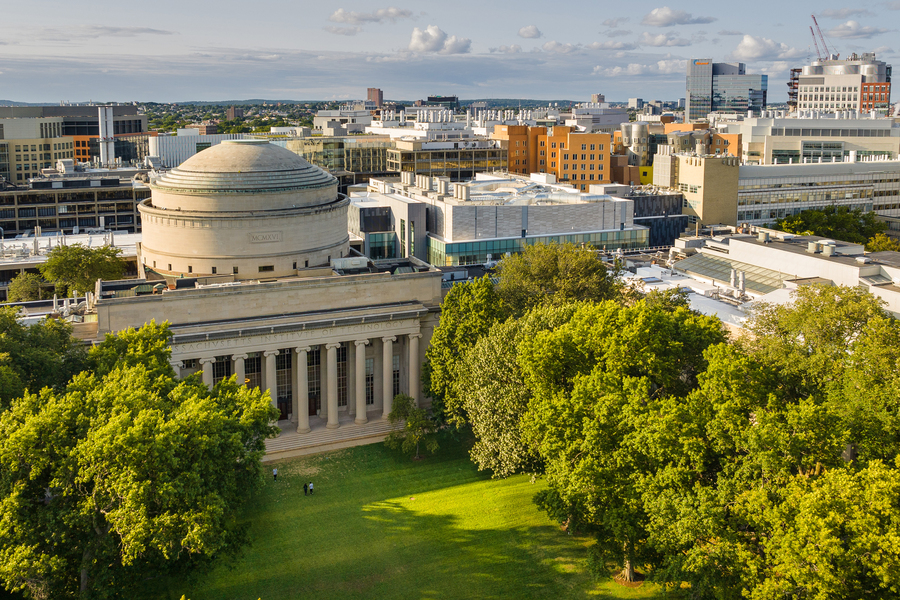


- MIT and the Commonwealth of Massachusetts announced plans to establish the Quantum Systems Laboratory (QSL) at MIT, which will be open to researchers across the region.
-
With the new funding from the state, which will match federal funding for quantum research already underway at MIT, the Institute aims to begin construction on the QSL facility this summer.
- The QSL will host specialized facilities that will enable Massachusetts scientists to undertake impactful work applying quantum research across practical domains, including life sciences and national defense.
Quantum technologies promise transformative changes in fields from computing, security, and navigation to health sciences, defense technologies, and space exploration. But how do we ensure Massachusetts stays on the leading edge of our nation’s coming quantum leap? Doing so is vital to the prosperity and security of our Commonwealth and country, serving to protect and advance America’s technological leadership in a world that has been upended by geopolitical rivalries.
On Thursday, May 28, Governor Maura Healey joined President Sally Kornbluth at MIT to announce a new effort aimed at establishing Massachusetts as a national hub for quantum innovation and catalyzing next generation quantum technologies. MIT and the Commonwealth of Massachusetts announced plans to establish the Quantum Systems Laboratory (QSL) at MIT, a new shared-use facility that will serve as a quantum toolbox for the region, aimed at accelerating quantum research, innovation, and growth in this critical field.
The QSL seeks to be the first facility in the world to bring together state‑of‑the‑art quantum computers with quantum sensors and peripherals, joined by quantum interconnects (physical channels that transfer quantum information). The facility will provide researchers from MIT and other institutions hands‑on access to significant quantum hardware and specialized experimental capabilities that are necessary to achieve the full transformative potential of quantum science and engineering.
Thanks to a $25 million investment from the state, which will match a portion of the federal funding for quantum research already underway at MIT, the Institute is now in a position to move forward as early as this summer with construction on the QSL facility, positioning the region to dominate the next generation of quantum research, according to Institute officials. The Commonwealth’s investment adds to MIT’s own financial commitment, as well as generous philanthropic support from Thomas Tull.
“Greater Boston has the greatest concentration of quantum talent anywhere in the world, working on a range of potential applications. Through the new Quantum Systems Laboratory, we will help position Massachusetts to lead the next era of quantum technologies,” says Kornbluth. “This facility will serve those at the edges of our wildest imaginations in physics and quantum computing, yes. But it will also equip the talent in our region — and ultimately, our nation — to push our knowledge to new limits, and new innovations.”
The QSL will be located at Building 39 on the MIT campus and will serve as a multi-disciplinary quantum hub with modern experimental infrastructure. Because quantum research involves the creation and study of coherent phenomena in systems that are isolated from the rest of the universe, it must take place in a highly controlled environment. Work is already underway in Building 39, with significant investments by MIT, to upgrade the physical infrastructure for these unique demands. The state’s support will supercharge this work and allow for the transformation of the lab into a hub for scientists across the region working on next-generation quantum technologies, startup applications, defense and health tech, and more.
“Our region has unparalleled strengths in science-intensive innovations and tough tech breakthroughs that combine engineering, science, and computing,” notes Anantha Chandrakasan, MIT’s provost. “With the new Quantum Systems Laboratory, we aim to arm Massachusetts with the compute power and integrated platforms needed to lead the coming era of quantum technologies.”
By the numbers
The QSL will host specialized facilities that will enable Massachusetts scientists to undertake impactful work applying quantum research across practical domains. As a shared-use facility, the QSL is being developed with the underlying mission of returning broad scientific, workforce, and economic benefit to the public.
For example, quantum technologies provide significant opportunities in the fields of life sciences and defense technologies, which are $50 billion contributors to the Massachusetts economy, with dozens of startups working in the area. During a time of increased economic anxiety and labor market concerns, investing in foundational quantum facilities will infuse our region with new job opportunities, in academic research institutions, startups and more. Construction on the QSL facility alone is anticipated to create over 150 full-time, on-site construction jobs, plus another 75 to 100 jobs across the Commonwealth in supply chain and professional services supporting the project.
Startups from MIT are also a key driver of the state’s entrepreneurial ecosystem; in 2015, Sloan Professors Edward Roberts and Fiona Murray published a report detailing how the Institute’s alumni entrepreneurs have created more than 30,000 active companies, employing 4.6 million people, and generating annual global revenues of $1.9 trillion, a figure greater than the gross domestic product (GDP) of the world’s 10th-largest economy, as of 2014. The QSL facility will provide the necessary equipment and facilities for startups working on quantum technologies, thereby strengthening the region’s innovation economy.
“The new QSL will introduce modern experimental infrastructure to quantum research at MIT and beyond, allowing us to scale experiments and expand into critical domains in disciplines such as biology and chemistry, where we see enormous innovative potential,” explains Ian Waitz, MIT’s vice president for research. “As the new physical home of the MIT Quantum Initiative (or QMIT), the QSL will serve not only as an on-campus incubator, but more broadly, a regional hub to catalyze quantum innovation, growth, and investment in this critical R&D sector for the Commonwealth.”
One floor of the facility will allow for development of radio-frequency (RF) electronics for controlling and interfacing with quantum systems. The QSL will also support researchers in the creation of customized quantum experiments with advanced high-frequency packages, which are required to protect quantum data in real-world applications. The facility will also develop the associated THz electronics needed by advanced quantum systems.
A history of future-focused plays
Nearly a decade ago, MIT made a similarly big bet on nanotechnology, developing MIT.nano — a state-of-the-art, shared-use facility with more than 200 tools and instruments that support nanoscale discovery and innovation through imaging, fabrication, characterization, and prototyping. Set in the heart of campus in the Lisa T. Su Building, MIT.nano is home to a thriving research community, an industry consortium, and a startup accelerator. More than a fifth of the 1,500 users of MIT.nano come from outside of MIT, and half of the companies in its START.nano accelerator have had non-MIT founders.
The QSL will also complement the capabilities of MIT Lincoln Laboratory’s SQUILL Foundry, a quantum fabrication hub for superconducting qubit systems that serves researchers across Massachusetts and the nation free of charge.
