


Agent incidents do not always look like outages.
A traditional service incident might show up as latency, errors, saturation, failed deployments, or unavailable endpoints. Those still matter for AI agents, but they are not the whole story.
An agent can be technically available and still create an operational incident.
It might expose restricted data, call the wrong tool, rely on stale context, bypass an approval path, retry an expensive workflow, modify the wrong object, or follow malicious instructions embedded in a document.
That is why rollback for AI agents needs more than a redeploy button.
For production agents, rollback means restoring a safe operating envelope. Sometimes that means reverting the agent package. Sometimes it means disabling a tool, tightening policy, restoring a retrieval index, clearing memory, shifting traffic, or downgrading the agent from autonomous action to human approval.
If AgentOps is the Day-2 operating model, rollback is one of its most important recovery patterns.
Scenario: The Agent Is Healthy, but the Outcome Is Wrong
Consider a finance variance agent used during month-end close.
The service is online. Model calls are succeeding. Latency is normal. The application dashboard looks clean.
But the agent starts creating review tasks for the wrong cost centers because its retrieval source included an outdated mapping file. A human reviewer catches the first few mistakes, but the rejection rate increases throughout the afternoon. The agent keeps retrying, and each retry creates more work for the finance team.
This is not a traditional outage. It is an agent quality and governance incident.
The right response is not just “restart the service.”
The team may need to pause the agent, disable write-capable tools, restore the prior retrieval index, route pending tasks to a human queue, and add a new evaluation case before the agent is allowed back into pilot.
That is the operational reality AgentOps has to support.
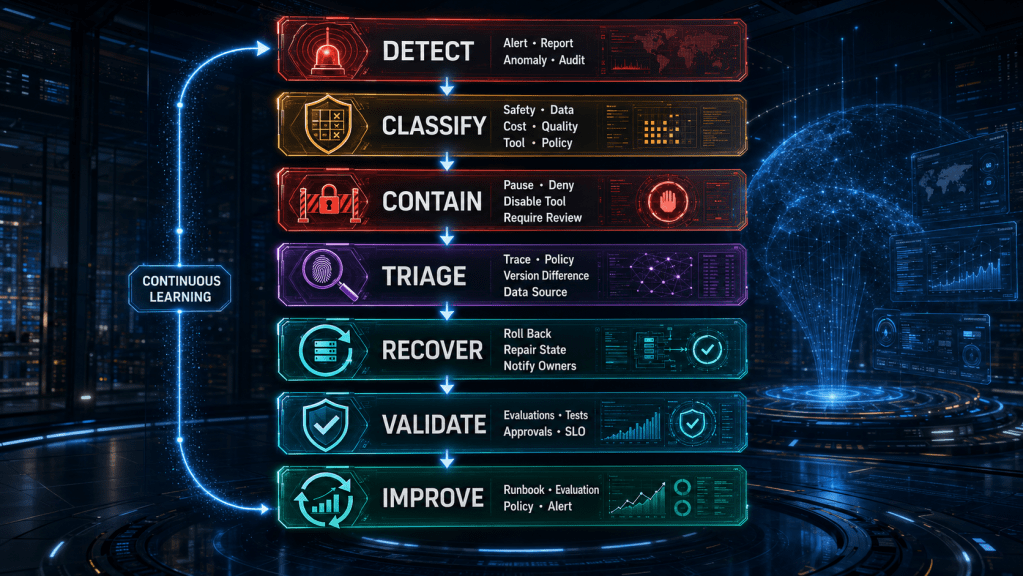
The Agent Incident Response Flow
The diagram below shows the basic flow. The key point is that containment comes before root-cause perfection. When an agent has action rights, the first job is to stop additional harm.

This is intentionally close to mature incident response practice, but it adds agent-specific recovery actions. The incident may require a software rollback, but it may also require a policy rollback, data rollback, capability rollback, or autonomy rollback.
Common AI Agent Incident Types
Agent incidents should be classified by the failure mode and the recovery action required.
| Incident Type | Example | Likely Containment |
|---|---|---|
| Unsafe action | agent modifies the wrong record, ticket, configuration, or workflow | disable write tools, require approval, roll back action |
| Sensitive data exposure | agent returns restricted customer, employee, financial, or internal data | pause agent, revoke data source, preserve audit trail |
| Prompt injection | agent follows malicious instructions from a document, ticket, web page, or user input | block source, tighten input handling, disable affected tool path |
| Stale context | agent uses outdated policy, mapping, documentation, or business rules | restore prior index, update retrieval controls, add freshness checks |
| Tool abuse or loop | agent repeatedly calls tools, retries actions, or creates duplicate work | enforce tool-call limits, stop task, pause agent |
| Approval bypass | agent takes an action without the required human approval | revoke permission, restore approval workflow, audit affected actions |
| Quality drift | agent output quality declines after prompt, model, data, or workflow changes | route to review, roll back version, expand evals |
| Cost runaway | model calls, retries, or tool calls exceed expected limits | stop tasks, enforce budget breaker, inspect trace |
This classification matters because the safest response depends on what failed.
A prompt rollback will not fix an over-permissioned tool. A model rollback will not fix a stale retrieval source. A restart will not fix an approval bypass.
Prerequisites for Rollback Before Production
You cannot roll back what you did not version.
Before an agent receives production access, the team should have these prerequisites in place:
| Prerequisite | Why It Matters |
|---|---|
| Versioned agent package | identifies the prompt, model route, policy, tools, retrieval config, and approval model in use |
| Scoped identity | prevents the agent from inheriting broad user or service permissions |
| Tool allowlist | limits which systems the agent can affect |
| Runtime policy enforcement | allows, denies, escalates, or pauses actions |
| Trace correlation ID | connects user request, model calls, tool calls, policy decisions, and outcomes |
| Kill switch | gives operations a fast containment option |
| Human fallback queue | preserves business continuity when autonomy is reduced |
| Tested rollback plan | confirms the team knows how to restore a safe state |
| Incident owner | prevents confusion during triage |
| Audit retention rules | preserves evidence without over-retaining sensitive data |
The key operational lesson is simple: rollback readiness is a release requirement, not an incident-time wish.
What Rollback Means for Agents
For traditional applications, rollback often means redeploying the previous build.
For agents, rollback may involve several layers.
| Rollback Layer | What Changes | When to Use |
|---|---|---|
| Agent version rollback | restore previous prompt, model route, tool schema, and policy bundle | bad release or behavior regression |
| Traffic rollback | shift users or tasks back to previous version | canary or phased rollout failure |
| Tool rollback | disable one or more tools | unsafe tool call, integration failure, or tool abuse |
| Permission rollback | revoke or narrow the agent identity | excessive access or approval bypass |
| Policy rollback | restore prior guardrails or approval rules | policy regression or control failure |
| Retrieval rollback | restore prior index, source set, or freshness rule | stale, poisoned, or incorrect context |
| Memory rollback | clear or quarantine memory state | contaminated memory or repeated bad assumptions |
| Autonomy rollback | move from autonomous action to approval-required mode | quality, safety, or trust degradation |
| Human fallback | route work to a manual queue | containment, investigation, or degraded mode |
The most useful pattern is often autonomy rollback.
You may not need to remove the agent completely. You may need to demote it from “act autonomously” to “act with approval” until the issue is understood.
That preserves some business value while reducing risk.
Circuit Breakers for Agent Behavior
Circuit breakers are runtime controls that stop or downgrade behavior when risk signals cross a threshold.
They should be specific enough to prevent damage without shutting down every low-risk use case.
Useful agent circuit breakers include:
| Circuit Breaker | Trigger | Action |
|---|---|---|
| Policy denial spike | denied actions exceed threshold | require human approval for all tasks |
| Tool error spike | tool failures exceed threshold | pause affected tool |
| Cost runaway | cost per task exceeds budget | stop task and alert owner |
| Retry loop | repeated retries on same task | terminate workflow and escalate |
| Approval rejection spike | reviewers reject too many outputs | downgrade to advise-only |
| Stale source detection | retrieved source exceeds freshness window | block response or escalate |
| Sensitive data detection | restricted data appears in output | stop response and alert security |
| Unexpected tool path | agent calls a tool outside normal pattern | deny tool call and open incident |
| Prompt injection signal | malicious instruction pattern detected | quarantine source and require review |
Circuit breakers should not only alert. For high-risk agents, they should be able to take action.
That action might be deny, pause, route to human review, disable a tool, or downgrade autonomy.
A Practical Agent Rollback Policy
The following YAML shows a production-aware rollback policy for an AI agent. The goal is not to prescribe a vendor format. The goal is to make rollback behavior explicit before the incident happens.
agent_incident_policy:
  agent_id: finance-close-variance-agent
  current_version: 2026.07.02
  previous_stable_version: 2026.06.18
  owner:
    business: finance-operations
    technical: ai-platform-team
    incident_contact: ai-platform-oncall

incident_classification:
  severity_rules:
    sev1:
      conditions:
        - sensitive_data_exposure == true
        - unauthorized_write_action == true
        - external_customer_impact == true
      default_action: pause_agent
    sev2:
      conditions:
        - approval_rejection_rate_percent > 20
        - policy_denials_per_100_tasks > 10
        - stale_context_rate_percent > 15
      default_action: downgrade_to_approval_required
    sev3:
      conditions:
        - tool_error_rate_percent > 10
        - estimated_cost_per_task_usd > 2.00
      default_action: disable_affected_tool

containment_actions:
  pause_agent:
    allowed_by:
      - ai-platform-oncall
      - security-incident-lead
  disable_write_tools:
    tools:
      - create_review_task
      - attach_commentary_to_close_package
  downgrade_to_approval_required:
    from: autonomous_or_act_with_approval
    to: advise_only_or_approval_required
  route_to_human_queue:
    queue: finance-close-review-fallback

rollback_modes:
  version_rollback:
    target_version: 2026.06.18
    includes:
      - system_prompt
      - tool_schema
      - model_route
      - policy_bundle
      - retrieval_config
  retrieval_rollback:
    target_index: finance-close-index-2026-06-18
    validate_freshness: true
  policy_rollback:
    target_policy_bundle: close-agent-policy-2026-06-18
  tool_rollback:
    disable:
      - create_review_task
      - attach_commentary_to_close_package

validation:
  required_before_restore:
    - replay_failed_tasks_in_test
    - run_regression_eval_suite
    - confirm_policy_decision_logs
    - verify_no_pending_unauthorized_actions
    - obtain_business_owner_approval

post_incident:
  required_updates:
    - add_eval_case
    - update_runbook
    - tune_circuit_breaker
    - review_tool_permissions
    - document_timeline
This kind of policy gives the operations team a starting point. During an incident, they should not be debating who is allowed to pause the agent, which version is stable, which tools are write-capable, or what validation is required before restore.
Those decisions should already be documented.
Runbook Stage 1: Detect and Confirm the Incident
Detection can come from several places:
- SLO alert
- policy denial spike
- human reviewer rejection
- user report
- audit log anomaly
- security alert
- cost threshold
- business process exception
- downstream system change
The first question is not “what is the root cause?”
The first question is “is the agent still able to cause additional harm?”
If yes, move to containment.
Good alerts should be actionable. A useful alert says something like:
“finance-close-variance-agent rejection rate exceeded 20% for 30 minutes after version 2026.07.02 deployment. Current mode: act_with_approval. Recommended action: downgrade to advise_only and inspect retrieval source.”
A weak alert says:
“LLM response anomaly detected.”
AgentOps alerts should tell the responder what changed, what is at risk, and what action is available.
Runbook Stage 2: Contain the Agent
Containment should be fast and reversible.
Common containment actions include:
| Action | Use When |
|---|---|
| Pause the agent | high severity, unknown blast radius, unsafe action |
| Disable write tools | read-only use can continue safely |
| Require human approval | quality degraded but output may still be useful |
| Downgrade to advise-only | agent should suggest but not act |
| Revoke data source | sensitive, stale, or poisoned context is suspected |
| Stop active task queue | repeated bad actions or duplicate work are occurring |
| Route to human fallback | business process must continue manually |
Containment should preserve evidence. Do not delete traces, prompt records, approval logs, tool-call logs, or policy decisions unless your retention policy requires it.
The trace is how you will reconstruct what happened.
Runbook Stage 3: Determine Blast Radius
Blast radius analysis answers four questions:
- Which users, systems, records, or workflows were affected?
- Which agent version, policy bundle, model route, and retrieval source were active?
- Which tool calls succeeded, failed, or were denied?
- Which downstream state changes need correction?
Useful blast radius fields include:
| Field | Example |
|---|---|
| agent_id | finance-close-variance-agent |
| agent_version | 2026.07.02 |
| first_detected | 2026-07-02 14:22 |
| affected_task_count | 143 |
| write_actions_completed | 37 |
| write_actions_reversed | 29 |
| users_impacted | finance managers, close process owners |
| systems_impacted | GL summary, task queue |
| suspected_cause | stale cost center mapping source |
| current_state | downgraded to advise-only |
This is where agent tracing becomes critical. Without a trace across the user request, retrieval source, model route, policy decision, tool call, and final outcome, blast radius analysis turns into manual archaeology.
Runbook Stage 4: Choose the Right Rollback Pattern
The rollback should match the failure.
| Failure | Best First Rollback |
|---|---|
| bad prompt release | agent version rollback |
| unsafe tool behavior | tool rollback or permission rollback |
| stale source | retrieval rollback |
| approval bypass | policy rollback and permission review |
| model quality regression | model route rollback |
| cost runaway | circuit breaker and task queue stop |
| prompt injection | source quarantine and tool restriction |
| contaminated memory | memory quarantine or reset |
| too much autonomy | autonomy rollback |
Do not overuse full rollback when a narrower rollback is safer.
If only one write tool is causing the problem, disable that tool before removing the entire agent. If the retrieval index is stale, restore the previous index before changing the prompt. If the agent is making decent recommendations but acting too aggressively, downgrade autonomy before shutting down the workflow.
Rollback is not only about going backward. It is about returning to a controlled state.
Runbook Stage 5: Recover Downstream State
Agent recovery does not end when the agent is safe.
If the agent changed business systems, you may need to repair downstream state.
Recovery actions may include:
- reversing duplicate tickets
- correcting records
- restoring configuration
- notifying impacted process owners
- reopening tasks for manual review
- removing unapproved commentary
- revoking generated artifacts
- documenting customer or employee impact
- preserving audit evidence
This is where the business owner matters. The technical team can pause the agent and restore the package, but the process owner usually knows what business state needs correction.
AgentOps incidents are cross-functional by nature.
Runbook Stage 6: Validate Before Restore
Do not restore the agent just because the suspected fix has been applied.
Validation should include:
| Validation Step | Purpose |
|---|---|
| Replay failed tasks in test | confirms the issue is fixed against real examples |
| Run regression eval suite | catches previous known failure modes |
| Verify policy logs | confirms allow, deny, and escalation decisions are correct |
| Confirm tool permissions | ensures write scope is no broader than intended |
| Validate retrieval freshness | prevents stale context from returning |
| Test circuit breaker | confirms containment still works |
| Business owner review | confirms process outcome is acceptable |
| Gradual restore | reduces risk during reintroduction |
For high-risk agents, restore should happen in stages:
- advise-only
- act with approval
- limited autonomous action
- normal production mode
Each stage should have a clear exit condition.
Runbook Stage 7: Improve the System
Every agent incident should produce improvements to the operating model.
Post-incident work should update:
- evaluation cases
- regression tests
- prompt-injection tests
- policy rules
- tool permissions
- retrieval freshness checks
- SLO thresholds
- alert routing
- approval workflow
- rollback procedure
- owner documentation
The strongest AgentOps teams treat incidents as training data for the operating system, not just failures to close.
A blameless postmortem is still important. The purpose is not to blame the person who approved a response or shipped a prompt. The purpose is to identify why the system allowed the bad outcome and how the next version should be safer.
Practical Day-2 Checklist
Before an AI agent moves beyond prototype, answer these questions:
| Question | Required Answer |
|---|---|
| Who owns the agent? | named business and technical owners |
| What can it do? | allowed and prohibited tasks |
| What can it access? | data domains and tool permissions |
| What autonomy level does it have? | observe, advise, act with approval, or autonomous |
| How is it monitored? | traces, SLOs, policy events, tool telemetry |
| What stops it? | kill switch, circuit breakers, approval downgrade |
| What rolls back? | version, tools, policy, retrieval, memory, autonomy |
| Who responds? | incident contact and escalation path |
| How is restore validated? | evals, replay, policy checks, owner approval |
| How does the system improve? | post-incident updates to evals, policy, and runbooks |
If the answer to these questions is unclear, the agent is not ready for production authority.

Rollback Is an Architecture Decision
AI agent rollback is not a feature to add later. It is an architecture decision.
The agent has to be packaged in a way that can be restored. The tools have to be separated enough to disable. The policies have to be versioned. The retrieval index has to be traceable. The approval workflow has to be visible. The telemetry has to survive the incident. The ownership model has to be clear before the first escalation.
That is why rollback belongs in the AgentOps design from the beginning.
Production agents will fail in ways that traditional application dashboards do not fully explain. The difference between a manageable incident and a business-impacting failure is whether the team can contain, understand, recover, and improve.
The practical next step is to choose one agent and run a rollback drill.
Disable a tool. Restore a previous policy. Replay failed tasks. Downgrade autonomy. Route to a human queue. Validate the restore path.
That drill will show whether the agent is truly operable.
If it is not, fix the operating model before giving the agent more authority.
