

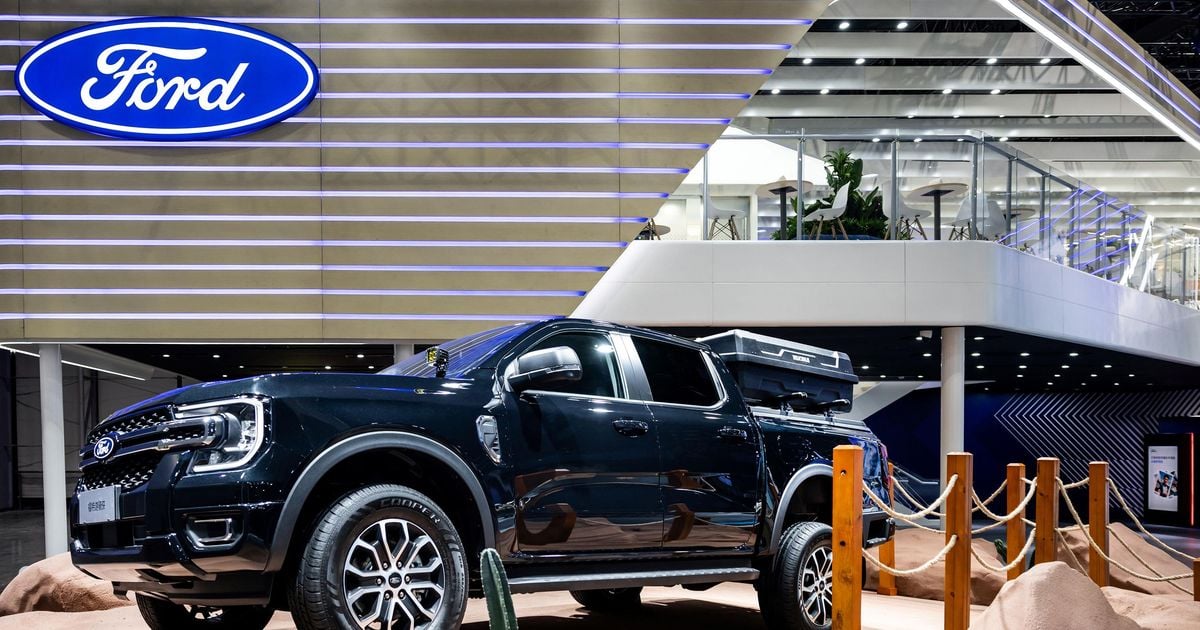

A partnership between Ford and Chinese automaker Jiangling Motors Co (JMC) has been axed after ongoing losses totalling at least ¥750 million (A$153m) since it was announced in January 2022.
According to Ford, the Jiangling Ford Automobile Technology (JFT) joint venture was created to “accelerate growth of Ford’s passenger vehicle business in China”.
However, a Jiangling Motors report published in 2025 confirmed the JV accumulated even higher losses of ¥2.3 billion (A$480m) over four years, with its revenue falling 45.4 per cent last year alone.
According to Chinese news outlet Soho.com, the JV has now been liquidated. Ford has not made any official statement.
CarExpert can save you thousands on a new car. Click here to get a great deal.

While the JV did not manufacture vehicles, it was tasked with driving sales growth through the development of a dealer network of 181 outlets across China, branded as outdoor/adventure lifestyle-oriented ‘Ford Beyond’ stores.
Separate from Changan Ford – a 50:50 joint venture between Ford and Changan which manufactures the brand’s vehicles in China – the ‘Ford Beyond’ outlets focused on SUVs and pickups rather than traditional passenger cars.
The strategy aimed to capitalise on easing Chinese regulations around pickup use in urban areas.
This was expected to present an opportunity for more lifestyle-oriented models such as a Chinese-market version of the Ford Ranger – Australia’s best-selling model for the past three years.
The first Ford Beyond dealership opened in October 2023 in Chongqing, where restrictions on pickup trucks had already been lifted.
The lineup also included the Bronco from 2024 and the Ford Equator Sport SUV, also known as the Territory (not sold in Australia, and unrelated to the locally developed 2004-2016 Territory).
Ford Beyond dealers also offered the Bronco New Energy, an electric SUV which is tipped for a future Australian launch.
The now-liquidated JV formed part of Ford’s broader strategy to shift towards selling global models in China, rather than developing bespoke vehicles solely for the local market.
Ford held a 49 per cent stake in the JV, with Jiangling Motors Holding (JMH) owning the remaining 51 per cent.
However, JMC and Ford remain long-term partners, with the US automaker first investing in the Chinese company in 1995.
Ford remains JMC’s largest shareholder, holding around 32 per cent, with the company continuing to build Ford vehicles in China for both domestic and export markets.
The second-generation Territory, for example, is produced by JMC in China, Taiwan and Vietnam, while exports include Transit vans to markets in the Middle East, Southeast Asia and South America.
JMC also manufactures vehicles marketed by other brands, none of which are sold in Australia.
In a reversal of decades of joint ventures enabling foreign brands to enter China, earlier this year Ford’s global president and CEO Jim Farley proposed similar partnerships between US and Chinese manufacturers to allow Chinese brands such as BYD to build vehicles there.
Chinese automakers remain largely locked out of the US market – the world’s second-largest by volume behind China – due to tariffs, national security concerns, and a preference for domestic manufacturing.
Speaking to the Wall Street Journal, Mr Farley said Ford is also looking to increase its partnerships with Chinese companies outside the US.
“They’re really leading the world in many ways when you look at the technology and the cost and the speed of what they’re doing.”
MORE: Explore the Ford showroom
