

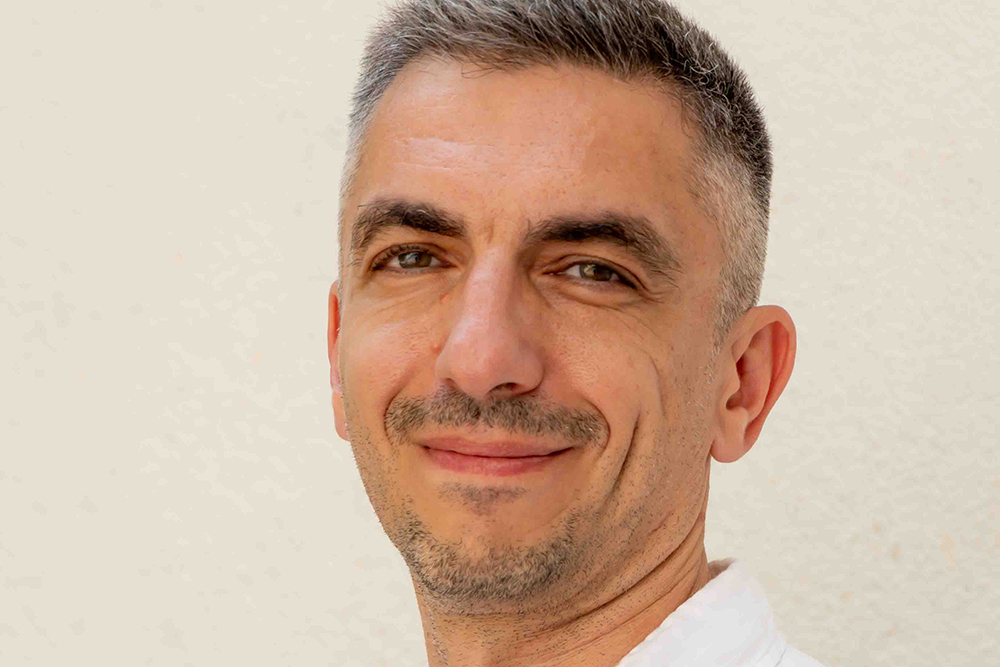


Alexander “Sasha” Rakhlin PhD ’06, the Distinguished Professor in Data, Systems, and Society at the MIT Institute for Data, Systems, and Society (IDSS); and a professor of brain and cognitive sciences at MIT, has been named the next director of the MIT Statistics and Data Science Center (SDSC).
Rakhlin succeeds Ankur Moitra, the Norbert Wiener Professor of Mathematics, associate director of the IDSS, and a faculty member in the MIT Department of Electrical Engineering and Computer Science (EECS) who has been SDSC director since 2021. Philippe Rigollet, the Cecil and Ida Green Distinguished Professor of Mathematics and a core faculty member in IDSS, also served as interim director in 2024-25.
“Sasha is one of the sharpest theoretical minds working in statistics and machine learning today, and also one of the most devoted mentors I know,” says Fotini Christia, the Ford International Professor of the Social Sciences and director of IDSS, which houses SDSC. “He has helped train an entire generation of interdisciplinary scholars through the Interdisciplinary Doctoral Program in Statistics (IDPS), while his own research keeps pushing the boundaries. The SDSC could not ask for a more fitting leader.”
Rakhlin is the inaugural holder of the Distinguished Professorship in Data, Systems, and Society, an endowed chair created in 2025 by the generosity and vision of IDSS professor Richard “Dick” Larson, an “MIT lifer” and pioneer in operations research, queueing theory, and system optimization.
“I am honored to take on this role,” says Rakhlin. “The strength of the Statistics and Data Science Center has always been its people — students, postdocs, and faculty from across MIT who bring sharply different perspectives to the most interesting problems of the day in statistics, machine learning, and AI. My goal is to support that community as it takes on the constantly evolving questions reshaping the field.”
Rakhlin has been connected to the Statistics and Data Science Center as a visiting professor since 2016, before formally joining MIT in 2018 in the Department of Brain and Cognitive Sciences and IDSS. As the initial chair of the Interdisciplinary PhD in Statistics program at the SDSC, Rakhlin has seen the successful defense of over 75 IDPS PhD students across a variety of departments at MIT, including IDSS’ own Social and Engineering Systems program.
“I have been fascinated by machine learning since my PhD work more than 20 years ago, drawn by its beautiful connections to statistics, probability, algorithms, optimization, and game theory,” says Rakhlin. “At the Statistics and Data Science Center, I work alongside colleagues who share this fascination and pursue these connections in many directions. The recent revolution in AI is extending this web into the sciences; it promises to accelerate discovery, and it raises new questions for statistics. Answering them demands a rigorous science of the tools themselves. As AI enters medicine, energy, and public life, its safety and security are, at their core, statistical and mathematical questions: quantifying uncertainty, providing guarantees, understanding failure, and resisting manipulation.”
As Rakhlin puts it, the SDSC is built for this moment. “Statistics is a shared language across MIT,” he adds. “Through the Interdisciplinary Doctoral Program in Statistics, the center connects students and faculty from economics and political science to physics and engineering. Collaborations in areas from biology to nuclear fusion have shown how statistical thinking accelerates science itself.”
As director, one of his goals is to deepen these interdisciplinary connections. He hopes to help make SDSC the Institute’s home for the rigorous foundations of data science and AI, and a bridge to the scientific and societal questions where those foundations are most needed.
Rakhlin received his bachelor’s degrees in mathematics and computer science from Cornell University, and doctoral degree from MIT. He was a postdoc at the University of California at Berkeley in EECS before joining the University of Pennsylvania, where he was an associate professor in the Department of Statistics and co-director of the Penn Research in Machine Learning center.
