

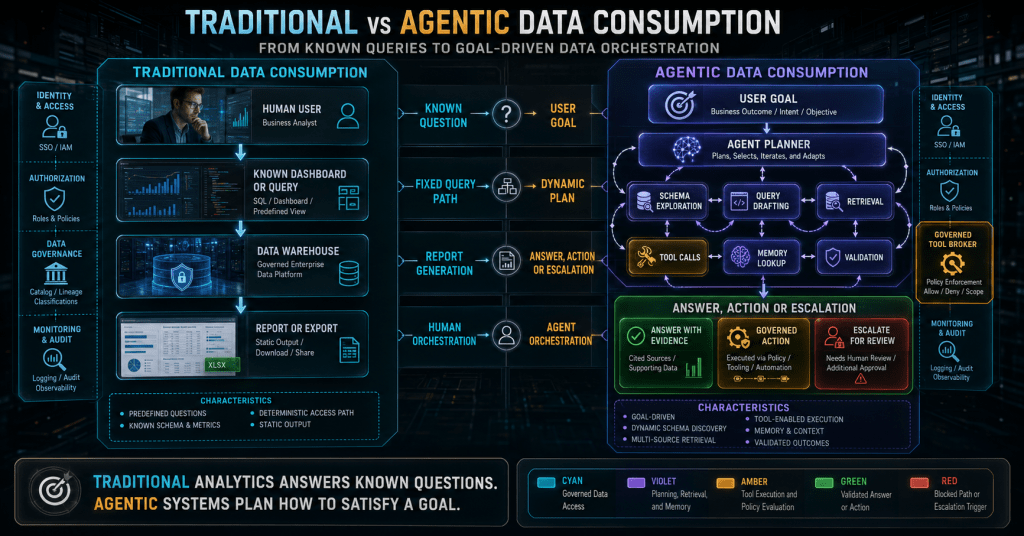

Enterprise AI teams are learning a hard lesson: agents do not behave like human users.
A human analyst may ask a few questions, inspect a dashboard, and refine a query. An AI agent may generate dozens or hundreds of intermediate queries, inspect schemas, test assumptions, call tools, create temporary state, retry failed paths, and coordinate with other agents. Once organizations move from chatbots to agentic workflows, the data layer becomes more than a place to retrieve documents.
It becomes an operating substrate.
That is why agentic data systems deserve attention. The next wave of enterprise AI will not be limited by whether a model can produce a fluent answer. It will be limited by whether the surrounding data systems can support agent behavior safely, efficiently, and observably.
Why Traditional Data Access Patterns Break
Most enterprise data platforms were designed around known consumers.
Human users run reports. Applications issue predictable queries. Dashboards refresh on schedules. Pipelines move data through controlled stages.
Agents are different.
They speculate. They branch. They retry. They generate partial plans. They ask questions that were not pre-modeled by a dashboard team. They may need memory from previous attempts, corrective instructions from prior failures, and access to structured business context that does not fit cleanly into a prompt.
That changes the workload shape.

The second pattern creates more traffic, more intermediate state, and more governance complexity. It also creates new opportunities to optimize work across agents instead of treating every query as unrelated.
The Three Data System Patterns For Agents
A useful way to frame the shift is to separate three patterns.
| Pattern | Meaning | Enterprise question |
|---|---|---|
| Data systems for agents | Data platforms optimized for agent workloads | Can the platform handle speculative, repetitive, high-volume agent queries? |
| Data systems of agents | Shared memory, state, coordination, and recovery for agent swarms | Where do agents store durable task state and corrective knowledge? |
| Data systems by agents | Agents generating or modifying data systems, queries, schemas, or pipelines | How do we verify what agents create before it affects production? |
This gives architects a better vocabulary than simply saying “we need RAG.”
RAG is one capability. Agentic data systems are broader. They include retrieval, structured memory, query reuse, state management, coordination, verification, rollback, and auditability.
The Agentic Data Substrate
The architecture should treat agent activity as a first-class workload.
The important point is not the specific product choice. The important point is the separation of concerns. Querying, memory, coordination, verification, and trace capture are different responsibilities.
A vector database alone does not solve this.
Structured Memory Beats Prompt Stuffing
Many early agent implementations use files, notes, or raw conversation history as memory. That can work in small labs. It becomes fragile in enterprise workflows.
Agents need memory that can be retrieved by task type, system, data source, failure mode, policy condition, and corrective instruction. Otherwise, the agent either misses important context or stuffs too much irrelevant history into the prompt.
A better pattern is structured memory.
agent_memory_record:
  memory_type: corrective_instruction
  applies_to:
    business_domain: finance
    system: revenue_reporting
    table: sales_transactions
    column: booking_date
    operation: date_filtering
    failure_mode: wrong_fiscal_period
  instruction: Use fiscal calendar boundaries for quarterly revenue analysis, not calendar quarter boundaries.
  confidence: approved
  approved_by: finance-data-owner
  created_from:
    incident: ai-query-review-2026-042
    trace_id: trace-78491
  expiration:
    review_required_after_days: 180
This format gives operations teams something they can govern. It also gives agents more precise context than a pile of markdown notes.
Query Reuse Becomes A Cost And Performance Lever
Agents often generate overlapping queries while exploring a task. Multiple agents working on the same business question may inspect the same schemas, filter the same entities, or run similar aggregations with slight variations.
That creates waste.
A mature agentic data layer should detect overlapping work and reuse results where safe. It should also return partial or approximate answers when they are good enough for an agent to choose the next step.
This is similar to how infrastructure teams think about caching, shared scans, materialized views, and workload optimization. The difference is that the workload is now generated dynamically by agents instead of pre-built applications.

The goal is not only lower cost. It is faster reasoning, less database pressure, and better control over what agents are allowed to explore.
Governance Changes When Agents Generate Data Work
The riskiest pattern is not agents querying data. It is agents generating queries, schemas, transformations, pipelines, dashboards, or data services that other people trust.
That requires validation before execution.
An agent-generated SQL query should be checked for access boundaries, expensive joins, destructive statements, business-rule violations, and evidence quality. An agent-generated pipeline should be tested against known data contracts. An agent-generated dashboard should be reviewed for metric definitions before executives make decisions from it.
A practical policy pattern looks like this:

The mistake is assuming that because an agent produced a working artifact, the artifact is safe. Working is not the same as governed.
Practical Implementation Notes
Start small.
Choose one workflow where agents need to interact with structured data, such as incident investigation, cost analysis, sales operations, or support case triage. Capture every intermediate query, retrieval event, tool call, policy decision, and final answer.
Then look for patterns:
- Which queries are repeated?
- Which memory would have prevented mistakes?
- Which data access decisions need policy enforcement?
- Which generated artifacts need approval?
- Which traces would help debug failures?
- Which parts of the workflow can be safely cached?
Do not begin by buying another database and calling it an agent memory layer. Begin by mapping the workload and the controls.
Caveats And Gotchas
Agentic data systems introduce their own risks.
Shared memory can become polluted with bad lessons. Cached results can leak across permission boundaries if identity is not enforced. Agents can create expensive query storms. Generated data artifacts can appear authoritative even when they encode the wrong business logic. Coordination between multiple agents can produce race conditions, conflicting edits, or stalled workflows.
These are not reasons to avoid agentic data systems. They are reasons to design them deliberately.
Conclusion
Enterprise AI will not scale on model calls alone.
As agents become more capable, the data layer has to evolve from passive retrieval into an active substrate for exploration, memory, coordination, validation, and governance. That does not mean every organization needs a futuristic agent swarm platform tomorrow. It means architects should stop treating RAG as the whole data architecture.
Agents need more than context.
They need governed access, structured memory, reusable work, durable traces, and controlled promotion paths for anything they generate.
The organizations that understand this early will build AI systems that are not only smarter, but easier to operate.
External References
BAIR, Intelligence is Free, Now What? Data Systems for, of, and by Agents
https://bair.berkeley.edu/blog/2026/07/07/intelligence-is-free-now-what/
dbt Documentation, Jinja and macros
https://docs.getdbt.com/docs/build/jinja-macros
Temporal, Durable execution platform
https://temporal.io/
NIST, AI Risk Management Framework: Generative AI Profile
https://www.nist.gov/publications/artificial-intelligence-risk-management-framework-generative-artificial-intelligence
