


Introduction
Enterprise AI teams eventually reach the same uncomfortable question: what should the agent remember?
That question sounds simple until it touches real systems. A support agent may need to remember a customer preference, a recent escalation, a policy exception, and the current conversation state. A platform engineering agent may need to remember approved deployment patterns, failed remediation attempts, environment-specific constraints, and the operator’s preferred workflow.
Those are not the same kind of memory.
Treating agent memory as a single feature usually creates one of two problems. The agent forgets things users expect it to retain, or it stores too much and turns memory into a stale, risky, unaudited data swamp. Both outcomes are architecture problems, not prompt problems.
Agent memory needs to be designed like an enterprise data boundary. That means defining what can be stored, where it lives, who can read it, when it expires, how it is corrected, and how it is retrieved into the context window.
Why Memory Becomes an Operating Model
A stateless assistant is easy to reason about. Every interaction starts fresh. That can be limiting, but it is also clean.
A stateful agent is more useful, but it introduces operational responsibilities. Once the agent remembers previous work, prior incidents, user preferences, approval history, or workflow decisions, the memory layer becomes part of the system of record for how the agent behaves.
That changes the ownership model.
Memory is no longer a convenience feature. It becomes part of identity, privacy, compliance, retrieval quality, cost control, and operational trust.
In practical terms, every memory design should answer these questions:
- Is the information temporary or durable?
- Is it a stable fact or an event history?
- Is it user-specific, team-specific, tenant-specific, or global?
- Can the agent write to it automatically, or does a human need to approve the write?
- Can the user inspect, correct, or delete it?
- Is retrieval filtered by authorization and context?
- What happens when old memory conflicts with current policy?
If those questions are skipped, the agent may appear smarter in the demo while becoming harder to govern in production.
The Memory Boundary at a Glance
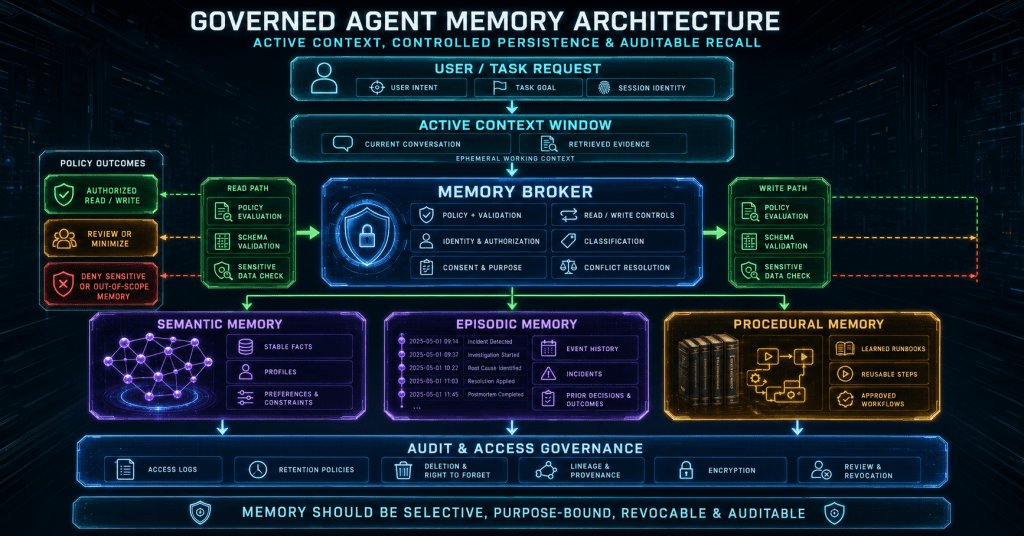
The key design pattern is to keep the model from writing directly into every memory store. A memory broker, policy layer, or controlled service should sit between the model and persistent memory.

What matters in this diagram is the boundary. The model can request context, suggest memory updates, or produce a write candidate, but the memory broker decides whether the action is allowed. That broker is where retention, authorization, data classification, and auditability belong.
Working Memory Belongs in the Session
Working memory is the short-lived state needed to complete the current interaction. It includes the conversation so far, intermediate tool results, unresolved clarifications, and task-local state.
This memory should usually stay close to the runtime. It may be trimmed, summarized, or compressed as the task grows, but it should not automatically become durable memory.
For example, a troubleshooting agent may need to remember that it already checked DNS, vCenter reachability, and authentication during the current investigation. That does not mean every intermediate command output should be stored forever.
Working memory should be treated as disposable unless there is a clear reason to preserve it.
Semantic Memory Stores Stable Facts
Semantic memory stores durable facts the agent can reuse across sessions. This might include a user’s preferred language, a team’s default cloud region, a product entitlement rule, a known environment name, or a governed architectural standard.
This kind of memory should not be a random vector dump. Stable facts are often better represented as structured records, knowledge graph entities, configuration documents, or governed profile objects.
A common mistake is using semantic search for everything. Vector search is useful when the agent needs to find meaning across unstructured content, but stable enterprise facts often need canonical fields, ownership, timestamps, and update rules.
A preference that changed last week should not compete with a stale preference from six months ago because both were embedded into the same store.
Episodic Memory Stores What Happened
Episodic memory is event history. It captures prior interactions, incidents, decisions, escalations, tool calls, approvals, and outcomes.
This memory is valuable when sequence matters. For example, an operations agent should know that a remediation already failed twice, that a previous change was rolled back, or that an exception was approved by a specific owner for a specific window.
Episodic memory should be stored like an event log, not like a profile. It needs timestamps, actors, scope, source systems, and retention rules. It may also need summarization when the event history grows too large.
The danger is retrieval without context. Pulling old incidents into a new session without freshness, relevance, or environment filtering can cause the agent to recommend yesterday’s workaround for today’s different failure.
Procedural Memory Stores Reusable Workflows
Procedural memory is not a transcript. It is the distilled operating pattern learned from repeated successful work.
For a platform team, procedural memory might store:
- The approved sequence for restarting a service
- The validation checklist after a failed deployment
- The standard rollback path for a common automation error
- The preferred evidence package before requesting a change approval
This layer should be governed carefully because it can influence how the agent acts in future sessions. A bad procedure stored as memory can become a repeatable failure pattern.
Procedural memory should be versioned, reviewed, and tied to success evidence. If it represents an operational runbook, it should behave like a runbook: owned, tested, approved, and reversible.
A Practical Decision Path for Agent Memory
Before storing anything, classify the information. This decision path keeps teams from treating every piece of context as permanent memory.
The discipline is simple: run the decision path per information category, not per agent. The same agent may need working memory for current task state, semantic memory for stable preferences, episodic memory for incident history, and procedural memory for reusable remediation patterns.
Memory Governance Controls That Matter
Enterprise memory design needs a governance layer before it needs a larger context window.
The minimum control set should include:
- Explicit write rules
- User or tenant scope
- Data classification
- Retention policy
- Correction and deletion workflow
- Source attribution
- Retrieval authorization
- Audit trail
- Conflict resolution
- Memory freshness scoring
A practical policy object might look like this:
agent_memory_policy:
  default_write_mode: explicit_approval
  stores:
    working:
      persistence: session_only
      retention: until_session_end
      approval_required: false
    semantic:
      persistence: durable
      retention: reviewed_annually
      approval_required: true
      allowed_data:
        - user_preference
        - team_standard
        - approved_environment_fact
    episodic:
      persistence: durable
      retention: ninety_days
      approval_required: false
      required_fields:
        - timestamp
        - actor
        - source_system
        - outcome
    procedural:
      persistence: durable
      retention: versioned
      approval_required: true
      required_fields:
        - owner
        - validation_method
        - rollback_path
        - last_reviewed
  retrieval:
    enforce_identity_scope: true
    require_source_attribution: true
    block_cross_tenant_retrieval: true
    prefer_recent_when_conflict_exists: true
This is not meant to be a universal schema. It is a starting point for turning memory from a vague feature into an enforceable contract.
Common Failure Modes
Memory failures rarely look dramatic at first. They show up as subtle trust erosion.
The agent remembers something that should have been forgotten. It uses an old preference after the user changed it. It retrieves information from the wrong customer, environment, or tenant. It stores a failed workaround as if it were a proven procedure. It keeps adding context until every session becomes expensive and noisy.
The most common failure modes are:
- Memory hoarding, where every interaction becomes durable
- Vector-store dumping, where structured facts are stored as unstructured embeddings
- Stale fact collision, where old and new facts compete without invalidation
- Unauthorized retrieval, where memory bypasses identity boundaries
- Hidden personalization, where users cannot see or correct what the agent remembers
- Procedure drift, where unreviewed workflows become default behavior
These are not theoretical problems. They are the same governance failures enterprise teams already understand from data platforms, configuration management, knowledge bases, and automation systems.
The difference is that an AI agent can operationalize the bad memory at runtime.
Practical Implementation Path
The best starting point is not full autonomous memory.
Start with read-only retrieval from trusted sources. Then allow explicit user-approved memory writes for low-risk facts. Add episodic event capture next, but keep it scoped and auditable. Only introduce procedural memory after the team has a way to validate whether the stored procedure actually improves future outcomes.
A sane rollout looks like this:

Autonomous memory writes should be earned through evidence. They should not be granted because the agent sounds confident.
Conclusion
Agent memory is not one bucket. It is an architecture pattern that spans session state, durable facts, event history, learned procedures, identity scope, retrieval policy, and auditability.
The practical takeaway is straightforward: design memory before the agent needs it. Define the memory stores, write rules, retrieval boundaries, retention policy, and correction workflow before production users begin relying on the agent’s memory.
A well-designed memory layer makes agents more useful. A poorly designed memory layer makes them unpredictable, expensive, and difficult to govern.
The goal is not to make the agent remember everything.
The goal is to make it remember the right things, for the right reason, inside the right boundary.
