


Build numbers are easy to treat as trivia until they become the deciding factor in a support case, security review, failed upgrade, or lifecycle audit.
Most teams know whether they are running “vSphere 8” or “vSphere 9.” Fewer teams can quickly answer the more useful operational question:
Which exact vCenter and ESX/ESXi builds are running in production, and are they aligned with the approved baseline?
That difference matters. Version labels are broad. Build numbers are evidence. They tell you the precise code level installed on vCenter Server, ESX/ESXi hosts, and related components such as vSAN, NSX, and VMware Tools.
In 2026, that evidence is especially important because many environments are balancing vSphere 8 patching, VCF or VVF-aligned vSphere 9 adoption, lifecycle-manager baselines, hardware vendor images, and cleanup work left behind by older vSphere 7 estates.
This article is not intended to be another giant build-number catalog. Vendor-maintained build tables already exist, and those tables change as new releases ship. Instead, this is a practical runbook for using vSphere build numbers correctly: how to collect them, how to map them, how to detect drift, and how to turn the result into an operational decision.
What You Will Accomplish
By the end of this runbook, you should be able to:
- Identify the exact vCenter and ESX/ESXi builds running in an environment.
- Understand why build numbers matter more than friendly release names during patch validation.
- Compare discovered builds against an approved internal baseline.
- Avoid common mistakes around vCenter UI version mismatches, ESX/ESXi patch naming, VCF bill-of-materials alignment, vSAN, VxRail, and VMware Tools.
- Use PowerCLI to export a basic build audit for change control or operational review.
Current Reference Snapshot
Use this table as a publication snapshot only. It was validated against Broadcom’s public build-number references on July 13, 2026. Do not treat it as a permanent source of truth. Before using these values in a production change, security exception, lifecycle decision, or customer deliverable, validate the latest entries against the current Broadcom documentation.
| Component | Release Track | Recent Release | Release Date | Build |
|---|---|---|---|---|
| vCenter | 9.1 | 9.1.0.0200 | July 13, 2026 | 25573614 |
| vCenter | 9.1 | 9.1.0.0100 | June 5, 2026 | 25417926 |
| vCenter | 9.0 | 9.0.2.0 | January 20, 2026 | 25148086 |
| vCenter Server | 8.0 | 8.0 Update 3j / 8.0.3.00900 | May 27, 2026 | 25413364 |
| ESX host component | 9.1 | ESX 9.1.0.0100 | June 5, 2026 | 25433460 |
| ESX host component | 9.0 | ESX 9.0.2.0 | January 20, 2026 | 25148076 |
| ESXi host component | 8.0 | ESXi 8.0 Update 3j / ESXi 8.0.3 P09 | May 27, 2026 | 25429389 |
The naming distinction is worth noticing. The current host build table labels the 9.x host line as ESX 9.x, while the 8.x line remains under ESXi 8.0. In day-to-day conversation, many administrators will still say “ESXi hosts,” but when documenting 9.x builds, use the naming that matches the official release table.
Why Build Numbers Matter Operationally
A build number is not just a release label. It is the exact artifact level installed on a component.
That matters in several common scenarios:
| Scenario | Why the Build Number Matters |
|---|---|
| Security remediation | Security advisories usually resolve to specific fixed versions or patch levels, not vague release families. |
| Upgrade planning | Upgrade paths depend on source and target versions, and the build helps confirm the real starting point. |
| Support cases | Support teams often ask for the build because it removes ambiguity. |
| Lifecycle Manager drift detection | A host can appear to be on the same major version while still being behind the intended image or patch. |
| VCF or VVF alignment | Component versions need to align with the supported bill of materials, not just the latest standalone vSphere release. |
| Audit evidence | A build export is more defensible than a screenshot that only says “8.0.3” or “9.1.” |
The important shift is to treat build numbers as part of your operational evidence chain.
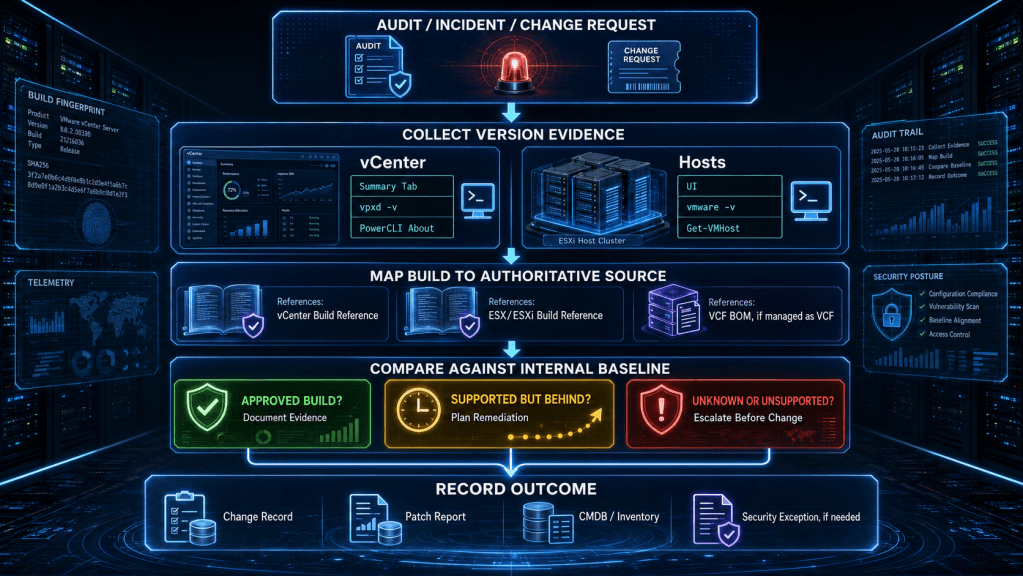
The Evidence Flow
The workflow below shows the approach I recommend. The key point is that you should not jump directly from “I found a build number” to “we are compliant.” Build numbers need to be mapped, compared, and interpreted in the context of your approved baseline.

This is where many teams get into trouble. They collect a build number, paste it into a ticket, and stop there. The stronger practice is to map the build to an official release, compare it against your internal standard, and record the decision.
Version Labels, Build Numbers, and Baselines Are Not the Same Thing
A lot of patching confusion comes from using these terms interchangeably.
| Term | What It Means | Common Mistake |
|---|---|---|
| Release family | Broad label such as vSphere 8, vSphere 9, or VCF 9.x | Assuming all builds in the family are equally patched |
| Product version | Version string such as 8.0.3.00900 or 9.1.0.0200 | Treating the version string as complete evidence without the build |
| Build number | Exact installed code build, such as 25573614 or 25433460 | Comparing vCenter build to ESX/ESXi build as if they should match |
| ISO release | Full install or upgrade artifact | Assuming ISO availability means it is the correct target for every environment |
| Patch release | Patch or express patch artifact | Missing it because it appears under a different portal area |
| Approved baseline | Your organization’s standard version and build | Confusing “latest” with “approved” |
| VCF BOM | Supported component mapping for VMware Cloud Foundation | Patching standalone components without checking the stack relationship |
The baseline is the operational decision. The build number is the evidence. The vendor table is the mapping.
Where to Find the Build Number
There are several practical ways to determine vCenter and ESX/ESXi build numbers.
Use the vSphere Client when you need a quick spot-check or a screenshot for a change record. Use the CLI when the UI is unavailable, when you are validating a single host, or when support asks for direct output. Use PowerCLI when you need repeatable inventory, audit evidence, or a CSV export.
vSphere Client Collection
For vCenter:
- Log in to the vSphere Client.
- Select the vCenter Server object.
- Open the Summary view.
- Record the version and build.
For hosts:
- Open Hosts and Clusters.
- Select the host.
- Record the version and build displayed for that host.
This is simple, but it does not scale well. It is useful for validation, not fleet reporting.
CLI Collection
On a host, use:
vmware -v
On the vCenter Server Appliance, use:
vpxd -v
This is useful during troubleshooting because it removes some UI interpretation from the equation.
PowerCLI Collection
PowerCLI becomes especially useful when you have multiple clusters, mixed host builds, Enhanced Linked Mode, or a patching program that needs monthly evidence.
Use PowerCLI when the output needs to be repeatable, exportable, and easy to attach to a change record or audit package.
PowerCLI Build Audit Example
The following PowerCLI example connects to vCenter, collects the vCenter build, collects all ESX/ESXi host builds visible to that vCenter, compares them against a small approved-build list, and exports the result to CSV.
Before using it, replace the approved build list with your organization’s actual standard. The values below are examples based on the snapshot earlier in this article.
param(
    [Parameter(Mandatory = $true)]
    [string]$VIServer,

    [string]$OutputPath = ".\vsphere-build-audit.csv"
)

Import-Module VMware.PowerCLI -ErrorAction Stop

# Replace these with your internal approved builds.
# Do not assume "latest" means "approved" for every cluster.
$ApprovedBuilds = @{
    "25573614" = "vCenter 9.1.0.0200"
    "25417926" = "vCenter 9.1.0.0100"
    "25433460" = "ESX 9.1.0.0100"
    "25148086" = "vCenter 9.0.2.0"
    "25148076" = "ESX 9.0.2.0"
    "25413364" = "vCenter Server 8.0 Update 3j"
    "25429389" = "ESXi 8.0 Update 3j"
}

Connect-VIServer -Server $VIServer | Out-Null

$Inventory = @()

# Collect vCenter version and build.
$ServiceInstance = Get-View ServiceInstance
$About = $ServiceInstance.Content.About
$VCenterBuild = [string]$About.Build

$Inventory += [pscustomobject]@{
    Component       = "vCenter"
    Name            = $About.Name
    Version         = $About.Version
    Build           = $VCenterBuild
    ReleaseHint     = if ($ApprovedBuilds.ContainsKey($VCenterBuild)) { $ApprovedBuilds[$VCenterBuild] } else { "Unknown or not approved" }
    ComplianceState = if ($ApprovedBuilds.ContainsKey($VCenterBuild)) { "Approved" } else { "Review" }
    ConnectionState = "Connected"
    MaintenanceMode = "N/A"
}

# Collect ESX/ESXi host versions and builds.
$Inventory += Get-VMHost | Sort-Object Name | ForEach-Object {
    $HostBuild = [string]$_.Build

    [pscustomobject]@{
        Component       = "ESX/ESXi Host"
        Name            = $_.Name
        Version         = $_.Version
        Build           = $HostBuild
        ReleaseHint     = if ($ApprovedBuilds.ContainsKey($HostBuild)) { $ApprovedBuilds[$HostBuild] } else { "Unknown or not approved" }
        ComplianceState = if ($ApprovedBuilds.ContainsKey($HostBuild)) { "Approved" } else { "Review" }
        ConnectionState = $_.ConnectionState
        MaintenanceMode = $_.ExtensionData.Runtime.InMaintenanceMode
    }
}

$Inventory | Export-Csv -Path $OutputPath -NoTypeInformation
$Inventory | Format-Table -AutoSize

Disconnect-VIServer -Server $VIServer -Confirm:$false
Example output might look like this:
Component      Name              Version Build    ReleaseHint                 ComplianceState
---------      ----              ------- -----    -----------                 ---------------
vCenter        VMware vCenter    9.1.0   25573614 vCenter 9.1.0.0200          Approved
ESX/ESXi Host  esx01.lab.local   9.1.0   25433460 ESX 9.1.0.0100              Approved
ESX/ESXi Host  esx02.lab.local   9.1.0   25433460 ESX 9.1.0.0100              Approved
ESX/ESXi Host  esx03.lab.local   8.0.3   25205845 Unknown or not approved     Review
That last row does not automatically mean the host is broken. It means the host does not match the approved list in this script. The next step is to map the build to the official source and decide whether it is acceptable, behind, unsupported, or intentionally excluded.
How to Interpret the Results
The output should be reviewed in three layers.
Confirm Whether the Build Is Recognized
First, confirm that the build maps to a known release.
If the build does not appear in your internal list, check the official vCenter or ESX/ESXi build reference. Do not assume it is unsupported just because your script does not recognize it. Your internal baseline may simply be stale.
Confirm Whether the Build Is Supported
A recognized build is not always a supported build for your environment.
For example, a vSphere 7 build can still be identifiable while also being outside normal general-support expectations. That distinction matters during audit reviews and security remediation discussions.
This is why build mapping and lifecycle status should be separate checks.
Confirm Whether the Build Is Approved for the Stack
This is where VCF, VVF, vSAN, NSX, and hardware-integrated platforms matter.
A standalone vSphere environment may be governed by your internal patch policy. A VCF environment should be validated against the VCF bill of materials because VCF maps versions across constituent products such as vCenter, ESX/ESXi, NSX, and management components.
The same logic applies to vSAN. vSAN has its own build and on-disk format considerations, so a vSAN environment needs more than a generic host version check.
Common Gotchas
The vSphere Client Version Does Not Match the vCenter Build
This can be expected behavior. The vCenter version and build represent the appliance and internal components, while the vSphere Client version and build are specific to the web UI and can differ.
Do not open a Sev1 just because the About dialog and appliance build do not look identical. Validate which component you are actually checking.
ESX and ESXi Builds Do Not Match vCenter Builds
They usually should not match. vCenter and ESX/ESXi are different components with different release artifacts. A healthy environment can have different build numbers across vCenter and hosts.
The question is not whether they match each other.
The question is whether each component is on a supported and approved build for the intended stack.
Patch media and full installation media may not always appear in the same portal area. Entitlement also matters. Only product versions covered by active licensing may appear as available for download.
If your team says, “The patch is not available,” confirm entitlement, product selection, and whether the artifact is under the correct portal area before assuming it was pulled or unavailable.
VxRail Is Not a Generic vSphere Patch Path
In VxRail environments, build numbers still matter, but the remediation path is different.
Use the build number for evidence and correlation. Do not use a generic standalone ESX/ESXi patch process unless the validated VxRail procedure says to. VxRail lifecycle should be handled through the appropriate VxRail-managed workflow.
VMware Tools should not be treated as the same build stream as ESX/ESXi or vCenter. It has its own version and build mapping.
That matters during audits. A host can be patched while guest tools remain behind, and the remediation plan may involve guest reboot coordination rather than host remediation.
Recommended Runbook for Build Validation
Use this workflow for audits, upgrade planning, or security patch validation.
Define the Approved Baseline
Before collecting anything, define what “good” means.
At minimum, document:
- Approved vCenter version and build.
- Approved ESX/ESXi version and build.
- Approved vSAN version and on-disk format expectations, if applicable.
- Approved NSX or VCF BOM level, if applicable.
- Hardware vendor image or platform-specific lifecycle requirements.
- Known exceptions with expiration dates.
This prevents the team from treating “latest available” as the automatic target.
Collect Current State
Use PowerCLI for repeatable reporting, and keep the raw export.
For smaller environments, collect manually through the vSphere Client and CLI. For larger environments, build a scheduled report and store the result in your documentation system, CMDB, or patch evidence repository.
Map Builds to Official Sources
Map vCenter builds to the official vCenter build reference.
Map host builds to the official ESX/ESXi build reference.
Map vSAN, NSX, VMware Tools, VCF, or VxRail separately if those components are in scope.
Do not use screenshots from an old ticket, a spreadsheet copied from another team, or a community table as your final authority.
Compare Against the Baseline
Classify each component:
| State | Meaning | Action |
|---|---|---|
| Approved | Build matches internal standard | Record evidence |
| Supported but behind | Build is recognized but not current for your standard | Plan remediation |
| Unsupported | Build is outside support expectations | Escalate and prioritize |
| Unknown | Build not mapped or script baseline is stale | Validate against official source |
| Exception | Build is intentionally different | Confirm owner and expiration date |
The goal is not to shame every deviation. The goal is to know which deviations are intentional, which are risks, and which are simply inventory gaps.
Use the right lifecycle path:
- Standalone vSphere: vSphere Lifecycle Manager image or baseline workflow.
- VCF: SDDC Manager and supported VCF BOM process.
- VxRail: VxRail Manager and Dell-validated upgrade process.
- vSAN: vSAN-aware upgrade sequencing and on-disk format planning.
- NSX-integrated environments: validated NSX and host transport node compatibility checks.
- Guest tooling: VMware Tools lifecycle through guest operations, templates, or application maintenance windows.
Build numbers tell you where you are. They do not replace the upgrade design.
Record the Decision
The final output should not be just a CSV.
A useful build validation record should include:
- Date collected.
- Collector name or automation job.
- vCenter name.
- Cluster or workload domain.
- Component.
- Version.
- Build.
- Mapped release.
- Compliance state.
- Remediation plan or exception owner.
This gives operations, security, and leadership a shared view of patch posture.
Troubleshooting Quick Reference
| Symptom | Likely Cause | What to Check |
|---|---|---|
| vSphere Client About page does not match vCenter appliance build | Client package and vCenter appliance build can differ | Check vCenter Summary, VAMI, and vpxd -v |
| Host says 8.0.3 but build does not match expected patch | Same version family, different patch level | Map the build to the ESX/ESXi build reference |
| Patch cannot be found in portal | Entitlement, product selection, or portal location issue | Check licensing and the correct download area |
| VCF environment has mixed component versions | BOM alignment may be incomplete | Check VCF version-to-component mapping |
| VxRail host build differs from standalone ESXi expectations | VxRail release bundle controls the stack | Check VxRail release correlation and lifecycle process |
| Security team asks whether a CVE is remediated | Version label is not specific enough | Use fixed-version guidance plus build evidence |
Practical Publishing Advice
It is tempting to publish every vCenter, ESX/ESXi, vSAN, NSX, and VMware Tools build in one massive article. That may get search traffic, but it creates a maintenance problem.
A better approach is to publish a compact current snapshot, explain how to validate the authoritative source, and give readers an operational workflow they can reuse.
That makes the article more durable and more useful.
The vendor build tables should remain the source of truth for exact build mappings. Your article should help readers understand what to do with those mappings.
Final Thoughts
Build numbers are not glamorous, but they are one of the most practical pieces of evidence in a VMware environment.
They tell you what is actually installed. They help separate assumption from fact. They support change control, security remediation, lifecycle planning, and vendor support.
The operational maturity comes from what you do after collecting them.
A build number should lead to a decision: approved, remediate, validate, or escalate. Once your team treats build validation that way, patch reviews become cleaner, upgrade planning becomes less speculative, and support conversations start with better evidence.
External References
Broadcom KB: VMware vCenter Server versions and build numbers – https://knowledge.broadcom.com/external/article/326316/build-numbers-and-versions-of-vmware-vce.html
Broadcom KB: Build numbers and versions of VMware ESXi/ESX – https://knowledge.broadcom.com/external/article/316595/build-numbers-and-versions-of-vmware-esx.html
Broadcom KB: Determining the build number of VMware ESXi and VMware vCenter Server – https://knowledge.broadcom.com/external/article/345263/determining-the-build-number-of-vmware-e.html
Broadcom KB: vCenter Version Build Number and vSphere Client version mismatches – https://knowledge.broadcom.com/external/article/380386/vcenter-version-build-number-and-vsphere.html
Broadcom KB: Correlating VMware Cloud Foundation version with the versions of its constituent products – https://knowledge.broadcom.com/external/article/314608/correlating-vmware-cloud-foundation-vers.html
Broadcom KB: Download vCenter Server patches and ISOs for latest releases – https://knowledge.broadcom.com/external/article/387785/download-vcenter-server-patches-and-isos.html
Broadcom KB: End of General Support for vSphere 7.0 – https://knowledge.broadcom.com/external/article/415405/end-of-general-support-for-vsphere.html
Broadcom KB: Build numbers and versions of VMware vSAN – https://knowledge.broadcom.com/external/article/326465/build-numbers-and-versions-of-vmware-vsa.html
Broadcom KB: Build numbers and versions of VMware Tools – https://knowledge.broadcom.com/external/article/304809/build-numbers-and-versions-of-vmware-too.html
Broadcom KB: Correlating VxRail Release with VMware build numbers – https://knowledge.broadcom.com/external/article/326855/correlating-vxrail-release-with-vmware-b.html
