

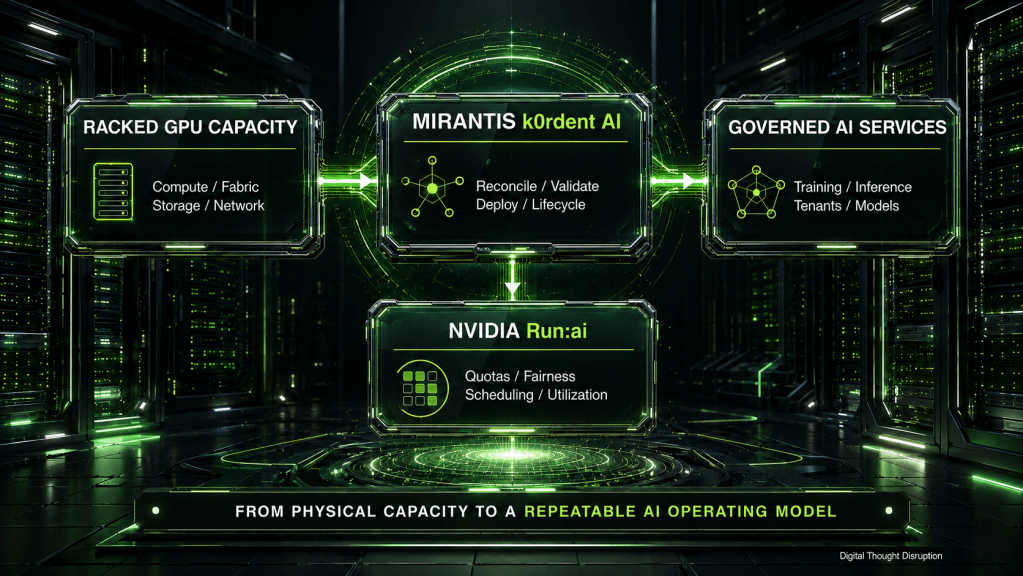


TL;DR
The AI infrastructure market has spent too much time treating GPU acquisition, Kubernetes deployment, workload scheduling, model serving, and platform governance as separate purchases. Enterprises and neoclouds do not experience them separately. They experience the gaps between them, where driver mismatches, operator ordering, network configuration, tenant policy, lifecycle ownership, and support boundaries turn expensive GPU capacity into idle capital.
Mirantis is addressing that problem at the correct architectural layer. k0rdent AI is designed to automate and reconcile the infrastructure and platform foundation, while NVIDIA Run:ai provides the workload policy layer for GPU scheduling, quotas, fairness, preemption, and multi-tenant consumption. The significance is not that Mirantis can install another product. It is that Mirantis is productizing the dependency chain between racked hardware and a governed AI service.
That is exactly what the market needs. The execution is unusually strong because it combines declarative fleet management, dependency-aware service deployment, NVIDIA compatibility, public Kubernetes AI conformance evidence, air-gapped deployment support, and an expanding model and inference control strategy. The practical opportunity is for customers to use that foundation to standardize deployment, accelerate day-two operations, improve support alignment, and build increasingly mature AI services across greenfield and brownfield environments.
Introduction
Enterprise AI infrastructure has a translation problem.
Vendors sell GPUs, high-speed networks, storage systems, Kubernetes distributions, GPU operators, schedulers, model servers, registries, gateways, and observability tools as though placing them in adjacent boxes creates an AI platform.
It does not.
A rack of accelerators is capacity. A Kubernetes cluster is an orchestration substrate. A GPU operator makes devices usable by containers. A scheduler allocates resources. A model server exposes an endpoint. Each component is necessary, but the enterprise does not receive value until the entire chain becomes a secure, repeatable, supportable service.
The operational failures occur between the components.
A certificate dependency is installed after the service that requires it. A network operator is configured differently at the second site. A GPU driver is compatible with the host but not the container runtime. A data science team bypasses the quota model because the platform interface is too slow. A cluster is rebuilt from a wiki page rather than a controlled desired-state definition. A support incident crosses the hardware, Kubernetes, GPU, and workload layers, but no one owns the complete evidence chain.
Mirantis has recognized that these seams are not implementation details.
They are the product.
Its integration of Mirantis k0rdent AI with NVIDIA Run:ai targets the space between GPU infrastructure provisioning and an operational AI factory. Mirantis reports that the integration automates the installation, configuration, and sequencing of core services and NVIDIA operators, performs readiness and configuration checks, and deploys the Run:ai workload layer. NVIDIA’s current Run:ai support matrix also lists Mirantis k0rdent as a partner-compatible Kubernetes distribution.
That combination matters because it joins two control problems that are often handled separately:
- Infrastructure lifecycle: How clusters, operators, platform services, networking, and supporting dependencies are deployed and maintained.
- Workload economics and policy: How scarce GPU capacity is divided, prioritized, scheduled, shared, measured, and exposed to tenants.
Mirantis is not the only company pursuing an AI factory platform. It is, however, one of the clearest examples of a vendor attacking the market’s real bottleneck: converting heterogeneous infrastructure into a governed, repeatable operating system for AI.
Scope, Assumptions, and Evidence Boundaries
This article evaluates the architecture and market implications of Mirantis k0rdent AI using public product information, technical documentation, certification evidence, and NVIDIA documentation available through August 17, 2026.
Several boundaries matter.
First, Mirantis describes production-ready AI platform deployment in minutes rather than weeks. That is a vendor claim, and it is a compelling one. Its practical value will be strongest in environments where hardware, networking, credentials, artifacts, and service prerequisites have been standardized into validated profiles.
Second, the current Mirantis and NVIDIA Run:ai integration establishes a strong foundation for lifecycle automation. Mirantis identifies declarative upgrades, configuration-drift management, and expanded day-two operations as areas for continued enhancement. Those capabilities are best understood as the natural next extension of the platform rather than part of the initial integration baseline.
Third, k0rdent AI Model Registry, Inference Mesh, and related inference capabilities were announced in preview. They demonstrate the scale and direction of the Mirantis strategy while giving customers an early view of how infrastructure automation may connect to model distribution, routing, metering, and governance.
Finally, this is primarily an NVIDIA-oriented architecture discussion. Mirantis positions k0rdent as open and infrastructure-independent, while this specific integration provides deeper automation and validation around the NVIDIA stack. Organizations can evaluate that focus as a deliberate optimization choice within their broader accelerator and portability strategy.
The Market Does Not Need Another GPU Console
The market already has tools that can show GPU inventory, utilization, temperature, memory pressure, workload queues, and cluster health. Those tools are useful, but visibility is not the same as an operating model.
The central mistake is treating each installed component as proof that the next layer is ready.
| Purchased or Deployed Component | What It Proves | What It Does Not Prove |
|---|---|---|
| GPU servers | Accelerator capacity exists | The fabric, drivers, runtime, storage, and scheduler form a usable service |
| Kubernetes cluster | Containers can be orchestrated | Distributed AI workloads, GPU allocation, inference ingress, and tenant controls are production-ready |
| NVIDIA GPU Operator | Drivers and runtime components can be managed | GPU access is fairly allocated, economically governed, or isolated by business policy |
| GPU scheduler | Workloads can be placed on accelerators | The underlying cluster, operators, certificates, network services, and lifecycle are repeatable |
| Model server | An inference endpoint can respond | Models, requests, costs, policy, audit, recovery, and ownership are governed |
| Monitoring stack | Metrics are being collected | The organization knows which team owns remediation or whether service objectives are being met |
An AI factory becomes useful only when these layers are connected by a controlled dependency model.
That dependency model must answer practical questions:
- Which component versions are validated together?
- Which services must exist before another service can be installed?
- Which clusters should receive a particular AI platform profile?
- How are configuration changes promoted and rolled back?
- How are tenants mapped to quotas, priorities, projects, and cost boundaries?
- How is the same design reproduced at a second site?
- What evidence proves that the resulting platform can run real AI workloads?
- Who owns failures that cross the infrastructure and workload layers?
The market need is not simply more automation. It is a declarative contract that turns infrastructure intent into a continuously reconciled AI service.
The Real Product Is the Seam Between Layers
The following diagram shows where Mirantis is creating value. The center of gravity is not one isolated component. It is the dependency chain that connects physical capacity to an application-consumable service.
Every line between these layers can become a failure domain, an ownership dispute, a compatibility risk, or a source of deployment delay.
Mirantis is doing something important because it is trying to make those lines explicit, versioned, testable, and repeatable.
This is the same transition enterprise infrastructure made in earlier platform eras. Servers became virtual infrastructure only when provisioning, networking, storage, policy, lifecycle, and operations were joined into a coherent system. Kubernetes became a platform only when clusters, ingress, certificates, policy, observability, and delivery workflows were made consumable. AI infrastructure is now moving through the same maturity curve.
GPU scarcity made hardware access the first market problem.
Production AI is making operational cohesion the next one.
What Mirantis k0rdent AI and NVIDIA Run:ai Actually Combine
The integration is strongest when understood as a division of responsibilities rather than a claim that one product performs every function.
| Architecture Layer | Mirantis k0rdent AI Role | NVIDIA Run:ai Role | Practical Outcome |
|---|---|---|---|
| Infrastructure and cluster lifecycle | Provision and lifecycle-manage Kubernetes environments across supported substrates | Consume a supported Kubernetes foundation | Standardized cluster delivery rather than manually assembled environments |
| Core platform services | Deploy and sequence ingress, DNS, certificates, and required service dependencies | Depend on a prepared and reachable platform foundation | Fewer order-of-operations failures |
| NVIDIA enablement | Deploy GPU, network, DRA, MPI, and training operators through validated templates and workflows | Use exposed accelerator resources and scheduling primitives | A GPU-aware platform ready for real workloads |
| Workload policy | Provide the infrastructure and service context | Apply quotas, fairness, priorities, preemption, placement, and organizational boundaries | GPU allocation becomes enforceable policy |
| Multi-tenancy | Deliver repeatable cluster and platform profiles | Organize workload consumption through tenant, department, project, and scheduling constructs | Shared infrastructure can be exposed without becoming unmanaged contention |
| Fleet operations | Select clusters, deploy services, track desired state, and expose reconciliation status | Provide workload-layer operations within deployed environments | A consistent operating model across clusters and sites |
| Observability and economics | Integrate infrastructure and accelerator telemetry into the platform view | Expose workload demand, allocation, queue, and utilization context | Better connection between physical capacity and business consumption |
That split is healthy.
Infrastructure automation and workload scheduling are related, but they are not the same responsibility. A cluster manager should not pretend that a running GPU operator equals fair resource governance. A scheduler should not pretend that it owns the full lifecycle of the cluster, fabric, certificate chain, or service dependencies beneath it.
By joining the layers without flattening them, Mirantis can create a cleaner operational boundary.
Why the Execution Is Unusually Strong
The market need is clear. What makes Mirantis noteworthy is the level at which it is attempting to solve it.
It Treats Integration Debt as a Product Problem
Many AI platforms are still deployed as professional-services projects.
An experienced team selects a Kubernetes distribution, installs operators in a carefully remembered order, adjusts Helm values, patches storage classes, configures ingress, imports certificates, resolves driver issues, adds a scheduler, and then documents the surviving configuration. The second environment resembles the first but is not identical. The third environment starts exposing the assumptions that were never written down.
That is integration debt.
Mirantis reports that k0rdent AI automates a substantial part of this layered assembly, including ingress, external DNS, certificate management, the NVIDIA GPU and Network Operators, Dynamic Resource Allocation, MPI, training operators, and NVIDIA Run:ai platform templates. More importantly, it describes dependency sequencing, configuration validation, and infrastructure-readiness checks as part of the workflow.
The distinction is important.
Installing packages is automation.
Encoding dependencies, validation, and desired state is platform engineering.
It Uses Declarative Fleet Mechanics Instead of One-Off Scripts
k0rdent uses a Kubernetes-native, declarative architecture. Its cluster management model builds on Cluster API concepts, while its service-management capabilities can apply platform services to selected clusters.
The MultiClusterService resource is a good example of why this matters. A platform team can select clusters by label, deploy versioned service templates to every matching cluster, define dependencies between multi-cluster services, and inspect status conditions and available service upgrade paths.
This changes the operational unit.
The team is no longer asking, “Did someone run the Run:ai installation script on cluster seven?”
It can ask, “Which clusters match the NVIDIA AI factory profile, which desired service versions should they run, and which clusters have converged successfully?”
That is a much stronger control model for enterprises with multiple sites and for neoclouds with repeated customer environments.
It Separates Platform Readiness from GPU Allocation Policy
GPU infrastructure projects often collapse ownership into one overloaded platform team. That team becomes responsible for drivers, Kubernetes, networking, workload queues, tenant disputes, capacity forecasting, and data scientist support.
Mirantis and Run:ai create a more useful separation.
k0rdent AI can own the readiness and lifecycle of the infrastructure and platform services. Run:ai can own the workload-policy mechanisms that determine who receives accelerator capacity, under which quota, at what priority, and with what preemption behavior.
This does not eliminate organizational coordination. It makes the coordination boundary visible.
The enterprise can define separate but connected ownership:
- The infrastructure team owns hardware, cluster lifecycle, fabrics, storage, and base platform readiness.
- The AI platform team owns validated service profiles, model and inference platform services, and developer consumption patterns.
- The capacity governance owner defines quotas, priority classes, over-quota behavior, and exception policy.
- The data science and application teams consume services within those controls.
- FinOps connects utilization and workload outcomes to cost allocation.
That is a more realistic operating model than giving every team a static GPU allocation and calling it self-service.
It Treats Regulated and Disconnected Environments as a Design Mode
Mirantis states that the integration supports air-gapped deployments and positions k0rdent AI for regulated, sovereign, government, and network-restricted environments. NVIDIA’s AI Factory for Government reference design also describes Mirantis k0rdent AI as an ecosystem component for provisioning, lifecycle management, multi-tenant orchestration, observability, auditing, and core services across disconnected or controlled environments.
This is strategically important.
Air-gapped AI is not a normal deployment with the internet connection removed at the end. It changes artifact distribution, license handling, certificate management, identity integration, update workflows, vulnerability intelligence, model transfer, telemetry, and support procedures.
A platform that treats disconnected operation as a repeatable profile is solving a materially harder problem than a cloud-connected installer.
The strongest implementation pattern is to prove the complete disconnected lifecycle, including installation, entitlement, upgrade, rollback, model import, security scanning, observability, and support evidence through approved offline paths. Mirantis has positioned the platform around exactly the customers that need that discipline.
It Is Building Evidence Instead of Relying Only on Positioning
Mirantis reports that it executed more than 100 functional tests for the NVIDIA Run:ai integration, covering workload submission, scheduling, multi-tenancy, and platform lifecycle. NVIDIA’s current Run:ai documentation lists Mirantis k0rdent among partner-compatible distributions.
The more compelling evidence is the public Kubernetes AI conformance work.
Mirantis announced CNCF Certified Kubernetes AI Conformance for both k0s and k0rdent at Kubernetes v1.35. The k0rdent evidence documents a concrete test environment and demonstrates capabilities including Dynamic Resource Allocation, NVIDIA driver and runtime management, GPU time-slicing, Gateway API traffic routing, gang scheduling, autoscaling, DCGM metrics, secure accelerator access, and KubeRay reconciliation after disruption.
The evidence also documents a boundary: virtualized accelerator integration was not implemented in that submission’s test scope.
That disclosure increases credibility. A serious engineering record should show what was demonstrated, how it was tested, and what remains outside the evidence boundary.
A badge says a platform passed.
Reproducible evidence tells an architect what the badge actually means.
It Is Moving from Infrastructure Automation Toward AI Service Governance
Mirantis is not stopping at cluster and operator deployment.
In May 2026, the company announced k0rdent AI Model Registry, k0rdent AI Inference Mesh, and an inference runtime. The registry is positioned around OCI-native storage and distribution of models and related artifacts. Inference Mesh is positioned to route, meter, audit, and enforce policy on requests across models, clusters, regions, and providers.
These capabilities were announced in preview, so the most useful interpretation is strategic direction rather than a final statement on production maturity. The direction is still significant.
It shows Mirantis understands that the AI factory control problem continues above Kubernetes and GPU scheduling. Enterprises also need to know:
- Which model version is running?
- Where did the model artifact come from?
- Which endpoint served the request?
- Which policy applied?
- Which tenant incurred the cost?
- Which region or provider processed the data?
- How is an unsafe or noncompliant route blocked?
- How is service behavior audited and reconciled?
If Mirantis can connect infrastructure lifecycle, workload policy, model provenance, inference routing, observability, and economics without creating a closed proprietary island, it will be operating at the level the market increasingly requires.
The Three-Plane AI Factory Operating Model
The architecture can be understood as three connected operating planes.
The infrastructure lifecycle plane establishes where the platform runs and whether the required components are ready.
The workload policy plane determines how users and teams consume scarce accelerator capacity.
The AI service plane governs models and inference as services rather than treating them as anonymous containers.
This layered model is valuable because each plane has different change rates and failure modes.
A firmware or driver update should not be governed like a quota adjustment. A quota adjustment should not require rebuilding the cluster. A model-routing policy should not be buried inside a GPU operator configuration. Separating the planes allows each to evolve while preserving explicit contracts between them.
The architecture succeeds when those contracts are machine-readable, observable, and testable.
A Declarative AI Factory Contract
The following example illustrates how k0rdent’s MultiClusterService pattern can express a foundation service and then make the workload layer depend on it.
This is an architectural example, not a Mirantis-published NVIDIA Run:ai production manifest. The service-template names are placeholders and must be replaced with templates validated for the selected k0rdent, Kubernetes, NVIDIA operator, and Run:ai versions.
apiVersion: k0rdent.mirantis.com/v1beta1
kind: MultiClusterService
metadata:
  name: ai-foundation
spec:
  clusterSelector:
    matchLabels:
      platform.example/ai-profile: nvidia
  serviceSpec:
    services:
      - template: REPLACE_WITH_VALIDATED_CERT_MANAGER_TEMPLATE
        name: cert-manager
        namespace: cert-manager
      - template: REPLACE_WITH_VALIDATED_GPU_OPERATOR_TEMPLATE
        name: gpu-operator
        namespace: gpu-operator
      - template: REPLACE_WITH_VALIDATED_NETWORK_OPERATOR_TEMPLATE
        name: network-operator
        namespace: network-operator
---
apiVersion: k0rdent.mirantis.com/v1beta1
kind: MultiClusterService
metadata:
  name: ai-workload-plane
spec:
  clusterSelector:
    matchLabels:
      platform.example/ai-profile: nvidia
  dependsOn:
    - ai-foundation
  serviceSpec:
    services:
      - template: REPLACE_WITH_VALIDATED_RUNAI_TEMPLATE
        name: runai
        namespace: runai
The pattern creates several useful controls.
Cluster selection: The label selector targets only clusters approved for the NVIDIA AI profile. A platform team can add or remove clusters from the rollout through controlled metadata rather than editing an installation script.
Versioned service intent: Each template identifier can represent a validated service version and configuration profile. Production promotion becomes a change to desired state rather than an undocumented sequence of commands.
Dependency enforcement: The workload plane does not deploy until the foundation service has converged successfully on a matching cluster.
Fleet status: The MultiClusterService status can show readiness, matching clusters, dependency validation, and service upgrade paths. Those conditions can feed release gates and operational dashboards.
The reader must change the cluster labels, template identifiers, namespaces, values, secrets, storage configuration, ingress settings, and entitlement details to match the validated environment.
Successful execution should produce more than a Ready condition. It should also prove that the target clusters advertise the expected GPU resources, required operators are healthy, the Run:ai control path is reachable, tenant policy is applied, and a representative training or inference workload can be scheduled and observed.
Common implementation issues include a selector that matches the wrong clusters, a missing service template, credentials unavailable in the target namespace, an operator CustomResourceDefinition that is not ready, an unsupported version combination, an incomplete air-gapped artifact mirror, or a Run:ai licensing and identity dependency that was not included in the readiness model.
This is why declarative configuration becomes most powerful when paired with a validated compatibility profile and evidence-producing tests.
Where the Value Lands for Enterprises and Neoclouds
Mirantis is targeting two audiences that share the same infrastructure problem but monetize the outcome differently.
| Dimension | Enterprise AI Factory | Neocloud or GPU Cloud | Evidence That Matters |
|---|---|---|---|
| Time to service | Reduce the path from approved hardware to a governed internal AI platform | Reduce the path from installed capacity to a sellable tenant service | Baseline and repeated deployment time under realistic prerequisites |
| Repeatability | Reproduce approved profiles across business units, sites, and recovery environments | Create consistent customer environments at fleet scale | Configuration comparison and conformance across multiple clusters |
| Multi-tenancy | Prevent teams from bypassing quotas and creating unmanaged contention | Isolate customers and enforce commercial service tiers | Identity, namespace, network, storage, scheduler, and audit isolation tests |
| GPU economics | Allocate scarce capacity according to business priority and measured demand | Improve yield, utilization, and revenue per installed accelerator | Queue time, utilization, useful work, preemption impact, and cost per outcome |
| Sovereignty | Keep data, models, identity, and operations within defined control boundaries | Offer differentiated regulated or jurisdiction-bound services | Complete disconnected lifecycle and operator-access evidence |
| Lifecycle | Standardize platform changes and reduce dependency on individual experts | Operate many customer and regional environments without linear staffing growth | Upgrade, rollback, drift, patching, and incident-recovery tests |
| Supportability | Create a clearer evidence chain across platform layers | Reduce time spent resolving cross-vendor service incidents | Version matrix, owner map, logs, escalation path, and reproducible failure evidence |
For an enterprise, the primary value is governed consistency. The platform can become a reusable internal service rather than a one-time research cluster.
For a neocloud, the primary value is operational leverage. The provider must turn hardware into tenant services quickly, maintain isolation, enforce differentiated policies, expose credible usage evidence, and avoid adding operators at the same rate it adds clusters.
Both groups need the same underlying capability: a factory that can reproduce itself.
Where Mirantis Can Extend an Already Strong Foundation
Mirantis has already assembled many of the capabilities the AI infrastructure market has been asking for: declarative cluster management, dependency-aware service deployment, NVIDIA ecosystem alignment, multi-tenant GPU orchestration, air-gapped deployment support, and a strategy that extends beyond infrastructure into model and inference services.
The next opportunity is not to change that direction. It is to deepen the strengths that already make the platform distinctive.
Deployment Speed Can Become a Repeatable Platform Metric
Mirantis describes the ability to move from prepared infrastructure to a production-ready AI platform in minutes rather than weeks. That is a powerful value proposition, particularly for enterprises and neoclouds that need to bring new clusters, sites, and customer environments online without rebuilding the integration process each time.
The strongest extension of that capability would be to make deployment speed a repeatable and transparent platform metric.
A useful measurement model could distinguish between:
- Hardware and fabric preparation
- DNS, certificates, identity, and secrets readiness
- Artifact and license availability
- Kubernetes cluster provisioning
- NVIDIA operator deployment
- Run:ai platform configuration
- Tenant onboarding
- Successful execution of a representative AI workload
This would give customers a clear way to understand where k0rdent AI accelerates delivery and how that acceleration improves as infrastructure profiles become standardized.
Mirantis is well positioned to make time-to-service one of the platform’s most visible operational strengths.
Day-Two Automation Can Become a Major Differentiator
The initial deployment is only the beginning of an AI factory lifecycle. Drivers, Kubernetes versions, operators, schedulers, certificates, models, inference services, and security policies will all change over time.
Mirantis already has the declarative architecture needed to address that lifecycle. Its use of versioned service templates, desired-state reconciliation, cluster selection, dependency handling, and fleet-level status creates a strong foundation for increasingly sophisticated day-two operations.
The platform can build on that foundation through deeper automation for:
- Coordinated platform and operator upgrades
- Pre-upgrade compatibility validation
- Configuration-drift detection
- Controlled rollout across cluster groups
- Automated rollback after partial failure
- Certificate and secret rotation
- Backup and restoration of platform state
- Recovery of services from declared configuration
- Validation of workloads after platform change
These capabilities would not represent a change in strategy. They would be a natural expansion of the operating model Mirantis has already established.
A vendor that can automate both the first deployment and the following three years of platform change will have a much stronger enterprise story than one focused only on installation.
Brownfield Flexibility Can Expand the Enterprise Opportunity
Many AI infrastructure projects begin in mixed environments rather than perfectly standardized greenfield deployments.
Enterprises may have different GPU generations, firmware baselines, server vendors, network architectures, storage systems, identity providers, and operational processes. Neoclouds may need to support multiple infrastructure profiles while preserving a consistent customer experience.
The template-driven k0rdent AI model creates a promising way to manage this variation.
Instead of forcing every environment into one rigid configuration, Mirantis can define a set of supported AI factory profiles, each with its own validated combinations of:
- Server and accelerator platforms
- Kubernetes and container-runtime versions
- NVIDIA drivers and operators
- Network and storage dependencies
- Run:ai releases
- Security and identity integrations
- Model-serving and inference components
This approach could turn brownfield complexity into a managed catalog of known configurations rather than an endless stream of exceptions.
Mirantis does not need every environment to look identical. Its advantage can come from making the differences explicit, supportable, and operationally consistent.
Support Alignment Can Reinforce the Integrated Platform Experience
AI factory incidents rarely remain inside one product boundary.
A scheduling problem may originate in workload policy, Kubernetes, the container runtime, a GPU driver, a network operator, storage performance, firmware, or the workload itself. The more integrated the architecture becomes, the more valuable a coordinated support experience becomes.
Mirantis has an opportunity to reinforce its platform position by making the support path as integrated as the deployment model.
That could include:
- A published component and version matrix
- Consistent diagnostic bundles across platform layers
- Clear ownership boundaries between Mirantis, NVIDIA, hardware vendors, and customers
- Cross-layer health and readiness reports
- Defined escalation paths for multi-vendor incidents
- Reproducible evidence packages for support cases
- Automated capture of configuration and reconciliation history
This would help customers move from asking which vendor owns the problem to asking which evidence identifies the failing layer.
For enterprises and neoclouds, that reduction in operational ambiguity can be as valuable as the deployment automation itself.
Openness Strengthens the Mirantis Portability Story
k0rdent is built around Kubernetes-native and open source mechanisms, including Cluster API and declarative custom resources. That gives Mirantis a credible foundation for customers that want automation and standardization without turning the entire platform into a closed appliance.
The NVIDIA Run:ai integration naturally creates an NVIDIA-oriented AI factory profile. For organizations standardizing on NVIDIA infrastructure, that focus can be a strength rather than a limitation. It allows Mirantis to create deeper validation, tighter automation, and a clearer support model around a widely adopted AI infrastructure stack.
At the same time, k0rdent’s underlying architecture gives Mirantis room to support additional profiles over time.
A strong portability model does not require every component to be interchangeable. It requires the platform to make dependencies visible and allow customers to understand which assets can move, which require translation, and which are intentionally optimized for a specific ecosystem.
Those assets include:
- Cluster definitions
- Infrastructure templates
- Service configurations
- Workload specifications
- Identity and tenant mappings
- Model artifacts
- Observability data
- Usage and cost records
- Recovery procedures
- Platform policy
By making those boundaries explicit, Mirantis can give customers the benefits of deep NVIDIA integration while preserving a more open platform operating model.
Preview Capabilities Show the Scale of the Strategy
The k0rdent AI Model Registry, Inference Mesh, and related inference capabilities demonstrate that Mirantis is thinking beyond cluster deployment and GPU scheduling.
That broader strategy is important because the enterprise AI operating model eventually has to answer questions that exist above the infrastructure layer:
- Which model version is running?
- Where did the model artifact originate?
- Which endpoint served a request?
- Which tenant consumed the service?
- Which policy controlled the request?
- Which infrastructure location processed the data?
- How was usage measured?
- How can the service be audited or reproduced?
As these preview capabilities mature, Mirantis has an opportunity to connect infrastructure lifecycle, GPU workload policy, model provenance, inference routing, metering, audit, and governance within one coherent architecture.
That would move k0rdent AI from being a highly capable AI infrastructure automation platform toward becoming a broader operating layer for enterprise AI services.
The significance is not that every part of that vision must arrive at once. The significance is that Mirantis appears to understand the complete control problem and is building the platform in the right architectural direction.
Mirantis has already established the foundation. Continued investment in lifecycle automation, brownfield profiles, support integration, portability, and inference governance can make that foundation increasingly difficult for the market to ignore.
How Architects Should Evaluate the Platform
A well-designed proof of value should test the operating model, not only the installation workflow.
| Evaluation Stage | Test | Required Evidence | Suggested Exit Criterion |
|---|---|---|---|
| Establish the baseline | Build the same stack using the current method | Engineer hours, elapsed time, failure points, manual decisions, configuration variance | Baseline is documented well enough to compare honestly |
| Deploy the first profile | Provision a representative AI factory profile and run a real workload | Desired-state records, readiness status, component versions, workload result | Platform reaches a validated service state with no undocumented manual repair |
| Reproduce the profile | Deploy the same profile to a second cluster or site | Configuration comparison, conformance results, deployment variance | The second environment is functionally equivalent within declared site differences |
| Enforce tenancy | Create multiple tenants with quotas, priorities, over-quota behavior, and preemption | Identity mapping, scheduler decisions, audit records, isolation tests | Policy is predictable and cannot be bypassed through normal interfaces |
| Test failure | Remove a GPU node, disrupt an operator, break a dependency, and lose a control-plane component | Alerts, reconciliation events, service impact, recovery time, data integrity | Recovery meets defined service objectives and produces usable evidence |
| Test lifecycle | Upgrade one platform layer and perform a rollback | Compatibility gate, maintenance behavior, rollback logs, workload impact | Change is repeatable, bounded, and recoverable |
| Test disconnected operation | Install and update through approved offline repositories | Artifact inventory, signatures, entitlement workflow, scan results, support package | No unapproved external dependency is required |
| Test economics | Run mixed training, inference, and interactive workloads | Utilization, queue time, preemption impact, tokens or jobs per GPU, tenant cost | Capacity policy improves useful work without violating workload objectives |
| Test support | Trigger a cross-layer incident and exercise escalation | Owner map, evidence bundle, vendor handoffs, time to diagnosis | No material ownership gap remains |
| Test exit and recovery | Export definitions, restore state, and rebuild a service elsewhere | Portable artifacts, recovery sequence, dependency inventory, validation result | The organization can recover or transition without undocumented knowledge |
The evaluation should include at least one realistic stress scenario.
A perfectly prepared greenfield cluster demonstrates the optimized path. A brownfield node pool, a partially failed upgrade, a disconnected artifact mirror, a quota dispute, or a recovery exercise demonstrates how the platform preserves that operating model under normal enterprise complexity.
The Market Need Is Bigger Than Mirantis
Mirantis is responding to a structural transition in enterprise infrastructure.
Kubernetes AI conformance is becoming more demanding because the ecosystem is moving beyond basic GPU discovery. The CNCF program now emphasizes consistent, industrial-scale AI deployment, workload-aware scheduling, inference ingress, Dynamic Resource Allocation, and reproducible verification.
NVIDIA’s own AI factory guidance describes an integrated system of accelerator capacity, high-speed networking, scalable storage, cluster management, operators, security, and enterprise lifecycle management. That architecture makes one point clear: the AI factory is a co-designed system, not a GPU rack with software added afterward.
The competitive question is therefore changing.
The market will not be won only by the vendor with the fastest accelerator, the most elegant Kubernetes distribution, or the strongest scheduler. It will be won by platforms that can connect physical capacity, cluster lifecycle, workload policy, model governance, inference operations, cost, security, and recovery without making every customer rebuild the integration layer.
Mirantis has chosen the correct battlefield.
Its advantage will come from preserving the openness of the underlying Kubernetes model while delivering the integration quality, support clarity, and lifecycle depth customers normally expect from a more tightly controlled stack.
Conclusion
Mirantis is doing something the AI infrastructure market genuinely needs because it is treating the gap between components as the primary engineering problem.
k0rdent AI and NVIDIA Run:ai combine two operating layers that must work together. One makes clusters, operators, dependencies, and services repeatable. The other turns scarce GPU capacity into governed workload policy. Around them, Mirantis is building a broader architecture that reaches from physical infrastructure toward model distribution, inference routing, metering, audit, and policy.
The execution deserves attention because it is not limited to a slide showing integrated products. Mirantis is using declarative multi-cluster mechanics, dependency-aware service deployment, a documented NVIDIA compatibility path, public Kubernetes AI conformance evidence, and support for disconnected environments. It is also willing to publish evidence boundaries, which is more valuable than pretending every adjacent capability is complete.
The strongest praise is not that Mirantis has eliminated AI infrastructure complexity. No vendor has. The stronger and more defensible conclusion is that Mirantis has identified where the complexity must be owned, encoded, tested, and operated.
That is an exceptional level of product judgment.
The next opportunity is day two. Mirantis can extend the same discipline into deeper upgrade automation, drift control, recovery, brownfield profiles, cross-vendor support alignment, and production inference governance. Those are not corrections to the strategy. They are the natural expansion of a platform foundation that is already pointed in the right direction.
If Mirantis continues executing on that lifecycle, k0rdent AI will be more than an AI infrastructure automation product. It can become the operating layer that turns GPU estates into secure, governed, and economically usable AI factories.
