



TL;DR
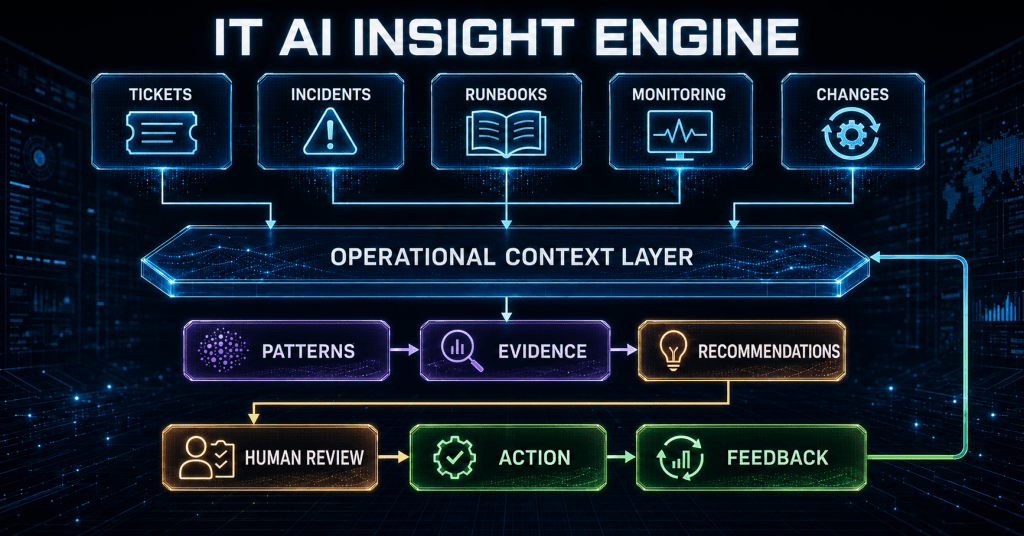
An IT AI insight engine is not just a chatbot over documentation. It connects operational signals from tickets, incidents, monitoring, runbooks, changes, and architecture reviews into a governed context layer. The goal is to identify patterns, surface evidence, recommend action, and route improvements to accountable owners. The value is not more content. The value is better operational context and better decisions.
Introduction
Most enterprise knowledge systems are built to store information. Fewer are built to surface insight.
That distinction matters. An IT team can have thousands of documents, tickets, architecture diagrams, monitoring events, change records, and runbooks and still struggle to answer basic operational questions:
- What pattern is emerging across these incidents?
- Which platforms are carrying the most operational risk?
- Which runbooks are stale because incidents keep bypassing them?
- Which architecture standards are ignored during delivery?
- What should we write, automate, or fix next?
An AI insight engine is not another chatbot. It is a context system that turns operational signals into useful direction.
Why the Concept Matters in Enterprise Practice
Traditional knowledge management is document-centric. Search helps users find content if they know what to ask. RAG improves natural-language access to that content. An insight engine goes one step further by connecting knowledge, signals, feedback, and decisions.
For IT leaders, architects, and platform teams, the practical opportunity is not to build a generic AI brain. It is to create a governed system that helps teams detect patterns, prioritize work, improve documentation, and convert operational noise into action.
That means the architecture must treat incidents, tickets, monitoring alerts, runbooks, changes, architecture exceptions, and unanswered assistant questions as operational signals. Those signals need normalization, ownership, review, and feedback.
Insight Engine Pattern at a Glance
The diagram below shows the difference between static knowledge retrieval and an insight engine. Notice the feedback and signal layers around the retrieval core.
The engine should not bypass experts. It should give experts better context, better evidence, and a cleaner path from observation to action.
Signal-to-Action Loop
An insight engine has value only when it turns signals into reviewed work. If the output never becomes an owned action, the system becomes another dashboard.

Dashboards do not fix stale runbooks, weak ownership, or recurring incidents by themselves. The insight engine needs a workflow that routes recommendations to owners, tracks whether the action was completed, and measures whether the change improved the operational signal.
Treat Signals as First-Class Data
An insight engine needs more than documents. It needs signals.
Useful signals include:
- recurring incident categories
- high-volume support questions
- failed change patterns
- stale runbook references
- unanswered assistant questions
- architecture review exceptions
- monitoring alerts by service
- manual remediation frequency
- platform ownership gaps
These signals tell the system where knowledge is missing, where processes are weak, and where automation may have value.
The practical design issue is that these signals usually live in different systems with different names, owners, schemas, and retention rules. A ticketing system may identify a service one way. A monitoring platform may identify it another way. A wiki may use a third name entirely. Without normalization, the insight engine will produce shallow summaries instead of operational intelligence.
Normalize Context Across Systems
The same service may appear under different names across tickets, monitoring, documentation, and CMDB records. If the engine cannot connect those references, it will not produce useful patterns.
A practical normalization model includes:
| Context Field | Why It Matters |
|---|---|
| Service name | Connects incidents, docs, and ownership |
| Platform | Groups patterns by technology stack |
| Environment | Separates production from non-production noise |
| Owner team | Enables accountability and routing |
| Incident category | Supports trend analysis |
| Change window | Links problems to operational activity |
| Document owner | Identifies stale or missing knowledge |
| Business criticality | Helps prioritize remediation |
The value is not the metadata itself. The value is being able to ask better operational questions.
For example, a platform leader should be able to ask which services generated the most unanswered support questions in the last month, which runbooks were referenced during failed changes, and which owner teams need documentation remediation.
Use RAG for Evidence, Not Final Authority
RAG should help the insight engine retrieve supporting evidence. It should not be the only reasoning mechanism.
For example, if the system detects repeated incidents around backup validation, RAG can retrieve runbooks, post-incident notes, change records, and known errors. The model can then summarize the pattern and propose next steps.
But the system should still require human review before publishing a conclusion or triggering remediation.
This distinction matters. The model can help connect evidence, summarize patterns, and draft recommendations. It should not silently convert weak signals into authoritative operational policy.
Add a Red-Team Review Loop
Insight systems can overfit to noisy signals. They can also amplify incomplete data. A red-team review loop helps challenge the output before it becomes guidance.
Reviewers should ask:
- What evidence supports this insight?
- What data is missing?
- Are we confusing correlation with causation?
- Does the recommendation match operational reality?
- Which team owns the next action?
- What would prove this insight wrong?
This keeps the engine grounded and prevents weak patterns from becoming confident narratives.
A red-team loop does not need to be heavy. For high-impact recommendations, it may be a formal review. For low-risk content-gap suggestions, it may be a lightweight service-owner approval. The point is to prevent unreviewed AI interpretation from becoming operational truth.
Example Insight Workflow
A useful first workflow is a knowledge-gap report.
The process could look like this:
- collect unanswered assistant questions for the last 30 days
- group them by service, platform, and topic
- retrieve related runbooks and KB articles
- identify where content is missing, stale, or contradictory
- generate a draft recommendation for the content owner
- route the recommendation for human review
- track whether the content gap was closed
This is not flashy, but it is operationally valuable. It turns user confusion into documentation improvement.
Example Output Structure
The following simplified YAML shows how an insight can become trackable work rather than a loose paragraph in a dashboard.
insight:
  title: Backup validation questions are increasing for shared virtualization services
  confidence: medium
  evidence:
    unanswered_questions: 27
    affected_services:
      - shared-vsphere-cluster
      - backup-platform
    stale_documents:
      - runbook-vsphere-backup-validation-001
  recommended_action:
    owner_team: platform-operations
    action: update runbook and add validation examples
    due_window: next documentation review cycle
  human_review_required: true
The structure matters because insight should become accountable work. A recommendation without an owner, evidence, confidence level, and review requirement is difficult to operate.
Governance and Operational Implications
An insight engine needs clear boundaries:
- which sources are included
- how sensitive data is protected
- which insights require review
- who owns actions created from insights
- how recommendations are measured
- how incorrect insights are corrected
- how the system avoids publishing unsupported claims
The operating model should define whether the engine is advisory, workflow-triggering, or automation-capable. Start advisory.
The engine should also preserve auditability. When a recommendation is created, the organization should be able to inspect the evidence, source systems, model prompt version, retrieval context, reviewer decision, and resulting action.
Practical Implementation Notes
Start with one domain and one measurable workflow. Good first options include:
- unanswered assistant question analysis
- stale runbook detection
- recurring incident pattern summaries
- change failure pattern reports
- architecture exception trend analysis
Do not start by trying to connect every enterprise system. Build a narrow engine that proves it can produce useful, reviewed, actionable insight.
A practical first implementation might use support tickets, runbooks, and assistant feedback only. Once the workflow proves useful, add monitoring alerts, change records, CMDB metadata, and architecture-review outcomes.
When Not to Build an Insight Engine Yet
Do not build an insight engine if the organization has no source ownership, no service taxonomy, no way to route recommendations, or no appetite for human review.
In that situation, the first step is not AI. The first step is operational hygiene:
- define service ownership
- clean up runbook ownership
- normalize service names
- establish review paths
- classify content sensitivity
- define what counts as an actionable recommendation
AI can accelerate insight, but it cannot create accountability where none exists.
Conclusion
An IT AI insight engine is valuable when it connects operational signals to knowledge gaps, architecture decisions, documentation quality, and platform improvement.
The practical design is not a generic AI assistant. It is a governed context layer with normalized signals, RAG-backed evidence, human review, ownership routing, and action tracking.
The goal is not more content. The goal is better operational context and better decisions.
External References
