

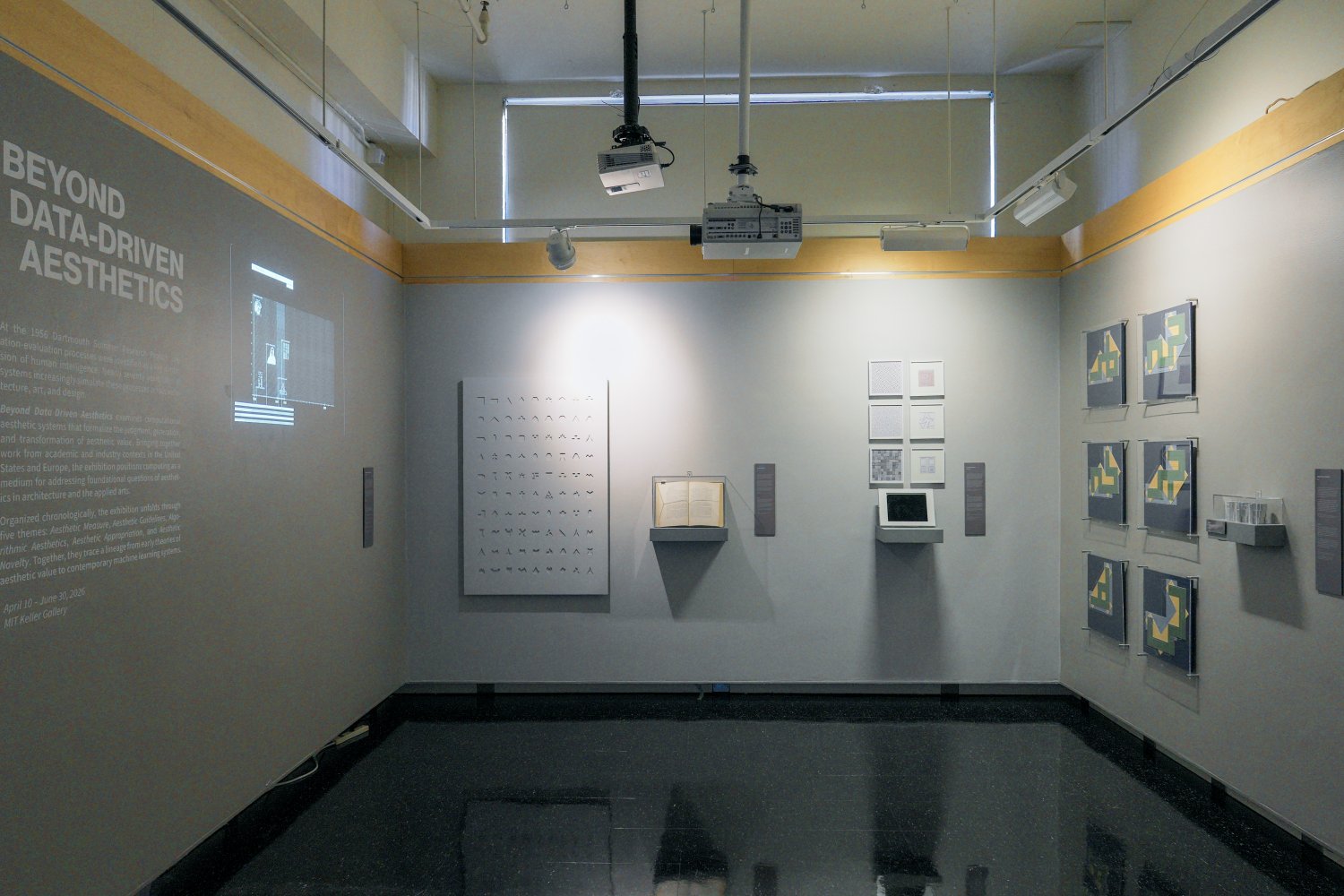


“Beyond Data-Driven Aesthetics,” by MIT Architecture alumnus and researcher Alexandros Haridis, on view at the MIT Keller Gallery through June 30, examines 20th- and 21st-century efforts to transform computing into a medium for creative production and aesthetic judgment in architecture and the applied arts. Drawing on philosophy, mathematics, computer science, and design computation, the exhibition translates algorithms, theories, and machine-learning systems into physical installations and interactive visualizations.
Q: What inspired “Beyond Data-Driven Aesthetics,” and what questions does it explore?
A: The conceptual origins of “Beyond Data-Driven Aesthetics” emerged from three intersecting lines of research.
First, while completing my PhD in design and computation in the MIT Department of Architecture around 2022, I observed in real time how advances in data-driven machine learning — systems such as ChatGPT and Stable Diffusion — were rapidly entering public discussions about creativity, aesthetic judgment, design, and even high-profile art auctions.
At the same time, my own research was already focused on aesthetic judgment and evaluation, and it became increasingly clear to me that many of the questions presented publicly as “new” in relation to AI actually have a much longer history across the 20th century. For example, in the 1956 Dartmouth Summer Research Project, a foundational event for the field of AI, creation and evaluation processes were identified as one of seven key dimensions of human intelligence that future AI research should address.
Second, the exhibition was influenced by research in design computation and shape grammars that investigates relationships between human insight and computation through rule-based methods, rather than purely data-driven learning. More recent interpretative studies of aesthetic theories — drawing from figures such as Samuel Taylor Coleridge, Oscar Wilde, and even John von Neumann — have been especially important to me. These studies examine whether theories of aesthetic value and comparison articulated in philosophical and literary texts may reveal possibilities or limitations in contemporary models of digital computation and AI in architecture and design.
Finally, the exhibition was motivated by the use of design, fabrication, and data visualization as methods for interpreting mathematical concepts, algorithms, and “black box” machine-learning systems. Across disciplines, researchers increasingly use reconstruction and visualization techniques to make computational systems more tangible and interpretable — from neural network visualization in computer science to software reconstruction and digital fabrication in architecture and curatorial practice.
Q: How do you translate research on computation and aesthetics into an exhibition?
A: The approach of the exhibition is to ask what exactly in a particular research paper or book captures its most salient idea, and then use design to interpret that idea in a visual, spatial, and experiential format. Drawing on design techniques such as software reconstruction, physical making, and data visualization, the exhibition takes written sources that are dense with algorithmic ideas, abstract concepts, and mathematical formulas, and translates them into stories in space that include interaction, material form, and digital visualization.
The exhibition itself is organized around five thematic areas: Aesthetic Measure, Aesthetic Guidelines, Algorithmic Aesthetics, Aesthetic Appropriation, and Aesthetic Novelty. Each theme functions as a selective “window” into a distinct computational approach to aesthetic judgment drawn from a specific publication — a book or research paper. The titles of these themes are derived from concepts central to each publication. For example, “measure” refers to mathematician George Birkhoff’s work in the 1930s to quantify aesthetic value mathematically, while “novelty” examines how the machine learning system AICAN judges generated images according to a theory in cognitive aesthetics that balances familiarity and deviation from known artistic styles.
Across all five cases, the key insight is that design itself can function as a method of interpretative translation — a way of making visible, tangible, and experiential what traditional academic scholarship in technical domains typically communicates only through words and word-like representational devices, such as scientific diagrams and tables.
Q: What questions are you hoping to explore next?
A: “Beyond Data-Driven Aesthetics” is conceived both as a research exhibition and as an ongoing platform for investigating how computational systems participate in processes of aesthetic judgment, generation, and transformation across architecture and the applied arts.
One of the central questions of the exhibition — and one that researchers across architecture, design, and engineering are increasingly focusing on — is computational evaluation beyond purely performative or functional requirements. This applies to many different design spaces, whether buildings, structural forms, or everyday products. The exhibition’s case studies suggest that many of these questions long predate current interest in computing and AI, and have been approached through a range of computational and theoretical models of evaluation since at least the early 20th century.
At the same time, I’m increasingly interested in how these ideas can move into broader applications related to the built environment. In particular, I am interested in how research connected to “Beyond Data-Driven Aesthetics” can help designers and engineers better understand how computation — whether rule-based or data-driven — can inform us about what contributes positively to human experience in relation to the spaces and objects people inhabit and use.
Finally, a direction I continue to explore is the methodological role of design itself as an interpretative device. Through software reconstruction, visualization, and physical making, the exhibition uses design to translate opaque computational systems into more legible, tangible, and experiential artifacts. More broadly, this opens questions not only about mechanizing “beauty” or “taste” (the traditional preoccupation of aesthetic formalism in the 20th century), but also about how traditional forms of research scholarship and communication may evolve through spatial, visual, and public-facing formats.
