

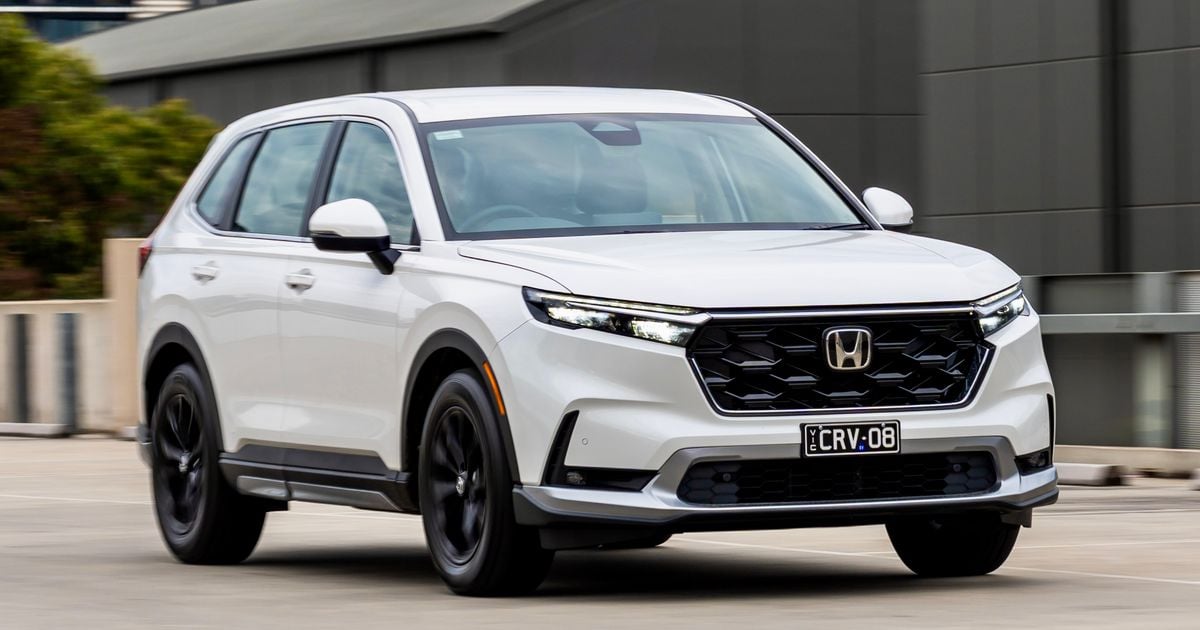

There’s a cheaper hybrid Honda CR-V in town, and it’s been a very long time coming.

Actually, there are now three cheaper CR-V e:HEV variants than there were just 12 months ago, as Honda has finally expanded the hybrid range of its largest SUV beyond a sole flagship grade. The range-topping e:HEV RS had been the only hybrid variant available since late 2023.
At the same time, Honda Australia has removed a fair chunk of petrol-only CR-V variants, leaving a six-grade lineup comprising two petrol-only and four hybrid grades. The only downside is that prices have increased by up to $4500 for existing variants.
That doesn’t seem to have had much impact, though, because CR-V sales are up only slightly this year to the end of June. Its 3200-odd sales so far in 2026 are still well down on segment leaders like the Toyota RAV4 and newcomers like the electric-only BYD Sealion 7. Still, the CR-V has regained relevance.
On test here is the 2026 Honda CR-V e:HEV X, the cheapest hybrid CR-V on sale now and exactly what Honda needs in an ever-competitive market. So how does it stack up against formidable new foes?
How much does the Honda CR-V cost?
With this year’s expansion of the hybrid lineup, the e:HEV X is now the most affordable hybrid-powered CR-V on sale, priced at $49,900 drive-away.
|
Model |
Drive-away price |
|---|---|
|
2026 Honda CR-V VTi X FWD |
$44,900 |
|
2026 Honda CR-V e:HEV X FWD |
$49,900 |
|
2026 Honda CR-V e:HEV L FWD |
$53,900 |
|
2026 Honda CR-V VTi L7 FWD |
$54,900 |
|
2026 Honda CR-V e:HEV LX AWD |
$58,900 |
|
2026 Honda CR-V e:HEV RS AWD |
$64,400 |
As with any mid-size SUV, a key rival is the Toyota RAV4. In base front-wheel drive GX trim, it costs $45,990 before on-road costs. The entire RAV4 range is hybrid-only.
A base Hyundai Tucson Hybrid 2WD, meanwhile, is priced at $42,850 plus on-roads, and a base plug-in hybrid Mitsubishi Outlander ES costs $58,990 plus ORCs. The new Mazda CX-5 will offer the nameplate’s first hybrid powertrain in 2027.
To see how the Honda CR-V stacks up against the competition, use our comparison tool
What is the Honda CR-V like on the inside?
Though it lacks bold stylistic pizzazz, there has always been a classy character to the CR-V’s cabin. It’s no different in the stripped-back X.
There’s a satisfying consistency in interior design across Honda’s catalogue, which not only makes it easy to visually identify as a Honda cabin, but also familiar to a buyer looking to upsize from a ZR-V, for example.
Find your perfect new car with CarExpert
In the CR-V, that simple design accentuates a spacious, upmarket cabin. Build quality is an indisputable highlight in any modern Honda, and it’s no different here, but we’d rather draw attention to the car’s impressive tactility and overall user-friendliness.
Honda is one of only a few manufacturers that has yet to fully embrace the iPad-on-dashboard phenomenon, but that works in its favour. Sure, the 9.0-inch touchscreen is comparatively small, but it allows for a more traditional centre stack with real climate controls.
The simple three-dial setup is an excellent example of well-designed cabin controls. It’s easy to understand even if you’re a newcomer, the buttons are real, and the dials are satisfyingly notchy – all of which contribute substantially to the cabin’s sense of quality.
Then there’s the sheer number of buttons everywhere else. The slab-like centre console houses most driving-related controls, and the steering wheel has a sensible number of buttons, so no key functions are buried in convoluted touchscreen menus.
We also like the large toggles for air vent adjustment behind the neat-looking hexagonal grille. It’s simply a traditionally configured interior that still feels modern, and you aren’t ‘punished’ for going for the low-ranking X grade because there are hardly any noticeable button blanks.
Furthermore, the included tech is quite good. The modest infotainment system does a good job of giving you everything you need without going over the top, which means there are still plenty of settings and apps to mess with if you want to.
Wireless Apple CarPlay is standard and reliable, and you can easily navigate the system using the simple buttons on the right-hand side. There’s another notchy dial there, too.
The CR-V’s instrument display, meanwhile, is at its smallest in the X. At 7.0 inches, it’s noticeably down on the 10.2-inch unit seen elsewhere in the range, but it’s still appropriately functional.
The basic two-dial theme is flanked by two simple gauges for battery charge and fuel, while you can navigate the screen’s various info displays using the textured scroll wheels on either side of the steering wheel.
Overall, though, the CR-V’s cabin is an enjoyable place to spend time. Classy materials help, as even this base model gets a leather-wrapped steering wheel, padded armrests, and comfortable seats – as you’d expect for $50,000. The driver’s seat is powered, though it’s finished in cloth rather than leather, and not heated.
You’re also given decent storage options, including a large central box, cupholders and slots on the centre console, plus bottle holders in the doors. There’s even a wireless phone charger to complement the two USB-C ports up front.
The second row is, as expected, relatively light on amenities, with just enough to keep occupants satisfied on longer drives. The only real amenities back here are two USB-C ports, air vents on the back of the centre console, and a soft fold-down armrest with built-in cupholders.
Ingress is also very easy thanks to the wide-opening rear doors, and there isn’t much of a driveline hump in the floor to get in the way if you need to scoot across. Bench-seat comfort and headroom could both be better, particularly the latter if you’re much taller than I am at 173cm.
In contrast, the boot is incredibly spacious, offering plenty of room for large suitcases or a substantial grocery run. There are also a couple of shallow ‘trays’ for loose items, but there’s quite a lot of hard plastic that will likely become scratched after frequent cargo carrying.
The base CR-V even gets a power tailgate, but being a hybrid model, there’s no spare wheel under the floor. A tyre repair kit is standard instead.
|
Dimensions |
Honda CR-V e:HEV X |
|---|---|
|
Length |
4704mm |
|
Width |
1866mm |
|
Height |
1681mm |
|
Wheelbase |
2701mm |
|
Cargo capacity |
589L (rear seats up) |
To see how the Honda CR-V stacks up against the competition, use our comparison tool
What’s under the bonnet?
Powering the CR-V e:HEV X is a 2.0-litre non-turbo four-cylinder petrol engine supported by two electric motors, a propulsion (traction) motor that sends power directly to the wheels, and a generator to charge the hybrid battery pack. The system sends 135kW of power and 335Nm of torque to the front wheels through an electronic continuously variable transmission (e-CVT).
|
Specifications |
Honda CR-V e:HEV X |
|---|---|
|
Engine |
2.0L 4cyl HEV |
|
Power |
135kW |
|
Torque |
335Nm |
|
Battery |
Li-ion |
|
Transmission |
e-CVT |
|
Drive type |
Front-wheel drive |
|
Kerb weight |
1741kg |
|
Fuel economy (claimed) |
5.5L/100km |
|
Fuel economy (as tested) |
5.2L/100km |
|
Fuel tank capacity |
57L |
|
Fuel requirement |
91-octane regular unleaded |
|
CO2 emissions |
125g/km |
|
Emissions standard |
Euro 6b |
|
Braked tow capacity |
750kg |
Our week with the CR-V involved highway commuting and a fair share of suburban driving. We recorded fuel consumption of 5.2L/100km, bettering Honda’s 5.5L/100km claim.
To see how the Honda CR-V stacks up against the competition, use our comparison tool
How does the Honda CR-V drive?
Like its interior, the CR-V’s driving experience is easy and unintimidating, though not particularly inspiring.
The only real learning curve you’ll encounter will likely come before you even set off. It’s the gear selector situation that’s somewhat alien, with the small panel of individual switches being much different from most other mainstream SUVs.
But as fun as a T-bar auto would be, these buttons work just fine. Press the D/B button, and you’ll be ready to go. Upon setting off, the CR-V proves smooth and comfortable.
The hybrid powertrain feels just as good here as it does in the existing e:HEV RS, and it drives similarly enough to any other combustion-powered SUV. That means there’s no real adjustment period for someone coming from an older car.
You won’t notice any stumbles or rough spots when the powertrain switches between petrol and electric power, and it responds promptly to varying throttle inputs. That means there’s no uncomfortable delay in power delivery when the petrol engine fires up.
The engine isn’t particularly sonorous when it does so, but Honda’s dual-motor hybrid system manages the transition between electric, petrol-assisted and engine-driven operation smoothly. It automatically selects the most suitable operating mode to balance driveability and efficiency.
A neat bonus is that Sport mode will have the transmission simulate gear shifts at high RPM, which makes it feel like a snappy sports automatic rather than something closer to a continuously variable automatic transmission. Of course, it isn’t a fast car, but it still has plenty of pep when you need it, particularly at low speed, given the immediate electric power on hand.
The only difference you may notice here is the lack of all-wheel drive, but the circumstances in which that may be an issue are few and far between. There isn’t enough power on hand for the front-drive layout to cause any problems, aside from maybe a hint of torque steer if you’re aggressive with the throttle from very low speeds.
When it comes to slowing down, the CR-V’s brake pedal also feels very natural – not always the case in hybrids that combine regenerative and friction braking. You have the option of several regen strengths too, which can be adjusted using the steering-wheel paddle shifters.
Doing so in Drive maintains the selected regenerative braking level only temporarily, whereas selecting B mode provides more persistent control over the system’s deceleration behaviour.
The CR-V’s ride and handling are pretty much bang-on, too. There’s no fancy adaptive damping or anything like that going on, but we found it to be compliant and comfortable – the firmer edge to its suspension is slightly offset by the chunkier rubber on the X’s smaller alloy wheels compared to the LX.
Its steering is also sensible, with decent weighting and a large-diameter steering wheel contributing to a substantial feel overall. It’s direct too, which means you won’t be sawing away at the wheel to get it to change direction.
There is some body roll, but it isn’t crazy. It all combines to create an SUV that’s just as comfortable in the city as it is in the country, though the tyres will be the first thing to hold the car back on a twisty road.
That also suggests the car is fairly heavy, and it certainly doesn’t feel small from behind the wheel.
But still, we found it to be stable and refined on the freeway, with road noise also a tad more suppressed than it is in the larger-wheeled variants. The CR-V, therefore, eats up the kilometres without fuss, and this base grade is just as enjoyable as any other – unless you want a more premium sound setup.
As a Honda, this car’s safety features are well-tuned. We had no issues with any technology during our week with the car, and we found its adaptive cruise function to be very reliable.
Overall, the base CR-V doesn’t really do anything wrong. That makes it exceptionally easy to jump in and drive with little extra thought.
To see how the Honda CR-V stacks up against the competition, use our comparison tool
What do you get?
There are four trim levels available across the updated CR-V lineup, and the X sits at the bottom.
Ready to buy? We’ll help you get a great deal.
If this is the car for you, we’ll compare offers from trusted dealers, handle the back and forth and manage your purchase from enquiry to delivery.
2026 Honda CR-V X (VTi, e:HEV) equipment highlights:
- 17-inch alloy wheels (VTi X)
- 18-inch gloss-black alloy wheels (e:HEV X)
- Full-size alloy spare (VTi X)
- Tyre repair kit (e:HEV X)
- Automatic LED headlights
-
- Manual height adjustment
- Automatic high-beam
- LED front fog lights
- Hands-free power tailgate
- Leather-wrapped steering wheel
- 8-way power driver’s seat with 4-way power lumbar
- Black fabric upholstery
- 7.0-inch instrument cluster screen
- 9.0-inch touchscreen infotainment system
- Google Built-in
- Wireless Apple CarPlay
- Wired Android Auto
- Wireless phone charger
- 8-speaker sound system
- 4 x USB-C outlets
- Dual-zone climate control with second-row air vents
- Beige headliner
- Honda Connect 3-year complimentary subscription
-
- Remote control of locks, climate control, lights, horn, tailgate and immobiliser
- Automatic collision detection
- Speed and geofencing alerts
- Emergency call button
- Location search
CR-V e:HEV L and VTi L7 add:
- 18-inch silver alloy wheels (VTi L7)
- 18-inch gloss-black alloy wheels (e:HEV L)
- Space-saver spare (VTi L7)
- Tyre repair kit (e:HEV L)
- Rain-sensing wipers
- Smart KeyCard
- 10.2-inch digital instrument cluster
- Driver’s seat memory
- 4-way power passenger seat
- Heated front seats
- Black leather-appointed upholstery
- Tri-zone climate control with independent rear controls, third-row air vents (VTi L7)
CR-V e:HEV LX adds:
- 19-inch alloy wheels
- All-wheel drive
- Automatic LED headlights with auto height adjustment
- DAB+ digital radio
- 12-speaker Bose sound system
- Piano black interior trim
- Ambient interior lighting
CR-V e:HEV RS adds:
- Adaptive LED headlights
- LED active cornering lights
- Panoramic sunroof
- Piano-black door handles, exterior mirrors, spoiler, wheel-arch garnish and B- and C-pillar trims
- Head-up display
- Ventilated front seats
- Heated outboard rear seats
- Heated steering wheel
- Red stitching
- Alloy pedals
- Black headliner
To see how the Honda CR-V stacks up against the competition, use our comparison tool
Is the Honda CR-V safe?
The Honda CR-V has a four-star ANCAP safety rating, based on testing conducted in 2024 by Euro NCAP.
|
Category |
Honda CR-V |
|---|---|
|
Adult occupant protection |
88 per cent |
|
Child occupant protection |
88 per cent |
|
Vulnerable road user protection |
76 per cent |
|
Safety assist |
68 per cent |
Standard safety equipment includes:
- 11 airbags, incl:
-
- Dual front
- Side
- Full-length curtain
- Front knee
- Front centre
- Adaptive cruise control with low-speed follow
- Autonomous emergency braking
- Blind-spot monitoring
- Driver attention monitor
- Front and rear parking sensors
- Lane-keep assist
- Post-collision braking
- Rear cross-traffic alert
- Reversing camera
- Traffic Jam Assist
- Traffic sign recognition
- Tyre pressure monitoring
The e:HEV L, e:HEV LX and e:HEV RS also get a surround-view camera, new for 2026.
To see how the Honda CR-V stacks up against the competition, use our comparison tool
How much does the Honda CR-V cost to run?
Honda Australia backs its range with a five-year, unlimited-kilometre warranty. Servicing for the CR-V is required every 12 months or 10,000km, and the first five services cost $199 each.
|
Servicing and Warranty |
Honda CR-V e:HEV |
|---|---|
|
Warranty |
5 years, unlimited kilometres |
|
Roadside assistance |
5 years |
|
Service intervals |
12 months or 10,000km |
|
Capped-price servicing |
5 years, $199 each |
|
Total capped-price service cost |
$995 |
Honda’s service pricing is consistently impressive, aided by the fact it’s the same across its model range. It’s also cheaper than key rivals like the Toyota RAV4 2WD, for which five years of maintenance will cost you $1625.
A front-drive Hyundai Tucson Hybrid, meanwhile, costs $2290 to service over five years.
To see how the Honda CR-V stacks up against the competition, use our comparison tool
CarExpert’s Take on the Honda CR-V e:HEV X
The Honda CR-V has always been a solid SUV relative to its competitors, and the current generation is no exception. With the addition of more affordable hybrid grades, it’s now far more relevant in a market that is gradually shifting towards electrified vehicles.
Even for stripped-back variants like the X, there are no compromises for Honda’s tried-and-proven e:HEV hybrid system, and we dare say it makes the base CR-V just that little bit nicer to drive. Nobody has ever complained about a smoother powertrain with a bit more low-end punch.
Its interior is just as refined and palatable as ever, and it’s still comfortable without the more luxurious fittings of higher-spec variants. It’s simply a high-quality, well-rounded package, and one that’s well worth considering if you want an electrified family SUV from an established brand that isn’t Toyota.
The addition of cheaper CR-V e:HEV grades is just one of Honda Australia’s sensible decisions of late. The same treatment for the smaller HR-V and ZR-V SUVs has made them more popular and contributed to an overall year-on-year sales increase for the Japanese brand, even if it’s only modest.
If Honda can make this e:HEV powertrain even more accessible to Australian buyers by bringing prices down further – without skimping on too much equipment – there’s no reason the CR-V can’t be as popular as it once was.
CarExpert can save you thousands on a new Honda CR-V. Click here to get a great deal.
Click the images for the full gallery
