

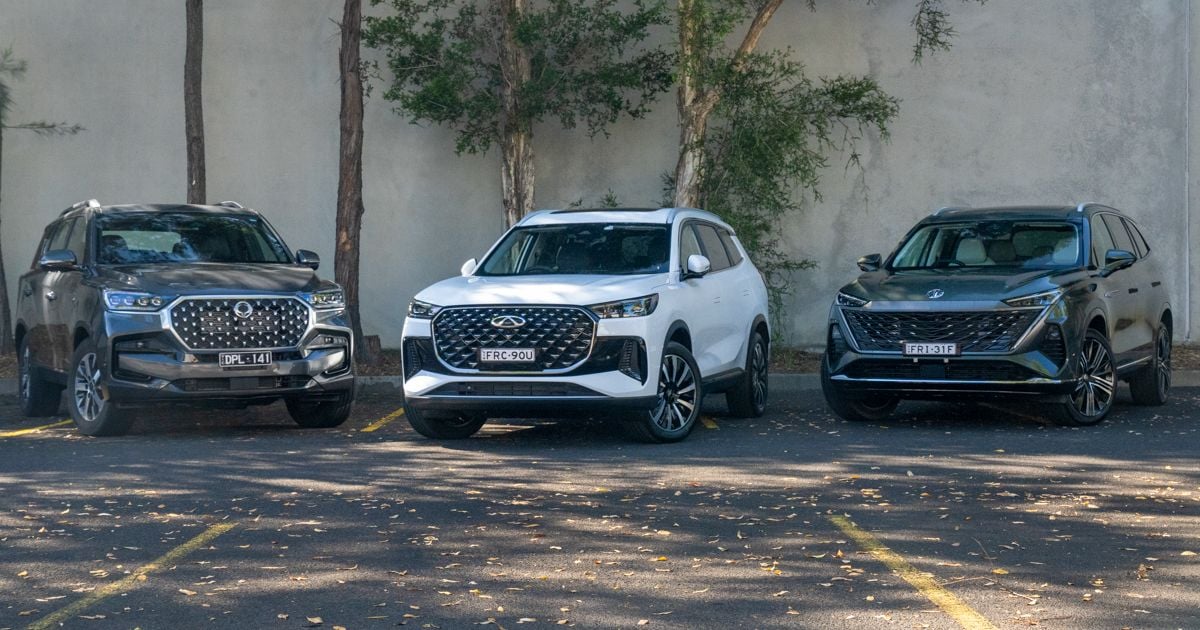

There are already plenty of financial burdens for bigger-than-nuclear families before it comes time to finding a car that’s big on space but tight on budget.

For those that need room for more than five, a proper people mover is the ideal solution. But at the moment there’s only one available in Australia for under $50,000 – the entry-level LDV Mifa.
There is, however, a wider selection of more affordable seven-seat crossover SUVs that offer more creature comforts, more car-like driving dynamics, and the latest in safety technology – like the three we’re comparing here: the Chery Tiggo 8 Super Hybrid, MG QS and KGM Rexton.
How much do they cost?
The Chery Tiggo 8 is the most affordable of this trio, with prices starting at $41,990 drive-away for the entry-level Urban with a standard turbo-petrol engine.
|
Model |
Drive-away price |
|---|---|
|
2026 Chery Tiggo 8 CSH Ultimate |
$49,990 |
|
2026 MG QS Essence |
$50,990 |
|
2026 KGM Rexton Advance |
$57,500 |
But the one we’re testing is the new plug-in hybrid – Super Hybrid or CSH in Chery-speak – in flagship Ultimate trim, which costs $49,990 drive-away. There is a cheaper Urban grade available for $45,990 drive-away.
The MG QS doesn’t have a hybrid powertrain but is also available in two model grades, starting at $46,990 drive-away for the entry-level Excite and rising to $50,990 drive-away for the Essence variant we have here.
Both the Chery and MG are built in China, whereas the KGM Rexton is built in South Korea.
KGM, as a brand, might seem to be a newcomer like its competitors, but it was formerly known as SsangYong which has been around in Australia for 30 years. The company was purchased in 2002 by the KG Group, which rebranded it as KG Mobility (KGM) here last year.
The Rexton has been a mainstay of its product lineup and the latest generation was first introduced in 2018 then facelifted in 2021 before being rebadged as a KGM model in 2024.
It is currently offered in three model grades, starting at $52,000 drive-away for the base ELX and topping out at $61,500 drive-away for the flagship Ultimate. For this comparison, we’re testing the mid-range Advance that costs $57,500 drive-away, making it the most expensive in this trio.
What do you get?
All three vehicles are fitted with a generous level of standard equipment, including the kit listed below.
Shared equipment highlights:
- 19-inch alloy wheels
- LED headlights and tail-lights
- Keyless entry
- Power-operated tailgate
- Synthetic leather trim
- Electrically adjustable front seats
- Heated and ventilated front seats
- Ambient interior lighting
- Climate control air-conditioning
- Twin digital displays
- Bluetooth connectivity
- Smartphone mirroring for Apple and Android devices
On top of that, both the Tiggo 8 Ultimate and MG QS have full-length panoramic glass sunroofs, while the Rexton is the only one with built-in retractable sunshades in the rear passenger doors and heated rear outboard seats.
They also have wireless phone chargers, which is something missing from the Rexton – and a sign of its age.
On the digital front, both the MG QS and KGM Rexton have twin 12.3-inch digital screens for the instrument cluster and infotainment touchscreen, while the Tiggo has a smaller 10.25-inch display in front of the driver but a larger 15.6-inch central screen.
Are they safe?
While all three models feature a comprehensive suite of advanced crash-avoidance systems and driver aids, only the newer Chery Tiggo 8 and MG QS have been tested by ANCAP, which awarded them a maximum five-star rating.
|
Category |
Chery Tiggo 8 |
MG QS |
KGM Rexton |
|---|---|---|---|
|
Adult occupant protection |
82 per cent |
88 per cent |
N/A |
|
Child occupant protection |
86 per cent |
86 per cent |
N/A |
|
Vulnerable road user protection |
80 per cent |
76 per cent |
N/A |
|
Safety assist |
82 per cent |
80 per cent |
N/A |
Shared standard safety features in all three models include:
- Autonomous emergency braking
- Forward collision warning
- Adaptive cruise control
- Lane-keeping assistance
- Blind-spot detection
- Rear cross-traffic alert
- Tyre pressure monitoring
- Front and rear parking sensors
- 360-degree parking display
All three models offer airbag protection for all three rows, but Chery and KGM have a total of nine airbags while the MG misses out on rear-seat side airbags.
What are they like on the inside?
All three of these SUVs have seating for seven across three rows and come loaded with practical convenience features, making them ideal for larger families.
The MG is physically the largest vehicle, measuring 4983mm in overall length and riding on a 2915mm wheelbase, which makes it more than 130mm longer than the Rexton and 250mm longer than the Tiggo 8.
What that equates to is more space inside the cabin, where there’s generous headroom in all three rows and the most mid-room legroom. However, the MG sacrifices some cargo capacity (203 litres in seven-seat configuration and 517L as a five-seater) compared to the Rexton, which has the largest boot space (236L as a seven-seater and 641L with the third row folded flat).
The MG’s cabin is also the nicest in terms of presentation with a modern design to its dashboard and an interesting mix of brown and cream trim, plus raw woodgrain and brushed alloy highlights.
The main part of the dash flows across the car, with the centre section angled slightly towards the driver and its twin 12.3-inch digital screens sitting proudly above a row of physical buttons that provide easy access to often-used functions within the ventilation system.
The long centre console has dual wireless phone chargers at the front, twin cupholders hiding under the rollaway wooden slider and a large, lidded bin between the front seats, which are super-comfy and offer plenty of adjustment.
Those in the middle row have ample legroom – even in the centre seat thanks to a flat floor – plus twin USB-C power outlets. And it’s the only vehicle here with separate ventilation controls for rear-seat occupants.
Access to the third row is a two-step process – first to fold down the seatback and then slide the cushion forward – but the two seats are quite comfortable, even if they have restricted leg and toe room. There are cupholders and USB-C power outlets on each side, but no separate air vents back here.
The Chery Tiggo 8 is just as luxurious as the MG with its quilted seat trim, fake woodgrain highlights and large digital screen, but its dark grey colour palette isn’t as vibrant and highlights the fact it is the smallest of the three vehicles here.
It does, however, utilise the cabin space well and offers good headroom and decent legroom in the middle row, but the third-row seats are flatter and more cramped than in the others.
Access to the third row is also more difficult than in the MG and KGM, as the little ones will have to climb up and over the middle-row backrest when it is folded flat.
Those up front are cosseted by soft and comfortable seats, while the high-rise centre console has additional storage space underneath that’s large enough for a handbag.
The small digital instrument cluster in front of the driver is clear and bright, and all the information is visible through the steering wheel, while the oversized central infotainment touchscreen houses all of the vehicle controls, including the ventilation system, which can be a bit fiddly to navigate.
The KGM Rexton is the oldest vehicle here and is starting to show its age with the most conservative interior design of this trio.
The newer Chinese rivals certainly have more wow factor, but the Rexton feels better screwed together in terms of build quality, even though its cabin plastics are a bit harder and there are slight variations in the look and feel of the different alloy trim highlights.
The chunky four-spoke steering wheel falls nicely to hand, the digital instrument cluster is less prone to sun glare because it’s under a traditional cowl, and the front seats are the best here, with deep bolstering, soft cushions and plenty of adjustment.
The middle row offers almost as much legroom as the MG, with adjustable air vents, and single USB-A and 12V power outlets.
The Rexton is the SUV here without a panoramic sunroof, but also the only one with retractable sunblinds in the rear passenger doors and grab handles on the B-pillars.
It is also the easiest vehicle to access the third row in, thanks to a one-touch flip-and-fold function for the middle row. The rear bench sits higher than in the MG and Chery, which limits headroom for taller occupants but provides better legroom.
Those in the third row don’t score traditional cupholders, but there is a recess on each side with elastic holders that will keep items secure.
|
Dimensions |
Chery Tiggo 8 CSH |
MG QS |
KGM Rexton |
|---|---|---|---|
|
Length |
4724mm |
4983mm |
4850mm |
|
Width |
1865mm |
1967mm |
1960mm |
|
Height |
1718mm |
1778mm |
1825mm |
|
Wheelbase |
2694mm |
2915mm |
2865mm |
|
Cargo capacity |
117L (behind third row) |
203L (behind third row) |
236L (behind third row) |
What’s under the bonnet?
These three models take a different approach in terms of their mechanical configurations.
|
Specifications |
Chery Tiggo 8 CSH |
MG QS |
KGM Rexton |
|---|---|---|---|
|
Engine |
1.5L 4cyl turbo-petrol |
2.0L 4cyl turbo-petrol |
2.2L 4cyl turbo-diesel |
|
Engine outputs |
105kW 215Nm |
153kW 360Nm |
149kW 441Nm |
|
Electric motor outputs |
150kW 310Nm |
N/A |
N/A |
|
System outputs |
255kW 525Nm |
N/A |
N/A |
|
Battery |
18.4kWh LFP |
N/A |
N/A |
|
Transmission |
Single-speed DHT |
9-speed auto |
8-speed auto |
|
Drive type |
Front-wheel drive |
Front-wheel drive |
Four-wheel drive |
|
Weight |
1921kg |
2030kg |
2136kg |
|
Fuel economy (claimed) |
1.3L/100km |
8.8L/100km |
8.7L/100km |
|
Fuel economy (as tested) |
4.2L/100km |
9.4L/100km |
9.3L/100km |
|
Electric driving range |
95km |
N/A |
N/A |
|
Fuel tank capacity |
60L |
65L |
70L |
|
Fuel requirement |
95-octane premium unleaded |
95-octane premium unleaded |
Diesel |
|
CO2 emissions |
30g/km |
198g/km |
223g/km |
|
Braked tow capacity |
N/A |
2000kg |
3500kg |
The Chery Tiggo 8 Super Hybrid has the most advanced powertrain in the form of a plug-in hybrid setup that pairs a 1.5-litre turbocharged four-cylinder petrol engine with an electric motor that drives the front wheels via a single-speed transmission.
The engine on its own produces 105kW of power and 215Nm of torque, while the electric motor delivers an extra 150kW and 310Nm, and can provide up to 95km of zero-emissions driving range.
That results in theoretical average fuel consumption of just 1.3L/100km and a maximum range of more than 1200km before its 60-litre fuel tank or 18.4kWh battery need to be replenished.
The MG QS is the most conventional, with a 2.0-litre turbo-petrol four-cylinder that produces 153kW and 360Nm, and drives the front wheels through a nine-speed automatic.
It delivers claimed average fuel consumption of 8.8L/100km and requires 95-octane premium unleaded in its 65-litre tank.
The KGM Rexton is the better pick for adventurous families looking to head off the beaten track or those who need to tow a heavy load.
It has a 2.2-litre turbocharged common-rail four-cylinder diesel engine that produces 149kW/441Nm, driving a proper part-time four-wheel drive system with a low-range transfer case through an eight-speed automatic transmission.
It has combined fuel consumption of 8.7L/100km and the largest fuel capacity of 70L. It also has the highest maximum braked towing capacity of 3500kg, while the MG and Chery can only tow up to 2000kg and 750kg respectively.
How do they drive?
On the road, each of these cars delivers something completely different.
From expert reviews to the right deal
CarExpert brings together reviews, research tools and trusted buying support, guiding you from research to delivery with confidence.
As mentioned above, the KGM is the only one of these SUVs that offers genuine off-road capabilities, but it’s not to the detriment of its everyday driving character.
The engine is super-strong with excellent mid-range torque that makes it feel effortless to drive at any speed, as well as while carrying a full load. The eight-speed automatic is well tuned to tap into its seamless surge, and has smooth shifts and intuitive logic.
The steering is also nicely weighted with a positive on-centre feel for good stability when cruising at highway speeds, but is also light enough when manoeuvring around tight urban streets.
The suspension, however, could do with a bit of fine-tuning. It floats over big bumps and feels comfortable when lumbering along smooth highways, but it has less control over sharper impacts on rough surfaces, which shudder through to the cabin.
The MG QS has the most familiar driving character. Its 2.0-litre engine feels strong enough in most situations, with good mid-range power. But it also has a noticeable degree of turbo lag at lower revs, and it hesitates away from a standstill as the idle-stop system awakens the engine and the nine-speed auto finds a getaway gear.
The suspension is well sorted with a good balance between comfort and stability, and the steering is positive with good feel. It’s the most ‘normal’ and car-like to drive of this trio.
The Chery Tiggo 8 is the outlier here with its advanced and modern plug-in powertrain, as it drives like an electric vehicle most of the time.
What that means is it has significantly more instantaneous torque on tap which, on one hand, can scrabble the front tyres when you ask for all its power, but on the other hand it delivers seamless and effortless acceleration when used normally.
It’s also the quietest of these three, even when the turbo-four is called into action, adding an element of refinement above the others.
The dynamic character is clearly biased towards comfort rather than cornering, which means it soaks up bumps rather well but can feel a little ponderous through the bends. Sure, it’s not meant to be a sports car, but it could use a little more suspension control to reduce body roll and improve stability.
How much do they cost to run?
The MG QS comes with the longest warranty period – 10 years or 250,000km of coverage with free roadside assistance if the vehicle is maintained within the MG dealer network.
|
Servicing and Warranty |
Chery Tiggo 8 CSH |
MG QS |
KGM Rexton |
|---|---|---|---|
|
Warranty |
7 years, unlimited kilometres |
10 years or 250,000km (service-activated) |
7 years, unlimited kilometres |
|
Roadside assistance |
Up to 7 years (service-activated) |
Up to 10 years (service-activated) |
5 years |
|
Service intervals |
12 months or 15,000km |
12 months or 15,000km |
12 months or 15,000km |
|
Capped-price servicing |
7 years |
5 years |
7 years |
|
Average annual service cost |
$453 |
$471 |
$485 |
|
Total capped-price service cost |
$3174 |
$2354 |
$3397 |
Service intervals are 12 months or 15,000km, with five years of capped-price servicing costing a total of $2354 or an average of $470.80 per annum.
The Chery Tiggo 8 and KGM Rexton are both covered by a seven-year, unlimited-kilometre warranty and come with free roadside assistance plans. But the Chery’s is conditional on being serviced at an authorised dealer for the duration of the warranty period, and the KGM’s is restricted to the first five years of ownership.
Both require regular maintenance every 12 months or 15,000km and have seven-year capped-price servicing programs. The Tiggo 8 Super Hybrid costs $3174 – or an average of $453 per year – over seven years, making it the most affordable to maintain despite its complex powertrain, while the Rexton is the most expensive and costs $3397 at an average of $485 per year.
CarExpert’s Take
All three of these cars perform the role of weekday family runabout exceptionally well.
The MG QS is the most conventional of this trio and the easiest to live with. It’s spacious, comfortable, relatively efficient and nice to drive, and comes loaded with gear.
But both the KGM Rexton and Chery Tiggo 8 bring some extra – and unique – skills if you need a little more.
The KGM is the only option here for those with an adventurous streak. It’s a proper four-wheel drive with genuine off-road and heavy-duty towing capabilities.
Its cabin might not have the same wow factor as the Chery and MG, but it feels more robust and durable, and has the best third-row and cargo-carrying capacity. It ticks plenty of logical boxes.
And then there’s the Tiggo 8, which is the most affordable to purchase, the cheapest to maintain and comes equipped with a generous list of standard equipment.
Its biggest advantage is its plug-in powertrain, which is ultra-efficient if you optimise the battery pack through regular charging at home or work.
And, amid soaring living costs including high fuel prices, that could be a real benefit to the household budget.
Click the images for the full gallery
MORE: Explore the Chery Tiggo 8 showroom
