
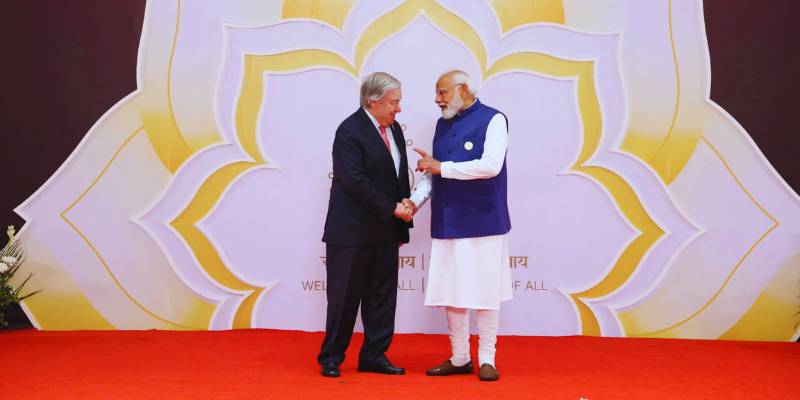

India’s AI summit in New Delhi this week was as much about diplomacy as it was about algorithms. Government officials, CEOs and other dignitaries met to discuss AI, its promise and its problems.
As described in a New York Times article about the summit in New Delhi, the gathering brought together top officials to discuss the benefits and risks of AI technology.
More from the article. While there were plenty of promises of AI’s ability to solve health care issues and improve crop yields, some in attendance acknowledged that AI is developing faster than governments can control it.
One official, speaking on the condition of anonymity, said that officials were “trying to catch a bullet train on a bicycle.”India’s prime minister, Narendra Modi, called for shared standards and universal access to the technology.
He emphasized that AI governance should not be a game of nations, drawing comparisons to how the rest of the world has implemented a shared system of electricity.
Similar efforts are underway in Europe, where lawmakers are meeting to discuss the E.U.’s AI Act, as reported in a New York Times article about the E.U.’s AI Act negotiations. But it’s not all kumbaya.
While Mr. Modi called for a shared approach, India is also seeking to compete with the U.S. and China in terms of compute power and semiconductor development.
The U.S. and China are pouring billions into compute power, semiconductors and advanced model development. India wants to be at that table, not as an afterthought.
During the summit, several international companies pledged billions in AI investments in India, a goal similar to one described in a New York Times article about big companies in India’s AI push.
But that’s the tension at the heart of this issue. Everyone wants to cooperate, but they also want to compete. Is it possible for nations to share advances when they can provide military and economic advantages?
Or is this just an arms race with a smile?Off stage, attendees expressed concern about the effects of AI on workforces and fears that automation would increase inequality if not managed properly.
Some experts pointed to data that suggests that automation could hit emerging markets particularly hard, given their reliance on digital services work.
According to a report by the International Monetary Fund, jobs most at risk from automation include routine or repetitive information-data-processing tasks and customer-service tasks.
The I.M.F. report on the risks of automation. There were also moments of inspiration. Health officials talked about the use of AI in rural medical facilities.
Climate officials talked about the potential of AI to help mitigate severe weather. We forget sometimes that AI can also mean helping a farmer prepare for a bad harvest, or helping doctors identify disease.
Away from the main stage, there was disagreement over whether global standards should be mandatory or voluntary. Some developing countries said that overly strict rules could leave them behind.
Western countries said that without them, AI could be used to undermine elections and spread disinformation on a massive scale. No one walked out, but no one declared victory either.
If one thing was made clear this week, it’s that AI is now a matter of foreign policy, economic policy and social policy all at once. My takeaway from reading the article? We’re winging it.
Officials are trying to create frameworks to regulate a technology that’s changing every six months. That’s not a failing of regulators. That’s just the nature of exponential growth. What was accomplished in New Delhi?
Not much in the way of regulation. Not much in the way of resolving global tensions. But perhaps something more important: The recognition that no one nation can control this alone.
Whether that holds once the competition truly begins remains to be seen. But for now, the future of AI looks a lot like traffic in Delhi: messy, aspirational, and occasionally maddening. But moving.
