


VMware Cloud Foundation has always been more than a collection of VMware products bundled together. The hard part has never been only deploying vSphere, NSX, vSAN, operations tooling, automation, or lifecycle tooling. The hard part is operating the full stack consistently after the environment grows past one cluster, one vCenter, one NSX deployment, or one team.
That is where VCF Operations Fleet Management matters.
Fleet Management is not just another section of the UI. It is part of a larger operating model shift in VMware Cloud Foundation 9.x: moving from component-by-component administration toward fleet-level control for identity, licensing, certificates, passwords, lifecycle, tagging, configuration, and operational visibility. Broadcom’s VCF 9.0 materials describe VCF Operations as the place for unified visibility and fleet-level operations across the workload and infrastructure stack, with Fleet Management listed as a core VCF Operations capability. [1]
There is one important version-specific distinction before we go further: the Fleet Management capability is not the same thing as the VCF 9.0 Fleet Management Appliance. In VCF 9.0, the appliance existed as part of the architecture. In VCF 9.1, Broadcom states that the standalone Fleet Management Appliance is replaced by Fleet Lifecycle and SDDC Lifecycle services running inside VCF Management Services, and the older appliance can be decommissioned after upgrade. [2]
That distinction matters because you should design around the capability and operating model, not around a specific appliance that changed between 9.0 and 9.1.
TL;DR
VCF Operations Fleet Management gives administrators a centralized way to manage common operational functions across one or more VCF instances in a VCF fleet. At a practical level, that means less time jumping between vCenter, NSX, SDDC Manager, certificate workflows, password processes, licensing tools, and lifecycle screens.
The key things to know:
| Area | What You Need to Know |
|---|---|
| Scope | A VCF fleet can include one or more VCF instances managed by fleet-level components. |
| Control plane | VCF Operations becomes the primary operational interface for fleet management, observability, licensing, lifecycle, and related Day 2 workflows. |
| Version guardrail | In VCF 9.1, the standalone VCF 9.0 Fleet Management Appliance is replaced by services inside VCF Management Services. |
| Operational impact | Fleet Management changes ownership, change control, lifecycle planning, certificate handling, password rotation, identity design, and tag governance. |
| Adoption advice | Treat Fleet Management as an operating model first and a UI feature second. |
VCF Fleet Management at a Glance
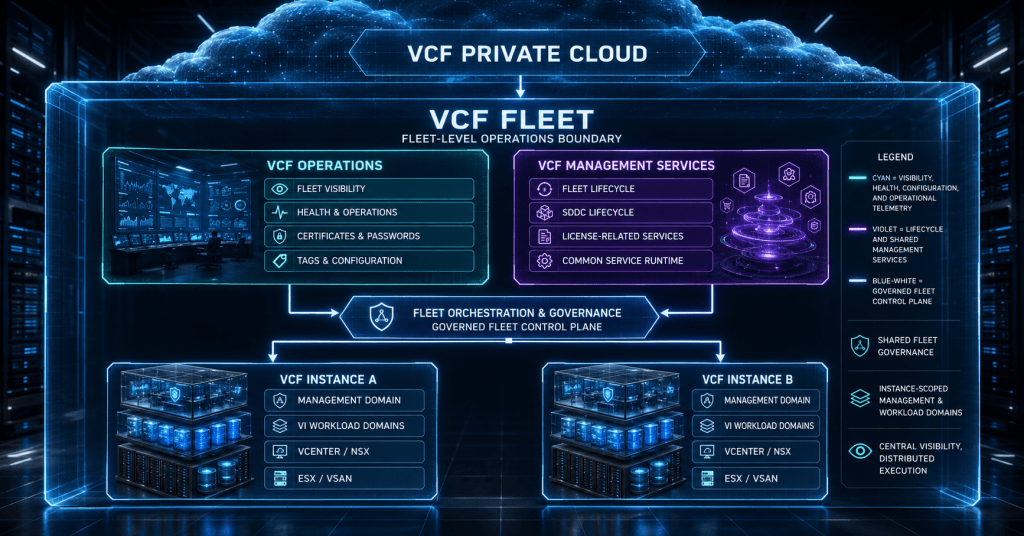
The easiest way to think about Fleet Management is as a fleet-level management boundary that sits above individual domains and components. A VCF instance contains a management domain and can contain additional VI workload domains. A fleet can contain one or more VCF instances, and VCF Operations and VCF Automation can be shared across the fleet. Broadcom’s VCF deployment guidance describes a VCF fleet as a construct where multiple VCF deployments can leverage common VCF Operations and VCF Automation instances. [3]
The diagram below is intentionally simple. The point is not to show every appliance. The point is to show the operational boundary.

What to notice: the fleet boundary does not remove the need for domain-level design. You still have management domains, workload domains, vCenter instances, NSX Managers, ESX hosts, vSAN clusters, identity providers, certificates, DNS, NTP, and maintenance windows. Fleet Management gives you a more centralized way to govern and operate those moving parts.
The Scenario: Why Fleet Management Shows Up in Real Environments
Most VCF conversations start with deployment. That makes sense. You need hardware, networking, storage, DNS, identity, certificates, and a working bill of materials before anything useful happens.
But the bigger operational pain usually arrives later.
You add another VI workload domain. You import existing vSphere infrastructure. You expand to another site. You standardize on a different certificate authority. You need to rotate passwords across management components. Security wants proof that certificates, identities, and patching are being handled consistently. Application teams want faster provisioning. Infrastructure teams want fewer maintenance windows.
Without a fleet-level model, those requirements turn into tool sprawl and process drift.
VCF 9 introduced several deployment pathways, including deploying a new VCF instance, expanding an existing VCF fleet, converging an existing vCenter deployment to VCF, and importing an existing vCenter deployment into VCF. [3] That flexibility is useful, but it also makes operational consistency more important. The more ways you can onboard infrastructure, the more discipline you need around how that infrastructure is governed after onboarding.
Scope and Terminology Guardrails
A lot of confusion around Fleet Management comes from overloaded terms. Before talking about operations, the vocabulary needs to be clear.
| Term | Practical Meaning |
|---|---|
| VCF Private Cloud | The highest-level private cloud construct. It can contain one or more fleets. |
| VCF Fleet | A management boundary containing one or more VCF instances. |
| VCF Instance | A Cloud Foundation deployment with a management domain and optional VI workload domains. |
| Management Domain | The domain that hosts core VCF management components for that instance. |
| VI Workload Domain | A domain used to host workload clusters with their own vCenter boundary and associated infrastructure services. |
| VCF Operations | The operations and management interface for observability, fleet management, lifecycle, licensing, health, and other Day 2 functions. |
| Fleet Management capability | The functional area for centralized operational management across the fleet. |
| Fleet Management Appliance | A VCF 9.0 architecture component that should not be treated as the long-term abstraction in VCF 9.1 designs. |
Broadcom’s VCF 9.0 planning guidance describes a VCF fleet as one or more VCF instances managed by fleet-level management components, with a single VCF Operations instance and a single VCF Automation instance used across domains and VCF instances. It also lists Fleet Management capabilities such as SSO and centralized identity, password and certificate management, configuration management, tag management, lifecycle management, and license management. [4]
That list is the practical center of gravity for this article.
What Fleet Management Actually Centralizes
Fleet Management is valuable because it centralizes the operational tasks that usually become inconsistent when infrastructure scales.
| Capability | Why It Matters Operationally |
|---|---|
| License management | Reduces the need to manage licensing component by component and improves visibility into consumption. |
| Single Sign-On and identity | Moves identity from fragmented component logins toward a fleet-level access model. |
| Certificate management | Helps standardize certificate lifecycle handling across management and workload components. |
| Password management | Provides a central way to monitor and update important platform credentials. |
| Lifecycle management | Consolidates upgrade and patch orchestration into a more unified workflow. |
| Tag management | Creates a common metadata layer that can support ownership, automation, chargeback, policy, and reporting. |
| Configuration management | Helps reduce drift by giving teams a clearer place to manage fleet-level settings. |
| Health and diagnostics | Connects component health to a broader fleet view rather than isolated troubleshooting screens. |
VCF Operations in VCF 9.0 is described as a unified management and observability plane rather than only a monitoring tool. Broadcom specifically calls out centralized licensing, fleet management, performance monitoring, and lifecycle operations as part of that shift. [7]
The operational takeaway is straightforward: Fleet Management is not just about convenience. It is about reducing the number of places where critical platform state can drift.
The VCF 9.0 to 9.1 Shift You Should Not Ignore
If you are planning around VCF 9.x, you need to be precise about version behavior.
In VCF 9.0, Fleet Management included a standalone Fleet Management Appliance. Upgrade guidance for VCF 9.0 also references manually deploying the VCF Operations Fleet Management Appliance after upgrading Aria Operations to VCF Operations 9.0 in some scenarios. [5]
In VCF 9.1, that changes. Broadcom’s upgrade sequence guidance states that VCF 9.1 introduces VCF Management Services as a common runtime and unified set of components for lifecycle and operational capabilities. The same guidance says the 9.0 Fleet Management Appliance is completely replaced by Fleet Lifecycle and SDDC Lifecycle services running natively within VCF Management Services. [2]
That means your mental model should be:
| Version | Design Implication |
|---|---|
| VCF 9.0 | Expect the Fleet Management Appliance to exist in the architecture. |
| VCF 9.1 | Plan for VCF Management Services, Fleet Lifecycle, and SDDC Lifecycle instead of the standalone Fleet Management Appliance. |
| Mixed planning | Do not document Fleet Management as “the appliance.” Document it as a capability and note the version-specific implementation. |
VCF 9.1 also introduces additional planning requirements around VCF Management Services. Broadcom’s upgrade guidance states that VCF Management Services requires a minimum of 12 IP addresses, can require up to 30, and all IP ranges must be on the management network. It also warns about the internal 198.18.0.0/15 service runtime range and possible overlap with a customer management network. [2]
That is not a cosmetic change. It affects IP planning, DNS planning, firewall rules, deployment sequencing, and upgrade readiness.
Identity Becomes a Fleet-Level Design Decision
Identity is one of the clearest examples of why Fleet Management is an operating model discussion, not only a tooling discussion.
In older environments, many administrators became used to separate logins, separate identity configuration, or different access paths across vCenter, NSX, Aria components, and management tooling. VCF 9.0’s unified SSO approach changes that pattern. Broadcom describes VCF Operations as providing a built-in workflow to enable VCF Single Sign-On and states that identity is part of Fleet Management within VCF Operations. [6]
VCF 9.0 also introduces Identity Broker as the modern authentication service across the VCF stack, with support for modern identity providers and directory-based services such as Okta, Microsoft ADFS, Microsoft Entra ID, Ping, SAML 2.0 providers, Active Directory/LDAP, and OpenLDAP. [6]
The practical questions are not just technical. They are governance questions:
| Decision | Why It Matters |
|---|---|
| Which identity provider is authoritative? | Determines where MFA, conditional access, group lifecycle, and access reviews happen. |
| Which groups map to fleet-level roles? | Prevents every component from becoming its own access island. |
| Who can rotate certificates and passwords? | Separates operational convenience from security authority. |
| Who can trigger lifecycle workflows? | Prevents accidental changes across too broad a blast radius. |
| How are break-glass accounts handled? | Ensures centralized identity does not remove emergency access paths. |
A good Fleet Management design should include an identity access matrix before production onboarding begins.
Certificates and Passwords Stop Being Background Tasks
Certificate and password hygiene is one of those areas that looks small until it causes an outage, failed upgrade, expired integration, or emergency maintenance window.
VCF Operations includes centralized certificate and password management capabilities. Broadcom’s VCF 9.0 operations guidance describes unified certificate management for VCF environments, including certificate updates, renewal workflows, certificate authority integration, and importing externally signed certificates. It also describes a centralized password dashboard for status, updates, rotations, and expiration notifications. [1]
Another Broadcom operations post states that VCF Operations can monitor and manage certificates across management components such as VCF Operations, VCF Automation, and VCF Operations for Networks, as well as workload components such as vCenter, NSX Manager, and ESX hosts. It also describes password alerts for expiring root and admin accounts across management and workload components. [7]
The operational improvement is obvious, but so is the risk. Centralizing certificate and password workflows gives you leverage. It also means you need change control, role separation, rollback planning, and validation.
A recommended pattern:
| Practice | Recommended Approach |
|---|---|
| Certificate authority | Decide whether Microsoft CA, OpenSSL CA, or externally signed certificate workflows are the standard. |
| Expiration monitoring | Treat certificate and password expiration as operational risk, not hygiene noise. |
| Role separation | Limit who can replace certificates or rotate privileged credentials. |
| Maintenance windows | Tie certificate and password operations to application and platform dependency awareness. |
| Auditability | Track who changed what, when, and why. |
Lifecycle Management Is Where the Fleet Model Gets Real
Fleet Management becomes most visible during lifecycle operations.
In component-centric operations, upgrades often become a sequence of separate runbooks: upgrade one management component, validate another, switch tools, re-check compatibility, run another precheck, then repeat for domains, clusters, or sites.
VCF 9.x moves toward a more centralized lifecycle model. Broadcom describes VCF 9.0 lifecycle management as consolidating Day 2 tasks under VCF Operations for version control and upgrade orchestration. [1] In VCF 9.1, Broadcom describes a declarative lifecycle model where administrators define a target version and Fleet Lifecycle orchestrates the rest across the fleet. [9]
That does not mean upgrades become “easy.” It means the operating model changes.
You still need to manage:
| Area | Lifecycle Consideration |
|---|---|
| Management layer | VCF Operations, VCF Automation, VCF Management Services, Cloud Proxy, and related services. |
| Control plane layer | vCenter, NSX Manager, Supervisor, and Kubernetes-related control components. |
| Data plane layer | ESX, vSAN, NSX Edge, and workload-impacting infrastructure. |
| Offline depots | Required for disconnected or restricted environments. |
| Prechecks | Still critical before committing lifecycle operations. |
| Blast radius | Fleet-level orchestration must be matched with staged execution and rollback thinking. |
VCF 9.1 patching guidance separates management, control plane, and data plane patching because each layer has a different disruption profile. That is exactly how infrastructure teams should think about fleet lifecycle: not as one giant patch button, but as a coordinated control model across layers. [9]
Tagging is often treated as cosmetic metadata until teams start needing automation, reporting, ownership, compliance mapping, and cost attribution.
VCF 9.0 introduced centralized tag management as part of the Fleet Management UI. Broadcom describes the capability as allowing administrators to create, import, edit, distribute, and push tags and categories across managed domains. It also describes use cases such as ownership, compliance zones, operational states, smarter automation, policy enforcement, and simplified fleet operations. [8]
That makes tagging a design decision.
A useful VCF tag taxonomy might include:
| Tag Category | Example Values | Operational Use |
|---|---|---|
| Business Owner | Finance, RetailOps, Manufacturing | Chargeback, reporting, escalation |
| Environment | Production, PreProd, Lab | Policy and maintenance windows |
| Compliance Zone | PCI, Internal, Restricted | Audit scoping and placement |
| Recovery Tier | Tier-0, Tier-1, Tier-2 | DR planning and prioritization |
| Platform State | Standard, Exception, Migrating | Drift and lifecycle tracking |
The mistake is to let every team invent its own tags. Fleet-level tagging should be governed like DNS naming, IP allocation, or certificate standards.
Licensing Moves Closer to the Operating Model
Licensing is another area where Fleet Management changes day-to-day operations.
In VCF 9.0, Broadcom describes VCF Operations as the License Manager for the VCF stack, using a single license file per VCF Operations instance instead of long license keys applied to each component. [1] VCF 9.1 adds more changes. Broadcom’s VCF 9.1 operations post says connected-mode deployments automate license file downloads every 24 hours, replacing the VCF 9.0 pattern where administrators manually acknowledged refreshed license files every 180 days or less. [10]
VCF 9.1 also introduces a centralized VCF License Server. Broadcom’s upgrade guidance describes it as a mandatory component for VCF and vSphere Foundation environments and notes that it must have DNS A and PTR records. [2]
This has practical implications:
| Question | Why It Matters |
|---|---|
| Who owns license administration? | License changes now affect fleet-wide compliance and capacity visibility. |
| Is the deployment connected or disconnected? | Connected mode changes refresh behavior; disconnected environments need a controlled process. |
| Are DNS records complete? | The License Server requires correct forward and reverse DNS. |
| Is RBAC mapped properly? | License roles should not automatically equal full platform administration. |
| Is reporting aligned to finance? | License and consumption visibility can support cost governance if ownership is clear. |
Do not treat licensing as a one-time post-deployment step. In VCF 9.x, licensing is part of fleet operations.
Decision Criteria: When Fleet Management Should Change Your Design
Fleet Management should influence your architecture when any of the following are true:
| Condition | Design Response |
|---|---|
| You have more than one VCF instance | Define the fleet boundary, shared services, identity scope, and lifecycle ownership. |
| You are importing existing vSphere environments | Standardize tags, certificates, DNS, NTP, and identity before importing at scale. |
| You operate across multiple sites | Decide whether lifecycle, patching, and identity policies are global or site-specific. |
| You have strict compliance requirements | Build role separation, audit workflows, and certificate/password governance into the operating model. |
| You run disconnected or restricted environments | Plan depot management, license handling, and offline bundle processes early. |
| You are upgrading from 9.0 to 9.1 | Plan the transition from the Fleet Management Appliance to VCF Management Services. |
| You are modernizing from VCF 5.2.x | Expect a larger management-plane transition, not just a component upgrade. |
Broadcom’s VCF 5.2.x to 9.1 upgrade guidance describes the move to VCF 9.1 as a transition to a unified Management Services layer, with VCF Management Services hosting services such as the License Server, Software Depot, and Salt RaaS in a consolidated cluster. [11]
That is a platform architecture change. Treat it with the same discipline you would apply to identity, network segmentation, or lifecycle design.
Ownership Model: Who Should Own What?
Fleet Management works best when the ownership model is explicit. If every administrator has full access to every fleet-level operation, centralization can turn into risk concentration.
A practical ownership model looks like this:
| Role | Fleet-Level Responsibility |
|---|---|
| Platform Architecture | Defines fleet boundaries, management-plane topology, standards, and upgrade strategy. |
| Cloud Foundation Operations Team | Operates VCF Operations, lifecycle workflows, health, diagnostics, and fleet dashboards. |
| Identity and Security Team | Owns identity provider integration, MFA, RBAC, privileged access, and audit requirements. |
| Certificate and PKI Team | Owns CA standards, certificate templates, renewal policy, and exception handling. |
| Network Team | Owns DNS, NTP, routing, firewall rules, management network reachability, and load balancer dependencies. |
| Storage and Compute Team | Owns cluster readiness, vSAN health, ESX lifecycle, hardware compatibility, and host remediation. |
| Application or Tenant Owners | Consume services and provide workload maintenance windows, ownership metadata, and recovery requirements. |
The important point: Fleet Management centralizes workflows, but it should not collapse accountability into one overloaded team.
Operational Checklist Before You Rely on Fleet Management
Before you make Fleet Management the operational center of gravity, validate the foundation.
| Area | Questions to Answer |
|---|---|
| Version | Are you on VCF 9.0, 9.0.x, or 9.1? Are you designing for the current implementation? |
| Management Services | Have you planned the required management-network IP ranges for VCF 9.1? |
| DNS | Are forward and reverse records complete, lower-case where required, and consistent across management components? |
| NTP | Are all management and workload components time-synchronized? |
| Identity | Is the identity provider selected, tested, and mapped to least-privilege roles? |
| Certificates | Is the CA model defined, and are renewal/import workflows documented? |
| Passwords | Are rotation policies, break-glass procedures, and alert handling defined? |
| Licensing | Is connected or disconnected licensing behavior understood? Is the License Server planned? |
| Depot | Is the software depot online, offline, or private? Who maintains it? |
| Tags | Is there a governed tag taxonomy before onboarding or import? |
| Lifecycle | Are prechecks, staging, maintenance windows, and rollback paths documented? |
| Backups | Are management components protected before major changes? |
| Scale | Have current configuration maximums and support matrices been validated for your design? |
Broadcom’s 9.1 upgrade sequence guidance calls out concrete planning requirements around VCF Management Services IP ranges, management-network placement, internal service runtime ranges, License Server DNS, and the retirement of the 9.0 Fleet Management Appliance. [2] Those are the kinds of details that should be captured before the first production change window.
Automation and API Considerations
Fleet Management should not be isolated from automation planning.
VCF 9.1 expands SDK coverage across the VCF platform, including VMware Cloud Foundation Operations, Log Management, VMware Cloud Foundation Operations for Networks, Fleet Lifecycle, and SDDC Lifecycle Management. Broadcom also highlights VCF PowerCLI 9.1 enhancements as part of the broader programmable infrastructure story. [13]
That matters because Fleet Management workflows can become part of a larger platform engineering approach:
| Use Case | Automation Value |
|---|---|
| Inventory reporting | Normalize fleet, instance, domain, cluster, and host data. |
| Lifecycle readiness | Pull health, compatibility, and precheck status into change records. |
| Certificate compliance | Report expiration windows and renewal status. |
| Tag governance | Detect missing or nonstandard tags before automation consumes them. |
| License reporting | Export usage and allocation data for operations and finance. |
| Drift management | Compare desired standards against deployed state. |
The recommendation is to stabilize the manual operating model first. Then automate the repeatable parts.
Automation should reinforce governance, not bypass it.
What Good Looks Like
A mature Fleet Management implementation has a few recognizable traits:
| Mature Pattern | What It Looks Like |
|---|---|
| Clear fleet boundaries | Teams know which VCF instances belong to which fleet and why. |
| Shared identity model | Access is role-based, group-driven, and tied to enterprise identity. |
| Governed certificate process | Certificate changes are planned, auditable, and tested. |
| Standard tags | Tags reflect ownership, environment, compliance, lifecycle, and cost needs. |
| Lifecycle discipline | Patching and upgrades are planned by layer, with prechecks and rollback paths. |
| Operational dashboards | Health, diagnostics, logs, capacity, and security signals are reviewed regularly. |
| Documented exceptions | Nonstandard configurations are visible and time-bound. |
| Version-aware architecture | 9.0 and 9.1 differences are understood, especially around Management Services. |
The outcome is not “single pane of glass” for its own sake. The outcome is a private cloud that can scale without every new domain, cluster, or site adding a new layer of operational inconsistency.
Conclusion
VCF Operations Fleet Management is one of the most important concepts to understand in VMware Cloud Foundation 9.x because it changes the management boundary.
It brings licensing, lifecycle, identity, certificates, passwords, tags, configuration, health, and diagnostics closer to a fleet-level operating model. That can reduce drift and operational overhead, but only if the architecture and ownership model are designed deliberately.
The biggest mistake is treating Fleet Management as a feature tour.
The better approach is to treat it as a control plane conversation:
Who owns the fleet?
Which identity model is authoritative?
How are lifecycle operations staged?
Where do certificate and password policies live?
How are tags governed?
What changes between VCF 9.0 and 9.1?
What has to be validated before a production change?
Answer those questions first, and Fleet Management becomes a powerful operational foundation. Skip them, and the fleet becomes just another place where inconsistent decisions accumulate.
External References
[1] Broadcom / VMware Cloud Foundation Blog — Modern Infrastructure Operations in VCF 9.0
https://blogs.vmware.com/cloud-foundation/2025/06/17/modern-infrastructure-operations-vcf-9-0/
[2] Broadcom Knowledge Base — Upgrade Sequence and Related Issues for VMware Cloud Foundation 9.1
https://knowledge.broadcom.com/external/article/440630/upgrade-sequence-and-related-issues-for.html
[3] Broadcom / VMware Cloud Foundation Blog — VCF 9.0 Deployment Pathways
https://blogs.vmware.com/cloud-foundation/2025/07/03/vcf-9-0-deployment-pathways/
[4] Broadcom / VMware Cloud Foundation Blog — Planning a Successful VMware Cloud Foundation 9.0 Deployment
https://blogs.vmware.com/cloud-foundation/2025/07/28/planning-a-successful-vmware-cloud-foundation-9-0-deployment/
[5] Broadcom / VMware Cloud Foundation Blog — How to Upgrade to VMware Cloud Foundation 9.0
https://blogs.vmware.com/cloud-foundation/2025/09/25/how-to-upgrade-to-vmware-cloud-foundation-9-0/
[6] Broadcom / VMware Cloud Foundation Blog — Bringing Out-of-the-Box Modern Identity to Your Infrastructure with VMware Cloud Foundation 9.0
https://blogs.vmware.com/cloud-foundation/2026/02/18/bringing-out-of-the-box-modern-identity-to-your-infrastructure-with-vmware-cloud-foundation-9-0/
[7] Broadcom / VMware Cloud Foundation Blog — Why VCF 9.0 Improves IT Operations and Management
https://blogs.vmware.com/cloud-foundation/2026/02/06/why-vcf-9-0-improves-it-operations-and-management/
[8] Broadcom / VMware Cloud Foundation Blog — Introducing Centralized Tag Management in VMware Cloud Foundation 9.0
https://blogs.vmware.com/cloud-foundation/2025/07/22/introducing-centralized-tag-management-in-vmware-cloud-foundation-9-0/
[9] Broadcom / VMware Cloud Foundation Blog — Security Patching in VCF 9
https://blogs.vmware.com/cloud-foundation/2026/06/30/security-patching-in-vcf-9/
[10] Broadcom / VMware Cloud Foundation Blog — Scale, Simplify, and Secure Your Private Cloud Operations with VCF 9.1
https://blogs.vmware.com/cloud-foundation/2026/05/05/scale-simplify-and-secure-your-private-cloud-operations-with-vcf-9-1/
[11] Broadcom / VMware Cloud Foundation Blog — Modernizing Infrastructure: VMware Cloud Foundation 5.2.x to 9.1 Upgrade Guide
https://blogs.vmware.com/cloud-foundation/2026/06/05/modernizing-infrastructure-vmware-cloud-foundation-5-2-x-to-9-1-upgrade-guide/
[12] Broadcom Newsroom — Broadcom Announces VMware Cloud Foundation 9.1
https://news.broadcom.com/releases/broadcom-announces-vmware-cloud-foundation-9-1
[13] Broadcom / VMware Cloud Foundation Blog — Unlocking the Full Potential of Programmable Infrastructure with VMware Cloud Foundation 9.1
https://blogs.vmware.com/cloud-foundation/2026/05/25/unlocking-the-full-potential-of-programmable-infrastructure-with-vmware-cloud-foundation-9-1-new-features-and-capabilities/
