



TL;DR
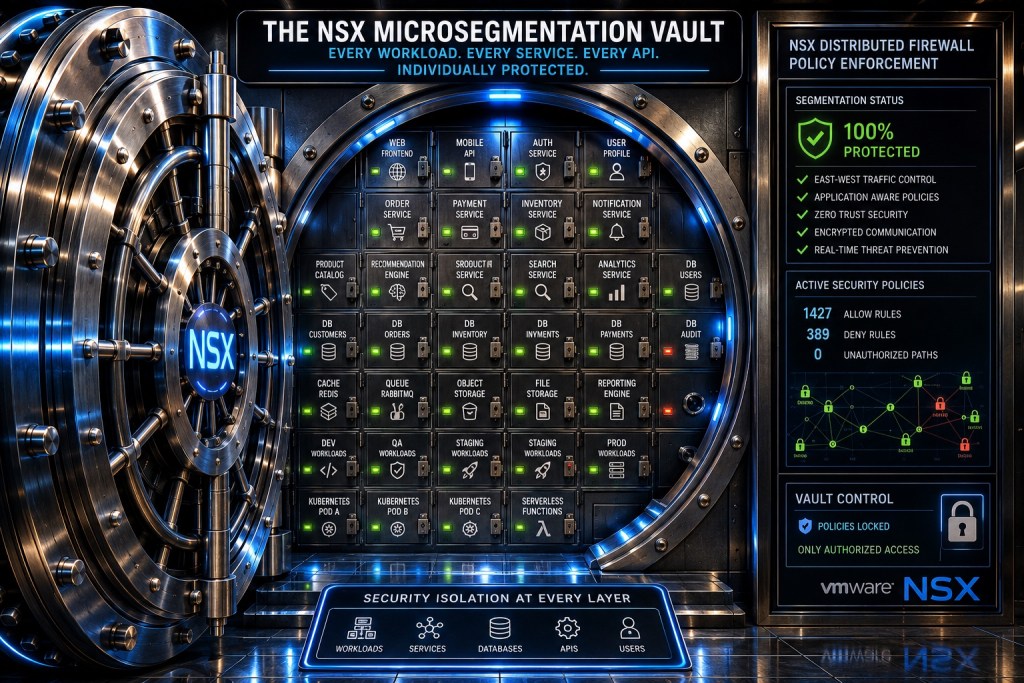
The vault image presents a useful mental model for NSX microsegmentation: every workload should occupy a controlled security compartment rather than inheriting trust from a shared network segment. NSX Distributed Firewall can provide distributed enforcement close to protected workloads, but the real outcome depends on accurate application discovery, reliable groups and tags, narrowly scoped policy, staged enforcement, and disciplined day-2 operations.
The image is also intentionally aspirational. Network microsegmentation does not automatically authorize every API transaction, encrypt every connection, eliminate vulnerabilities, or prove that an environment is “100% protected.” A defensible architecture combines distributed firewall policy with identity, application-layer authorization, encryption, observability, endpoint controls, governance, and tested recovery procedures.
Introduction
Traditional network security was designed around a simple assumption: place important systems inside a trusted network, protect the entrances, and inspect traffic crossing major boundaries. That model becomes increasingly fragile when applications are distributed across hundreds of virtual machines, databases, services, Kubernetes components, development environments, and shared infrastructure platforms.
Most modern application communication also happens east-west. Web servers call APIs. APIs query databases. authentication services communicate with directory systems. Monitoring platforms collect telemetry from nearly everything. Backup systems reach protected workloads. Developers use automation that crosses several infrastructure and application boundaries.
The result is a security problem that cannot be solved by adding another large firewall at the perimeter.
The supplied image reframes the problem as a vault. Instead of protecting one large room, the vault contains individually secured compartments for workloads, services, databases, APIs, and users. The NSX Distributed Firewall becomes the enforcement fabric that determines which compartments may communicate, which services they may use, and which paths must remain closed.
That is the right mental model. The implementation, however, requires considerably more discipline than placing green status lights beside every workload.
The castle model creates a large trusted interior. Once an attacker, compromised workload, or misconfigured service enters that interior, the environment frequently offers more reachability than the application actually requires.
The vault model starts from a different assumption. Access to one compartment does not grant access to the others. Each workload is treated as a separately protected resource, and every communication path must have an explainable purpose.
A payment service may need to reach the payment database, but it should not automatically reach the customer-profile database. A web server may need to call an application API, but it probably does not require direct database access. A quality-assurance workload should not reach production simply because both environments use the same virtualization platform.
This changes the fundamental design question.
The perimeter question is:
Which networks are allowed to communicate?
The microsegmentation question is:
Which application component is allowed to use which service on which destination, under which conditions, and who owns that decision?
The second question is harder to answer. It is also far more useful during a security incident.
Where the Image Is Accurate and Where It Is Aspirational
The image combines sound architecture concepts with several statements that should be interpreted carefully.
| Image concept | Practical interpretation | Architecture caveat |
|---|---|---|
| Every workload individually protected | Apply narrowly scoped policy to workload groups and application tiers | Coverage depends on supported enforcement points, accurate inventory, policy realization, and workload placement |
| Every service protected | Permit only required service-to-service flows | The organization must understand dependencies, service ports, ownership, and failure behavior |
| Every API protected | Restrict which workloads can reach an API endpoint | Network policy does not replace API authentication, authorization, rate limiting, schema validation, or application security |
| Encrypted communication | Require protected protocols and trusted communication paths | Distributed firewall policy does not automatically encrypt traffic; TLS, mutual TLS, IPsec, or another mechanism is still required |
| Real-time threat prevention | Combine segmentation with telemetry and threat-detection capabilities | Distributed firewalling alone is not equivalent to a complete detection and response platform |
| Policies locked | Protect policy through role-based access, approvals, automation, and audit history | Permanently static policy can become obsolete as applications change |
| 100% protected | Measure policy coverage, unknown flows, exceptions, and validation results | A dashboard percentage cannot prove that policies are correct or that every attack path has been eliminated |
The critical lesson is that microsegmentation is an enforcement architecture, not a security guarantee.
Why East-West Traffic Changes the Security Model
A centralized firewall remains important for north-south traffic, internet access, external services, and major routing boundaries. It becomes less effective when two application components communicate within the same virtualized environment.
Forcing all internal communication through a centralized inspection point can introduce unnecessary routing complexity, traffic hairpinning, scaling pressure, and operational dependencies. It may also leave same-host or same-segment communication insufficiently controlled.
Distributed enforcement changes the traffic path. Policy is placed close to the workload rather than requiring every internal flow to visit a centralized appliance.
| Perimeter-centered control | Distributed microsegmentation |
|---|---|
| Protects major network entrances and exits | Protects individual workloads and application tiers |
| Primarily organized around subnets and zones | Can be organized around workload identity, groups, tags, applications, and environments |
| Internal networks may inherit broad trust | Internal communication requires explicit policy |
| Moving a workload can change its network relationship | Policy can follow logical workload membership when identity attributes remain accurate |
| Same-zone communication may bypass inspection | Policy can be enforced close to the workload |
| A compromise may expose a large network area | A compromise can be contained within a smaller policy boundary |
Microsegmentation does not eliminate the perimeter. It reduces the consequences of relying on the perimeter as the primary internal trust boundary.
NSX Distributed Firewall as the Enforcement Fabric
The most important architectural distinction is the separation between centralized policy management and distributed traffic enforcement.
Administrators define policy intent using workload groups, services, application relationships, environments, and scope. That intent is translated into firewall rules and distributed to the applicable enforcement points.

The diagram shows what the vault image is trying to communicate. There is one policy system, but there are many enforcement locations.
This architecture has several operational advantages:
- Security policy can be expressed independently from the physical traffic path.
- Controls can remain effective when workloads communicate within the same host or logical network.
- Application tiers can be isolated without creating a dedicated physical firewall zone for every tier.
- A workload can inherit policy from logical group membership rather than relying only on a fixed IP address.
- An incident-response team can contain a workload group without redesigning the physical network.
Those advantages are only realized when the objects feeding the policy remain trustworthy.
Groups and tags are often treated as administrative conveniences. In a microsegmented environment, they become security dependencies.
Consider a policy that permits members of the APP-PAYMENTS-WEB-PROD group to reach APP-PAYMENTS-API-PROD. The rule may be technically correct, but its security depends on several questions:
- Who can assign the workload tags?
- Can an application administrator add an unrelated workload to the group?
- Are tags removed when a workload is repurposed?
- Can the same workload accidentally receive development and production classifications?
- Is group membership validated against the configuration management database?
- Are automated provisioning pipelines applying the correct metadata?
- Is there an alert when a protected group becomes empty or unexpectedly grows?
A broad group with weak membership controls is functionally similar to a broad firewall rule.
Dynamic membership reduces manual administration, but it transfers part of the security boundary into inventory accuracy, tagging governance, identity permissions, and automation pipelines.
Build Policy from Application Intent, Not Discovered IP Addresses
Flow discovery is valuable, but observed communication should not automatically become approved communication.
Existing traffic may include troubleshooting sessions, legacy dependencies, malware callbacks, abandoned services, overly broad administrative access, or applications that were never designed with least privilege in mind. Blindly converting every observed flow into an allow rule preserves the weaknesses of the current environment.
Start with application intent.

What matters in this diagram is not the number of components. It is the limited number of approved relationships.
A useful policy record should answer:
| Policy attribute | Required question |
|---|---|
| Source | Which application component initiates the connection? |
| Destination | Which service or component receives it? |
| Service | Which protocol, port, or recognized application is required? |
| Environment | Is the relationship development, test, staging, or production? |
| Scope | Which workloads should receive the rule? |
| Business purpose | Why does the communication exist? |
| Owner | Who confirms that the flow is still required? |
| Logging | What evidence is required for validation and investigations? |
| Expiration | Is the rule permanent, temporary, or tied to a migration? |
| Failure behavior | What business process fails if the rule is unavailable? |
This is what turns firewall configuration into application security architecture.
A Policy Hierarchy That Can Scale
A flat collection of thousands of rules eventually becomes difficult to reason about. A scalable design needs a hierarchy that separates platform-wide guardrails from application-specific policy.
| Policy layer | Purpose | Typical examples | Primary owner |
|---|---|---|---|
| Emergency containment | Rapidly isolate compromised or high-risk resources | Quarantine group, block malicious destination, incident containment | Security operations |
| Shared infrastructure | Permit approved foundational services | DNS, NTP, identity, monitoring, backup, certificate services | Platform and infrastructure teams |
| Environment boundaries | Separate development, test, staging, and production | Deny development-to-production access, restrict shared administration | Platform security |
| Application policy | Permit required application-tier relationships | Web-to-API, API-to-database, service-to-service communication | Application owner with security review |
| Administrative access | Control management and support paths | Jump hosts, automation runners, privileged management | Infrastructure and identity teams |
| Default posture | Deny communication not explicitly authorized | Application or environment default deny | Security architecture |
A global default-deny rule may look attractive, but deploying it before the application model is understood can create a large outage rather than a secure environment.
The safer approach is to establish narrow boundaries, validate them, and expand enforcement as confidence improves.
A Practical Microsegmentation Lifecycle
Microsegmentation is not a single firewall change. It is an operational lifecycle.
| Phase | Main activity | Exit condition |
|---|---|---|
| Discover | Inventory workloads, application owners, dependencies, data classifications, and environments | Every in-scope workload has an accountable owner and an initial application assignment |
| Observe | Collect representative traffic across normal operations, batch jobs, backup windows, maintenance, and failover events | Important flows have been captured across an agreed observation period |
| Model | Translate required communication into application-tier policy intent | Application owners and security reviewers agree on required and prohibited paths |
| Classify | Create governed groups, tags, services, and environment identifiers | Membership logic is testable, controlled, and reconciled with authoritative inventory |
| Stage | Deploy narrowly scoped allow rules with logging and validation | Expected application traffic succeeds and unexpected paths are visible |
| Enforce | Introduce deny controls at the selected application or environment boundary | Enforcement passes functional, performance, recovery, and rollback tests |
| Operate | Review utilization, exceptions, drift, ownership, and application changes | Policy remains aligned with the running environment and change process |
The discovery phase must include more than daytime user activity. Month-end processing, certificate renewal, backup, disaster recovery, patching, monitoring, vulnerability scanning, and support workflows often reveal dependencies that a short capture window will miss.
Use a Policy-Intent Manifest Before Automating NSX
The following YAML is not an NSX API payload. It is an implementation-neutral governance artifact that can be stored in source control, reviewed by application and security teams, and later translated into platform-specific objects.
application: payments
environment: production
business_owner: finance-applications
technical_owner: payments-platform
security_owner: enterprise-security

groups:
  web: APP-PAYMENTS-WEB-PROD
  api: APP-PAYMENTS-API-PROD
  database: APP-PAYMENTS-DB-PROD
  shared_identity: SHARED-IDENTITY-PROD

allowed_flows:
  - source: web
    destination: api
    service: https-8443
    purpose: customer checkout requests

  - source: api
    destination: database
    service: postgresql-5432
    purpose: payment transaction storage

  - source: api
    destination: shared_identity
    service: ldaps-636
    purpose: service identity lookup

default_posture: deny
log_denied_connections: true

exceptions:
  approval_required: true
  maximum_duration_days: 30
  renewal_requires_owner_validation: true

validation:
  functional_test: checkout-transaction
  rollback_owner: network-security
  evidence_retention_days: 90
Before using this pattern, the organization must replace the example owners, group names, service definitions, retention requirements, and validation tests.
Successful implementation means that the manifest can be traced to realized groups and policies, expected application tests pass, denied paths fail as designed, and the rollback procedure has been tested.
The most common failure is automating policy deployment before automating inventory and ownership validation. That merely creates incorrect rules faster.
The Hard Part Is Day-2 Operations
Creating the first microsegmentation policy is often straightforward. Keeping hundreds of policies accurate while applications change is the difficult part.
Rule Ownership
Every application rule should have an accountable owner. “Network team” is not enough because the network team rarely knows whether an internal application dependency is still required.
Application owners should confirm business intent. Security teams should define policy standards and review risk. Platform teams should operate the enforcement system and group automation. Operations teams should monitor realization, health, and unexpected behavior.
Exception Management
Temporary rules have a habit of becoming permanent infrastructure.
Every exception should include:
- a reason
- an approving owner
- an implementation date
- an expiration date
- a narrow source and destination
- a defined service
- a validation plan
- a removal condition
An unrestricted any-to-any rule without an expiration date is not an exception process. It is an unmanaged trust boundary.
Policy Drift
Policy drift can occur even when the firewall configuration has not changed. A workload may receive a new tag, an application may be renamed, a service may move to another tier, or an automation pipeline may begin creating resources with incomplete metadata.
This is why microsegmentation monitoring must compare intended state, configured state, realized state, and observed traffic.
Logging Strategy
Logging every allowed connection can overwhelm operational systems and obscure meaningful events. Logging nothing eliminates valuable evidence.
A balanced approach usually includes:
- logging for new or changed policy during validation
- logging for denied traffic at important boundaries
- targeted logging around privileged or sensitive services
- temporary enhanced logging during incidents
- retention aligned with investigation and compliance requirements
- periodic review of log volume and operational cost
Logging is a design decision, not a checkbox.
Common Failure Modes and Their Controls
| Failure mode | Operational symptom | Recommended control |
|---|---|---|
| Policy is built around static IP addresses | Rules break when workloads move or addresses change | Use governed logical groups where supported and validate membership |
| Tags have no ownership model | Unexpected workloads inherit sensitive access | Restrict tag assignment, audit changes, and reconcile with authoritative inventory |
| Every observed flow is approved | Legacy and unnecessary communication becomes permanent | Require application-owner validation and business justification |
| Default deny is introduced too early | Production outages and emergency rollback | Use limited pilots, staged enforcement, functional testing, and explicit rollback |
| Temporary rules never expire | The environment gradually returns to broad trust | Require expiration, ownership, review, and automated reporting |
| Rule count is treated as success | Thousands of policies exist without proven risk reduction | Measure coverage, unknown paths, exceptions, utilization, and containment outcomes |
| Policy is managed only through the user interface | Changes are difficult to review and reproduce | Use versioned intent, automation, peer review, and auditable deployment workflows |
| Kubernetes or serverless coverage is assumed | Workloads exist outside the intended enforcement boundary | Validate workload type, placement, integration, and enforcement support explicitly |
| Microsegmentation is presented as zero trust | Identity, device, data, and application controls remain incomplete | Treat segmentation as one component of the broader security architecture |
Microsegmentation Is Not the Entire Zero Trust Architecture
Zero trust is frequently reduced to a marketing synonym for segmentation. That is too narrow.
A complete zero trust architecture also depends on:
- strong human and workload identity
- continuous authentication and authorization decisions
- device and workload posture
- least-privilege access
- data classification and protection
- application-layer controls
- secrets and certificate management
- security telemetry
- incident response
- configuration governance
- recovery and continuity
NSX microsegmentation can materially limit lateral movement and reduce reachable attack paths. It cannot determine whether a user is authorized to approve a payment, whether an API request contains malicious data, whether a server has an unpatched vulnerability, or whether stolen credentials were used legitimately.
The vault still needs identity checks, cameras, tamper detection, accurate records, and a recovery plan.
Do Not Assume Every Pod or Function Is Automatically Protected
The image includes virtual machines, Kubernetes pods, and serverless functions inside the same vault. Architecturally, that is the desired policy outcome. Operationally, these workload types may have different enforcement models.
A VM-centric distributed firewall policy should not automatically be assumed to protect:
- every pod-to-pod connection inside a Kubernetes cluster
- traffic handled by a container network interface outside the expected enforcement path
- managed serverless functions running outside the NSX-controlled environment
- service-mesh communication using different identity and policy mechanisms
- workloads attached directly to external cloud-native networking services
For each workload class, confirm:
- where traffic is actually enforced
- which identities the policy can recognize
- whether east-west traffic remains visible
- who owns the policy plane
- how policy is tested
- what happens when the workload moves or scales
“Every workload” is an architecture objective that must be proven platform by platform.
Measure Outcomes Instead of Counting Rules
The image displays hundreds of allow and deny rules. Rule count is an activity metric, not a security outcome.
A mature microsegmentation program should monitor measures such as:
- percentage of in-scope workloads assigned to a known application and owner
- percentage of application flows covered by explicit approved policy
- number of workloads with missing, conflicting, or unauthorized tags
- number and age of temporary exceptions
- number of unused, shadowed, or ownerless rules
- number of unexpected paths found during validation
- time required to model and protect a new application
- time required to isolate a compromised workload
- difference between intended and realized policy
- successful containment during tabletop or technical testing
- application incidents caused by policy changes
- rollback time after a failed deployment
A credible “protected” status is derived from this evidence. It is not created by changing a dashboard indicator to green.
A Decision Path for New Applications
Before enforcing microsegmentation around an application, use a simple readiness test.
The most important decision is sometimes not to enforce yet.
Delaying enforcement while ownership, inventory, and rollback are corrected is more responsible than deploying a default-deny policy that the organization cannot explain or safely operate.
Practical Design Principles
A reliable NSX microsegmentation program should follow several consistent principles.
Protect applications, not arbitrary network ranges. Subnets remain useful network constructs, but application policy should reflect business services and required dependencies.
Make identity attributes governable. Tags, groups, service definitions, and environment classifications require ownership and access control.
Use narrow scope. Apply policy only where it is needed. An unnecessarily broad application scope increases both risk and troubleshooting complexity.
Separate shared services from application flows. DNS, identity, monitoring, backup, and management access should not be hidden inside application-specific rules.
Observe before enforcing. Collect enough traffic to understand normal, maintenance, recovery, and exception behavior.
Require an owner and expiration for exceptions. Temporary access should not silently become part of the permanent architecture.
Automate from reviewed intent. Source-controlled policy intent is more valuable than uncontrolled script execution.
Validate deny behavior. Testing only that the application still works does not prove that prohibited communication has been blocked.
Design for rollback. Every enforcement phase should have a known rollback owner, trigger, procedure, and validation step.
Review continuously. The application, its dependencies, and its owners will change even when the policy does not.
Conclusion
The NSX microsegmentation vault is a powerful way to explain the move from broad network trust to individually controlled application compartments. The Distributed Firewall provides the enforcement foundation, but the value does not come from the number of rules or the appearance of a green security dashboard.
Effective microsegmentation begins with application ownership and communication intent. It depends on trustworthy groups and tags, clear policy hierarchy, representative traffic observation, narrow enforcement scope, tested rollback, exception governance, and continuous validation.
The image’s strongest message is that access to one workload should not unlock the rest of the environment. Its most important limitation is that network segmentation cannot provide every control shown on the vault by itself. API authorization, encryption, identity, endpoint protection, detection, vulnerability management, and recovery remain separate architectural responsibilities.
The objective should not be to claim that every workload is protected. The objective should be to produce evidence that every approved path is explainable, every prohibited path is testable, and a compromised workload cannot freely move through the rest of the application estate.
