

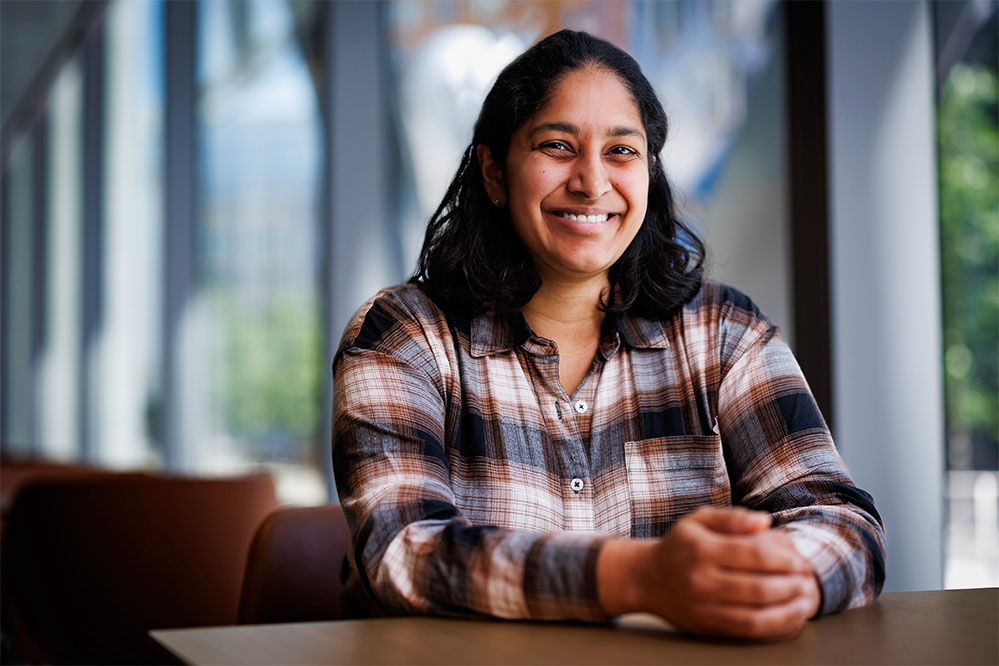


For Priya Donti, childhood trips to India were more than an opportunity to visit extended family. The biennial journeys activated in her a motivation that continues to shape her research and her teaching.
Contrasting her family home in Massachusetts, Donti — now the Silverman Family Career Development Professor in the Department of Electrical Engineering and Computer Science (EECS), a shared position between the MIT Schwarzman College of Computing and EECS, and a principal investigator at the MIT Laboratory for Information and Decision Systems (LIDS) — was struck by the disparities in how people live.
“It was very clear to me the extent to which inequity is a rampant issue around the world,” Donti says. “From a young age, I knew that I definitely wanted to address that issue.”
That motivation was further stoked by a high school biology teacher, who focused his class on climate and sustainability.
“We learned that climate change, this huge, important issue, would exacerbate inequity,” Donti says. “That really stuck with me and put a fire in my belly.”
So, when Donti enrolled at Harvey Mudd College, she thought she would direct her energy toward the study of chemistry or materials science to create next-generation solar panels.
Those plans, however, were jilted. Donti “fell in love” with computer science, and then discovered work by researchers in the United Kingdom who were arguing that artificial intelligence and machine learning would be essential to help integrate renewables into power grids.
“It was the first time I’d seen those two interests brought together,” she says. “I got hooked and have been working on that topic ever since.”
Pursuing a PhD at Carnegie Mellon University, Donti was able to design her degree to include computer science and public policy. In her research, she explored the need for fundamental algorithms and tools that could manage, at scale, power grids relying heavily on renewables.
“I wanted to have a hand in developing those algorithms and tool kits by creating new machine learning techniques grounded in computer science,” she says. “But I wanted to make sure that the way I was doing the work was grounded both in the actual energy systems domain and working with people in that domain” to provide what was actually needed.
While Donti was working on her PhD, she co-founded a nonprofit called Climate Change AI. Her objective, she says, was to help the community of people involved in climate and sustainability — “be they computer scientists, academics, practitioners, or policymakers” — to come together and access resources, connection, and education “to help them along that journey.”
“In the climate space,” she says, “you need experts in particular climate change-related sectors, experts in different technical and social science tool kits, problem owners, affected users, policymakers who know the regulations — all of those — to have on-the-ground scalable impact.”
When Donti came to MIT in September 2023, it was not surprising that she was drawn by its initiatives directing the application of computer science toward society’s biggest problems, especially the current threat to the health of the planet.
“We’re really thinking about where technology has a much longer-horizon impact and how technology, society, and policy all have to work together,” Donti says. “Technology is not just one-and-done and monetizable in the context of a year.”
Her work uses deep learning models to incorporate the physics and hard constraints of electric power systems that employ renewables for better forecasting, optimization, and control.
“Machine learning is already really widely used for things like solar power forecasting, which is a prerequisite to managing and balancing power grids,” she says. “My focus is, how do you improve the algorithms for actually balancing power grids in the face of a range of time-varying renewables?”
Among Donti’s breakthroughs is a promising solution for power grid operators to be able to optimize for cost, taking into account the actual physical realities of the grid, rather than relying on approximations. While the solution is not yet deployed, it appears to work 10 times faster, and far more cheaply, than previous technologies, and has attracted the attention of grid operators.
Another technology she is developing works to provide data that can be used in training machine learning systems for power system optimization. In general, much data related to the systems is private, either because it is proprietary or because of security concerns. Donti and her research group are working to create synthetic data and benchmarks that, Donti says, “can help to expose some of the underlying problems” in making power systems more efficient.
“The question is,” Donti says, “can we bring our datasets to a point such that they are just hard enough to drive progress?”
For her efforts, Donti has been awarded the U.S. Department of Energy Computational Science Graduate Fellowship and the NSF Graduate Research Fellowship. She was recognized as part of MIT Technology Review’s 2021 list of “35 Innovators Under 35” and Vox’s 2023 “Future Perfect 50.”
Next spring, Donti will co-teach a class called AI for Climate Action with Sara Beery, EECS assistant professor, whose focus is AI for biodiversity and ecosystems, and Abigail Bodner, assistant professor in the departments of EECS and Earth, Atmospheric and Planetary Sciences, whose focus is AI for climate and Earth science.
“We’re all super-excited about it,” Donti says.
Coming to MIT, Donti says, “I knew that there would be an ecosystem of people who really cared, not just about success metrics like publications and citation counts, but about the impact of our work on society.”
