

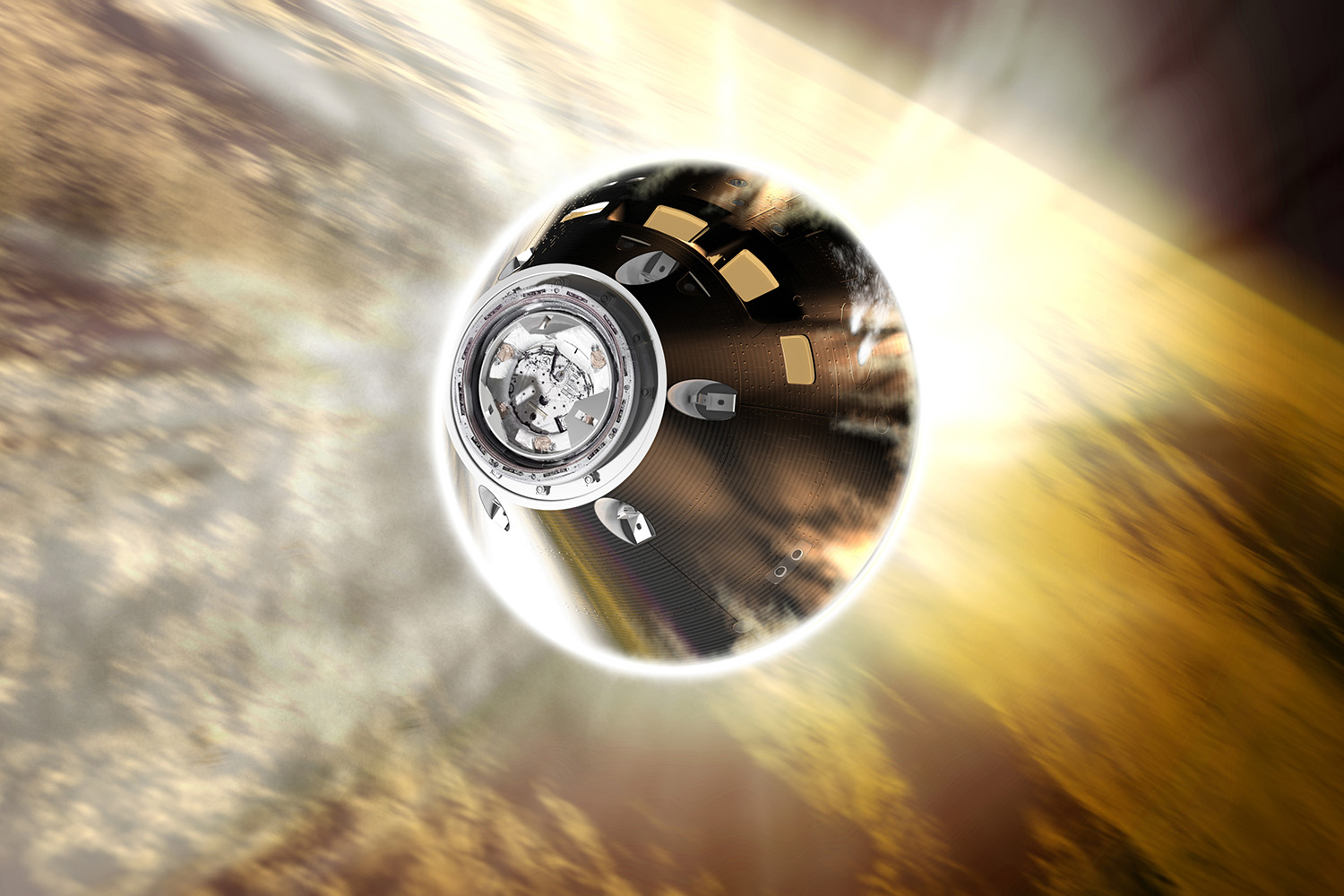


The U.S. Department of Energy’s National Nuclear Security Administration (DOE/NNSA) recently announced that it has selected MIT to establish a new research center dedicated to advancing the predictive simulation of extreme environments, such as those encountered in hypersonic flight and atmospheric re-entry. The center will be part of the fourth phase of NNSA’s Predictive Science Academic Alliance Program (PSAAP-IV), which supports frontier research advancing the predictive capabilities of high-performance computing for open science and engineering applications relevant to national security mission spaces.
The Center for the Exascale Simulation of Coupled High-Enthalpy Fluid–Solid Interactions (CHEFSI) — a joint effort of the MIT Center for Computational Science and Engineering, the MIT Schwarzman College of Computing, and the MIT Institute for Soldier Nanotechnologies (ISN) — plans to harness cutting-edge exascale supercomputers and next-generation algorithms to simulate with unprecedented detail how extremely hot, fast-moving gaseous and solid materials interact. The understanding of these extreme environments — characterized by temperatures of more than 1,500 degrees Celsius and speeds as high as Mach 25 — and their effect on vehicles is central to national security, space exploration, and the development of advanced thermal protection systems.
“CHEFSI will capitalize on MIT’s deep strengths in predictive modeling, high-performance computing, and STEM education to help ensure the United States remains at the forefront of scientific and technological innovation,” says Ian A. Waitz, MIT’s vice president for research. “The center’s particular relevance to national security and advanced technologies exemplifies MIT’s commitment to advancing research with broad societal benefit.”
CHEFSI is one of five new Predictive Simulation Centers announced by the NNSA as part of a program expected to provide up to $17.5 million to each center over five years.
CHEFSI’s research aims to couple detailed simulations of high-enthalpy gas flows with models of the chemical, thermal, and mechanical behavior of solid materials, capturing phenomena such as oxidation, nitridation, ablation, and fracture. Advanced computational models — validated by carefully designed experiments — can address the limitations of flight testing by providing critical insights into material performance and failure.
“By integrating high-fidelity physics models with artificial intelligence-based surrogate models, experimental validation, and state-of-the-art exascale computational tools, CHEFSI will help us understand and predict how thermal protection systems perform under some of the harshest conditions encountered in engineering systems,” says Raúl Radovitzky, the Jerome C. Hunsaker Professor of Aeronautics and Astronautics, associate director of the ISN, and director of CHEFSI. “This knowledge will help in the design of resilient systems for applications ranging from reusable spacecraft to hypersonic vehicles.”
Radovitzky will be joined on the center’s leadership team by Youssef Marzouk, the Breene M. Kerr (1951) Professor of Aeronautics and Astronautics, co-director of the MIT Center for Computational Science and Engineering (CCSE), and recently named the associate dean of the MIT Schwarzman College of Computing; and Nicolas Hadjiconstantinou, the Quentin Berg (1937) Professor of Mechanical Engineering and co-director of CCSE, who will serve as associate directors. The center co-principal investigators include MIT faculty members across the departments of Aeronautics and Astronautics, Electrical Engineering and Computer Science, Materials Science and Engineering, Mathematics, and Mechanical Engineering. Franklin Hadley will lead center operations, with administration and finance under the purview of Joshua Freedman. Hadley and Freedman are both members of the ISN headquarters team.
CHEFSI expects to collaborate extensively with the DoE/NNSA national laboratories — Lawrence Livermore National Laboratory, Los Alamos National Laboratory, and Sandia National Laboratories — and, in doing so, offer graduate students and postdocs immersive research experiences and internships at these facilities.
