
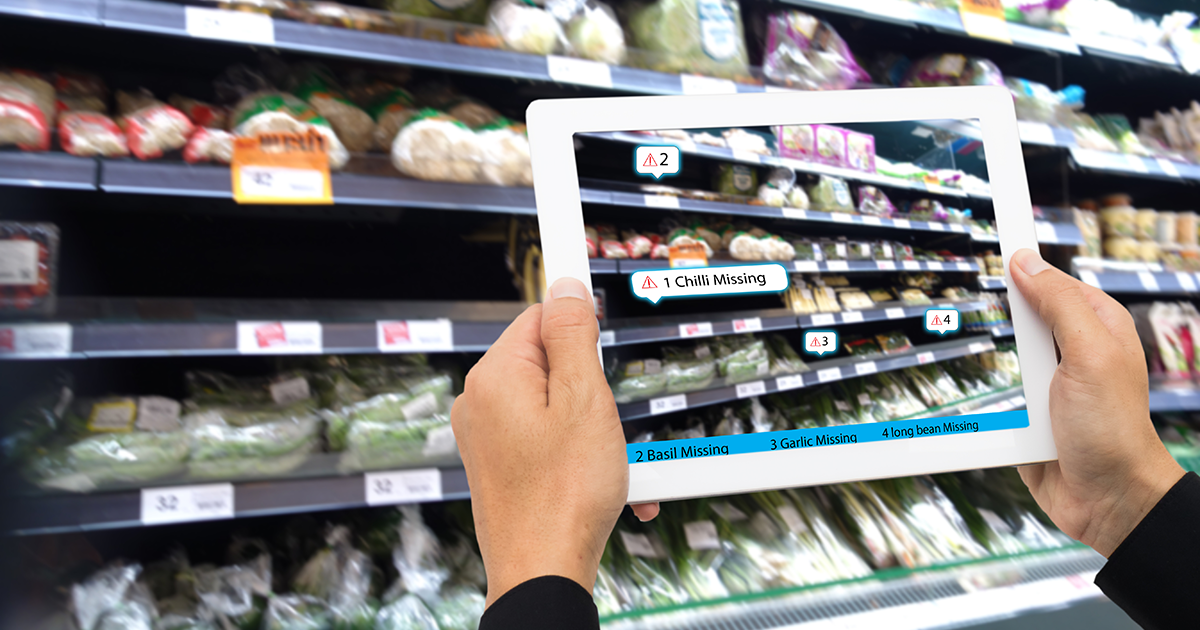

Accurate forecasts are the bedrock of most successful businesses. Forecasts give you a clearer picture of the future, and these pictures allow you to create an effective plan. In retail, for example, an accurate forecast can help you plan how much inventory to stock, how many customer service agents to have on standby, and how to avoid running into a cash flow problem if you spot material cost increases down the line.
But forecasts come in many forms. Today, we’re dealing with demand forecasting, covering what it is, why it’s important, and how it works.
So, let’s start with the main question.
What is demand forecasting?
Demand forecasting relates to any process focused on predicting future customer demand for a given period, using historical sales and other data sources (like the time of day, season, past marketing campaigns, customer preferences, or any relevant information).
Demand forecasting in retail gives stores crucial detail about the sales potential in local and international markets. And it enables managers to make data-driven decisions about pricing, investments, and growth strategies
What if a business chooses to ignore demand forecasting? Managers risk making the wrong decision about which markets to invest in, when to purchase raw materials, or how much of a particular product to stock.
And this type of mistake can have serious implications, including unexpected inventory storage costs, mid-season stock-outs, or, most damaging of all: unhappy customers.
This is where artificial intelligence plays an important role.
According to Gartner, demand forecasting is the most widely used ML application in supply chain planning.
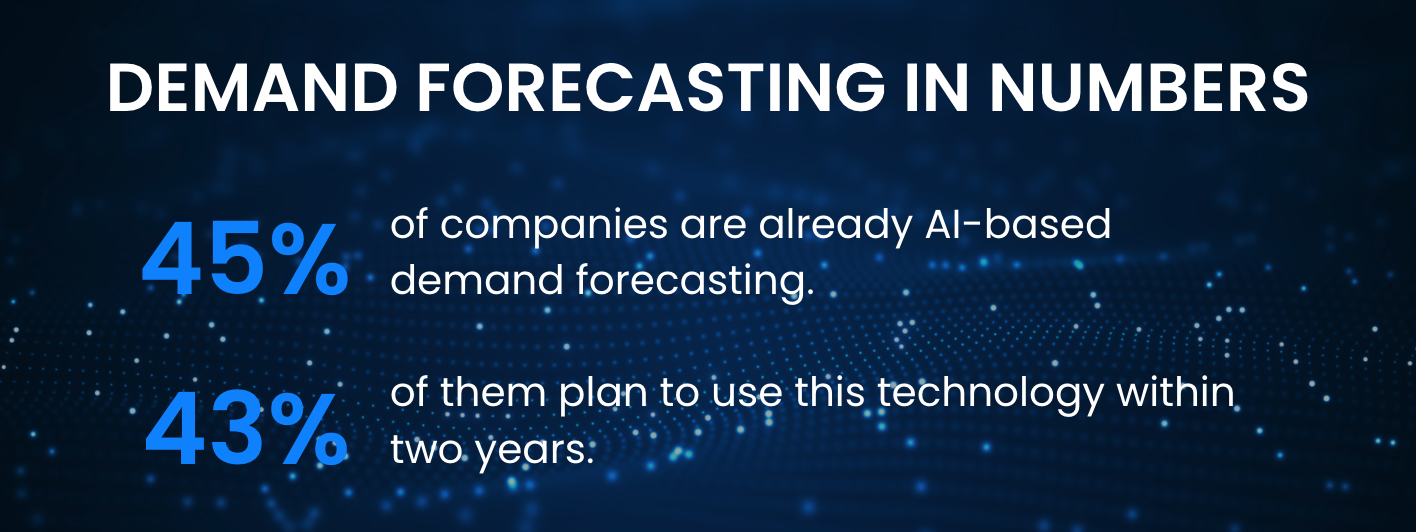
Source: Gartner
AI in retail: why is it important?
Artificial intelligence plays several vital roles in retail, offering more than demand forecasting. Thanks to AI, retailers can now implement effective solutions that improve the customer experience and boost sales.
Some eCommerce stores have even started using artificial intelligence to monitor the shopping experience in real-time. Researchers deploy high-precision cameras above computer screens to track how shoppers browse a website.
The researcher checks if the shopper can easily find the product they’re looking for; if not, the company knows to redesign the shopping experience.
And when it comes to boosting sales, artificial intelligence is just as powerful. Some stores have started pairing product recommendation engines with computer vision-powered virtual mirrors to recommend items a shopper might like.
The virtual mirror looks at what someone is wearing then compares the outfit against the store’s product catalog. When the software finds clothes that match the shopper’s color, shape, or size preferences, it recommends it.
One system, called FindMine, is particularly popular among retailers, with Perry Ellis and John Varvatos already using it to boost sales. The FindMine CEO claims retailers often see a 6% sales uptick when deploying the software in dressing rooms.
6 benefits of accurate AI-powered demand forecasting in retail
Accurate demand forecasting isn’t just important in retail.
It’s crucial — because it helps retailers reduce uncertainty by predicting metrics like the revenue they’ll generate at certain times of the year.
Executives can then use the forecasts to make data-driven decisions that guide the entire business strategy, from procurement to marketing. Better still, accurate demand forecasts often flag impending issues.
And by spotting challenges early on, teams can adjust their approach to either avoid them altogether or, at the very least, mitigate the impact.
Here are six core benefits of accurate demand forecasts in retail:
1. Sales boosts from optimal product availability
The only thing retailers hate more than excess inventory is stocking out. After all, a stock-out translates to lost sales, which means lost revenue. Accurate demand forecasts avoid this outcome as they show shops how much of each product to buy. According to Mckinsey Digital, AI-powered demand forecasting can reduce mistakes by 30 to 50% in supply chain networks. It leads up to a 65% reduction in lost sales due to inventory out-of-stock issues.
2. Better margins and more timely discounts
Forecasts can show when demand is likely to be both low and high, helping retailers know when to offer a discount in order to drum up business. And just as important: when demand is high, retailers can tweak pricing to get the best margin possible.
3. Avoidance of bottlenecks due to unforeseen demand
When demand exceeds a business’s capacity, the operation can quickly run into bottlenecks, whether an inability to fulfill orders or insufficient support staff to help with queries. In spotting demand might spike, a retailer can bring more delivery drivers onboard or add personnel to the checkout tills.
4. Lower operational costs through shift optimization
Just as staff shortages can cause customer happiness to drop: the bottom line will suffer if a business has too many people at work when customer numbers are low. Forecasts help retailers plan optimal shift patterns, meaning they never incur higher costs than necessary.
5. Fresher produce and reduced food spoilage
Supermarkets and grocery stores have a particularly tough time. Fresh produce has a limited shelf-life. According to Refed, food waste costs retailers about $18.2 billion annually. Meaning demand forecasts are crucial to avoid having shelves stacked with rotting fruit and vegetables
6. Costs and carbon footprint reduction
In some ways, this point is an extension of the previous one — but food wastage isn’t the only environmental challenge that retailers face.
No store wants to consume unnecessary resources by producing excess inventory, let alone be forced to throw unsold shorts and T-shirts away as summer comes to an end. By predicting seasonal sales, shops not only order the optimal amount of inventory.
They reduce their carbon footprint and costs. It is confirmed by a study by Mckinsey Digital, which says that demand forecasting using artificial intelligence leads to a reduction in storage costs of around 10 to 40%.
Demand forecasting: how does it work?
Now — let’s take a look at the mechanics of demand forecasting.
Suppose you work for a food manufacturer, and you want to know how much of a given soup to produce this winter. What can you do?
In short, you have two options. On the one hand, you can use a qualitative approach. You can ask a panel of experts to use their experience to offer a prediction — or you can ask each member of your sales team to come up with their best estimate.
Qualitative methods are acceptable, but they’re unlikely to tell you how much soup you’ll actually sell.
On the other hand, you can use a quantitative approach for a more precise prediction:
- The trend projection method works for businesses with at least 18-24 months of trading data. You can use this data to plot a time series of the past, then project future demand assuming trading conditions remain the same.
You can take things one step further by incorporating data sources like web analytics, environment data, historical shipments and known future orders, and competitor pricing, giving you a more flexible forecast that may flag emerging short-term trends.
- The barometric technique is more sophisticated, using statistical analysis and economic indicators to generate a demand forecast.
- The econometric forecasting technique uses a set of complex mathematical equations to establish a relationship between the factors that influence supply and demand, including the time of day and the season.
- The machine learning technique is useful for modeling and predicting complex trends based on features that can be as broad as current and future promotions, even customer preferences.
Now you know what demand forecasting is and how it works, let’s run through what AI demand forecasting looks like in the business world.

Demand forecasting in retail: business example
The example we’ll look at is from a DLabs.AI project.
We worked with a client on demand forecasting and cost optimization for a chain of 8,000 small and medium-sized convenience stores in Poland.
The store management wanted a scalable solution that could cover 100% of products. This was so they could improve the decision-making process across stores and, ultimately, lower costs and reduce food wastage.
The challenge was: management wanted forecasts for product sales at each store during specific time intervals for every day of the week. Why this level of detail? So that each store owner could use the output to plan local stock levels and ensure supply matched demand.
The requirement meant that each product at each store required a separate prediction. To achieve this, we built multiple machine learning models based on the client’s data, using industry best practices.
We started with data loading and preprocessing, fixing optimization issues to allow the model to process years of historical across all 8,000 stores.
The approach ultimate delivered a solution that satisfied all the stakeholders. However, we felt we could still improve it. Several breakthroughs enabled us to fix data quality issues within the dataset.
And we introduced several essential components, including:
- Model tuning
- Custom loss functions
- Experiment tracking
- Model evaluation
- Model explainability
Within these components, we managed to build a fully-automated pipeline that met the validation and monitoring requirements, but then a new challenge came to light.
In maximizing the model’s effectiveness, we used a black-box algorithm: an approach which can lead stakeholders to challenge the output. That’s why we introduced full explainability, which benefited our development team as much as the client.
Our developers could now validate the results, understand patterns, and identify weak spots. At the same time, the business could explain the reasoning behind predictions. And while the original scope was to handle just two products, the solution was fully scalable.
Meaning if the client wanted, they could quickly introduce different product lines at any point in the future.
Could demand forecasting transform your business?
Our close collaboration with the client in Poland ended up with us delivering dedicated workshops for the client’s data science team.
We shared our team’s and general industry best practices in machine learning and software development, which is something the DLabs.AI team loves to do. We’ve worked in a similar way with many companies across all manner of different projects.
So if you’re looking to learn how demand forecasting can transform your business, or you have a solution in mind, feel free to get in touch and let’s walk through how DLabs.AI can help.
