



“Awards!” says Moira Rose in the comedy series Schitt’s Creek when asked about her favourite season. Hard relate! The 26/27 season is set to be a good one. Apple TV, whose contenders include Widow’s Bay and Pluribus, have secured 87 Emmy nominations, Netflix earned 111 nominations for shows like Beef and The Diplomat but stretching out ahead in first place is HBO, who amassed 122 nominations powered by hits like Hacks and Task. While that’s an impressive, and worthy feat for the American network, what does the process of turning those nominations into wins actually look like? Is it even possible?
In some ways, HBO has become a victim of its own success. Their output has become so impressive that they have too much talent to contend with, both above and below the line. This is highlighted by the network’s latest flagship series, The Pitt, which centres on an emergency department at a fictional Pittsburgh hospital. The format of the show, which has different patients in and out of the ward across just a few episodes, means that there’s a slew of guest actors who are delivering career-best performances. Understandably, this leaves HBO with the difficult position of cherry-picking which actors to submit. One such actor is Brittany Allen, whose seven-episode arc as terminal cancer patient Roxie Hamler is arguably the second season’s most endearing storyline. “What drew me to Roxie was the quiet of it — how much she was holding inside a body that had to stay so still.” Allen explains. “All that fear, all that love, all that reckoning with what was coming, and so little room to physically express any of it. She was fighting to be present for the people she loved, for as long as she had left. I felt a responsibility to honor that, to not let the weight of her story overshadow her humanity. She was more than her diagnosis.”
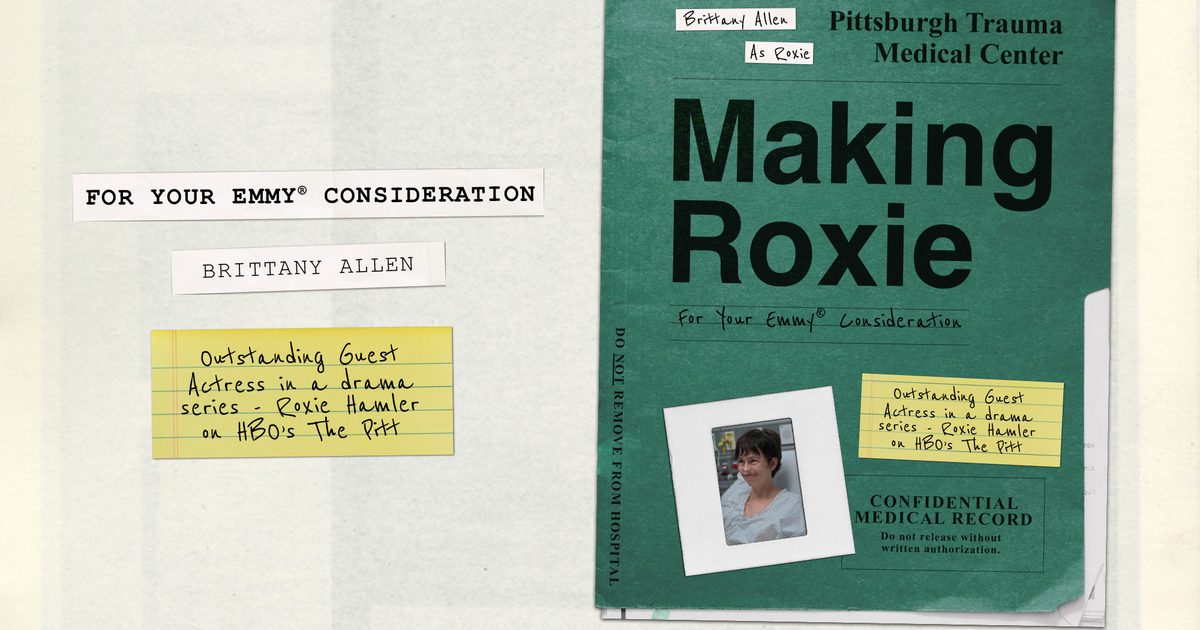
Allen approaches the character with such tenderness and sensitivity, that her internal struggle is palpable as she reckons with the idea of death and the fact she’s leaving behind two young sons and her husband. Certain she’d delivered a performance worthy of recognition, she decided to self-submit and has been nominated for Outstanding Guest Actress in a Drama Series. “I’ve learned that no one is going to advocate for your work harder than you will. Self-submitting wasn’t a strategic move — it was instinct. I knew what that performance took out of me, and I wasn’t going to let it go unseen.” She says.
Deeply moved by her small but perfectly calibrated turn, I reached out to Allen prior to her securing a nomination with the offer of helping on her campaign. Despite initially being unsure if she’d even see the Instagram message, she replied just a few hours later taking me up on my offer. The business of FYC (for-your-consideration) is a complex one. Many viewers watching award shows believe that the gong simply goes to the best performance, but the result is actually the product of months of campaigning, millions of dollars and full teams of people specialising in awards marketing. But what of the underdog? What of those whose performances are worthy, but don’t have the resources or the means to keep their name in the game? The offer of help was an opportunity to rectify that imbalance. “Before this year, I only knew campaigning from the outside — the glossy FYC ads, the events I wasn’t invited to. What I’ve learned is that it’s essentially a full-time job on top of the job of acting, and not every actor has the resources to take that on. It’s less about who gave the best performance, and more about who has the means to make sure people know they gave one. That’s part of why Ryan’s message meant so much — someone offering their skill and time just because they believed in the work.”
It’s not worlds away from your typical general election. Similar to campaigning politicians, the actor needs to be present, say the right things, justify why they should win but in a way that still feels humble and ultimately keeps them likable. They need to be confident, funny, down-to-earth and they need a good story.
