



The human brain remains one of the most fascinating and perplexing mysteries in medicine. Scientists still struggle to match neurological activity with brain function and detect problems early, slowing efforts to treat neurological disorders and other diseases.
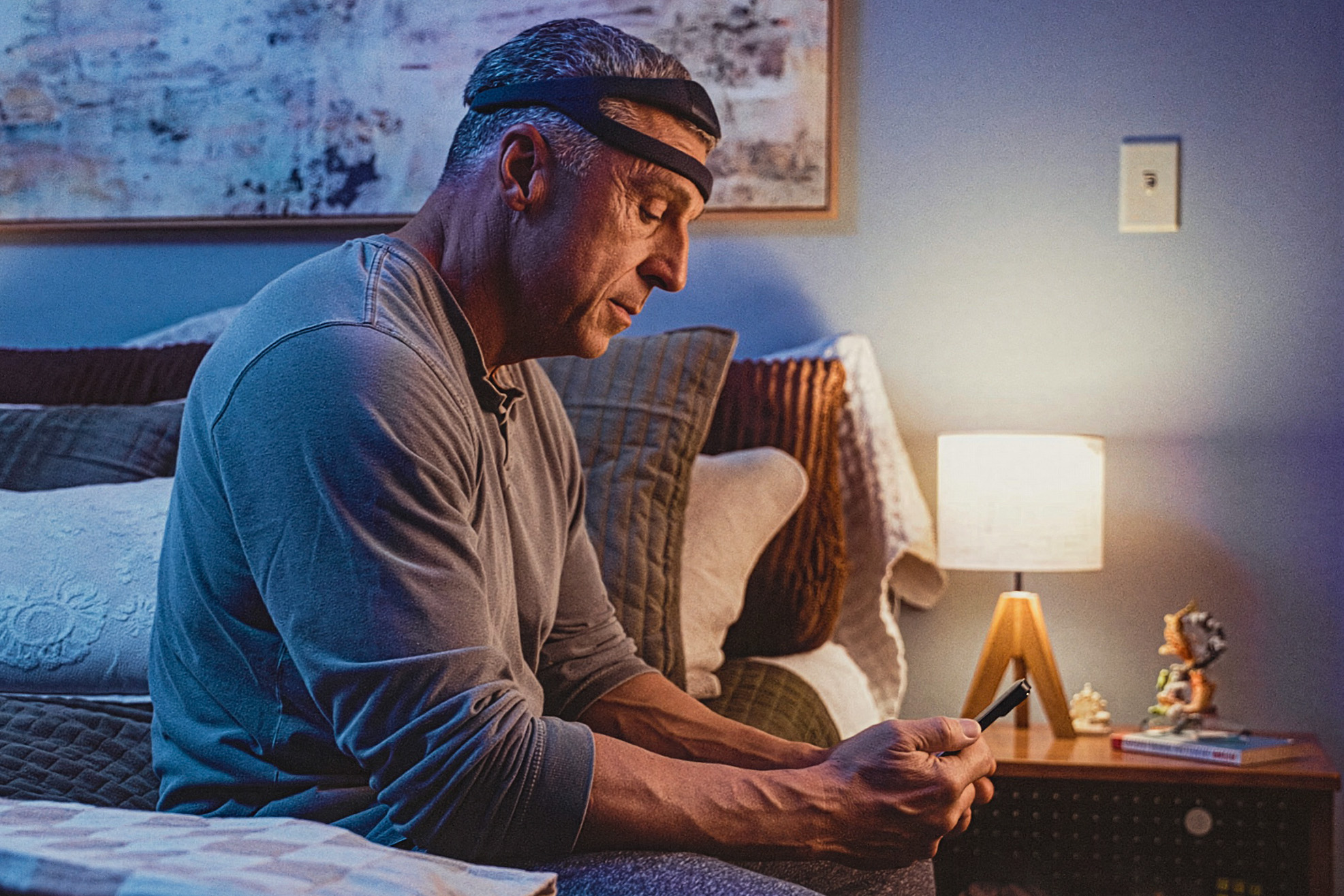
Beacon Biosignals is working to make sense of the brain by monitoring its activity while people sleep. The company, which was founded by Jake Donoghue PhD ’19 and former MIT researcher Jarrett Revels, developed a lightweight headband that uses electroencephalogram (EEG) technology to measure brain activity while people enjoy their normal sleep routines at home. Those data are processed by machine-learning algorithms to monitor the effects of novel treatments, find new signs of disease progression, and create patient cohorts for clinical trials.
“There’s a step-change in what becomes possible when you remove the sleep lab and bring clinical-grade EEG into the home,” says Donoghue, who serves as Beacon’s CEO. “It turns sleep from a constrained, facility-based test into a scalable source of high-quality data for diagnostics, drug development, and longitudinal brain health.”
Beacon partners with pharmaceutical companies to accelerate its path to patients. The company’s FDA 510(k)-cleared medical device has already been used in over 40 clinical trials across the globe as part of studies aimed at treating conditions including major depressive disorder, schizophrenia, narcolepsy, idiopathic hypersomnia, Alzheimer’s disease, and Parkinson’s disease.
With each deployment, Beacon learns more about how the brain works — insights it is using to create a “foundation model” of the brain.
“It’s our belief that the dataset that’s going to transform brain health doesn’t exist yet — but we are rapidly creating it,” Donoghue says. “Our platform can characterize the heterogeneity of disease progression, generating dynamic insights that are impossible to fully capture through static modalities like sequencing or imaging. The brain is an electric organ and changes through synaptic plasticity, so tracking brain function across many diseases at scale will allow us to discover novel subgroups of diseases and map them over time.”
Illuminating the brain
Donoghue trained in the Harvard-MIT Program in Health Sciences and Technology, completing his PhD in neuroscience at MIT under the guidance of professor of cognitive sciences Earl K. Miller, along with clinical training for an MD. While in the program, Donoghue trained at Massachusetts General Hospital and Boston Children’s Hospital, where he helped care for patients, including in oncology, during the rise of genomic sequencing to guide precision cancer therapies. He later worked in neurology and psychiatry, where care often relied on more iterative approaches — highlighting an opportunity to bring similarly data-driven precision to brain health.
“What struck me most was the inability to measure brain function in the ways that cardiologists can longitudinally monitor cardiac function in patients from home,” Donoghue says. “At MIT, I built this conviction that processing a lot of brain data and working to correlate that with brain function would be transformative to how these neurological diseases are identified and treated.”
Toward the end of his training, Donoghue began developing his ideas further, engaging with mentors including HST and Harvard Medical School professors Sydney Cash and Brandon Westover. He had met Revels, who was working as a research software engineer in MIT’s Julia Lab, during his PhD, and convinced him to co-found Beacon with him in 2019.
“We decided building a business to understand the organ of interest — the brain — would be a great start to understanding heterogeneous neuropsychiatric diseases and building better treatments,” Donoghue recalls.
Beacon began as a computation and analytics company building wearable devices to expand clinical impact and reach. From its early days, Beacon has been partnering with large pharmaceutical companies running clinical trials, offering a less invasive way to watch brain activity and learn how their drugs are impacting the brain as well as how patients sleep.
“It was clear sleep was the right window to understand the brain,” Donoghue says. “Neural activity during sleep can be an order of magnitude higher and more structured, almost like a language. It’s a great surface area for understanding brain function and how different drugs affect the brain.”
Donoghue says Beacon’s devices can collect lab-grade data on each patient for multiple sequential nights, resulting in higher quality assessment. The company uses machine learning to extract insights, such as the time patients spend in different sleep stages and the number of small awakenings that occur throughout the night. It can also detect subtle sleep architecture changes that might lead to cognitive decline.
“We’re starting to take features of sleep activity and link them to outcomes in a way that’s never been done with this level of precision,” Donoghue says.
To date, Beacon has taken part in clinical trials for sleep and psychiatric disorders as well as neurodegenerative diseases, where sleep changes can emerge years before the presentation of symptoms.
“We do a lot of work in areas like Alzheimer’s disease and Parkinson’s, which affected my grandfather,” Donoghue says. “We’re analyzing features of rapid-eye-movement and slow-wave sleep to detect early changes that precede clinical symptoms. It’s an opportunity to move these diseases from late recognition to much earlier, data-driven detection.”
Improving brain treatments for millions
Last year, Beacon acquired an at-home sleep apnea testing company that serves more than 100,000 patients each year across the U.S., accelerating access to high-quality, comprehensive testing in the home and expanding the reach of its platform. Then in November, the company raised $97 million to accelerate that expansion.
“The vision has always been to reach patients and help people at scale,” Donoghue says. “What’s powerful is that we’re building a longitudinal record of brain function over time,” Donoghue says. “A patient might come in for sleep apnea screening, but if they develop Parkinson’s years later, that earlier data becomes a window into the disease before symptoms emerged. That turns routine testing into a foundation for entirely new prognostic biomarkers — and a path to detecting and intervening in brain disease earlier, potentially before symptoms ever begin.”
