


# Introduction
Every organization loves to call itself “data-driven.” It’s become the gold standard of credibility, the thing you say to shut down dissent in a meeting. But here’s something worth sitting with for a second: the phrase “according to data analytics” can come from two very different places.
One is genuine curiosity. The other is someone who already knows what they want and went looking for a number to back it up.
And the weird part? Both of those people end up pushing for the same decision, using the same language, sitting on the same side of the table. That coalition is more common than you’d think, and it has a name.
# Bootleggers and Baptists
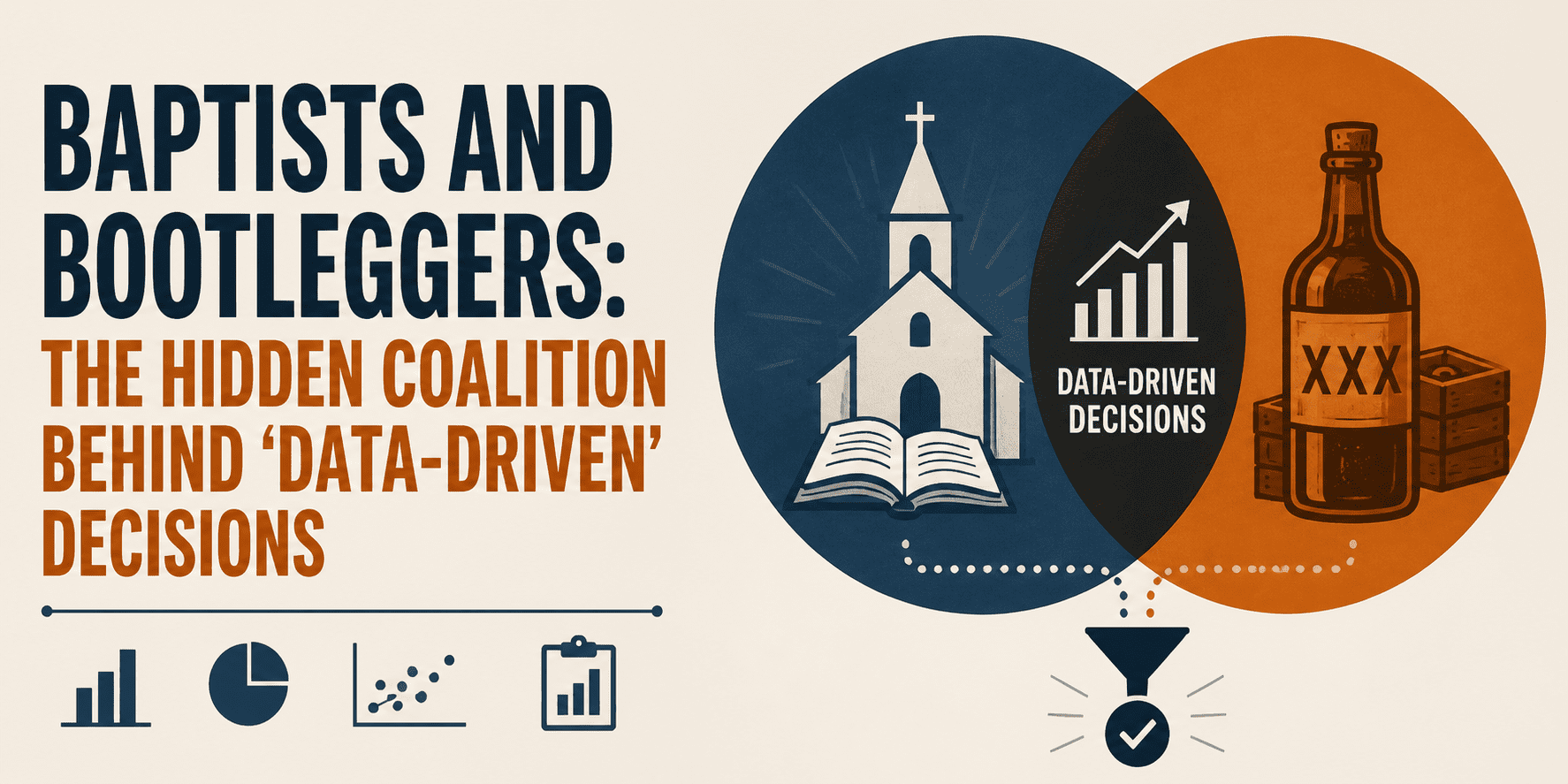
Back in 1983, regulatory economist Bruce Yandle introduced a concept he called “Bootleggers and Baptists.” The idea came from an observation about Sunday alcohol laws in the American South. Baptists pushed for those laws on moral grounds. They believed restricting Sunday liquor sales was the right thing to do. Bootleggers, meanwhile, loved the exact same laws because they eliminated their legal competition for a day.
Both groups wanted the same outcome, but for entirely different reasons. The Baptists provided the moral cover, the public-facing justification that politicians could point to. The bootleggers worked behind the scenes, quietly benefiting from the result. Yandle’s insight was that these unlikely coalitions tend to produce more successful regulatory outcomes than either group could achieve alone.
It’s a powerful framework. And it maps onto the world of data and analytics with uncomfortable precision.
In any data-literate organization, you’ll find people who are genuinely trying to let evidence guide their decisions. These are your Baptists. They want cleaner data pipelines, better dashboards, more rigorous A/B tests. They push for statistical significance not because it serves their agenda, but because they believe better data leads to better outcomes.
These folks are easy to spot. They’re the ones who change their minds when the data contradicts their hypothesis. They’re comfortable saying “I was wrong” or “we need more information before we move.” They treat data as a flashlight in a dark room — something that helps everyone see more clearly, even when what it reveals is inconvenient.
Baptists of data genuinely believe in the principle, no matter how the data is structured. And that belief is exactly what makes them useful to the bootleggers.
Now meet the other side. These are the people who already have a conclusion and reverse-engineer the data story to support it. They’re fluent in the language of evidence. They can cite numbers, reference dashboards, and present findings in polished slide decks. But the analytical process they followed was never really open-ended. The destination was fixed before the journey started.
Bootleggers of data do things like cherry-pick time ranges that support their preferred trend. They’ll choose metrics that flatter their initiative while quietly ignoring the ones that don’t. They’ll lean on correlation when it suits them and wave it away when it doesn’t. And they rarely, if ever, present the data that argues against their position.
Say someone’s pushing for AI-generated ad creative. They’ll pull up the click-through rates from a two-week test and call it a win. What they won’t mention is that bounce rates doubled, time on page dropped, and the campaign’s cost per acquisition actually went up. The AI ads got clicks, sure. But so do misleading thumbnails. The full picture tells a very different story, and that’s exactly why they don’t show the full picture.
The thing that makes them effective is that they sound exactly like the Baptists. Same vocabulary. Same emphasis on “what the data shows.” From the outside, it’s almost impossible to tell the two apart in a meeting.
# Why the Coalition Works So Well
This is where Yandle’s framework really clicks. The Baptists provide legitimacy. When someone with a genuine commitment to evidence-based thinking supports a decision, it lowers the political cost for everyone else to go along. The bootleggers ride that wave, using the Baptist’s credibility as cover for an outcome they wanted all along.
And here’s the kicker: the Baptists often don’t realize they’re part of a coalition. They think the decision was made on merit because, from their vantage point, the data really did point that way. They looked at the numbers in good faith and arrived at a conclusion. The bootlegger just made sure the right numbers were the ones on the table.
# Learning to Tell Them Apart
So what can you actually do? Start by watching what happens when data contradicts someone’s preferred outcome. The Baptists will engage with it. They’ll ask follow-up questions, revisit assumptions, maybe even change direction. The bootleggers will pivot. They’ll reframe the question, shift the metric, or suddenly decide the data “doesn’t capture the full picture.”
Likewise, pay attention to who presents the data versus who selects which data gets presented. There’s a meaningful difference between someone who analyzes all available evidence and someone who curates a subset of it.
You must also ask yourself whether the analytical process was genuinely exploratory or whether the conclusion was circulating before the data was even pulled. You won’t always be able to tell them apart.
The whole point of the coalition is that it’s hard to distinguish between the two. But being aware of the dynamic is already a significant advantage, because most people in most organizations have never even considered that their “data-driven” culture might be running on two very different engines at the same time.
# Final Thoughts
Yandle’s framework was built for regulatory economics, but the pattern it describes is universal. Wherever decisions carry moral or intellectual legitimacy, there will be people who believe in the principle and people who exploit the cover it provides. Data-driven culture is no exception.
The best defense you’ve got is simple: stay curious about who benefits from a decision, not just what the numbers say. Because the numbers can be real, the analysis can be sound, and the whole thing can still be a bootlegger’s dream. Good data practice means asking “why this data?” just as often as you ask “what does this data say?”
Nahla Davies is a software developer and tech writer. Before devoting her work full time to technical writing, she managed—among other intriguing things—to serve as a lead programmer at an Inc. 5,000 experiential branding organization whose clients include Samsung, Time Warner, Netflix, and Sony.
