


AI teams are starting to ship agents like application features.
That sounds normal until the agent has tools, memory, workflow access, delegated permissions, and the ability to take action across business systems. At that point, the agent is no longer just a prompt, a chatbot, or a model endpoint. It is an operational component.
A chatbot can give a bad answer.
An agent can take a bad action.
That distinction is why AgentOps is becoming the Day-2 operations model for enterprise AI. Teams need more than prompt testing and token dashboards. They need the same operational muscle they already apply to production systems: ownership, release control, observability, governance, incident response, and rollback.
Gartner’s recent agentic AI predictions make the timing difficult to ignore. Enterprise applications are moving toward task-specific agents, while governance warnings around autonomy, access scope, and agent sprawl are becoming more direct. The practical lesson is simple: AI agents are scaling faster than most operating models.
If agents are going to participate in production workflows, they need production controls.
What AgentOps Means in Practice
AgentOps is the operating discipline for managing AI agents after the prototype stage.
It is not just LLM monitoring. It is not only prompt evaluation. It is not a dashboard showing latency, token usage, and model errors.
AgentOps covers the full lifecycle of an agent:
- who owns the agent
- what the agent is allowed to do
- which data sources it can use
- which tools it can call
- how changes are tested before release
- how runtime behavior is monitored
- how policy is enforced
- how incidents are detected and handled
- how the agent can be paused, constrained, or rolled back
Traditional applications usually execute deterministic code paths. AI agents interpret goals, retrieve context, make probabilistic decisions, call tools, and sometimes chain multiple steps together. That makes the operational surface wider than application health alone.
An agent can fail because the model output is wrong. It can also fail because the retrieved context is stale, the tool permission is too broad, the approval workflow is weak, the business rule changed, or the agent continues trying to complete a task that should have been escalated to a human.
AgentOps is the control model that makes those failure modes visible and recoverable.
The AgentOps Lifecycle
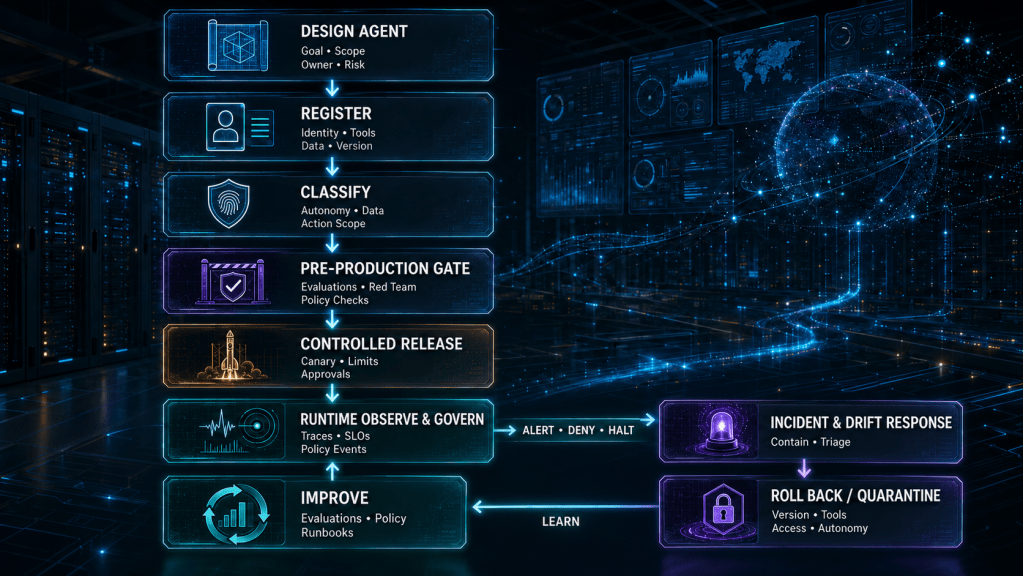
The important thing to notice in the lifecycle below is that AgentOps does not start with monitoring. Monitoring only helps if the agent was already registered, classified, versioned, and deployed with rollback hooks.

This is the Day-2 loop. The goal is not to prevent every mistake. The goal is to make agent behavior observable, governable, recoverable, and improvable.
Why Existing Ops Patterns Are Necessary but Not Enough
AgentOps borrows from several mature disciplines, but it cannot be reduced to any one of them.
| Discipline | What It Already Solves | Where Agents Add New Risk |
|---|---|---|
| AppOps | uptime, latency, errors, deployments, rollback | agent behavior may be wrong even when the service is healthy |
| SRE | SLOs, alerting, incident response, error budgets | agent quality and autonomy need their own service indicators |
| DevOps | CI/CD, release gates, automation, change control | prompts, tools, policies, memory, and eval sets become deployable artifacts |
| MLOps | model lifecycle, training, drift, model metrics | the model may be stable while the agent fails through tools, context, or workflow |
| GRC / Security | access control, audit, compliance, risk ownership | agent autonomy creates new combinations of identity, data access, and action scope |
SRE is especially useful because it forces teams to monitor symptoms that matter to users and operations, not just internal causes. For agents, that means alerting on bad business outcomes, unsafe tool use, abnormal approval bypasses, excessive escalations, or policy violations.
An agent can have normal infrastructure metrics and still be operationally unhealthy.
Start with Agent Inventory and Ownership
The first AgentOps mistake is allowing agents to exist without ownership.
Every production or pilot agent needs a registry entry. That registry should not be a spreadsheet buried in a project folder. It should become part of the AI platform control plane, service catalog, CMDB, or engineering system of record.
At minimum, the registry should track:
| Registry Field | Why It Matters |
|---|---|
| Agent ID | Gives the agent a durable operational identity |
| Business owner | Defines accountability for business outcomes |
| Technical owner | Defines accountability for runtime behavior |
| Autonomy level | Determines governance depth |
| Data domains | Shows what information the agent can access |
| Tool permissions | Shows what systems the agent can affect |
| Deployment version | Enables rollback and audit |
| Runtime environment | Separates dev, test, pilot, and production |
| Human approval model | Clarifies where judgment enters the workflow |
| Incident contact | Connects the agent to an escalation path |
Without inventory, agent sprawl becomes invisible. Without ownership, incidents become arguments. Without versioning, rollback becomes guesswork.
AgentOps starts by making the agent real enough to operate.
Classify Agents by Autonomy and Action Scope
Not every AI agent needs the same governance model.
A read-only summarization agent does not need the same controls as an agent that can open tickets, modify configurations, issue refunds, send customer communications, or trigger financial workflows. The risk is not just whether the system uses an LLM. The risk is what the agent can access, decide, and change.
A practical autonomy model looks like this:
| Autonomy Level | Example | Minimum Controls |
|---|---|---|
| Observe | Summarize documents, retrieve knowledge, explain code | scoped read access, user authentication, usage logging, output testing |
| Advise | Draft an email, recommend a change, propose a root cause | Level 1 controls plus quality evaluation, reliance guidance, review path |
| Act with Approval | Create a ticket, draft a configuration change, prepare a customer response | explicit approval, audit trail, policy enforcement, approval fatigue controls |
| Act Autonomously | Execute workflow steps within guardrails | continuous monitoring, circuit breakers, rollback, strong ownership, runtime policy |
The governance decision should follow the agent’s authority.
That means two things. First, simple agents should not be buried under controls designed for high-risk autonomous workflows. Second, high-risk agents should not inherit trust just because the demo worked.
Proportional governance is the difference between useful control and governance theater.
A standard application dashboard can tell you whether the agent service is online. It cannot tell you whether the agent made a safe decision.
AgentOps observability needs traditional telemetry and agent-specific signals.
Useful telemetry includes:
| Signal | What to Capture |
|---|---|
| Task trace | user request, agent plan summary, policy decisions, tool calls, final outcome |
| Tool telemetry | tool invoked, parameter class, success/failure, latency, denied actions |
| Policy events | allowed, denied, escalated, circuit breaker triggered |
| Human approval | approver role, approval time, rejected action, override reason |
| Retrieval quality | data source, document age, confidence, missing context |
| Outcome quality | completed, escalated, reversed, corrected, customer-impacting |
| Cost and capacity | model calls, token usage, retry loops, tool-call volume |
| Safety and security | prompt injection attempts, sensitive data exposure, excessive agency indicators |
The goal is not to log everything forever. Over-logging prompts, retrieved documents, or tool payloads can create privacy and security problems.

If the trace cannot answer those questions, the agent is not production-ready.
Define Agent SLOs Before the First Incident
Agents need service-level indicators, but they should not be limited to uptime.
An agent can be available, fast, and cheap while still creating bad outcomes. A support agent that answers every ticket quickly but escalates the wrong customers is not healthy. A remediation agent that executes every workflow successfully but changes the wrong objects is not reliable.
Agent SLOs should combine platform reliability and outcome quality.
| SLI | Description | Why It Matters |
|---|---|---|
| Successful task completion rate | percent of tasks completed without human correction | shows whether the agent actually works |
| Human override rate | percent of outputs rejected or changed by reviewers | reveals quality or trust problems |
| Unsafe action denial rate | number of policy-denied actions per task volume | shows pressure against guardrails |
| Escalation accuracy | percent of escalations that were appropriate | prevents both over-escalation and risky autonomy |
| Tool error rate | failed or retried tool calls per workflow | catches integration and permission failures |
| Stale context rate | retrievals from outdated or unapproved sources | catches knowledge drift |
| Cost per successful outcome | spend tied to useful task completion | prevents token dashboards from hiding poor ROI |
| Rollback readiness | percent of agents with tested rollback plans | measures operational maturity |
The most useful AgentOps dashboards are not just model dashboards. They connect agent behavior to operational outcomes.
Governance Has to Move into Runtime
AI governance often starts with a policy document, intake form, or steering committee. Those are necessary, but they are not enough for production agents.
Agents need governance that is enforced at runtime.
NIST’s AI Risk Management Framework is useful here because it organizes AI risk around Govern, Map, Measure, and Manage. That maps cleanly to AgentOps:
| NIST AI RMF Function | AgentOps Translation |
|---|---|
| Govern | ownership, policy, accountability, approval model |
| Map | agent inventory, data access, tools, business process, risk classification |
| Measure | evals, telemetry, SLOs, red-team tests, drift indicators |
| Manage | runtime guardrails, incident response, rollback, remediation |
The important word is continuous.
Agent risk is not fixed at release time. It changes when the workflow changes, when data changes, when a tool API changes, when the model changes, when users learn how to manipulate the agent, or when the agent is reused for a slightly different task.
Runtime governance should be able to allow, deny, escalate, pause, or downgrade agent behavior.
A policy that cannot affect runtime behavior is documentation, not control.
A Practical AgentOps Policy Envelope
The following YAML is not tied to a specific platform. It shows the kind of operating envelope a production agent should have before it is trusted in a business workflow.
agent:
  id: finance-close-variance-agent
  version: 2026.07.02
  owner:
    business: finance-operations
    technical: ai-platform-team
  business_process: month-end-close-variance-review
  autonomy_level: act_with_approval
  production_state: pilot

scope:
  allowed_tasks:
    - summarize_variance_drivers
    - draft_close_commentary
    - recommend_follow_up_questions
  prohibited_tasks:
    - post_journal_entries
    - approve_adjustments
    - modify_vendor_records
    - send_external_communications

data_access:
  allowed_sources:
    - general_ledger_readonly
    - cost_center_mapping_readonly
    - approved_close_calendar
  prohibited_sources:
    - payroll_detail
    - customer_pii
    - unapproved_file_uploads
  retrieval_requirements:
    max_document_age_days: 90
    require_source_citation: true

tools:
  deny_by_default: true
  allowlist:
    - name: query_gl_summary
      mode: read_only
    - name: draft_commentary
      mode: draft_only
    - name: create_review_task
      mode: write_with_approval

approvals:
  required_for:
    - create_review_task
    - attach_commentary_to_close_package
  approver_roles:
    - finance_manager
    - close_process_owner
  approval_timeout_minutes: 60
  on_timeout: escalate_to_human_queue

runtime_controls:
  policy_enforcement: required
  prompt_injection_detection: enabled
  sensitive_data_filtering: enabled
  max_tool_calls_per_task: 8
  max_retry_attempts: 2
  circuit_breakers:
    - condition: policy_denials_per_100_tasks > 5
      action: require_human_approval_for_all_tasks
    - condition: tool_error_rate_percent > 10
      action: pause_agent
    - condition: estimated_cost_per_task_usd > 2.00
      action: stop_task_and_alert

telemetry:
  traces: required
  tool_call_audit: required
  policy_decision_log: required
  approval_log: required
  retained_prompt_payload: restricted
  retained_business_output: approved_only
The important part is not the YAML syntax. The important part is that ownership, scope, data access, tools, approvals, runtime controls, and telemetry are explicit.
If those things are not defined, the agent is being operated on trust.
Minimum Viable AgentOps Controls
Not every team needs a full AgentOps platform on day one. But every production agent needs a minimum baseline.
| Control | Why It Matters |
|---|---|
| Agent registry | prevents invisible agent sprawl |
| Named owners | makes accountability explicit |
| Autonomy classification | determines governance depth |
| Versioned release package | enables change review and rollback |
| Tool allowlist | limits excessive agency |
| Scoped identity | prevents broad inherited permissions |
| Pre-production evals | catches known failure modes before release |
| Runtime telemetry | supports detection and triage |
| Policy enforcement | moves governance from document to control |
| Kill switch | enables immediate containment |
| Rollback plan | turns incidents into recoverable events |
| Post-incident eval updates | prevents recurrence |
This baseline is intentionally operational. It does not depend on one cloud provider, one model, one agent framework, or one observability platform.
The same pattern applies whether the agent is embedded in a SaaS platform, built with an internal orchestration framework, or exposed through a custom enterprise application.
Implementation Path: From Prototype to Managed Agent
A practical AgentOps rollout should happen in phases.
Phase 1: Inventory the Agents You Already Have
Start by finding assistants, agents, LLM-driven workflows, SaaS agents, internal prototypes, automation scripts using model calls, and shadow experiments.
Classify each one by:
- business process
- owner
- autonomy level
- data access
- tool access
- production state
- user population
- incident impact
The first deliverable is a living agent inventory.
Phase 2: Put Release Gates Around Agent Changes
Agents should not move to production because a demo worked.
Release gates should validate:
- prompt changes
- tool schema changes
- model or gateway changes
- permission changes
- retrieval source changes
- policy changes
- approval workflow changes
- evaluation results
- rollback readiness
Treat prompts, policies, tools, and retrieval configuration as deployable artifacts. If they can change behavior, they belong in the change process.
Phase 3: Normalize Telemetry
Do not wait for a major incident to decide what should have been logged.
Standardize the trace shape for agent tasks:
- task ID
- user or calling system
- agent version
- model route
- retrieval sources
- policy decisions
- tool calls
- approval events
- final outcome
- rollback correlation ID
This makes agent incidents diagnosable instead of anecdotal.
Phase 4: Add Runtime Guardrails
Guardrails should not only check content. They should control action.
Useful guardrails include:
- tool allowlists
- data-domain restrictions
- approval requirements
- prompt-injection detection
- sensitive-data filters
- retry limits
- cost limits
- escalation thresholds
- autonomy downgrade rules
A guardrail that only produces a report after the damage is done is not enough. Production agents need guardrails that can deny, pause, route, or escalate.
Phase 5: Practice Rollback
Rollback that has never been tested is a theory.
Run rollback drills for:
- bad prompt release
- stale retrieval source
- unsafe tool behavior
- approval workflow failure
- model quality regression
- cost runaway
- suspected prompt injection
- downstream system write error
Each drill should update the runbook, evaluation set, and policy bundle.
The Real Shift: From AI Projects to AI Operations
The organizations that succeed with agents will not be the ones with the most demos. They will be the ones that can operate agents safely after the demo.
AgentOps gives architects a control model.
It gives engineers a release and observability pattern.
It gives security and risk teams enforceable guardrails.
It gives operations teams a runbook path.
It gives leaders a way to scale agent adoption without pretending every agent has the same risk profile.
The practical next step is simple: take one production or near-production agent and build its Day-2 file.
Document its owner, autonomy level, tools, data, SLOs, telemetry, policy controls, incident path, and rollback plan. Then use that as the template for the next agent.
That is how AgentOps becomes real: not as another AI buzzword, but as the operating discipline that keeps agents useful, governed, and recoverable.
