



TL;DR
An AI gateway is only useful in production when it has an operating model around it. The gateway can route model calls, enforce token limits, apply policy, collect telemetry, and control tool access, but those controls do not define themselves.
The practical work is deciding who owns routes, who approves model and tool access, how user and agent identity is preserved, what telemetry is captured, how token spend is governed, and how gateway policies move safely from development to production.
This second article in the AI gateway series focuses on the operating model. Article One explained why the gateway is becoming the enterprise AI control point. This article explains how to make that control point usable, governable, observable, and safe enough for production adoption.
Introduction
The first mistake many teams make with AI gateways is treating them like a technical insertion point only. Put the gateway between the application and the model, point traffic through it, and assume governance has improved.
That is not enough.
A gateway without ownership becomes a bottleneck. A gateway without identity becomes a shared API key with better logging. A gateway without route-level policy becomes a pass-through proxy. A gateway without observability becomes another blind spot. A gateway without cost controls becomes a faster way to spread token spend across the business.
The enterprise value of an AI gateway is not the box in the architecture diagram. The value is the operating model around that box.
The Gateway Needs Product Ownership
The AI gateway should be treated as a platform product, not a sidecar owned by whichever team installed it first. It sits between application teams, AI teams, security teams, infrastructure teams, finance teams, and governance stakeholders. That makes ownership more important, not less.
A mature AI gateway program needs clear answers to practical questions:
- Who can onboard a new application?
- Who can create or modify a model route?
- Who approves access to high-cost models?
- Who approves access to enterprise tools?
- Who owns gateway availability?
- Who owns policy exceptions?
- Who reviews logs, token spend, and abnormal usage?
- Who handles incidents when a policy breaks a production workflow?
If those questions do not have owners, the gateway becomes fragile. Teams will either bypass it because it slows them down, or overload it because every decision depends on a small group of people.
The better pattern is to separate platform ownership from policy ownership. The platform team runs the gateway. Security and governance define control requirements. Application teams own their routes and business logic. Finance owns cost accountability. The AI platform or architecture team owns the model strategy and evaluation standards.
The AI Gateway Operating Loop
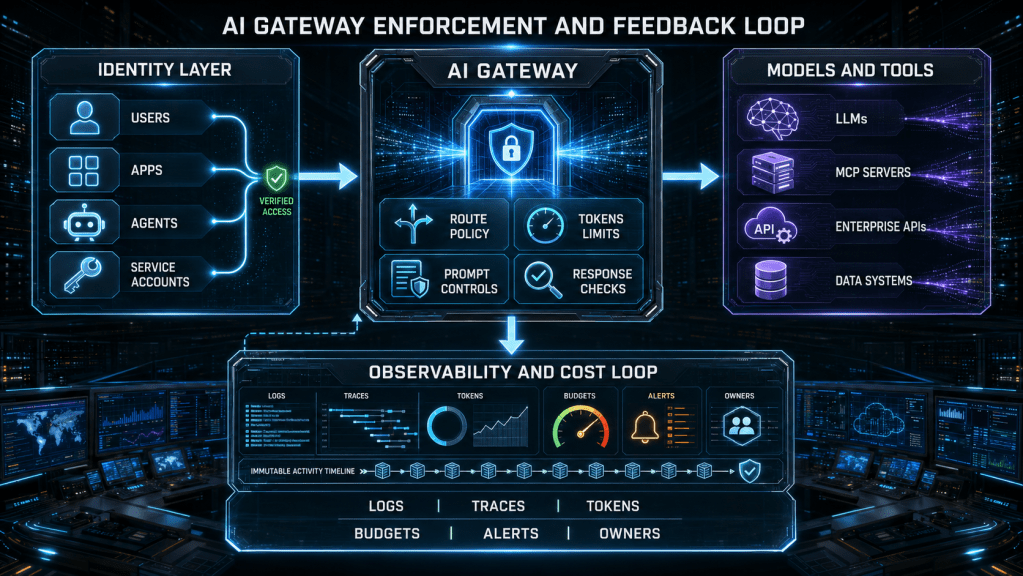
An AI gateway operating model should work like a loop. Identity informs policy. Policy controls traffic. Traffic produces telemetry. Telemetry informs cost, risk, performance, and route changes. Changes go back through a controlled release path.

The important thing to notice is that the gateway is not the end of the process. The gateway is where the process becomes enforceable. The operating loop is what makes the control point sustainable.
Identity Is the First Production Boundary
Identity should be designed before model routing, prompt controls, or cost reporting. Without identity, the organization cannot answer basic operational questions about who used what, which application generated the request, which agent called a tool, or which business owner should be charged for usage.
Human, Application, and Agent Identity
Enterprise AI traffic usually involves more than one identity. A user may trigger a workflow from a portal. The portal may call an internal AI service. The AI service may call the gateway. The gateway may route to a model and allow the agent to call a tool.
That chain can easily collapse into one shared credential if the architecture is rushed. That is operationally convenient and dangerous.
A stronger design preserves useful identity context across the flow:
- the human user or group
- the application or service making the request
- the agent or workflow identity
- the environment, such as development, test, or production
- the tenant, business unit, or cost center
- the route or use case being invoked
This does not mean every downstream provider needs every identity attribute. It means the gateway and observability layer should retain enough context to enforce policy and support audit, troubleshooting, and cost accountability.
Inbound and Outbound Authorization
AI gateways that handle agent and tool access need two authorization directions.
Inbound authorization validates who is allowed to call the gateway or target route. Outbound authorization governs what the gateway, agent, or tool connector is allowed to call next.
That distinction matters because agentic systems often cross boundaries. A support assistant may be allowed to summarize a ticket but not update the customer record. A developer assistant may read repository metadata but not create pull requests without approval. A network operations agent may diagnose a routing issue but not change production firewall policy automatically.
The gateway operating model should separate read, write, administrative, and privileged tool access. It should also define when user-delegated access is required versus when a machine identity is acceptable.
Policy Has to Be Route Specific
Generic AI policy is useful for governance conversations, but production enforcement needs route-level policy. A route is the practical unit where model choice, token limits, tool permissions, retention rules, fallback behavior, and ownership come together.
A route should describe what the workload is allowed to do, not only where traffic should go.
Route Policy Dimensions
A practical AI gateway route policy should include:
| Policy Area | Example Decision |
|---|---|
| Consumer access | Which apps, users, agents, tenants, or environments may call this route |
| Model access | Which model or deployment is allowed for this workload |
| Tool access | Which tools are allowed, blocked, or approval gated |
| Token controls | Maximum input tokens, output tokens, tokens per minute, and quota period |
| Data controls | Redaction, retention, classification, and logging rules |
| Prompt controls | Required system prompt template, blocked patterns, or policy guardrails |
| Response controls | Content safety checks, schema validation, or response filtering |
| Resilience controls | Timeout, retry, fallback, and degraded-mode behavior |
| Ownership | Business owner, technical owner, security reviewer, and escalation path |
The policy should be concrete enough that an engineer can implement it and an auditor can understand it.
A Practical AI Gateway Policy Example
The following YAML is a conceptual route policy. It is not intended to match one specific vendor syntax. The point is to show the operating model that should exist behind the gateway configuration.
ai_gateway_route:
  name: operations-ticket-assistant
  purpose: summarize_and_classify_operations_tickets
  environment: production

  owners:
    business_owner: infrastructure_operations
    technical_owner: ai_platform_team
    security_reviewer: cyber_governance
    cost_owner: infrastructure_operations

  consumers:
    allowed_applications:
      - service-desk-portal
      - operations-copilot
    allowed_agent_identities:
      - ops-ticket-assistant-prod
    require_user_context: true
    block_shared_api_keys: true

  model_policy:
    primary_model: approved-general-reasoning-model
    fallback_model: approved-fast-summary-model
    fallback_allowed: true
    fallback_requires_quality_warning: true

  token_policy:
    max_input_tokens: 12000
    max_output_tokens: 1200
    tokens_per_minute_limit: 250000
    monthly_token_quota: 50000000
    alert_threshold_percent: 75
    hard_stop_threshold_percent: 100

  tool_policy:
    allowed_tools:
      - ticket_read
      - knowledge_search
    blocked_tools:
      - ticket_update
      - user_directory_write
      - change_request_create
    approval_required_tools: []

  data_policy:
    prompt_body_retention: disabled
    response_body_retention: disabled
    retain_redacted_metadata: true
    redact_patterns:
      - payment_card
      - employee_ssn
      - api_secret
      - private_key

  response_policy:
    require_json_schema: true
    block_unclassified_sensitive_output: true
    require_citation_metadata: true

  observability:
    emit_metrics:
      - request_count
      - input_tokens
      - output_tokens
      - model_latency
      - fallback_count
      - policy_block_count
      - estimated_cost
    emit_traces: true
    emit_audit_events: true

  change_control:
    promotion_path:
      - development
      - test
      - production
    rollback_policy: restore_previous_route_version
    emergency_disable_supported: true
The operational value is in the decisions this policy forces. It makes the route owner visible. It separates model routing from tool permissions. It limits token exposure. It defines what is logged. It declares rollback behavior. That is the difference between gateway configuration and gateway governance.
Observability Must Explain the AI Transaction
Traditional API observability usually starts with request count, status code, latency, and error rate. AI observability needs those signals, but it also needs AI-specific context.
Operators need to understand how the model interaction behaved, not only whether the HTTP request completed.
Minimum Useful AI Gateway Telemetry
A production AI gateway should capture enough telemetry to answer these questions:
- Which application, user group, agent, route, and environment generated the request?
- Which model or provider handled the request?
- How many input and output tokens were used?
- What was the latency and time to first response when streaming is used?
- Was the request retried, throttled, blocked, cached, or routed to fallback?
- Which policy decision was applied?
- Which tool calls were requested, approved, blocked, or completed?
- What was the estimated cost?
- Which owner should receive the alert or chargeback signal?
This does not mean storing full prompts and responses by default. In many environments, full body logging creates retention and privacy risk. A safer starting point is redacted metadata logging with configurable capture for approved troubleshooting scenarios.
A Practical AI Gateway Event Schema
A simple event schema helps the platform team normalize logs from gateway, model, and tool interactions. This example shows the type of metadata worth collecting.
{
  "event_type": "ai_gateway_request",
  "timestamp": "2026-07-17T14:25:00Z",
  "route": "operations-ticket-assistant",
  "environment": "production",
  "application_id": "service-desk-portal",
  "agent_id": "ops-ticket-assistant-prod",
  "user_context_present": true,
  "business_unit": "infrastructure_operations",
  "model_provider": "approved_provider",
  "model_name": "approved-general-reasoning-model",
  "input_tokens": 8420,
  "output_tokens": 680,
  "estimated_cost_usd": 0.21,
  "latency_ms": 2380,
  "fallback_used": false,
  "cache_hit": false,
  "policy_decision": "allowed",
  "policy_version": "2026.07.17.3",
  "tool_calls_requested": 2,
  "tool_calls_blocked": 0,
  "prompt_body_logged": false,
  "response_body_logged": false,
  "redaction_applied": true,
  "correlation_id": "gw-req-01JZEXAMPLE"
}
The exact fields will vary by platform, but the principle should not. AI gateway telemetry needs to connect technical behavior to business ownership, policy decisions, and cost.
Cost Control Is an Architecture Requirement
AI gateway cost control should not be treated as a finance report generated after the fact. Cost control belongs in the architecture because tokens, retries, tool calls, fallback behavior, context size, and caching strategy all affect spend.
A single application can appear inexpensive during testing and become expensive in production when usage grows, prompts expand, retrieval context increases, or agents begin making multiple tool calls per user request.
Token Limits Are Not Enough
Token limits are a starting point, not a complete cost model. Mature cost control includes:
- token limits per route, application, tenant, or consumer
- budget thresholds with warning and hard-stop behavior
- model routing based on task complexity and quality needs
- semantic caching where repeated requests are common
- prompt compression or context reduction where safe
- fallback rules that consider cost and quality
- showback or chargeback by business owner
- abnormal usage detection
- cost review during route promotion
The goal is not to make every request as cheap as possible. The goal is to match model cost to business value and risk.
A Cost Feedback Loop for AI Gateway Operations
Cost management works best when it is tied to route ownership and telemetry. The gateway should produce signals that owners can act on.
The lesson is that cost optimization is not only a technical tuning task. It is a governance workflow. Someone has to decide whether to reduce context, change models, add caching, split a route, approve more budget, or retire a use case that does not justify its spend.
AI gateway operating models become more serious when agents can call tools. Model access can create cost, privacy, quality, and content risks. Tool access can create operational change.
A tool can read data, update records, trigger workflows, open tickets, change infrastructure, modify code, send messages, or execute business actions. That means tool access must be treated as a privilege boundary.
Tool Governance Patterns
A practical tool governance model should separate:
| Tool Type | Control Pattern |
|---|---|
| Read-only lookup tools | Allow with scoped authorization and logging |
| Sensitive read tools | Require stronger identity, redaction, and audit |
| Low-impact write tools | Allow only for approved routes and owners |
| High-impact write tools | Require approval, change record, or human confirmation |
| Administrative tools | Block by default, expose only through tightly governed workflows |
| Experimental tools | Restrict to non-production environments |
MCP and similar tool protocols make tool integration easier, but ease of integration does not reduce the need for enterprise authorization, tool registration, input validation, output validation, and audit trails.
Ownership Model for AI Gateway Operations
The gateway operating model should define responsibilities clearly enough that incidents do not turn into organizational archaeology.
| Capability | Primary Owner | Supporting Teams | Operational Notes |
|---|---|---|---|
| Gateway platform availability | Platform engineering | Network, cloud, SRE | Own deployment, scaling, upgrades, and uptime |
| Route onboarding | AI platform team | App team, security | Standardize intake, templates, and review gates |
| Model approval | AI architecture or AI governance | Security, legal, data owners | Approve models by use case, risk, and data class |
| Tool approval | Security and system owner | App owner, platform team | Treat tool access as privilege assignment |
| Policy templates | Security governance | AI platform, architecture | Maintain reusable baseline controls |
| Token budgets | Finance or FinOps | Business owner, platform team | Define showback, alerts, and quota behavior |
| Observability | Platform engineering | SRE, security operations | Maintain dashboards, alerts, traces, and audit feeds |
| Incident response | Operations or SRE | Security, app teams, AI platform | Define severity, containment, rollback, and communications |
| Exception handling | Governance board or delegated approver | Business owner, security | Require expiration dates and compensating controls |
The operating model does not need to be bureaucratic. It needs to be explicit. Clear ownership is what lets the gateway scale beyond the first few applications.
Change Control and Rollback
AI gateway policy should be versioned like production configuration. A route change can break an application, increase cost, block legitimate traffic, expose a tool, or change model behavior.
At minimum, production gateway changes should support:
- route policy versioning
- development, test, and production promotion
- approval for sensitive model or tool changes
- automated validation for syntax and required fields
- test traffic replay where possible
- rollback to the previous route version
- emergency disable for unsafe routes
- change records for production-impacting updates
Rollback deserves special attention. If a prompt template, model route, or policy update breaks a production workflow, the team should not be manually reconstructing the previous state. The gateway configuration should be recoverable.
Practical Readiness Checklist
Before treating the AI gateway as production-ready, architects and operators should be able to answer the following:
- Do routes have business and technical owners?
- Is user, application, and agent identity preserved where needed?
- Are shared API keys blocked or tightly limited?
- Are token limits and quota periods defined per route?
- Is model fallback tested for quality, schema behavior, latency, and cost?
- Are tool permissions separated by read, write, privileged, and administrative actions?
- Are prompt and response retention rules documented?
- Are logs redacted by default unless full capture is explicitly approved?
- Are token spend and cost visible by owner?
- Are policy versions promoted through environments?
- Is rollback tested?
- Are incident owners and escalation paths documented?
- Are exceptions time-bound and reviewed?
A gateway that cannot pass this checklist may still be useful for experimentation. It is not yet a durable production control point.
Conclusion
The AI gateway operating model is what turns a technical traffic path into an enterprise control point. The gateway can enforce identity, policy, token controls, routing, tool access, observability, and cost controls, but only when the organization defines the decisions behind those controls.
The most important work is not selecting the flashiest gateway feature. It is building the operating loop: identify the caller, apply route-specific policy, observe the transaction, review risk and cost, control changes, and roll back safely when needed.
AI gateways will become more important as agents gain access to more tools and enterprise systems. The organizations that succeed will not be the ones that simply proxy AI traffic first. They will be the ones that build a repeatable operating model around AI traffic before it becomes unmanageable.
The next article in this series will focus on choosing and implementing the right AI gateway pattern across API management platforms, cloud-native gateways, edge-based gateways, and agent tool gateways.
