



TL;DR
Agentic AI creates an accountability problem before it creates a technology problem. An AI agent can interpret goals, retrieve data, select tools, spend money, initiate workflows, and change business or technical systems. That authority cannot be assigned to an innovation committee, hidden inside a platform team, or treated as a normal software feature.
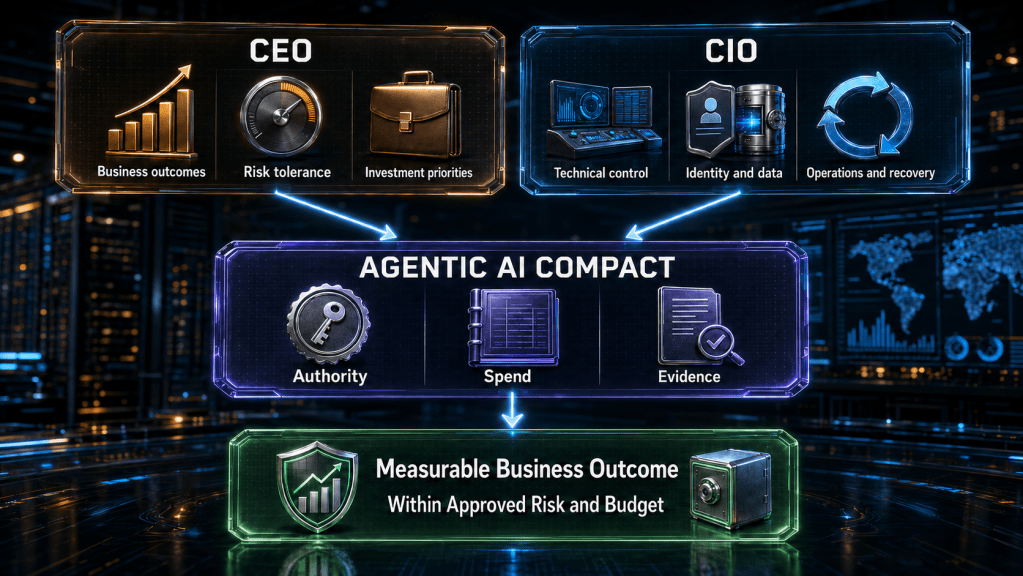
The CEO-CIO compact should establish a dual-key operating model. The CEO owns the business decision to delegate authority, the enterprise risk tolerance, the investment thesis, and the business outcome. The CIO owns the technical system that enforces the authority boundary, protects data, controls identities and tools, provides evidence, operates the service, and can stop or recover it. Neither side should be able to place a high-impact agent into production without the other.
The compact also needs named decision rights for budgets, data access, human approval, incidents, scaling, and decommissioning. AI spend should be measured against business units of value, such as cost per case resolved, cost per qualified action, or cost per hour of cycle time removed, not only tokens, API calls, or GPU hours.
Introduction
Most executive AI conversations begin with capability. What can the agent do? Which model should the enterprise use? How quickly can the workflow move from pilot to production?
The more important questions come next.
Who decided that the agent was allowed to act? Who approved its access to customer, employee, operational, or financial data? Who owns the budget when one business request turns into hundreds of model calls and tool actions? Who is accountable when the technical workflow completes successfully but the business outcome is wrong? Who has the authority to stop the agent during an incident?
Traditional applications execute logic written in code. Agentic systems introduce a model-driven decision layer that can select a path at runtime. The agent may decide which data to retrieve, which tool to call, how many times to retry, when to escalate, and whether the task is complete. The surrounding platform may still be deterministic, but part of the execution path has been delegated to probabilistic software.
That changes the executive operating model.
NIST’s AI Risk Management Framework places responsibility for AI development and deployment risk with executive leadership and calls for clear roles, lines of communication, inventories, oversight, monitoring, incident identification, and deactivation mechanisms. ISO/IEC 42001 frames AI governance as an organization-wide management system, not a collection of disconnected model reviews. FinOps guidance similarly emphasizes cross-functional ownership, cost thresholds, forecasting, and unit economics tied to value.
Those principles are useful, but executives still need a practical division of responsibility. The CEO-CIO compact provides it.
Agentic AI Requires an Executive Compact, Not an AI Committee
An AI steering committee can review policy, coordinate stakeholders, and recommend investments. It should not become the place where accountability disappears.
Committees are useful for consultation. Decision rights still need owners.
Agentic AI crosses several enterprise boundaries at once:
- Business process ownership determines what outcome the agent is expected to produce.
- Technology ownership determines how the agent is built, integrated, observed, changed, and recovered.
- Security ownership determines which identities, tools, and data paths are permitted.
- Finance ownership determines how spend is forecast, attributed, constrained, and compared with value.
- Legal, privacy, compliance, and workforce functions determine which obligations and human impacts must be addressed.
- Operations ownership determines who responds when behavior, cost, performance, or outcomes move outside the approved range.
A governance group can bring those perspectives together. It cannot substitute for a named executive who owns the business consequence and a named executive who owns the technical control system.
The compact should therefore establish two independent questions for every material agentic AI deployment:
- Should the enterprise delegate this class of business authority to an AI-enabled workflow?
- Can the enterprise enforce, observe, operate, and revoke that authority safely?
The CEO owns the first question. The CIO owns the second.
For high-impact uses, both answers must be yes.
The Dual-Key Decision Model
The compact is easiest to understand as a dual-key model. The CEO and CIO do not co-own every task. They own different gates that must both be satisfied before meaningful authority is delegated.
The CEO key answers whether the enterprise should automate or delegate the decision. The CIO key answers whether the enterprise can do so through a system that meets technical, security, operational, and evidence requirements.
This separation prevents two common failures.
The first is a business-led deployment that treats technical controls as implementation details. A business case may be compelling, but no expected return justifies invisible credentials, unrestricted data access, unbounded retries, or an agent that cannot be disabled cleanly.
The second is a technology-led deployment that treats an impressive demonstration as proof of business value. The system may be well engineered and still automate the wrong process, produce outcomes nobody owns, or consume more money and human review than the workflow saves.
The compact requires both business legitimacy and operational legitimacy.
CEO Decision Rights
The CEO does not need to approve every prompt, model version, or workflow change. The CEO should define and delegate the enterprise-level decisions that determine where agentic authority is acceptable.
Own the Business Outcome
Every production agent should map to a business process, an accountable business owner, and a measurable outcome. The CEO establishes the expectation that AI projects are not funded because they demonstrate capability. They are funded because they improve a defined result.
Examples include:
- reducing customer-service resolution time without increasing reopen rates;
- increasing qualified sales opportunities without degrading customer trust;
- accelerating software delivery without increasing escaped defects or security findings;
- reducing infrastructure incident duration without allowing unapproved changes;
- improving invoice processing without weakening financial controls;
- expanding employee productivity without exposing sensitive data.
The outcome owner may be a line-of-business executive, but the CEO is responsible for ensuring that the enterprise does not treat technical output as business value.
Define Enterprise Risk Tolerance
The CEO sets the business risk tolerance within legal, regulatory, contractual, safety, and policy boundaries that cannot simply be waived. The practical question is not whether the company accepts “AI risk” in general. It is which classes of delegated authority are acceptable under which conditions.
A useful executive risk model distinguishes among:
- advisory output that a human may ignore;
- recommendations that influence a business decision;
- preparation of a transaction that still requires approval;
- bounded execution with reversible effects;
- high-impact execution affecting money, customers, employees, production systems, legal rights, or safety;
- prohibited authority that the enterprise will not delegate to an agent.
The CEO should approve the enterprise authority ceiling and require lower-level delegations to remain within it.
Approve the Investment Thesis
The CEO decides which business capabilities deserve sustained investment. That includes whether the enterprise is building a reusable agent platform, purchasing task-specific SaaS capabilities, embedding agents into products, or limiting use to bounded internal workflows.
The investment thesis should identify:
- the business capability being created;
- the expected time horizon;
- the value mechanism;
- the acceptable cost range;
- the risk assumptions;
- the conditions that would stop or redirect investment.
Without this thesis, the enterprise accumulates unrelated pilots that share cost and risk but not strategy.
Require Named Business Accountability
The agent is not accountable for the outcome. The model provider is not accountable for the outcome. The platform team is not automatically accountable for the outcome.
The CEO should require a named business owner who accepts responsibility for:
- the process being changed;
- the definition of a successful outcome;
- the quality and harm thresholds;
- the human roles affected;
- the adoption and change-management plan;
- the decision to scale, constrain, or retire the workflow.
CIO Decision Rights
The CIO owns the enforceable system around the agent. This responsibility extends well beyond selecting a model or operating an API gateway.
Own the Agent Authority Architecture
An agent’s practical power comes from the identities, data, tools, network paths, memory, triggers, and approval mechanisms around it. The CIO should require an authority architecture that answers:
- Which identity executes each action?
- Whose authority is delegated?
- Which tools are available?
- Which actions are read-only, write-capable, privileged, financial, destructive, or irreversible?
- Which data classifications can be accessed?
- Which network destinations can be reached?
- Which actions require human approval?
- Which limits apply to turns, tool calls, retries, concurrency, time, and spend?
- How is the agent disabled, isolated, rolled back, and recovered?
The model may propose. The technical control plane must decide what can execute.
Own Production Admission
The CIO should have the authority to block production deployment when the implementation cannot meet the approved control baseline. This is not a veto over business strategy. It is accountability for the reliability and integrity of the enterprise technology environment.
A production admission gate should require, at minimum:
- a registered owner and business purpose;
- a stable agent or workflow identifier;
- approved models, tools, and data sources;
- least-privilege human and machine identities;
- test evidence against representative and adversarial scenarios;
- budget controls and attribution;
- human-approval enforcement where required;
- complete logs, metrics, traces, and policy records;
- incident and disablement procedures;
- rollback or compensation paths;
- lifecycle and decommissioning criteria.
Own Observability and Evidence
An enterprise cannot govern what it cannot reconstruct.
The CIO should ensure that agent telemetry captures more than the final answer. Depending on risk, the evidence may need to include:
- requester and execution identity;
- model, prompt, policy, workflow, and tool versions;
- retrieved data sources and classifications;
- tool selections and validated arguments;
- approval requests and decisions;
- policy allow, deny, and escalation events;
- retries, failures, timeouts, and fallback paths;
- cost and resource consumption;
- executed actions and target state;
- post-action verification;
- stop reason and final business disposition.
The evidence should be retained according to business, legal, security, privacy, and operational needs. More logging is not always better. Sensitive prompts, documents, or responses may require minimization, redaction, hashing, restricted access, or separate retention controls.
Own Stop, Recovery, and Technical Decommissioning
The CIO must be able to reduce authority quickly when an agent becomes unsafe, unreliable, too expensive, or operationally unstable.
That requires technical controls such as:
- revoking or narrowing workload identity;
- denying a tool or action category;
- pausing a scheduler, queue consumer, webhook, or workflow trigger;
- applying provider quotas and rate limits;
- forcing read-only mode;
- isolating network egress;
- rolling back prompts, policies, tools, or runtime releases;
- restoring a deterministic process or manual fallback;
- preserving evidence before destructive remediation;
- decommissioning credentials, memory stores, indexes, logs, and integrations.
A system that can be launched but not safely disengaged is not production-ready.
The Executive Decision-Rights Matrix
The compact should be explicit enough that executives and delivery teams can use it during funding, architecture review, production admission, and incidents.
| Decision domain | CEO decision right | CIO decision right | Supporting owners | Required evidence |
|---|---|---|---|---|
| Business outcome | Approves enterprise objective and accountable business executive | Confirms the outcome can be measured through the system | Business owner, CFO, product leader | Baseline, target, value metric, adoption plan |
| Agent authority | Approves acceptable class of delegated business authority | Designs and enforces the technical authority ceiling | CISO, legal, risk, process owner | Tool inventory, identity map, action tiers, denial rules |
| Data access | Approves business purpose for using sensitive data | Enforces classification, access, retention, lineage, and egress controls | Data owner, privacy, legal, CISO | Data map, access policy, impact assessment, audit records |
| Budget and spend | Approves investment envelope and value threshold | Implements attribution, quotas, forecasting, optimization, and anomaly controls | CFO, FinOps, procurement, business owner | Cost model, unit metrics, budget alerts, provider commitments |
| Human approval | Approves which business decisions must remain human | Implements deterministic approval gates and payload enforcement | Process owner, risk, compliance, operations | Approval policy, evidence package, test results, audit trail |
| Production admission | Confirms business readiness and accountable ownership | Approves technical readiness or blocks deployment | CISO, architecture, operations, legal | Evaluation results, control checks, rollback plan, support model |
| Incident response | Owns material business, customer, regulatory, and reputation decisions | Owns technical containment, evidence, recovery, and service restoration | CISO, legal, communications, business owner | Incident severity, action log, affected scope, recovery evidence |
| Scaling | Approves expansion when value and risk remain acceptable | Confirms platform capacity, control performance, and operational readiness | CFO, business owner, platform engineering | Outcome trend, unit cost, control violations, capacity forecast |
| Decommissioning | Ends business sponsorship or authority delegation | Removes technical access, state, integrations, and residual risk | Data owner, security, finance, procurement | Exit plan, data disposition, credential revocation, cost closure |
The supporting owners matter. The compact does not reduce AI governance to two executives. It prevents the supporting functions from becoming a substitute for executive accountability.
Authority Must Be Tiered Before It Is Delegated
Agentic AI governance becomes more practical when the enterprise classifies authority instead of reviewing every use case as if it were unique.
A useful authority model includes six tiers.
Tier 0: Generate or Summarize
The system creates content but cannot retrieve sensitive enterprise data or invoke external tools. Normal information-security, quality, and acceptable-use controls still apply.
Tier 1: Retrieve Approved Information
The agent can search approved knowledge sources. Data classification, access trimming, citation or evidence behavior, and query logging become important.
Tier 2: Observe Operational or Business State
The agent can read systems of record, metrics, inventory, logs, tickets, or customer records. Least privilege, purpose limitation, and monitoring are required even though the tools are read-only.
Tier 3: Prepare a Transaction
The agent can construct a ticket, change set, refund request, purchase request, communication, deployment plan, or other action package, but a deterministic system or human must approve execution.
Tier 4: Execute a Bounded and Reversible Action
The agent can perform approved actions within narrow scope, such as updating one low-risk record, restarting one service through a controlled runbook, or sending a preapproved message. Limits, idempotency, rollback, verification, and detailed audit are mandatory.
Tier 5: Execute High-Impact or Privileged Actions
The agent can move money, modify identity or security policy, change production infrastructure, affect employment or eligibility decisions, create legal obligations, or perform another high-impact action. The default should be denial or a tightly controlled exception path with independent authorization, dual control, short-lived credentials, and post-action review.
The CEO approves which authority tiers the enterprise will permit for each business domain. The CIO ensures the technical implementation cannot silently exceed the approved tier.
AI Spend Is a Joint Accountability Problem
AI spending is often split across model APIs, SaaS licenses, public cloud services, private GPU infrastructure, data platforms, vector databases, integration tools, observability, security controls, and labor. A monthly provider bill captures only part of the economic picture.
The compact should separate three budget layers.
Exploration Budget
This funds discovery, prototypes, evaluations, and early user testing. It should be time-bound, owner-tagged, and capped. Exploration is allowed to produce learning rather than immediate return, but it should still produce evidence that informs a go, change, or stop decision.
Production Operating Envelope
This funds a live workflow within known demand, quality, latency, and risk assumptions. The CIO implements the consumption limits, forecasts, capacity controls, provider allocation, and technical cost telemetry. The business owner accepts the cost of the service within the approved envelope.
Outcome-Linked Scaling Budget
This funds expansion after the organization can show that value, reliability, and control performance scale with consumption. The CEO and CFO approve the larger commitment. The CIO confirms that platform architecture, operations, support, and technical risk can scale with it.
The metric should evolve from technical consumption to business value.
| Weak or incomplete metric | Stronger decision metric |
|---|---|
| Cost per token | Cost per useful response that meets quality policy |
| Cost per API call | Cost per completed workflow |
| GPU utilization | Cost per accepted business result at the required service level |
| Number of agent runs | Cost per case resolved without rework |
| Automation rate | Net cycle-time reduction after human review and exceptions |
| Model accuracy | Business outcome quality within risk and harm thresholds |
| Monthly AI spend | Outcome value, fully loaded cost, and risk-adjusted variance |
FinOps unit economics provides the right direction. Start with resource metrics because they are observable, then connect them to a unit the business recognizes. For an agent, that might be cost per approved change, cost per claim reviewed, cost per case deflected, cost per qualified lead, cost per incident investigated, or cost per employee hour returned.
The goal is not always to minimize consumption. A more expensive workflow may be the better choice when it produces materially better outcomes, reduces risk, or avoids costly human rework. The compact should optimize value within risk and budget, not tokens in isolation.
Human Approval Is a Decision Right, Not a User-Interface Feature
The CEO determines which decisions must remain human because they carry material business, ethical, legal, customer, workforce, financial, or reputation consequences.
The CIO ensures that human approval is technically enforceable.
A useful approval control should prove:
- what the agent proposed;
- which policy required review;
- which data and evidence the approver saw;
- who had authority to approve;
- the exact tool, target, arguments, amount, scope, and time limit approved;
- whether the executed payload matched the approved payload;
- what happened after execution;
- whether rollback, escalation, or post-action review was required.
The agent should not be responsible for remembering to ask permission. High-impact tool calls should pass through a deterministic enforcement point such as a workflow engine, tool broker, API gateway, policy service, or transaction system.
Approval also needs an expiration model. A decision may become stale when the target state, price, customer status, incident severity, inventory, policy version, or surrounding evidence changes. Approval should be scoped to one action or bounded batch, valid for a limited time, and invalidated when material preconditions change.
Data Access Requires Purpose, Not Just Permission
An identity may technically have permission to read a data source while the agent still lacks a valid business purpose to use it.
The CEO side of the compact approves the business purpose and the acceptable use of the resulting decision. The CIO side enforces access, classification, minimization, isolation, lineage, retention, and deletion.
Each production agent should have a data contract that identifies:
- approved data sources;
- business purpose;
- data owner;
- classifications and prohibited fields;
- retrieval filters and user-context rules;
- training, fine-tuning, logging, and memory restrictions;
- cross-border or residency constraints where applicable;
- retention and deletion behavior;
- output destinations;
- human review requirements;
- evidence and audit expectations.
Data access should be evaluated along the entire workflow, not only at retrieval. Sensitive information may enter a prompt, appear in a trace, persist in memory, move into a vector store, reach a third-party tool, or be reproduced in an output. The control model must follow the data through those transitions.
Agent Incidents Need Business and Technical Command
An agent incident is not limited to downtime. The system may be healthy by infrastructure standards while producing harmful, unauthorized, incorrect, or uneconomic behavior.
Incident triggers can include:
- an unauthorized action or attempted action;
- sensitive data exposure or prohibited retrieval;
- policy bypass or approval mismatch;
- runaway loops, retries, fan-out, or spend;
- repeated low-quality outcomes that cross an agreed threshold;
- incorrect financial, customer, workforce, or operational decisions;
- compromised credentials or tool supply chain;
- inability to reconstruct what the system did;
- behavior outside the approved use case or authority tier.
The CIO, often with the CISO, owns technical incident command: containment, identity revocation, tool denial, evidence preservation, runtime isolation, rollback, recovery, and validation.
The CEO or delegated executive owns material business decisions: customer remedy, business suspension, regulatory or contractual response, public communication, risk acceptance, and whether the capability should return.
The process owner determines how the affected business workflow continues manually or through a deterministic fallback.
This separation keeps incident response fast without hiding consequential decisions inside the operations team.
A Practical Executive Agent Charter
The compact should become a machine-readable and reviewable artifact. The following vendor-neutral YAML is an executive governance record, not a runtime schema. Teams should adapt the fields to their service catalog, architecture-review, policy, risk, FinOps, and operational systems.
apiVersion: governance.dtd.ai/v1
kind: ExecutiveAgentCharter
metadata:
  agentId: customer-resolution-agent
  businessUnit: customer-operations
  lifecycleState: pilot

spec:
  executiveCompact:
    businessAccountable: chief-customer-officer
    enterpriseSponsor: ceo
    technicalAccountable: cio
    securityAccountable: ciso
    financialPartner: cfo

  outcome:
    objective: reduce-resolution-cycle-time
    baselineMetric: hours-per-resolved-case
    targetImprovementPercent: 25
    qualityGuardrails:
      reopenRateMaximumPercent: 5
      policyViolationMaximum: 0
      customerEscalationIncreaseMaximumPercent: 0

  authority:
    approvedTier: prepare_transaction
    permittedActions:
      - retrieve-approved-case-data
      - search-approved-knowledge
      - draft-customer-response
      - prepare-refund-request
    prohibitedActions:
      - approve-refund
      - change-customer-entitlement
      - modify-identity
      - send-unreviewed-legal-language

  data:
    approvedClassifications:
      - internal
      - confidential-customer
    prohibitedFields:
      - full-payment-card-number
      - authentication-secret
    memoryRetention: session-only
    trainingUse: prohibited

  humanApproval:
    requiredFor:
      - refund-request-over-threshold
      - policy-exception
      - customer-commitment
    payloadMatchRequired: true
    approvalTtlMinutes: 15

  budget:
    monthlyOperatingEnvelope: 50000
    currency: USD
    unitMetric: cost-per-resolved-case
    warningThresholdPercent: 75
    hardStopThresholdPercent: 110

  operations:
    maxToolCallsPerRun: 12
    maxRetriesPerTool: 2
    killSwitchOwner: ai-platform-operations
    manualFallback: customer-service-standard-process
    evidenceRetentionDays: 365

  reviewGates:
    productionRequires:
      - outcome-owner-acceptance
      - technical-admission-pass
      - security-review-pass
      - cost-attribution-pass
      - incident-exercise-pass
    reapprovalTriggers:
      - new-write-capable-tool
      - new-data-classification
      - authority-tier-increase
      - material-model-change
      - budget-increase-over-20-percent
The team should replace every example owner, metric, threshold, and action with approved values. Successful implementation means the charter can be joined to runtime identity, tool policy, data controls, evaluations, budget dashboards, incident runbooks, and lifecycle records.
Common failures include using role names that do not map to real people, setting outcome targets without a measurable baseline, describing tools too broadly, omitting prohibited actions, failing to enforce budget thresholds, and creating approval requirements that the runtime cannot technically validate.
The Operating Lifecycle for the Compact
The compact is not a one-time signature. It should control the complete agent lifecycle.
[Frame Outcome]
 CEO + Business Owner
        |
        v
[Classify Authority and Data]
 CEO + CIO + Risk Functions
        |
        v
[Design Controls and Economics]
 CIO + CISO + CFO + Engineering
        |
        v
[Evaluate and Admit]
 Business Acceptance + Technical Gate
        |
        v
[Operate and Measure]
 Outcome + Cost + Risk + Reliability
        |
        v
[Scale | Constrain | Stop]
 Executive Decision with Current Evidence
        |
        +-----------> [Reapprove on Material Change]
Frame the Outcome
Define the process, current baseline, target, affected stakeholders, business owner, and expected mechanism of value. Confirm that an AI-enabled approach is appropriate and compare it with a simpler deterministic alternative.
Classify Authority and Data
Assign the authority tier, approved actions, prohibited actions, data sources, classifications, human decision points, and impact boundaries. Identify what the agent could reach through inherited credentials or connected tools, not only what the design intends it to use.
Design Controls and Economics
Build the identity, tool broker, policy, approval, observability, evaluation, spend, incident, and fallback architecture. Define fully loaded cost and the unit of business value.
Evaluate and Admit
Test normal, edge, adversarial, failure, stale-context, retry, cost, and human-approval scenarios. The business owner accepts the outcome behavior. The CIO organization confirms technical readiness. Security, legal, privacy, finance, and other control functions provide required evidence within their mandates.
Operate and Measure
Monitor value, quality, harm, policy interventions, cost, latency, reliability, approval behavior, human rework, and incidents. Measure trends by agent, version, business process, authority tier, data class, and owner.
Scale, Constrain, or Stop
Scale only when outcome value, unit economics, reliability, and controls remain acceptable. Constrain the workflow when one dimension degrades. Stop it when the outcome no longer justifies the cost or risk, when controls cannot keep pace with authority, or when the use case is no longer appropriate.
The Compact Scorecard
A CEO-CIO review should not become a model benchmark meeting. The scorecard should show whether the delegated authority is producing acceptable enterprise results.
| Scorecard area | Executive question | Example measure |
|---|---|---|
| Business value | Is the workflow improving the intended result? | Cycle time, revenue, cost to serve, risk reduction |
| Outcome quality | Are results usable and correct enough for the process? | Acceptance rate, rework, reopen rate, verified accuracy |
| Harm and policy | Is the system staying inside enterprise boundaries? | Violations, denied actions, unsafe outputs, complaints |
| Authority | Is the agent using only approved data and tools? | Unauthorized attempts, privilege drift, tool exceptions |
| Human oversight | Are people reviewing the right decisions with useful evidence? | Approval time, rejection rate, stale approvals, overrides |
| Unit economics | Is consumption producing proportional value? | Cost per case, action, change, lead, or hour saved |
| Reliability | Does the service perform consistently under real demand? | Completion rate, latency, timeout, retry, fallback rate |
| Operational load | Is automation reducing work or moving it elsewhere? | Human review effort, support tickets, incident hours |
| Recoverability | Can the workflow be stopped and restored safely? | Exercise success, disablement time, rollback validation |
| Lifecycle health | Does every production agent remain owned and current? | Attestation age, orphaned agents, expired exceptions |
A rising success rate with rising policy violations is not success. Lower token cost with higher human rework is not optimization. Greater automation with unclear ownership is not scale.
The scorecard must preserve the tradeoffs.
Common Failure Patterns
The CEO Owns Vision While Everyone Else Owns Consequences
The executive message encourages adoption, but no one defines acceptable authority, risk, or outcome thresholds. Delivery teams interpret enthusiasm as permission and make governance decisions locally.
The CIO Owns All AI Outcomes
The technology organization becomes accountable for business adoption, process quality, workforce change, customer impact, and return on investment. That is neither fair nor effective. The CIO can operate the platform, but the business must own the result.
Shared Ownership Means No Final Decision
A committee reviews the project, but no named executive can approve, block, scale, or stop it. Decisions become consensus artifacts, and incidents become debates about who was informed.
The Budget Is Centralized but Value Is Not
A platform budget absorbs model, cloud, and infrastructure costs while business units receive the benefit. Without allocation and unit economics, the platform appears expensive and the consuming workflows appear free.
Human Approval Exists Only in the Prompt
The agent is instructed to ask before acting, but it retains direct tool access. A policy statement is mistaken for an enforcement mechanism.
Security Review Happens Before the Tool List Stabilizes
The agent passes review as a read-only assistant, then gains write-capable connectors, broader identity, persistent memory, or new data sources without executive reapproval.
The Incident Plan Covers Availability but Not Authority
Operations can restart the service, but nobody can quickly revoke tool access, pause triggers, preserve traces, identify affected business transactions, or restore the manual process.
Success Is Defined by Adoption
Usage grows, but no one measures whether the agent improves the process after errors, review time, rework, exceptions, and full operating cost are included.
What the CEO and CIO Should Agree to in Writing
The compact can be concise. It must still be specific.
The CEO and CIO should agree that:
- every production agent has a named business owner and technical owner;
- agent authority is classified, bounded, and technically enforced;
- high-impact authority requires dual business and technical approval;
- the business owns outcome definitions, adoption, and process consequences;
- the CIO organization owns production controls, evidence, operations, and recovery;
- the CFO and FinOps functions can attribute spend to workflows and business units;
- the CISO and control functions retain their mandated authority and escalation paths;
- human approval is enforced outside the model for material actions;
- data use is purpose-bound and follows the information through retrieval, memory, logs, tools, and outputs;
- incidents include harmful actions, policy failures, data exposure, and runaway spend, not only outages;
- scaling requires evidence of business value, acceptable unit economics, and control effectiveness;
- material changes to authority, data, models, tools, budget, or deployment context trigger reapproval;
- the enterprise can disable and decommission every agent it places into production.
This is the minimum viable executive contract for agentic AI.
Conclusion
Agentic AI forces enterprises to decide where business authority ends and software authority begins.
The CEO should own the decision to delegate that authority, the risk tolerance, the investment thesis, and the business outcome. The CIO should own the architecture that enforces the boundary, protects the data, controls identities and tools, records evidence, manages spend signals, operates the service, and restores or stops it when necessary.
The strongest model is not vague shared ownership. It is explicit interlocking accountability. The CEO cannot approve a business outcome into production when the authority cannot be controlled. The CIO cannot approve a technically elegant agent when no business executive owns the result.
The compact becomes real when it is visible in budgets, architecture gates, authority tiers, data contracts, approval policies, incident command, scorecards, and decommissioning plans. That is how an enterprise moves from experimenting with agents to governing delegated digital authority.
