



TL;DR
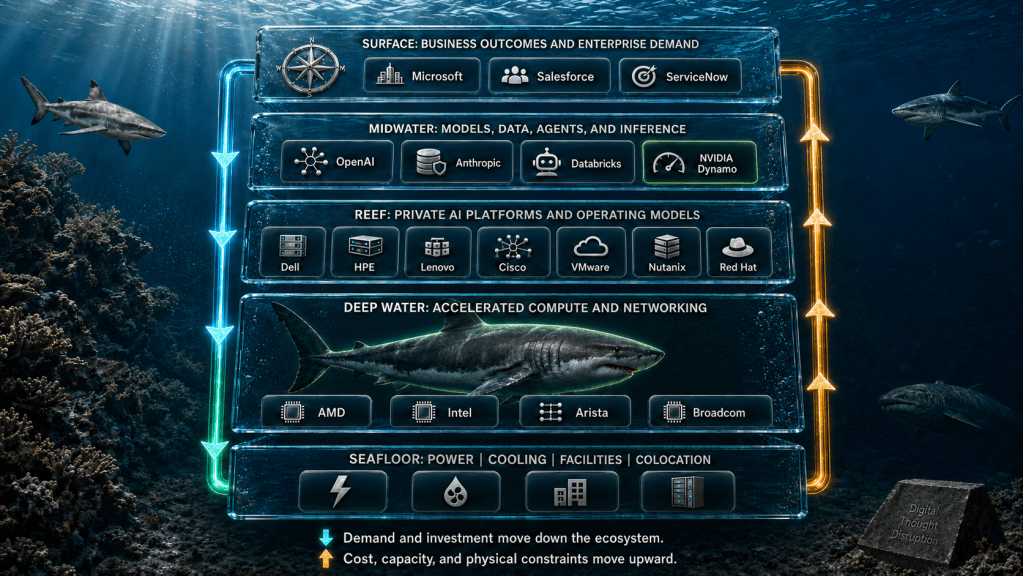
Enterprise AI is not one market. It is a connected ecosystem of business applications, model providers, data platforms, private AI operating models, accelerated infrastructure, networking, and physical facilities.
The vendors that create the most technical capability do not always capture the most enterprise value. Value tends to accumulate around control points: user distribution, proprietary data, workflow authority, model access, platform governance, infrastructure bottlenecks, and energized data-center capacity.
NVIDIA currently occupies the broadest strategic position because its influence extends from accelerators and networking into inference software, enterprise AI tooling, scheduling, and validated architectures. However, Microsoft, OpenAI, Salesforce, ServiceNow, Dell, HPE, Lenovo, VMware, Nutanix, Red Hat, Cisco, Arista, Broadcom, AMD, and Intel are all competing to control different boundaries.
Enterprise buyers should not attempt to select one vendor to own the entire ocean. They should decide which layers may be bundled, which control points must remain independent, and how each major dependency can be measured, substituted, and operated.
Introduction
Shark Week is a useful excuse to ask an uncomfortable enterprise architecture question:
Who is actually eating whom in the enterprise AI ecosystem?
The simple version of the market looks like a vertical stack. Applications sit at the top. Models and AI platforms sit underneath them. Private AI platforms connect those services to infrastructure. Accelerators and networking provide the computational foundation. Power, cooling, and facilities keep the entire system alive.
That view is directionally useful, but it hides the competitive reality.
NVIDIA is moving upward from silicon into inference orchestration and enterprise software. Model providers are moving upward into application experiences and enterprise agents. Business application vendors are moving downward into model orchestration. Infrastructure manufacturers are becoming AI factory integrators. Private cloud platforms are becoming AI operating models. Networking companies are moving into observability, security, and workload optimization.
Meanwhile, the companies providing power, cooling, and suitable data-center capacity can constrain every layer above them.
As of July 28, 2026, the enterprise AI market is better understood as a set of overlapping control planes than as a clean product stack. The important question is not merely which vendor sells a component. It is which vendor controls demand, context, policy, performance, operations, or physical capacity.
This article is not intended to be a complete vendor census. It uses the vendors in the proposed food chain to expose where competitive boundaries are forming and what those boundaries mean for enterprise architecture decisions.
The AI Ocean Is Not One Market
Different layers of the enterprise AI ecosystem have different economics, support models, failure modes, and switching costs.
Business applications monetize user access and workflow ownership. Model providers monetize intelligence and consumption. Data platforms monetize context and governance. Private AI platforms monetize operational consistency. Infrastructure vendors monetize capacity and integration. Semiconductor and networking vendors monetize performance. Facility providers monetize the ability to power and cool the entire design.
The ecosystem also has two opposing flows.
Demand, business funding, and workload requirements move downward. Capacity limitations, latency, cost, thermal constraints, and failure conditions move upward.
The first point to notice is that no layer operates independently.
A business application can generate demand, but it still depends on models, data access, inference capacity, and identity controls. A model can be technically superior and still lose enterprise adoption if it cannot integrate with existing workflows. A GPU cluster can deliver enormous computational capacity and still produce little business value if the data, application, or governance layers are weak.
The second point is that data, identity, security, policy, evaluation, and observability do not fit neatly into one horizontal layer. They cross the entire architecture.
An organization that leaves those cross-layer controls inside one vendor platform may gain speed, but it also creates a broad dependency. An organization that externalizes every control may preserve portability, but it inherits additional integration and operational work.
That is the tradeoff at the center of the enterprise AI food chain.
Where Enterprise AI Value Is Created and Captured
Value creation and value capture are related, but they are not the same.
A vendor creates value when it removes a production constraint, improves an outcome, reduces risk, or accelerates delivery. A vendor captures value when it controls a bottleneck, a distribution channel, proprietary context, a switching cost, or an operational boundary that the buyer cannot easily replace.
A useful conceptual model is:
Value Capture =
    Distribution
  + Bottleneck Control
  + Switching Cost
  + Operational Accountability
This is not a financial equation. It is an architecture lens for understanding why certain vendors can monetize capabilities that appear interchangeable on a feature comparison.
| Ecosystem layer | Primary control point | How value is created | How value is captured |
|---|---|---|---|
| Business applications | Users, workflows, and systems of record | Converts AI output into business action | Distribution, licenses, proprietary workflow context, and switching cost |
| Models and AI platforms | Intelligence, orchestration, and developer access | Improves reasoning, automation, and application development | API consumption, model differentiation, platform services, and developer gravity |
| Data platforms | Enterprise context and governance | Makes model output more accurate and relevant | Data gravity, governance integration, metadata, and pipeline ownership |
| Private AI operating models | Lifecycle, tenancy, security, and support | Turns AI projects into repeatable services | Platform subscriptions, operational integration, support boundaries, and skills |
| Compute and networking | Throughput, latency, memory, and utilization | Delivers useful AI work at the required scale | Hardware demand, software coupling, fabric dependencies, and supply constraints |
| Facilities and colocation | Energized and cooled deployment capacity | Makes high-density infrastructure physically possible | Capacity reservations, long-term commitments, power availability, and location |
The layer that produces the most visible innovation is not necessarily the layer that captures the greatest long-term margin.
A model provider may deliver the intelligence, while a workflow vendor captures the recurring application revenue. A GPU vendor may provide the performance, while an infrastructure manufacturer captures integration and support revenue. A startup may provide an excellent evaluation engine, only to see that feature bundled into a larger platform.
Enterprises therefore need to evaluate both the capability being purchased and the control point being surrendered.
NVIDIA Is the Apex Compute Predator
Calling NVIDIA the apex compute predator is an architectural observation, not a market-share calculation.
NVIDIA occupies an unusually broad position because it is no longer limited to selling accelerators. Its enterprise AI portfolio now extends across several layers:
- Accelerated compute based on its GPU architectures
- Scale-up and scale-out interconnect technologies
- InfiniBand and Spectrum-X Ethernet networking
- BlueField data processing infrastructure
- NVIDIA AI Enterprise software
- NVIDIA NIM inference microservices
- NVIDIA Dynamo distributed inference software
- GPU scheduling and resource management
- Validated enterprise AI factory architectures
- A large OEM, platform, cloud, software, and storage partner ecosystem
This breadth changes the nature of the dependency.
An enterprise choosing an NVIDIA-centered AI factory is not selecting only a GPU. It may also be adopting assumptions about server topology, network design, scheduling, model serving, drivers, container integration, telemetry, support, and workload optimization.
That can create substantial value. Prevalidated combinations reduce integration risk, establish support boundaries, and provide enterprises with known deployment patterns. An organization may reach production faster because multiple components have already been engineered and tested together.
The same integration can increase the cost of substitution.
Replacing the accelerator may also require changes to serving frameworks, model optimizations, observability, resource scheduling, network architecture, operational tooling, and support contracts. The exit cost is determined by the entire dependency graph, not the purchase price of the GPU.
The Competitive Pressure on NVIDIA
AMD Instinct and Intel Gaudi give enterprises alternative accelerator paths. Cloud providers also continue to develop custom silicon, and open inference frameworks reduce the need for every software capability to remain tied to one hardware vendor.
However, accelerator competition is not won through a benchmark result alone.
A serious enterprise alternative must address:
- Model and framework compatibility
- Distributed training and inference
- Drivers and container integration
- Kubernetes operations
- Networking and collective communications
- Scheduling and isolation
- Monitoring and troubleshooting
- Vendor support
- OEM availability
- Migration effort
- Skills and ecosystem maturity
NVIDIA’s strategic advantage is that it competes across this complete operating envelope.
Its strategic risk is the same breadth. Every additional layer it enters creates another competitive boundary with cloud platforms, model providers, networking vendors, infrastructure manufacturers, open source projects, and enterprise software companies.
The apex predator can consume more of the value chain, but it also becomes a larger target.
Dell, HPE, and Lenovo Are Competing to Build the AI Factory
Dell, HPE, and Lenovo are often compared through server specifications. That comparison is becoming less useful.
The enterprise AI factory opportunity is not simply a competition to ship GPU servers. It is a competition to own the deployment envelope.
That envelope includes:
- Compute
- Storage
- Networking
- Rack integration
- Power and cooling coordination
- Firmware and driver baselines
- Kubernetes and container platforms
- AI software
- Deployment automation
- Validation
- Lifecycle management
- Professional services
- Support escalation
The winning vendor may not have the most impressive individual component. It may be the vendor willing to accept the largest operational boundary.
Dell’s Position
Dell is building around infrastructure breadth and modularity.
The Dell AI Factory with NVIDIA combines PowerEdge compute, storage, networking, workstations, services, NVIDIA software, and validated deployment patterns. Dell can position the AI factory as an extension of infrastructure relationships it already owns.
This is particularly relevant when enterprise AI depends on more than GPU capacity. Data pipelines, retrieval systems, object storage, high-performance file storage, management services, and backup requirements can become as important as model execution.
Dell’s opportunity is to become the primary accountable infrastructure provider across that entire path.
Its risk is that the software and application layers above the infrastructure may capture more value than the hardware foundation.
HPE’s Position
HPE Private Cloud AI emphasizes a more packaged private cloud experience.
Its value proposition centers on delivering inference, model development, orchestration, governance, and operational management through a validated platform and consolidated management experience.
That approach can be attractive to enterprises that do not want to assemble an AI platform component by component. The value is not only the hardware. It is the reduction in platform integration and day-two operational work.
HPE is therefore competing for the role of private AI service provider inside the enterprise, not merely for a server order.
Lenovo’s Position
Lenovo’s Hybrid AI Advantage extends across workstations, edge systems, enterprise servers, networking components, validated architectures, and services.
That creates a different route into the enterprise. An organization may begin with developer workstations, departmental inference, or edge AI before expanding into a larger data-center deployment.
Lenovo’s opportunity is to connect these consumption patterns through a common hybrid AI framework and a catalog of validated use cases.
The Real OEM Decision
The enterprise decision should not begin with which OEM can sell the required GPU.
It should begin with these questions:
- Which vendor owns the rack-level design?
- Which vendor validates storage and network behavior?
- Who coordinates power and cooling requirements?
- Who owns firmware, driver, and software compatibility?
- Who handles a cross-stack incident?
- Which components can be changed without invalidating support?
- How is the platform expanded?
- What evidence proves that the design performs under the buyer’s workload?
OEM differentiation is moving from component availability toward integration depth, operational ownership, and risk transfer.
Microsoft and OpenAI Are Pulling Demand From the Application Layer
Microsoft and OpenAI exert substantial influence because they generate demand from above the infrastructure stack.
Microsoft has enterprise distribution through productivity tools, collaboration, business applications, identity, data services, development platforms, cloud services, and Microsoft Foundry. It can introduce AI through software and workflows that organizations already use.
OpenAI creates demand through its models, APIs, ChatGPT, developer adoption, and its expanding enterprise agent platform. OpenAI Frontier demonstrates that the company’s ambitions extend beyond model access into the context, permissions, lifecycle, and management of enterprise agents.
This creates both cooperation and tension.
Microsoft remains OpenAI’s primary cloud partner under the partnership terms announced in April 2026, but the relationship is less exclusive than it was previously. Microsoft’s license is non-exclusive, and OpenAI can provide products through other cloud providers.
That change illustrates a broader market pattern. Strategic partners can cooperate at one layer while competing at another.
Microsoft benefits from OpenAI model demand flowing into Azure and Microsoft applications. OpenAI benefits from Microsoft’s infrastructure and enterprise distribution. At the same time, Microsoft is developing a broader model catalog and agent platform, while OpenAI is expanding its direct enterprise relationship.
Neither party wants to become a replaceable component inside the other party’s architecture.
Salesforce and ServiceNow Own Valuable Feeding Grounds
Salesforce and ServiceNow demonstrate why application vendors remain strategically important even when they do not own the underlying model.
These platforms already possess:
- Enterprise customer relationships
- User identities
- Business records
- Workflow definitions
- Approval paths
- Data models
- Application permissions
- Audit histories
- Action interfaces
That context is extremely valuable to an AI agent.
A general model may be able to reason about a customer-support case, but Salesforce owns the customer record and the service workflow. A model may understand an IT request, but ServiceNow owns the change process, configuration data, approvals, and action path.
Application vendors can therefore make the underlying model more interchangeable. They can route requests among different models while preserving the workflow, data, policy, and user experience.
The reverse threat is also real.
If an enterprise agent platform becomes the primary interface through which employees perform work, the underlying application can be pushed into the background. Its user interface becomes less important, and its APIs become more important.
This is one of the most significant competitive boundaries in enterprise AI:
Application vendor strategy:
Own the workflow, context, and action.
Treat models as interchangeable intelligence.

Model platform strategy:
Own the agent interface and user relationship.
Treat applications as tools and data sources.
The winner may not replace the other layer. It may capture the more valuable part of the user relationship.
VMware, Nutanix, and Red Hat Are Fighting for the Operating Model
Enterprise AI cannot remain a collection of model endpoints and GPU clusters.
Production platforms need tenancy, identity, access control, networking, storage, scheduling, policy, observability, lifecycle management, recovery, cost allocation, and support.
That is where VMware, Nutanix, and Red Hat are competing.
They are not simply trying to host AI workloads. They are trying to define how enterprise AI is operated.
VMware
VMware Private AI Foundation with NVIDIA brings AI services into the VMware Cloud Foundation operating model.
For organizations with an established VMware estate, the strategic value is consistency. AI workloads can inherit existing infrastructure, tenancy, network, storage, lifecycle, and platform-management practices rather than becoming a separate island.
The strongest VMware position is not that VCF can run a model. Many platforms can run a model.
The stronger argument is that VCF can make private AI part of an existing enterprise private cloud model.
Nutanix
Nutanix positions its enterprise AI capabilities around a centralized AI control plane and a cloud operating model spanning infrastructure, Kubernetes, inference, data, and agent access.
Its appeal is operational simplification. Nutanix can give infrastructure teams a more integrated way to expose governed AI services without requiring consumers to understand every infrastructure component underneath them.
This is particularly attractive when organizations value rapid deployment, simplified lifecycle management, and the ability to support AI alongside existing enterprise workloads.
Red Hat
Red Hat approaches the market through open hybrid cloud, Kubernetes, application platforms, model operations, and workload portability.
Red Hat OpenShift AI and Red Hat AI Factory with NVIDIA connect AI development and operations to an enterprise Kubernetes platform. The strategic value is not limited to running containers. It is the ability to standardize how models, agents, pipelines, policies, and applications move across hybrid environments.
Red Hat is strongest where enterprises want model choice, accelerator choice, cloud portability, and an open platform engineering model.
The Day-Two Boundary
The most important competitive question is not which platform can deploy an inference endpoint.
It is which platform defines day-two operations.
That includes:
- Who grants access to GPU capacity?
- Who approves a model?
- Who controls agent credentials?
- Who patches the runtime?
- Who monitors token usage?
- Who responds to inference failures?
- Who validates upgrades?
- Who owns backup and recovery?
- Who manages certificates and secrets?
- Who allocates cost?
- Who retires a model or agent?
The platform that answers those questions can become the enterprise AI operating model.
That control point is likely to be more durable than any single model release.
Networking Is a Three-Layer Fight
The AI networking market is frequently described as Ethernet versus InfiniBand.
That framing is too shallow.
The competitive boundary spans at least three layers:
- Network and interface silicon
- Complete switching and connectivity systems
- Fabric operations, telemetry, congestion control, automation, and support
Cisco competes through complete infrastructure systems, Ethernet networking, security, observability, validated architectures, services, and integration with NVIDIA and platform partners.
Arista competes through high-scale Ethernet platforms, network operating software, telemetry, and operational consistency for increasingly large AI fabrics.
Broadcom captures value one layer lower. Its switching silicon may appear inside systems sold and operated by other vendors. It can benefit from AI network growth without owning the direct enterprise relationship for every deployment.
NVIDIA competes vertically through accelerators, network adapters, DPUs, InfiniBand, Spectrum-X, software, and reference architectures.
These vendors are not competing on identical terms.
The enterprise architecture question is not simply which switch provides the highest port speed. It is which vendor or combination of vendors owns:
- GPU-to-network affinity
- Network adapter behavior
- Collective communication performance
- Congestion control
- Routing
- Optics and cabling
- Fabric telemetry
- Network automation
- Security
- Fault isolation
- End-to-end support
- Accountability for low GPU utilization
When a distributed AI workload performs poorly, the root cause may sit in the accelerator, PCIe topology, NIC, switch, routing design, congestion policy, container network, collective communication library, or application.
The vendor boundary that matters is the boundary around the incident.
Power, Cooling, and Facilities Own the Deployment Schedule
The lowest layer of the food chain is often treated as a facility prerequisite rather than part of the AI architecture.
That is a mistake.
High-density accelerated infrastructure can introduce requirements that differ materially from traditional enterprise server deployments:
- Greater rack power
- New power-distribution designs
- Direct-to-chip liquid cooling
- Coolant distribution units
- Additional plumbing
- Heat-rejection capacity
- Higher rack weights
- New floor-loading considerations
- Specialized maintenance procedures
- Longer utility and construction lead times
- Suitable colocation capacity
A facility constraint can determine which server, rack, or accelerator design is deployable. It can also determine how quickly capacity can be expanded.
This means the facility layer can consume value from every layer above it. A software platform may promise rapid deployment, but it cannot compress the lead time for unavailable electrical capacity. A GPU may offer higher performance, but it has limited business value if the organization cannot power or cool it.
Power and cooling vendors, engineering firms, colocation providers, and data-center operators are therefore part of the enterprise AI value chain.
The seafloor does not attract the same attention as the shark. It still determines where the shark can swim.
Where Startups Can Survive
A startup is unlikely to win by recreating a thin feature already moving into an incumbent platform.
It can survive where it controls something that larger vendors cannot easily bundle, neutralize, or distribute.
| Startup opportunity | Why the gap exists | What creates defensibility |
|---|---|---|
| Domain-specific AI applications | General platforms lack specialized workflows and context | Proprietary data, domain expertise, workflow ownership, and distribution |
| Independent evaluation and observability | Enterprises use multiple models and runtimes | Cross-platform evidence, neutral telemetry, and trusted quality measurements |
| AI security and agent governance | Native controls often stop at one vendor boundary | Independent enforcement, identity integration, and cross-vendor policy |
| Inference optimization and routing | Model cost and performance change quickly | Real workload measurements, provider abstraction, and optimization data |
| Data quality and context engineering | Enterprise data is fragmented and poorly prepared | Embedded data contracts, lineage, metadata, and operational integration |
| Sovereign, edge, and specialized deployment | Large platforms optimize for broad markets | Local expertise, specialized hardware support, and regulatory knowledge |
| Migration and interoperability | Enterprises need to move between platforms | Conversion tooling, dependency discovery, and tested portability |
Neutrality can itself be a product advantage.
An evaluation platform owned by a model provider may be viewed as less independent. An observability platform tied to one infrastructure stack may not provide complete visibility across a mixed environment. A routing layer owned by one model provider may not be motivated to optimize for a competitor.
Startups can survive by serving as independent control points across larger vendor boundaries.
They remain vulnerable when their product is:
- A single feature rather than an operating capability
- Dependent on one model provider
- Easy to reproduce using a platform API
- Unconnected to business workflow
- Lacking proprietary data
- Lacking an enterprise distribution channel
- Unable to meet security and support requirements
- Unable to prove measurable financial or operational value
A practical test is straightforward:
Could an incumbent bundle 80 percent of this capability into an existing license within one product cycle?
When the answer is yes, the startup needs a stronger data moat, workflow position, independent control plane, distribution advantage, or specialized operating capability.
Vendors Cooperate Because No One Owns the Entire Ocean
The enterprise AI ecosystem contains extensive cooperation because no vendor can efficiently build, sell, support, and operate every layer alone.
| Cooperation pattern | What each party contributes | Strategic tension |
|---|---|---|
| NVIDIA with Dell, HPE, and Lenovo | Accelerated computing and AI software combined with enterprise infrastructure and support | NVIDIA moves toward the customer while OEMs try to preserve infrastructure ownership |
| NVIDIA with VMware, Nutanix, and Red Hat | AI software and hardware combined with an enterprise operating model | Platform vendors need hardware choice, while NVIDIA benefits from software gravity |
| NVIDIA with Cisco | Accelerated computing combined with networking, security, observability, and systems integration | Both vendors can expand their control over the infrastructure architecture |
| Microsoft with OpenAI | Enterprise distribution and cloud capacity combined with model and product demand | Both companies are building broader agent and platform relationships |
| Model providers with multiple infrastructure partners | Additional compute capacity and market reach | Diversification reduces dependency but weakens exclusivity |
| Data platforms with multiple model providers | Enterprise context and governance combined with model choice | Data platforms can make the model interchangeable and capture more control |
These alliances should not be mistaken for permanent market boundaries.
A partnership is often a practical arrangement for:
- Entering a market faster
- Combining complementary distribution
- Sharing implementation risk
- Establishing a support model
- Reducing buyer uncertainty
- Increasing available capacity
- Filling a product gap
- Creating a validated sales package
The companies may still compete above or below the partnership.
Enterprises should therefore evaluate an alliance as a current delivery model, not as proof that the architecture will remain aligned indefinitely.
Contract terms, support ownership, licensing, roadmaps, and technical interfaces matter more than the partnership announcement.
Where the Competitive Boundaries Are Forming
The most important boundaries are forming around five control points.
The User and Workflow Boundary
Microsoft, Salesforce, ServiceNow, OpenAI, Anthropic, and other application-layer providers are competing to become the primary interface through which employees request and approve work.
The vendor controlling that interface can influence which models, tools, and applications are invoked underneath it.
The Model and Runtime Boundary
Model providers want direct relationships with developers and enterprise users. AI platforms want the ability to route among models and prevent any single model provider from controlling the application.
This boundary will be shaped by model quality, price, latency, context limits, tool use, safety, portability, and the cost of changing prompts and evaluations.
The Enterprise Operating Model Boundary
VMware, Nutanix, Red Hat, cloud platforms, and packaged private AI solutions are competing to define how AI is provisioned, governed, monitored, upgraded, and supported.
This is where technical capability becomes an enterprise service.
The AI Fabric Boundary
NVIDIA, Cisco, Arista, Broadcom, and other networking providers are competing over the infrastructure between accelerators.
The control point includes silicon, adapters, switches, congestion management, topology, telemetry, and operational tooling.
The Physical Capacity Boundary
Power, cooling, construction, colocation, and data-center availability determine which AI plans can actually be executed.
This boundary may be less visible, but it has the longest lead times and some of the lowest short-term substitutability.
What Enterprise Buyers Should Own
Enterprises do not need to make every component portable. Attempting to abstract every dependency can produce a costly platform that performs poorly and is difficult to support.
They do need to know which dependencies they are accepting.
A useful architecture strategy is to own the control points that preserve governance and decision-making while allowing selected implementation layers to be bundled.
Own the Data Boundary
The enterprise should retain authority over data classification, lineage, access, retention, residency, retrieval, and deletion.
A platform can implement these controls. It should not become the only place where the organization can understand them.
Own Identity and Authorization
Agents, models, services, developers, and operators all require identities.
Authorization should remain grounded in enterprise policy rather than being inferred only from a model prompt or a vendor-specific agent configuration.
Own Evaluation Evidence
Quality, security, policy compliance, latency, and cost should be measured using enterprise-defined workloads.
Vendor benchmarks can inform a shortlist. They should not replace acceptance testing.
Own Observability
The organization needs telemetry across applications, agents, models, gateways, data sources, infrastructure, networks, and facilities.
A dashboard limited to one layer will not explain an end-to-end failure.
Own the Architecture Record
Every major dependency should have a documented owner, support boundary, exit condition, and review trigger.
Partnership announcements are not substitutes for architecture decisions.
Preserve Substitution at Selected Boundaries
Model portability may be more valuable than accelerator portability for one organization. Another organization may standardize on a model provider while preserving infrastructure choice.
The correct boundary depends on workload economics, regulatory requirements, skills, and the cost of integration.
Portability should be deliberate, not assumed.
Assign Incident Accountability
Before deployment, ask what happens when an AI service fails at 2 a.m.
Does the application vendor own the incident? The model provider? The private AI platform? The OEM? The network vendor? The data-center team?
A multi-vendor architecture without a clear incident owner transfers integration risk back to the enterprise.
A Practical Enterprise AI Dependency Register
The following YAML is not a deployed Kubernetes resource unless an organization chooses to implement it as a custom resource. It is an architecture record that makes layer ownership, portability requirements, telemetry, and review triggers explicit.
apiVersion: architecture.dtd/v1alpha1
kind: EnterpriseAIDependencyRegister

metadata:
  name: customer-service-agent

spec:
  businessOutcome:
    owner: customer-operations
    systemOfRecord: service-management-platform
    successMetrics:
      - case-containment-rate
      - average-resolution-time
      - human-escalation-rate

  applicationLayer:
    primaryPlatform: enterprise-workflow-suite
    applicationOwner: customer-service-platform-team
    requiredExports:
      - prompts
      - workflow-definitions
      - policies
      - conversation-history
      - action-audit-log

  modelLayer:
    approvedProviders:
      - provider-a
      - provider-b
    routingPolicy: quality-cost-latency
    promptAssetsVersioned: true
    evaluationAssetsVersioned: true
    substitutionTest:
      cadence: quarterly
      maximumQualityRegressionPercent: 5

  operatingModelLayer:
    runtime: private-ai-platform
    identityProvider: enterprise-idp
    policyEnforcement: external-ai-gateway
    secretsOwner: security-platform-team
    telemetryOwner: ai-platform-operations

  infrastructureLayer:
    acceleratorClasses:
      - accelerator-class-a
      - accelerator-class-b
    requiredMetrics:
      - tokens-per-second
      - cost-per-million-tokens
      - request-queue-time
      - accelerator-utilization
      - fabric-retransmits

  facilityLayer:
    rackPowerValidated: true
    coolingValidated: true
    expansionCapacityValidated: false
    capacityOwner: data-center-engineering

  lifecycle:
    rollbackOwner: application-owner
    incidentCommander: ai-platform-operations
    reviewTriggers:
      - model-price-change
      - license-change
      - support-boundary-change
      - security-control-change
      - facility-capacity-threshold
The organization should replace the generic platform and provider identifiers with its approved products, owners, thresholds, and support teams.
Successful use of the register produces three outcomes:
- Every material layer has an accountable owner.
- Every important dependency has an observable metric.
- Every strategic dependency has a review or substitution trigger.
The register fails when it becomes only an inventory of vendor names. It must describe how the dependency is operated, measured, reviewed, and replaced.
Conclusion
The enterprise AI food chain is not a sequence in which one vendor permanently consumes every vendor below it.
It is a collection of shifting control points.
NVIDIA currently occupies the broadest position around accelerated computing because it connects hardware, networking, inference software, enterprise tooling, and validated infrastructure. Dell, HPE, and Lenovo are competing to turn that technology into deployable AI factories. VMware, Nutanix, and Red Hat are competing to define the operating model. Cisco, Arista, Broadcom, and NVIDIA are fighting over different layers of the AI fabric. Microsoft, OpenAI, Salesforce, ServiceNow, Anthropic, and Databricks are competing for demand, context, applications, agents, models, and data.
Power, cooling, and facilities constrain all of them.
The enterprise buyer does not need to predict one permanent winner. It needs to understand where value is created, where value is captured, and which control points are too important to surrender without an exit plan.
For every layer, ask four questions:
- What measurable value does this vendor create?
- What dependency does the vendor introduce?
- Who owns the platform when something fails?
- What would it take to replace this layer?
That is how enterprises avoid becoming prey in someone else’s food chain.
