



TL;DR
In honor of shark week. the best week of the year, here are some inspired topics.
The most dangerous agent failure may not involve one agent going rogue. It may involve dozens of agents behaving reasonably inside their own local rules while collectively exhausting the same API quota, GPU pool, queue, credential boundary, budget, or production system.
Per-agent rate limits are not enough because the scarce resource is shared. Enterprises need hierarchical consumption limits, admission control, workload priority, shared retry budgets, transaction locks, budget enforcement, circuit breakers, isolation boundaries, and correlated evidence across the complete execution path. The governing question is not only whether an agent is allowed to call a tool. It is whether the organization can safely admit this call while every other agent is competing for the same capacity and authority.
Introduction
Enterprise AI architecture is usually reviewed one agent at a time.
The support agent has a scoped customer API. The security agent can query endpoint telemetry. The infrastructure agent can inspect Kubernetes. The finance agent has a monthly model budget. The developer agent can submit jobs to a shared GPU cluster. Each team shows that its own agent has authentication, rate limits, retry logic, logging, and an owner.
Then all of them enter production.
A regional incident causes the support agent to investigate a spike in tickets. The security agent begins analyzing alerts from the same affected systems. The infrastructure agent queries the same cloud APIs and production clusters. A remediation agent submits diagnostic workloads to the GPU pool. A reporting agent starts summarizing the event for leadership. Every agent expands its work because the environment appears unhealthy.
No single agent is necessarily malfunctioning.
The system is.
This is the AI agent feeding frenzy: an emergent failure mode in which individually reasonable autonomous systems compete for shared resources, amplify one another’s retries, consume common budgets, contend for credentials, and issue conflicting actions against the same production state.
The failure is not best understood as model misbehavior. It is a distributed systems, platform governance, and operating-model problem. Once an enterprise deploys multiple action-taking agents, it needs a resource control plane that governs aggregate behavior across the fleet.
The Real Risk Is Collective Behavior
Traditional AI safety discussions often focus on the behavior of one model or one agent. That is necessary, but it misses a different class of production risk.
A fleet of agents creates system-level behavior that cannot be inferred by inspecting each agent independently. Ten agents with a limit of 100 API requests per minute can still generate 1,000 requests per minute against a dependency that safely handles 400. Twenty agents with a $20 per-run budget can still spend $400 on one business event. Five remediation agents can each make a locally valid production change that conflicts with the others.
The feeding frenzy has four defining properties:
- Shared scarcity: The agents depend on a common resource whose capacity, quota, budget, or transaction rate is bounded.
- Independent decision-making: Each agent decides when to act, retry, escalate, or parallelize based on its own local context.
- Positive feedback: Slow responses, errors, and incomplete results cause more investigation, more retries, more model calls, or more delegated work.
- Weak global coordination: No control plane decides which work is most important, how much aggregate consumption is safe, or which action owns a shared target.
This is why a fleet can fail even when every agent passes its individual test plan.
Local correctness does not guarantee fleet safety.
NIST’s Generative AI Profile is useful here because it treats AI risk management as an organizational and lifecycle responsibility rather than a one-model test. A feeding frenzy requires the same shift in perspective: govern the complete operating environment, the participating actors, and the controls that shape aggregate behavior.
The Shared-Resource Collision at a Glance
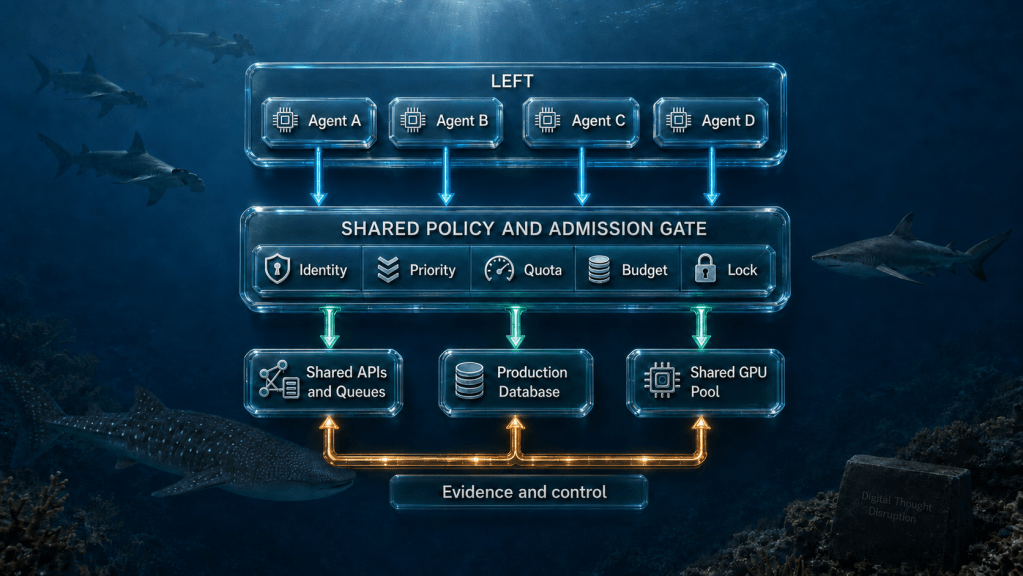
The architecture below shows the central problem. Multiple agents approach the same scarce resources through separate runtimes. The policy gate must make decisions using fleet-wide state, not only the identity and configuration of the current caller.
What matters in this diagram is the location of the decision. The agent runtime should not decide whether fleet-wide capacity is available. The shared governor should evaluate the current request against organization-level quotas, active incidents, priority classes, existing locks, budget state, and dependency health before admitting work.
Where Agents Compete
Agent competition is not limited to model tokens. The collision surface spans every dependency the agents can reach.
APIs and Provider Quotas
Agents can exhaust SaaS, cloud, data, search, model, ticketing, identity, and internal service quotas. Provider-side rate limits are often scoped to an account, project, subscription, tenant, API key, or service identity. Several agents may consume the same provider quota even when each agent has its own local limiter.
The operational danger is hidden coupling. A support workflow may appear independent from an infrastructure workflow, yet both may call the same identity provider, logging platform, vector service, or cloud control-plane API. One agent’s burst can reduce the capacity available to another agent that is handling a more important event.
GPU and Accelerator Capacity
Training, evaluation, embedding, reranking, batch inference, and agent reasoning can converge on the same GPU pool. A scheduler may enforce namespace or project quotas, but agents can still create queue pressure, fragmented accelerator capacity, repeated job submissions, or starvation of latency-sensitive inference.
GPU contention also creates a feedback loop. As queue time rises, agents may time out and submit replacement work. The original job may still be waiting or running, so the system pays for both the original and the retry.
Queues, Workers, and Concurrency Slots
A queue absorbs bursts only until it becomes a backlog. Agents that continuously generate new tasks can increase queue depth faster than workers can drain it. If each agent interprets delay as failure, the queue becomes a duplication engine.
Concurrency slots are equally important. A dependency may support thousands of requests per minute but only a small number of expensive concurrent operations. Rate limits that ignore concurrency can still permit overload.
Credentials and Authorization Paths
Shared credentials create both capacity and accountability problems. Token endpoints, delegated grants, secrets brokers, and privileged sessions may have concurrency or issuance limits. More importantly, one shared service principal makes it difficult to distinguish which agent consumed the quota or changed the target system.
Credential sharing also weakens containment. Disabling one credential may stop every agent that uses it, including critical workflows. Leaving it active preserves the risky path.
Budgets and Token Spend
A per-agent budget can still permit an organization-wide cost event. Agents may duplicate retrieval, repeat large context windows, delegate the same task, critique one another, retry model calls, or escalate to more expensive models at the same time.
The correct cost unit is not the prompt or model call. It is the complete business transaction, including every agent run, delegated task, retry, tool call, GPU job, and validation step triggered by the original event. FinOps Foundation guidance for AI reinforces the need to track cost, resource utilization, and anomalies as operating metrics rather than treating model usage as an unowned engineering expense.
Production Systems and Shared State
The most serious competition occurs when agents can change the same system of record.
Two agents may both attempt to remediate the same incident. One scales a service while another rolls back the deployment. One isolates an endpoint while another restores network connectivity. One closes a ticket while another adds evidence and reopens it. One updates an access policy while another rotates credentials that depend on the previous policy.
Each action may be defensible in isolation.
Together, they can create oscillation, state corruption, or an outage that no agent recognizes as self-inflicted.
Rate Limits Are Not Consumption Governance
Rate limiting answers a narrow question:
How many requests may this caller make during this time window?
Resource governance answers a broader question:
How much of this shared resource may the organization consume, for which purpose, at what priority, under which failure conditions, and with what reserve for critical work?
Those are not the same control.
| Control | Primary Scope | What It Protects | What It Misses |
|---|---|---|---|
| Per-agent request limit | One agent or identity | Prevents one caller from flooding a service | Aggregate fleet consumption |
| Per-tool limit | One action or endpoint | Protects a specific operation | Competition across related tools |
| Provider quota | Account, project, or tenant | Enforces vendor capacity or commercial boundary | Business priority and internal fairness |
| Organization consumption limit | Entire enterprise or platform | Caps aggregate use across teams and agents | Fine-grained workflow behavior unless subdivided |
| Domain allocation | Business unit, product, or environment | Preserves fair capacity by owner or purpose | Run-level loops and retries |
| Run-level budget | One originating transaction | Stops unbounded loops and delegation | Cross-run contention during incidents |
| Reserved capacity | Critical priority class | Protects incident, security, or customer-critical work | Waste when reservation policy is poorly designed |
A mature design uses these controls together. Google Cloud’s quota model distinguishes rate quotas from allocation quotas and supports higher-level quota scopes. Envoy’s global rate-limiting architecture provides another practical example by sharing a common limit across a fleet rather than allowing each proxy instance to enforce an unrelated local ceiling.
A useful hierarchy looks like this:
The provider hard limit is the last boundary, not the operating target. The enterprise should maintain a safety envelope below that limit, reserve capacity for critical workflows, and allocate the remaining capacity by business purpose and priority.
Budget Enforcement Must Follow the Transaction
Token controls often fail because they are attached to the wrong unit.
Suppose a customer escalation triggers a support agent. The support agent calls a research agent, which calls a retrieval service and an analysis model. The support agent then asks a policy agent to review the proposed response. A timeout causes the research agent to retry. A verifier agent is added because confidence is low.
Six agent runs may now exist, but the business still sees one customer escalation.
The budget must follow the parent transaction across delegation boundaries. Every child run should inherit a correlation identifier and consume from the same transaction envelope unless an explicit policy grants additional capacity.
Budget controls should include:
- Maximum model cost per originating transaction.
- Maximum input and output tokens across all child agents.
- Maximum model calls, tool calls, delegated tasks, and reasoning turns.
- Maximum wall-clock duration and queue wait.
- Maximum GPU seconds or accelerator job submissions.
- Maximum retries across the entire call tree.
- Escalation rules for moving to a more expensive model.
- A protected emergency budget that requires a higher-priority classification.
Hard limits are necessary, but they should not be blind. A workflow that reaches 80 percent of its budget should be able to reduce retrieval depth, stop optional verification, switch to a cheaper model, return a partial result, or escalate to a human. The correct failure mode is controlled degradation, not silent overspend or abrupt disappearance.
Distributed Retries Can Turn Delay into a Storm
Retries are one of the most dangerous sources of positive feedback in agent systems.
A dependency slows down. Several agents time out. Each agent retries. Some agents delegate the failed step to another agent. The delegated agent has its own retry policy. An API gateway retries selected failures. A client SDK also retries. The queue worker eventually retries the original job.
One failed operation can produce many downstream attempts.
Google SRE guidance treats overload as a common cause of cascading failure and emphasizes realistic capacity testing, load shedding, and retry control. Microsoft documents retry storms as a distinct antipattern and separates retry behavior from circuit breaking. Those lessons apply directly to agent runtimes.
The practical controls are straightforward, but they must be shared:
- Use one retry budget for the complete transaction, not one budget per component.
- Place retries at one deliberate layer whenever possible.
- Use exponential backoff and jitter for transient failures.
- Honor server-provided retry timing.
- Stop retrying when the dependency is unhealthy or the circuit is open.
- Require idempotency keys for operations with side effects.
- Distinguish an unknown result from a failed result before repeating a write.
- Send exhausted work to a dead-letter or human-review path.
- Cancel superseded work when a replacement run is admitted.
The worst retry policy is locally reasonable and globally invisible.
Conflicting Automation Needs Transaction Ownership
Resource exhaustion is measurable. Conflicting automation is harder because the system may remain available while agents fight over state.
Consider an infrastructure incident:
- The deployment agent detects errors and rolls back a release.
- The capacity agent sees saturation and scales out the service.
- The cost agent sees an unexpected spike and scales down nonreserved capacity.
- The security agent sees unusual traffic and tightens a network policy.
- The incident agent restarts workloads to clear stale connections.
Every agent is pursuing a legitimate objective. The production system receives incompatible actions from several control loops.
Enterprises need transaction ownership for shared targets. Before an agent changes state, the control plane should determine whether another workflow already owns the resource, incident, change domain, or recovery sequence.
Useful patterns include:
- Leases: One workflow receives temporary authority over a resource or incident scope.
- Fencing tokens: Each authorized action includes a monotonically increasing token, and stale controllers are rejected.
- Idempotency keys: Duplicate requests resolve to the same transaction rather than creating another side effect.
- Change intents: Agents submit proposed state, and a deterministic reconciler decides the valid transition.
- Optimistic concurrency: Writes require the expected resource version, preventing updates against stale state.
- Saga or compensation workflows: Multi-step changes record recovery actions when a true rollback is impossible.
- Single-writer boundaries: Only one governed service can commit sensitive changes, even when several agents can recommend them.
The design objective is not to prevent several agents from analyzing the same event. It is to prevent several agents from independently owning the final write path.
Admission Control Decides Which Work Enters the System
When demand exceeds capacity, something must wait, degrade, or be rejected.
Without admission control, that decision happens accidentally. The fastest agent, most aggressive retry loop, or largest team consumes the resource first. Critical work may be starved by low-value background automation.
Kubernetes API Priority and Fairness provides a useful distributed-systems analogy. It classifies requests, isolates them, queues brief bursts, and uses fair queuing so a poorly behaved controller does not starve others. Kubernetes ResourceQuota provides another relevant pattern by limiting aggregate resource consumption within a namespace.
Agent platforms need equivalent controls at the business-workload level.
A practical priority model might include:
| Priority Class | Example Work | Admission Behavior |
|---|---|---|
| Critical containment | Security isolation, active outage protection | Reserved capacity, immediate admission, strict scope |
| Production recovery | Incident diagnosis, rollback validation | High priority, bounded concurrency |
| Customer transaction | Support, order, account, payment preparation | Protected service objective, queue with deadline |
| Interactive knowledge work | Research, analysis, drafting | Best effort with per-user fairness |
| Batch optimization | Summaries, enrichment, indexing | Preemptible, pause during pressure |
| Experimentation | Evaluation, sandbox, autonomous exploration | Lowest priority, no production reserve |
Admission decisions should evaluate more than a static priority label. They should include deadline, expected cost, resource type, current dependency health, business impact, rollback class, environment, and whether equivalent work is already running.
A high-priority label must also be governed. If every team marks its agent critical, the priority system becomes decorative.
Kill Switches, Circuit Breakers, and Isolation Boundaries
A kill switch should not be one button that shuts down the entire AI platform. It should be a set of control levers with different scopes.
Kill Switches Stop Authority
Useful kill switches include:
- Disable one agent identity.
- Revoke one delegated grant or credential.
- Deny one tool action across all agents.
- Set one business domain’s quota to zero.
- Force a workflow class into draft-only or approval-only mode.
- Block egress to a dependency or unregistered endpoint.
- Pause a queue or cancel pending child runs.
- Disable production writes while preserving read-only investigation.
The narrower the switch, the more likely operations can use it without causing unnecessary collateral damage.
Circuit Breakers Stop Repeated Pressure
A circuit breaker opens when a dependency is failing or overloaded and prevents further calls for a controlled period. This is different from retry logic. Retry assumes another attempt may succeed. A circuit breaker concludes that more attempts are currently harmful.
Agent-aware circuit breakers should consider:
- Error rate and timeout rate.
- Queue depth and wait time.
- Provider quota consumption.
- GPU saturation and pending-job count.
- Cost anomaly rate.
- Repeated policy denials.
- Duplicate action attempts against the same target.
- Evidence gaps that prevent safe execution.
When a circuit opens, the system should choose an explicit degraded mode: cached data, read-only behavior, partial output, delayed execution, alternate provider, manual review, or denial.
Isolation Boundaries Limit Correlated Failure
Bulkheads prevent one workload class from consuming every resource. Agents should be isolated by environment, business domain, risk tier, credential set, queue, concurrency pool, and sometimes model or GPU allocation.
Isolation creates overhead. Separate pools may reduce utilization and increase operational complexity. The decision should reflect blast radius. High-risk production agents deserve stronger separation than low-impact drafting assistants.
Evidence Must Reconstruct the Sequence, Not Just the Output
During a feeding frenzy, the important question is not which agent produced the final response.
The important question is how one originating event became a fleet-wide resource and change sequence.
W3C Trace Context provides a standard mechanism for propagating request context across distributed services. OpenTelemetry’s GenAI work extends observability into model calls, token usage, tools, and agent operations. Those standards provide a foundation, but enterprises still need an event model that captures policy, budget, queue, credential, and state-change evidence.
The evidence record should include:
| Evidence Field | Why It Matters |
|---|---|
trace_id and parent_run_id |
Connect the originating transaction to every child agent and tool call |
agent_id and agent_version |
Attribute behavior to a governed deployable unit |
initiating_principal |
Distinguish autonomous, scheduled, event-driven, and user-delegated work |
policy_version |
Reproduce the admission and authorization decision |
priority_class |
Explain why work was admitted, queued, preempted, or rejected |
budget_before and budget_after |
Reconstruct token, cost, retry, and GPU consumption |
credential_id and grant type |
Identify the authority used without logging secrets |
tool_name and tool_version |
Connect behavior to a specific execution contract |
target_resource and expected version |
Detect conflicting or stale writes |
idempotency_key and retry attempt |
Separate legitimate retry from duplicate execution |
queue_name, position, and wait time |
Explain backlogs and starvation |
circuit_state |
Show whether the dependency was healthy, half-open, or blocked |
result_status and external request ID |
Reconcile agent evidence with the target system |
previous_state and new_state summary |
Show what changed and support recovery |
kill_switch_event |
Prove when containment changed the execution path |
Timestamps alone are not enough. Distributed clocks can drift, events can arrive late, and several actions can occur concurrently. Preserve sequence numbers, parent-child relationships, target-system request identifiers, and policy decisions so the incident timeline can be reconstructed as a causal graph.
The operational test is direct:
Can an incident responder explain which event triggered the work, how many agents participated, what each consumed, why each action was admitted, which retries multiplied the load, which shared state changed, and which control finally contained the event?
If not, the evidence model is too weak.
A Platform-Neutral Agent Resource Policy
The following YAML is a reference architecture artifact, not a specification for a current product. It shows the control fields an enterprise agent platform should be able to express through gateways, schedulers, policy engines, queue systems, identity platforms, FinOps controls, and observability tooling.
apiVersion: dtd.ai/v1alpha1
kind: AgentResourcePolicy
metadata:
  name: enterprise-agent-fleet-production
  owner: ai-platform-team
  policyVersion: "2026.07"

spec:
  defaultDecision: deny

  enterpriseEnvelope:
    monthlyBudgetUSD: 25000
    tokensPerMinute: 2000000
    apiRequestsPerSecond: 800
    concurrentGpuJobs: 12
    maxProductionWritesPerMinute: 120
    safetyHeadroomPercent: 20

  reservedCapacity:
    - priorityClass: critical-containment
      apiCapacityPercent: 20
      gpuCapacityPercent: 15
      budgetUSDPerIncident: 500

  priorityClasses:
    critical-containment:
      queue: agent-critical
      preemptLowerPriority: true
      approvalRequiredForWrites: true
    production-recovery:
      queue: agent-production
      maxConcurrentRuns: 20
    customer-transaction:
      queue: agent-customer
      maxQueueWaitSeconds: 30
    interactive:
      queue: agent-interactive
      maxConcurrentRunsPerUser: 3
    batch:
      queue: agent-batch
      preemptible: true
    experimentation:
      queue: agent-sandbox
      productionAccess: false

  transactionBudgets:
    default:
      maxCostUSD: 5
      maxInputTokens: 250000
      maxOutputTokens: 50000
      maxModelCalls: 20
      maxToolCalls: 40
      maxDelegatedAgents: 5
      maxWallClockSeconds: 600
      maxTotalRetries: 4
      maxGpuSeconds: 300
      onBudgetWarningPercent: 80
      degradedMode: summarize-and-escalate

  retryPolicy:
    scope: originating-transaction
    retryAtSingleLayer: true
    exponentialBackoff: true
    jitter: true
    honorRetryAfter: true
    requireIdempotencyKeyForWrites: true
    cancelSupersededAttempts: true
    onExhaustion: dead-letter-and-escalate

  credentialPolicy:
    sharedStaticCredentials: prohibited
    shortLivedCredentialsRequired: true
    oneIdentityPerLogicalAgent: true
    recordCredentialIdInTrace: true
    maxConcurrentPrivilegedSessions: 5

  conflictControl:
    requireLeaseFor:
      - production-change
      - incident-remediation
      - identity-modification
    leaseScope: target-resource-and-incident
    requireExpectedResourceVersion: true
    rejectStaleFencingToken: true
    singleWriterTools:
      - production.change.commit
      - identity.policy.modify
      - payment.release

  circuitBreakers:
    shared-api:
      openWhen:
        timeoutRatePercent: 20
        errorRatePercent: 25
        quotaConsumptionPercent: 85
      openSeconds: 60
      degradedMode: cached-read-only
    gpu-pool:
      openWhen:
        pendingJobs: 50
        queueWaitSeconds: 300
      degradedMode: defer-batch-and-preserve-production
    production-write:
      openWhen:
        conflictingWriteAttemptsPerMinute: 10
        evidenceMissingPercent: 1
      degradedMode: approval-only

  killSwitches:
    - disable-agent-identity
    - revoke-agent-grant
    - deny-tool-action
    - pause-priority-class
    - set-domain-quota-zero
    - force-draft-only
    - cancel-pending-child-runs
    - block-production-writes

  evidence:
    required: true
    propagateTraceContext: true
    requiredFields:
      - trace_id
      - parent_run_id
      - agent_id
      - agent_version
      - initiating_principal
      - policy_version
      - priority_class
      - budget_before
      - budget_after
      - credential_id
      - tool_name
      - tool_version
      - target_resource
      - expected_resource_version
      - idempotency_key
      - retry_attempt
      - queue_name
      - queue_wait_ms
      - circuit_state
      - result_status
      - external_request_id
      - state_change_summary
      - kill_switch_event
    redactSecrets: true
    storePayloadHashes: true
Several design decisions matter here.
The policy defines an enterprise envelope before per-agent limits. Critical capacity is reserved rather than assumed. Budgets follow the originating transaction. Retries share one total budget. Privileged sessions are capped. Production writes require ownership and current state. Circuit breakers react to pressure and conflicting behavior. Kill switches have narrow scopes. Evidence is mandatory for admission, not an optional debugging feature.
A real implementation would distribute these controls across several platforms. The objective is not one universal policy engine. The objective is one coherent control model with deterministic enforcement at every resource boundary.
A Practical Implementation Sequence
Enterprises do not need to redesign every agent before improving fleet safety. Start with the shared resources whose exhaustion or conflicting use would create the largest operational impact.
Inventory Shared Resources and Hidden Coupling
Build a dependency map across agents, not only within each agent. Record APIs, provider accounts, projects, tenants, service identities, queues, workers, GPU pools, databases, production tools, and budget owners.
The output should reveal which resources are shared across teams and which limits are currently enforced only locally.
Establish Enterprise Envelopes
For each scarce resource, define the safe operating envelope below the provider or platform hard limit. Include headroom, reserved capacity, business allocations, and an owner who can change the policy during an incident.
Add Transaction-Level Correlation and Budgets
Propagate one trace and budget context from the originating event through every child agent, queue, model, tool, and GPU job. This is the foundation for controlling retries, delegation, and total cost.
Centralize Admission for High-Impact Resources
Start with model gateways, production write tools, GPU schedulers, identity actions, payment systems, and incident remediation. These paths need fleet-wide state before admitting work.
Introduce Priority and Fairness
Define a small number of priority classes with objective entry criteria. Reserve capacity for critical workflows, make batch work preemptible, and prevent one team or agent class from monopolizing the platform.
Enforce Single-Writer and Lease Patterns
For shared production state, assign transaction ownership before execution. Use leases, expected resource versions, idempotency keys, and deterministic reconcilers to prevent control-loop conflict.
Test the Failure Mode, Not Only the Happy Path
Run coordinated tests in which several agents encounter the same dependency slowdown, provider quota pressure, GPU backlog, or production incident. Measure retry amplification, queue growth, cost, time to circuit opening, priority behavior, containment time, and evidence completeness.
Make Fleet Resource Review a Day-2 Practice
Review quota consumption, denied admissions, budget warnings, retry amplification, queue starvation, conflicting write attempts, circuit-breaker events, and kill-switch use. A policy that is never reviewed will drift into irrelevance.
Common Design Mistakes
Every Agent Gets Its Own Limit
Per-agent limits look disciplined but can still exceed the capacity of a shared dependency. The fleet needs an aggregate ceiling and a fair allocation model.
Provider Quotas Are Treated as Capacity Plans
A provider quota says what the platform permits, not what your service can safely consume while preserving headroom and critical capacity.
Retries Are Implemented at Every Layer
Agent runtimes, SDKs, gateways, workers, and queues can each retry the same operation. Without a shared budget and one deliberate retry layer, amplification becomes inevitable.
Multi-Agent Delegation Has No Parent Budget
Child agents receive fresh token, time, and retry allowances, allowing one business transaction to expand without a governing envelope.
Shared Credentials Hide the Actor
One service principal may simplify setup, but it destroys attribution and makes targeted containment difficult.
Priority Exists Without Entry Criteria
When every workflow can declare itself critical, the priority system cannot protect truly critical work.
Logging Captures Events but Not Causality
Independent logs cannot explain how the transaction branched, which retries duplicated work, or which agent owned the final write.
Kill Switches Require a Deployment
If containment depends on changing code and waiting for a release pipeline, operations does not have a real kill switch.
Decision Guidance for Enterprise Teams
Before deploying another autonomous workflow, ask these questions at the fleet level:
- Which APIs, quotas, credentials, queues, GPU pools, budgets, and systems of record does this agent share with existing agents?
- What is the safe aggregate consumption limit, not only the per-agent limit?
- Which capacity must remain available for incident response, security, and customer-critical work?
- Does the originating transaction retain one budget across every delegated agent and retry?
- Can two agents attempt conflicting writes against the same target?
- Who owns admission, priority, quotas, and emergency policy changes?
- Which circuit opens when the dependency is unhealthy?
- Which narrow kill switch can contain one agent, tool, domain, or action class?
- Can evidence reconstruct the complete causal sequence without trusting an agent-generated summary?
- Has the architecture been tested under coordinated contention rather than isolated agent load?
The design is not ready when these answers are distributed across teams and nobody owns the aggregate behavior.
Conclusion
The next major agent failure may not look like a rogue autonomous system breaking every rule.
It may look like a dozen useful agents doing exactly what they were designed to do, at the same time, against the same constrained environment.
That is why agent governance must expand beyond prompts, permissions, and per-agent rate limits. The enterprise needs organization-wide resource envelopes, transaction budgets, fair admission, priority, retry control, transaction ownership, circuit breakers, isolation, kill switches, and evidence that spans the full agent fleet.
The core principle is simple:
Shared resources require shared governance.
An agent should not be admitted because it is locally authorized and under its own limit. It should be admitted only when the fleet-wide control plane can prove that the request fits the current capacity, priority, budget, transaction, and risk state of the organization.
That is how enterprises prevent autonomous systems from turning useful parallelism into a coordinated feeding frenzy.
