

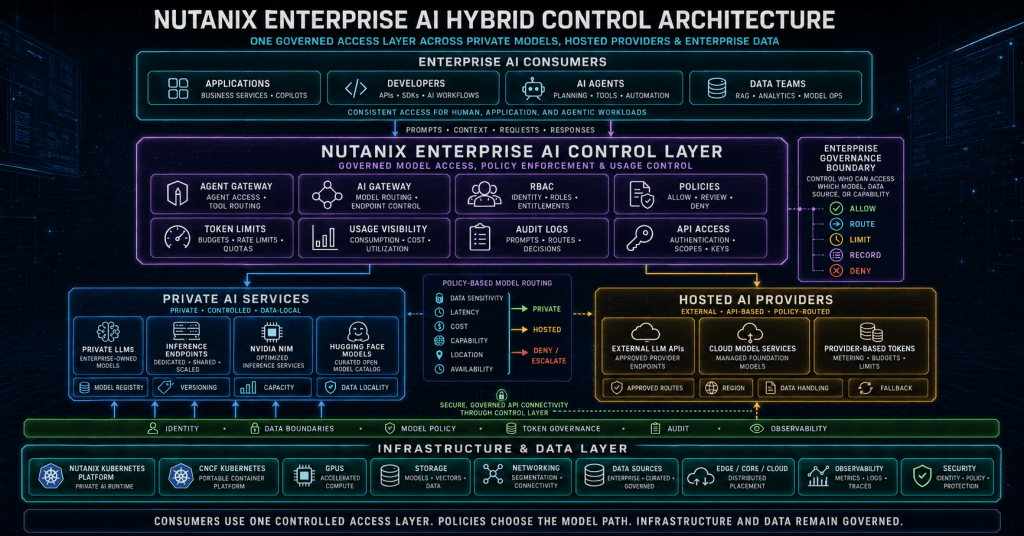

Private AI does not always fail because the model is wrong.
It often fails because the organization never defines the control point.
The first team deploys a model. Another team connects an agent. A developer experiments with a hosted LLM. A business unit wants internal document search. Security asks which data sources the agent can reach. Finance asks who owns the token usage. Operations asks where the logs live. Platform engineering asks why every project is building a different path to inference.
That is the enterprise private AI problem Nutanix Enterprise AI is trying to solve.
Nutanix Enterprise AI is not best understood as “Nutanix can run models.” That framing is too narrow. The more useful framing is this:
Nutanix Enterprise AI gives organizations a governed control layer for model access, inference endpoints, agents, token usage, role-based access, auditability, and hybrid placement.
That matters because most organizations will not run private AI in one clean location. Some models may run on-prem. Some may use cloud-hosted providers. Some workloads may live near regulated data. Some may run at the edge. Some agentic workflows may need access to internal tools, APIs, and business systems.
Without a control layer, that becomes sprawl.
With a control layer, it becomes an architecture.
Why Nutanix Belongs in the Private AI Conversation
Nutanix has always had a strong operational simplicity story.
That matters in private AI because AI platforms can become complicated quickly. What begins as a model endpoint can turn into a stack involving Kubernetes, GPUs, storage, networking, model catalogs, token controls, APIs, identity, observability, data access, and governance.
The Nutanix angle is not that every enterprise AI workload must run on Nutanix infrastructure. The stronger point is that Nutanix Enterprise AI is designed to give IT and platform teams a more controlled way to expose AI services across private and hybrid environments.
This is different from the VMware Cloud Foundation conversation.
VCF 9.1 starts from the private cloud foundation. It asks how AI can inherit the VMware operating model for infrastructure, tenancy, lifecycle, networking, and Day-2 operations.
Nutanix Enterprise AI starts from the AI consumption and governance layer. It asks how the enterprise can control who uses AI, which models they can access, how agents connect to tools, how tokens are consumed, and how AI usage is monitored across environments.
That is a different center of gravity.
For organizations trying to avoid unmanaged AI adoption, that distinction matters.
The Problem Is Not Just Model Hosting
A private model by itself does not create a private AI platform.
A model endpoint can answer prompts. It cannot define policy. It cannot decide which agents are trusted. It cannot validate whether a user should call a model. It cannot track token usage across teams. It cannot prove which tool an agent reached during a workflow. It cannot create a consistent operating model across private and hosted providers.
That is where many early AI platforms break down.
The organization may technically have private AI, but the operating model remains fragmented.
Developers call models directly.
Agents use different access paths.
Teams create API keys without consistent ownership.
Token usage becomes difficult to attribute.
Public and private models are consumed through different patterns.
Security has limited visibility into agent and tool access.
Operations cannot easily trace behavior across the workflow.
The platform problem is not simply, “Where does the model run?”
The better question is, “Where does control happen?”
Nutanix Enterprise AI is most relevant when that control point becomes the architectural priority.
The Nutanix Enterprise AI Control Model
A useful way to think about Nutanix Enterprise AI is as a governed access layer between AI consumers and AI execution targets.
Those consumers may be applications, developers, internal assistants, business workflows, automation tools, or autonomous agents. The execution targets may be private LLMs, hosted model providers, inference endpoints, enterprise tools, or data sources.
The platform value sits in the middle.

The important thing to notice in this diagram is the middle layer.
That is where Nutanix Enterprise AI becomes more than model hosting. It gives the organization a place to enforce access, observe usage, apply token controls, expose endpoints, and govern agent behavior before requests reach models, providers, tools, or sensitive data.
For enterprise AI, that middle layer is not optional for long.
It is the difference between controlled adoption and AI sprawl.
Why Agent Governance Changes the Architecture
The private AI conversation changes when agents enter the picture.
A chatbot usually responds to a user. An agent can participate in a workflow. It may call tools, retrieve information, invoke APIs, interact with business systems, or chain multiple steps together.
That changes the risk model.
An agent that can summarize a document is useful.
An agent that can reach internal tools is powerful.
An agent that can reach internal tools without policy, logging, or limits is a problem.
That is why the gateway pattern matters.
A gateway gives the enterprise a point of control before agents interact with models, tools, and data. Without that control point, access decisions are scattered across code, API keys, scripts, developer notebooks, plugins, and individual application teams.
A serious agent governance model should answer practical questions:
Which agents are allowed to call which models?
Which users can invoke which agents?
Which tools can an agent reach?
Which requests are logged?
Which token limits apply?
Which team owns the cost?
Which model provider handled the request?
Which policy allowed the workflow to run?
What can be disabled quickly during an incident?
These are not theoretical concerns. They are the difference between a useful agent platform and an unmanaged automation risk.
Nutanix Agent Gateway is aimed directly at this problem. Its value is strongest when the enterprise needs centralized control over agent traffic, model access, token visibility, and policy enforcement across both private and hosted inference paths.
There is an important caveat here. Some Nutanix materials identify certain MCP-related capabilities as Tech Preview. That means those specific capabilities should not be treated as production dependencies without validating the current version, support status, and implementation guidance.
The pattern is still valid.
The production design needs to respect the maturity of each feature.
Private AI Does Not Mean Single-Location AI
Private AI often gets described as if everything must run inside one datacenter.
That is not how many enterprises will actually operate.
A realistic enterprise AI environment may include several placement patterns:
Private models for regulated data.
Hosted models for general productivity use cases.
Edge-local models for latency-sensitive workflows.
Internal inference endpoints for application integration.
Cloud-connected models for experimentation or specialized capability.
Agent workflows that need controlled access to private tools and data sources.
This is why hybrid placement matters.
The enterprise does not need every workload to run in the same place. It needs a consistent way to govern access, usage, identity, observability, and policy across the places where AI actually runs.
The following diagram shows the placement decision more clearly.
This is where Nutanix Enterprise AI can be compelling.
It does not force the architecture into a simplistic on-prem versus cloud decision. It gives teams a way to think about AI placement through the lens of control, sensitivity, provider flexibility, and operational consistency.
That is a better enterprise model.
Where Nutanix Enterprise AI Fits Best
Nutanix Enterprise AI is strongest when the organization needs to standardize AI access and governance without turning every AI project into a custom platform build.
It is a good fit when the enterprise already has Nutanix platform gravity, but that is not the only scenario. It can also be relevant when teams need a governed AI layer across supported Kubernetes environments, private models, hosted model providers, and agentic workflows.
The best-fit environments usually have one or more of these traits:
The organization is already using Nutanix as a strategic platform.
AI adoption is spreading across multiple teams.
Developers need access to private and hosted models through a more consistent interface.
Security needs better visibility into model and agent activity.
Finance needs clearer token usage and cost attribution.
Platform teams want to avoid direct, unmanaged model provider access.
The organization wants to support private inference without blocking hybrid model usage.
Agentic AI is moving from lab experiments toward business workflows.
There is a need for air-gapped, dark site, or disconnected operating models.
The common pattern is control.
Nutanix Enterprise AI is not just attractive when the organization wants to run AI. It is attractive when the organization wants to govern AI without slowing useful adoption to a crawl.
Architecture Decisions to Make Before Deployment
Nutanix Enterprise AI should not be deployed as a generic AI tool.
It should be deployed as part of an enterprise AI operating model.
Before broad rollout, the architecture team should define the major decisions that will shape governance, scale, security, and supportability.
| Design Area | Decision to Make |
|---|---|
| Control model | Decide whether Nutanix Enterprise AI becomes the standard access path for AI models, agents, hosted providers, or selected use cases. |
| Kubernetes placement | Validate where the platform will run, including Nutanix Kubernetes Platform or other supported CNCF-certified Kubernetes environments. |
| Model strategy | Decide which models are approved, where they run, how they are versioned, and who owns promotion or retirement. |
| Provider strategy | Decide which hosted model providers are allowed and when workloads should use private models instead. |
| Endpoint ownership | Define who owns inference endpoints, API keys, scaling behavior, availability, and lifecycle. |
| Agent governance | Define how agents are registered, approved, monitored, restricted, and retired. |
| Tool access | Define which tools or MCP servers are allowed, who approves them, and how tool usage is audited. |
| Token controls | Define quotas, rate limits, usage alerts, chargeback, showback, and exception handling. |
| Identity and RBAC | Map users, groups, service accounts, administrators, and developers to the right access boundaries. |
| Audit and retention | Decide which logs are retained, who reviews them, and how they support incident response or compliance. |
| Air-gapped operations | Validate model sources, registries, updates, dependencies, and support workflows for disconnected environments. |
These decisions should not be left to individual project teams.
A private AI platform becomes valuable when it gives teams a paved road. That road should define which patterns are standard, which decisions require approval, and where teams still have room to innovate.
Governance Is the Product Value
The strongest Nutanix Enterprise AI story is governance.
That does not mean governance as paperwork. It means governance as a working control system.
The platform should make it easier to answer questions that matter during real operations:
Who is using AI?
Which model did they use?
Which endpoint handled the request?
Which agent initiated the workflow?
Which tools did the agent reach?
How many tokens did the workflow consume?
Which team owns that usage?
Which policy allowed the request?
Which logs prove what happened?
Which service can be disabled if something goes wrong?
These questions become more important as AI moves closer to production workflows.
When AI is limited to experiments, weak governance looks inconvenient. When AI begins touching internal tools, regulated data, customer workflows, or operational systems, weak governance becomes risk.
Nutanix Enterprise AI is valuable because it gives infrastructure, security, and platform teams a practical control point. It helps move governance closer to execution instead of leaving it as a policy document that nobody can enforce consistently.
Token Visibility Is an Operations Requirement
Token usage is not just a billing detail.
In enterprise AI, token usage becomes an operational signal.
A sudden increase in token consumption might indicate adoption. It might also indicate a runaway workflow, inefficient prompt design, excessive retrieval context, agent recursion, abuse, or a poorly scoped application pattern.
Without visibility, teams cannot tell the difference.
That is why token observability and rate limiting matter. They help platform teams understand which applications, agents, models, teams, and providers are driving usage. They also create a mechanism to prevent uncontrolled consumption before it becomes a cost or stability issue.
A mature private AI platform should support practical token governance:
Usage visibility by team or application.
Token limits for high-risk or experimental workflows.
Rate limiting for shared endpoints.
Alerting for abnormal usage patterns.
Cost attribution across hosted and private model paths.
Review cycles for expensive or inefficient workloads.
A private model may reduce dependence on hosted providers, but it does not make AI free. The cost simply moves into infrastructure, GPU utilization, storage, operations, and lifecycle.
Token visibility helps make that cost visible before it becomes a surprise.
Model Choice Needs a Curated Strategy
Enterprises do not need unlimited model choice.
They need governed model choice.
Different use cases may require different models. A developer assistant, document summarizer, service desk assistant, compliance workflow, and operational automation agent may not all need the same model. Some workloads may be better served by a local private model. Others may justify a hosted model. Some may require NVIDIA NIM. Some may use Hugging Face models. Some may require custom model uploads.
Flexibility is valuable, but only when the enterprise curates it.
Without curation, model choice becomes model sprawl.
A practical model strategy should define:
Approved models by workload class.
Model version standards for production use.
Security review for models touching sensitive data.
Performance expectations for inference endpoints.
Retirement rules for models that are no longer approved.
Ownership for model updates and validation.
Exception handling for teams that need something outside the standard catalog.
Nutanix Enterprise AI can support model flexibility, but the organization still needs to decide what “approved” means.
The platform can enforce policy.
It cannot invent the operating model by itself.
How Nutanix Differs from VCF
This series started with VCF 9.1 because VCF frames private AI as part of the private cloud operating model.
That is a strong fit for VMware-heavy organizations that want AI workloads to inherit existing private cloud governance, infrastructure lifecycle, network controls, namespace models, and operational discipline.
Nutanix Enterprise AI approaches the problem from a different direction.
It is centered more directly on AI access, inference governance, agent control, token visibility, model flexibility, and hybrid placement.
| Decision Area | VCF 9.1 | Nutanix Enterprise AI |
|---|---|---|
| Primary center of gravity | Private cloud operating model | AI governance and consumption control |
| Strongest starting point | VMware Cloud Foundation estate | Nutanix estate, hybrid AI, or agent governance requirement |
| Core architecture question | How do we run AI inside the private cloud? | How do we control model, agent, and endpoint access across environments? |
| Best fit | VMware-heavy platform teams | Teams prioritizing simplicity, governance, hybrid placement, and AI visibility |
| Key strength | Infrastructure consistency and private cloud operations | Centralized AI access, token controls, agent governance, and model flexibility |
| Primary risk | Platform complexity and prerequisite alignment | Feature maturity, version support, and governance design discipline |
This is not a simple winner and loser comparison.
It is an operating model comparison.
VCF makes the most sense when the enterprise wants AI to be governed through the same private cloud foundation as the rest of the infrastructure estate.
Nutanix Enterprise AI makes the most sense when the enterprise needs a cleaner control layer for AI access, agents, models, tokens, and hybrid inference patterns.
Practical Rollout Pattern
A Nutanix Enterprise AI rollout should start with control, not scale.
The first goal should not be onboarding every team. The first goal should be proving that the operating model works.
Start with a narrow use case that has clear value and manageable risk. Internal knowledge search, summarization, service desk assistance, developer enablement, or a controlled operational assistant can be good candidates.
Then define the governance path around that use case:
Who can access the model?
Which endpoint should the application call?
Which model is approved?
What token limits apply?
What logs must be retained?
Which data sources are allowed?
Who owns support?
How will success be measured?
Once that pattern works, expand carefully. Add more models, more users, more agents, and more integrations only after the control layer is stable.
A practical rollout sequence looks like this:

The sequencing matters.
If teams start with broad access and add governance later, the platform inherits bad habits. If teams start with governance and expand intentionally, AI adoption becomes more supportable.
Caveats and Gotchas
Nutanix Enterprise AI has a strong platform story, but production teams should still validate the details before making architectural commitments.
Feature status matters. Some capabilities may be generally available, while others may be Tech Preview or version-dependent.
Supported Kubernetes platforms should be validated against current Nutanix documentation.
GPU and accelerator support should be validated against the actual hardware and deployment model.
Air-gapped support should be tested with real model sources, registries, dependency paths, and update workflows.
Identity integration should be mapped to enterprise access processes, not only lab users.
Token controls should be aligned to real cost reporting, chargeback, or showback requirements.
Audit trails should be reviewed against compliance and incident response expectations.
Agent workflows should be tested with realistic tool access, not only simple prompt and response examples.
The most important caveat is that governance is not automatic.
A gateway gives the enterprise a place to enforce control. It does not decide the controls for you. The organization still needs clear policy, ownership, approval paths, data classification, operational support, and lifecycle management.
Conclusion
Nutanix Enterprise AI belongs in the private AI conversation because it focuses on one of the hardest parts of enterprise AI: control.
Private AI is not only about where the model runs. It is about who can access it, which agents can use it, which tools they can reach, how tokens are consumed, how activity is audited, and how the platform team keeps the environment supportable over time.
That is where Nutanix Enterprise AI has a clear architectural role.
It gives organizations a way to centralize AI access, model flexibility, token visibility, agent governance, inference endpoint management, and hybrid placement. For teams that want private AI without unmanaged sprawl, that control layer may matter more than the location of any single model.
VCF 9.1 answers the private AI question from the private cloud foundation upward.
Nutanix Enterprise AI answers it from the AI governance layer outward.
The right answer depends on which operating model your organization is ready to own.
External Reference Links
Nutanix Enterprise AI Datasheet
https://www.nutanix.com/library/datasheets/nutanix-enterprise-ai
Supports Nutanix Enterprise AI positioning around endpoint APIs, NVIDIA NIM, Hugging Face, RBAC, dark site or air-gapped operations, Day-2 operations, CNCF Kubernetes support, AI Gateway, and MCP-related capabilities.
Introducing Nutanix Agent Gateway: Unified Governance and Cost Control for Agentic AI
https://www.nutanix.com/blog/introducing-nutanix-agent-gateway
Supports Agent Gateway general availability in Nutanix Enterprise AI 2.7, centralized policy enforcement, token observability, unified API behavior, hosted and self-hosted model access, audit logs, and the Tech Preview caveat for MCP server access.
Nutanix Enterprise AI Guide
https://portal.nutanix.com/page/documents/details?targetId=Nutanix-Enterprise-AI-v2_7:Nutanix-Enterprise-AI-v2_7
Primary documentation entry point for Nutanix Enterprise AI 2.7 implementation details and operational requirements.
Nutanix Enterprise AI Requirements
https://portal.nutanix.com/page/documents/details?targetId=Nutanix-Enterprise-AI:top-nai-requirements-c.html
Primary documentation reference for Nutanix Enterprise AI deployment requirements.
Nutanix Enterprise AI: Securing AI Models and Endpoints
https://portal.nutanix.com/page/documents/details?targetId=Nutanix-Enterprise-AI-v2_7:top-secure-models-t.html
Primary documentation reference for model and endpoint security scanning workflows.
Nutanix Enterprise AI: Accessing an Endpoint Using OpenAI Compatible Clients
https://portal.nutanix.com/page/documents/details?targetId=Nutanix-Enterprise-AI-v2_7:top-nai-access-open-ai-clients-t.html
Primary documentation reference for accessing Nutanix Enterprise AI endpoints using OpenAI-compatible clients.
