


This scene is playing out across engineering teams everywhere.
Someone wraps a few LangChain calls inside a loop, adds a couple of tools, and proudly declares, “We’ve built an AI agent.” The demo looks great. Everyone is impressed.
Then it goes to production.
The first unexpected input arrives. The workflow breaks. Logs fill up. Alerts start firing. Suddenly, you’re debugging the system in the middle of the night.
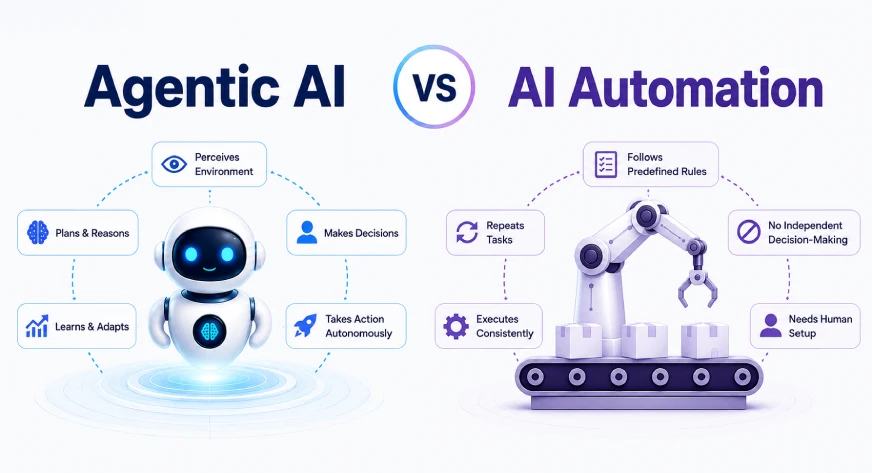
The problem isn’t the code. It’s that automation and agentic AI are fundamentally different.
Treating an automation like an AI agent, or expecting an agent to behave like a deterministic workflow, leads to unpredictable failures. Your “agent” might send the same email to a customer 47 times, skip critical steps, or make decisions you never intended.
Understanding where automation ends and where agentic AI begins isn’t just a technical distinction. It’s the difference between building reliable systems and creating expensive, hard-to-debug problems.
Agentic AI vs Automation
| Automation | Agentic AI |
|---|---|
| Execute predefined workflows | Achieve a goal, regardless of the exact path |
| Follows fixed rules and logic | Makes decisions based on context and observations |
| Predetermined sequence of steps | Dynamic sequence decided during execution |
| Cannot adapt beyond programmed rules | Changes strategy when conditions change or failures occur |
| Developer controls every step | Developer defines the objective; the agent decides the steps |
| Works best with structured, expected inputs | Can handle ambiguous and unstructured inputs |
| Stateless unless explicitly programmed | Maintains memory of previous actions and outcomes |
| No planning capability | Plans, reprioritizes, and selects the next action |
| Stops or throws an error when assumptions break | Attempts alternative approaches before failing |
| Tools are called in a fixed order | Chooses which tool to use based on the current state |
| Highly predictable and deterministic | Less predictable but more flexible |
| Easy to trace every step | Requires logging of reasoning and decision history |
| Best suited for ETL pipelines, invoice processing, compliance checks, and scheduled reports | Best suited for research agents, coding assistants, customer support, and multi-step problem solving |
| Example: A daily sales report generated using fixed business rules | Example: A research agent deciding whether to search, gather more information, or summarize |
| Cannot operate outside predefined rules (e.g., a changed CSV schema breaks the workflow) | Can make unexpected decisions if guardrails and boundaries are not defined |
What is AI Automation?
Think of automation as a vending machine. You select B4, and the machine responds the same way every single time.
Automation gives you direct control: you outline how things should be done and in what order. Whether it’s a cron job from 2008 or a modern data pipeline, automation does exactly what you told it to do.
And honestly, automation is underrated. It’s fast, auditable, and predictable. Invoice processing, ETL pipelines, compliance checks, nightly reports: these are automation problems, solved beautifully by automation. Adding “agent” to the description doesn’t make them better.
Hands-on: A Simple Automation Pipeline
def run_daily_report(input_path: str, output_path: str):
    df = pd.read_csv(input_path)
    df["processed_at"] = datetime.now().isoformat()
    df["high_value"] = df["revenue"] > 10000  # fixed rule, always
    df.to_csv(output_path, index=False)
    print(f"Done. {len(df)} rows processed.")

run_daily_report("sales.csv", "daily_report.csv")
Output:


Now rename the “revenue” column to “total” in the source CSV. The pipeline breaks. That’s the limitation of automation: it works perfectly within its frame, and fails the moment it steps outside it.

What is Agentic AI?
An agent behaves like a contractor. You say “build me a deck by Friday,” and that’s the whole brief. They handle the permits, the materials, the weather delays, and the build sequence, none of which you specified. They perceive the situation, form a plan, act, observe the results, and adjust.
The main features of a real agent are:
- A purpose instead of a list, it knows what constitutes the end of the process, not just the next steps;
- Smart planning, it can decide on the right tools based on the previous experiences;
- The memory, it can track what has been done before, and how;
- The adaptability, if it fails, it manages to switch the tactics instead of falling apart.
Hands-on: Build a Minimal Agent Loop
This is a research agent that has the same aim every time, but it chooses the route itself, depending on its previous knowledge.
class ResearchAgent:
    def __init__(self, tools: dict):
        self.tools = tools
        self.memory = {"findings": [], "goal": None}

    def decide_next_action(self) -> str:
        if not self.memory["findings"]:
            return "search_web"          # nothing yet, start searching
        if len(self.memory["findings"]) < 3:
            return "fetch_detail"        # need more depth
        return "write_summary"           # enough to summarize

    def run(self, goal: str) -> str:
        self.memory["goal"] = goal
        for _ in range(10):              # always cap your loops
            action = self.decide_next_action()
            result = self.tools[action](self.memory)
            self.memory["findings"].append(result)
            if action == "write_summary":
                break
        return self.memory["findings"][-1]
Output:

The method decide_next_action() is all it takes. The agent finds out what it knows in order to act. In case you want to improve your code, introduce a new condition in which the agent uses search_alternative if search_web gives empty results. This is called adaptation, and machines can’t do it.
The basic process: detect → think → act → change → go back to the beginning.
Where Most Systems Actually Fall
An inconvenient truth: most systems called “agents” today are automation with an LLM bolted onto one step. The LLM fills in a form or classifies some input, and the next step runs regardless of what it decided. That’s not agency. It’s a fancier vending machine.
A more honest classification:
| Level | Behavior | Real Example |
| Basic automation | Fixed steps, no LLM | Cron job, ETL pipeline |
| LLM-assisted automation | Fixed steps, LLM at one node | RAG with hardcoded retrieval |
| Partially agentic | LLM chooses tools, goal is fixed | ReAct agent with a tool registry |
| Fully agentic | LLM sets sub-goals, builds tools | Self-directed research or coding agents |
Most commercial deployments sit at level 2 or 3, and that’s fine. Level 3 is a genuinely good use of the technology. The problem starts when a team claims level 4 while shipping level 2, then can’t figure out why it falls apart outside the happy path.
Side-by-Side: Customer Support Ticket Handler
Same problem, two systems: categorize the ticket, write a response.
The Automation Version
def handle_ticket(ticket_text: str) -> dict:
    category = classify(ticket_text)       # always runs
    template = get_template(category)      # always runs
    response = fill_template(template, ticket_text)  # always runs
    return {"category": category, "response": response}
Output:

Fast, predictable, cheap to run. But it can’t check order history, flag a VIP customer, or ask a clarifying question. Every ticket gets the same treatment: “URGENT, you charged me twice and my account is locked” gets handled exactly like “Where is my order?
The Agentic Version
def handle_ticket_agentic(ticket_text: str, tools: dict) -> dict:
    state = {"ticket": ticket_text, "history": [], "resolved": False}
    for _ in range(8):                     # bounded loop
        next_action = llm_decides(state)   # LLM picks the next tool
        result = tools[next_action](state)
        state["history"].append({"action": next_action, "result": result})
        if next_action == "resolve":
            state["resolved"] = True
            break
    return state
Output:

Here, the path is decided at runtime. For the urgent billing message, the agent might check account status and transaction history, flag the billing issue, and escalate before responding. For “Where is my order?”, it resolves in a couple of steps using the shipping API. Same system, different route, based on what the ticket actually needs.
How to Choose Between Them?
This isn’t about which technology is newer. It’s about the shape of the problem.
Use automation when:
- The task follows the same, auditable procedure every time
- Speed matters more than flexibility
- Compliance requires every step to be traceable
- You’re running the same operation at high volume
Use Agentic AI when:
- The right sequence of steps depends on what’s discovered along the way
- The input is unstructured (emails, documents, conversations)
- A failure needs a new approach, not just a retry from the top
- The problem is genuinely open-ended
Conclusion
Automation is built to be predictable. Agentic AI is built to be adaptable. Neither is better; they solve different problems.
“Agent” sounds more impressive than “pipeline,” so teams reach for it even when what they’ve built is closer to the latter. When that pipeline breaks on some edge case and someone asks why the agent failed, the honest answer is usually that it was never really an agent.
The better starting point is automation. Map out where it works and where it hits a wall. Reach for agentic behavior only where automation genuinely can’t go.
Frequently Asked Questions
A. Automation follows predefined workflows, while agentic AI adapts its actions to achieve a goal based on changing context.
A. Use agentic AI when tasks require planning, adaptation, tool selection, or handling ambiguous and unstructured inputs.
A. Many are fixed automation workflows with an LLM added, lacking true planning, memory, and adaptive decision-making.

Data Science Trainee at Analytics Vidhya
I am currently working as a Data Science Trainee at Analytics Vidhya, where I focus on building data-driven solutions and applying AI/ML techniques to solve real-world business problems. My work allows me to explore advanced analytics, machine learning, and AI applications that empower organizations to make smarter, evidence-based decisions.
With a strong foundation in computer science, software development, and data analytics, I am passionate about leveraging AI to create impactful, scalable solutions that bridge the gap between technology and business.
📩 You can also reach out to me at [email protected]
Login to continue reading and enjoy expert-curated content.
