



TL;DR
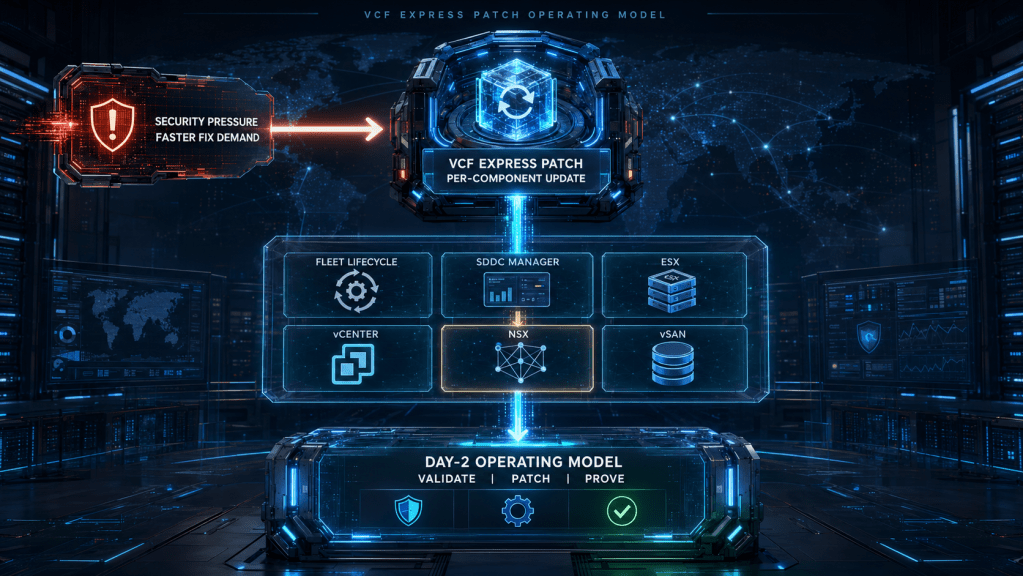
VCF Express Patches are not just smaller updates with a faster name. They represent a more active Day-2 lifecycle model for VMware Cloud Foundation 9.1 environments. Instead of waiting for every fix to arrive in a larger scheduled maintenance release, teams now need a repeatable process for tracking component applicability, synchronizing depot metadata, validating prerequisites, applying targeted updates, and proving the fleet is still in a known-good state afterward.
Introduction
For a long time, many VMware operations teams treated patching as a scheduled infrastructure event. You waited for an update release, read the release notes, scheduled the window, ran prechecks, upgraded the stack, and then spent the next few days watching for surprises. That model still exists, but VMware Cloud Foundation 9.x changes the lifecycle conversation.
VCF 9 introduced a more unified release and versioning model across the stack. VCF 9.1 then pushed the operating model further by making Express Patches part of the normal lifecycle conversation. The practical consequence is simple: patch awareness becomes continuous, not quarterly. The operations team has to know which component is affected, which version is current, which patch applies, which dependency matters, and what evidence proves the environment is safe after the change.
That is a different operating rhythm than the older “wait for the next bundle” approach.
Why Express Patches Matter Now
Security response is the obvious reason Express Patches matter. Enterprises no longer have the luxury of treating infrastructure patching as a slow administrative task when vulnerability discovery, exploit automation, and dependency risk are moving faster than traditional release windows. A private cloud platform that supports critical workloads needs a patch model that can react without forcing every fix into a full-stack upgrade motion.
But the more interesting impact is operational. Express Patches force platform teams to mature their lifecycle discipline. They need clean inventory, current depot metadata, predictable prechecks, patch sequencing awareness, and better post-change validation. If those habits are weak, faster patches can feel like more chaos. If those habits are strong, Express Patches become a practical way to reduce exposure without turning every change into a major program.
What Express Patches Are
An Express Patch is a targeted release vehicle used to deliver fixes faster than a normal maintenance or minor release cycle. In VCF 9.x, the important detail is that the release model is tied to a unified versioning structure across the VCF stack. That does not mean every component always receives every Express Patch. It means the versioning model is more consistent, while applicability remains component-specific.
That distinction matters. A VCF environment may show Express Patch availability for some components and not others. ESX, vCenter, NSX, vSAN, SDDC Manager, VCF Operations, VCF Automation, and VCF Management Services do not all have to move in lockstep for every Express Patch. Operators should stop thinking only in terms of “the whole stack patch” and start thinking in terms of “which component needs which fix, and what lifecycle service performs the work?”
The VCF Release Model in Plain Language
The diagram below shows the practical mental model. Major, minor, and maintenance releases still feel like larger lifecycle milestones. Express Patches and Hot Patches are more targeted release vehicles used when the fix cannot wait for the next larger release window.

The mistake to avoid is flattening every release type into “an upgrade.” A maintenance release and an Express Patch may both move versions, but they do not carry the same planning assumption. A maintenance release may have a stronger stack-level sequence. An Express Patch may be component-specific, cumulative for that component, and more focused on fixing a smaller set of urgent issues.
What Changes for Platform Teams
The biggest change is that lifecycle management becomes more continuous. VCF administrators can no longer think only in terms of occasional upgrade projects. They need a standing operating model for checking patch availability, reading component-specific release notes, validating the environment, and keeping the depot ready.
That shift touches several roles:
| Role | What Changes |
|---|---|
| Platform architect | Must understand the release model and how component-specific patching affects lifecycle design |
| VCF administrator | Must watch patch binaries, install binaries, prechecks, and upgrade plans more frequently |
| Security team | Must map vulnerability response timelines to the VCF patch process |
| Change manager | Must distinguish Express Patch risk from full maintenance release risk |
| Operations leader | Must require evidence that patching happened cleanly and the fleet remains healthy |
This is where VCF Express Patches become more than a technical feature. They become a governance and operating-model topic.
The New Patch Responsibility Boundary
Older VMware environments often allowed component teams to think independently. vSphere teams patched vCenter and ESXi. NSX teams patched NSX. Aria teams handled operations tooling. VCF 9.x continues the broader shift toward a platform-managed lifecycle boundary. Component knowledge still matters, but the control point increasingly moves through VCF lifecycle tooling and VCF Operations workflows.
That creates a healthier operating model if teams accept it. Instead of every product owner chasing a separate patch path, the VCF team owns a coordinated lifecycle process. But that also means the VCF team needs better communication habits. A security fix for vCenter, an SDDC Manager patch, or a VCF Management Services update may all affect different stakeholders, even when the lifecycle interface is centralized.
A Better Mental Model for Express Patch Decisions
Teams should evaluate Express Patches using a simple operational filter:
The key point is that patching is not only a question of availability. It is a question of applicability, dependency, risk, and proof.
What Not to Assume
Do not assume an Express Patch applies to every VCF component. The release notes and lifecycle UI must drive that conclusion.
Do not assume an Express Patch replaces the need for a required base version. If the environment is behind the required base release, the correct move may be to upgrade to the base version first and only then apply the Express Patch.
Do not assume “can be applied in any order” means “no operational sequencing matters.” In practice, if the patch includes lifecycle services that drive the patching process, those services deserve early attention. Fleet Lifecycle and related VCF Management Services components are not just another workload in the environment. They are part of the machinery that makes the rest of the lifecycle process reliable.
Do not assume faster patch cadence removes the need for change control. It changes the change-control conversation. Instead of waiting weeks for a large bundled upgrade, teams should define a lighter but still disciplined path for urgent component-specific fixes.
How to Think About Risk
Express Patches reduce one kind of risk while introducing another.
They reduce exposure risk by allowing security and product fixes to arrive faster. They can also reduce the amount of change compared to waiting for a larger maintenance release. That is the benefit.
They introduce operational risk when teams lack patch visibility, version discipline, tested rollback plans, or post-change validation. Faster patch delivery does not automatically mean safer operations. Safety comes from a repeatable process.
The practical question is not whether Express Patches are good or bad. The question is whether your VCF team has a patch operating model mature enough to use them well.
What Good Looks Like
A mature VCF Express Patch process has a few visible traits:
The team knows which VCF version and component versions are deployed.
The software depot is synchronized and understood, whether online or offline.
Patch applicability is reviewed by component, not assumed at the stack level.
Prechecks are treated as gates, not suggestions.
Management services and lifecycle components are evaluated before downstream patch execution.
Change records capture the starting state, target state, precheck result, patch outcome, and validation evidence.
Security and operations teams share the same patch calendar and risk language.
That is the operating model Express Patches are pushing teams toward.
Conclusion
VCF Express Patches are best understood as a Day-2 operations accelerator. They allow VMware Cloud Foundation environments to receive important fixes faster, but they also require teams to tighten lifecycle discipline. The teams that benefit most will not be the teams that click through the UI fastest. They will be the teams that understand component applicability, version baselines, depot behavior, lifecycle service dependencies, and validation evidence.
The practical takeaway is straightforward: treat Express Patches as a standing operational process, not an occasional upgrade surprise. Build the muscle now, because faster patch cadence is becoming part of the normal private cloud operating model.
External References
